Category Archives: Esoteric

The Fourth Way

“The Fourth Way” is the title of a 1957 book by Russian esotericist P. D. Ouspensky that is supposed to be about the self-development methods of the mystic/philosopher/teacher G. I. Gurdjieff. Ouspensky was a student of Gurdjieff for a significant part of his life until there was a parting of the ways. This book was published after Ouspensky died in 1947. A substantial amount of it is constructed in questions and answers, as a teacher might answer their student’s questions.

Ouspensky’s first book in 1909 was about the fourth dimension, which was much in the public consciousness in the first few years after Einstein published his theory of special relativity. His second book was titled “Tertium Organum”, or the third canon of thought, after Aristotle’s first and Francis Bacon’s second. Ouspensky’s third book “A New Model of the Universe” continued in this way, linking science with spirituality, or at least consciousness.

What is a person or what are the aspects of a person? Is a person a machine? A physicalist thinks that a person is their body, and the mind is what the brain does. A dualist thinks that a person has a body as well as a separate mind, but we know that the mind is dependent on the body for operation and it can be diminished by injury, neglect, or abuse. There are other aspects of the person, such as the emotions or “heart”, which are somewhere between the body and the mind.

And if you search on the web, “soul” or “spirit” are often shown in images along side body, mind, and mood, but these terms are imprecise. Sometimes soul is defined as spirit, sometimes spirit as soul. It is difficult to determine what is meant by them, but they are usually of a higher-order nature than the physical or mental or emotional. It is usually what remains the same for a person, the still point of a changing self, regardless if that endures after death.

  • Body
  • Mind
  • Mood (Heart or Emotions)
  • and Spirit?
  • or Soul?
  • or Balance?

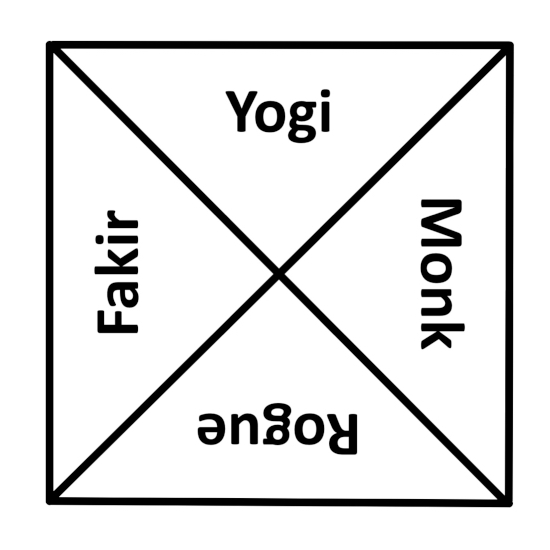
Various schools of spiritual people concentrate on the control and discipline of different aspects of the self: the physical for the Fakir, the mental for the Yogi, and emotions for the Monk. These are the first three historical ways for self-development, but they require separation from the normal social world, and neglect the other aspects of the self. The Fourth Way was said to require no extreme separation, and to develop body, mind, and mood in a balanced way.

Gurdjieff thought that most if not all people were machines because they were “asleep at the wheel” (my metaphor), the wheel being the control of their own consciousness. Similar to the practice of lucid dreaming, these teachings (also called “the work” or “the system”) purported to develop the conscious self into something much more than ordinary awareness. This aware self would have access to all sorts of abilities that remain hidden or dormant in most of us.

The Fourth Way is also said to be the way of the “sly man”, but to be sly is to be crafty, cunning, and tricky. If you are sly you are deceitful or a charlatan, dishonest and evasive, a “rogue”. You take advantage of people, or you game the social system. Are there any truth to these teachings, or were they merely a way that Gurdjieff found to make an easy living? If not, why call it the way of the “sly man”? On the other hand, who doesn’t want to develop their best selves in the most efficient and clever way?

  • Fakir: Physical
  • Yogi: Mental
  • Monk: Emotions
  • Rogue: Balance or ?

I also read that “sly man” is a translation of the French “le ruse”. The idea behind this name is for a person that takes advantage of opportunities in their normal life to development their awareness, rather than just their attitude towards others. And so it’s a posture towards the broader world, not just towards people. If I had a short word to substitute for “rogue” in the above diagram, I might do so, to prevent the negative impression I might be giving. But the term “rogue” is probably less offensive that it used to be, so I’ll keep it for now.

Yet people do love to be deceived. They love to be entertained, and they love a good story with charismatic characters. They also love to hear what they want to hear. Perhaps that’s all these teachings really were and are. And yet, many artists, writers, and thinkers have embraced the ideas of this fourth way. Certainly to enhance one’s consciousness is a positive thing to do, or to eliminate erroneous or harmful thought, or to “know thyself”. Socrates taught that “the unexamined life is not worth living”. Perhaps there is some worth to these teachings after all, but a person may have to determine this for themselves.

Further Reading:

https://en.wikipedia.org/wiki/Fourth_Way

https://en.wikipedia.org/wiki/The_Fourth_Way_(book)

https://en.wikipedia.org/wiki/George_Gurdjieff

https://en.wikipedia.org/wiki/P._D._Ouspensky

Tertium Organum online:

http://www.sacred-texts.com/eso/to/index.htm

https://en.wikipedia.org/wiki/Novum_Organum

https://en.wikipedia.org/wiki/Centers_(Fourth_Way)

https://en.wikipedia.org/wiki/Know_thyself

Some videos to entertain found by searching for “fourth way” and “sly man”:

[*10.168, *11.48]

<>


Seven Sermons to the Dead, V2

We must, therefore, distinguish the qualities of the pleroma. The qualities are pairs of opposites, such as—

The Effective and the Ineffective.
Fullness and Emptiness.
Living and Dead.
Difference and Sameness.
Light and Darkness.
The Hot and the Cold.
Force and Matter.
Time and Space.
Good and Evil.
Beauty and Ugliness.
The One and the Many. etc.

— Carl Jung, from Seven Sermons to the Dead

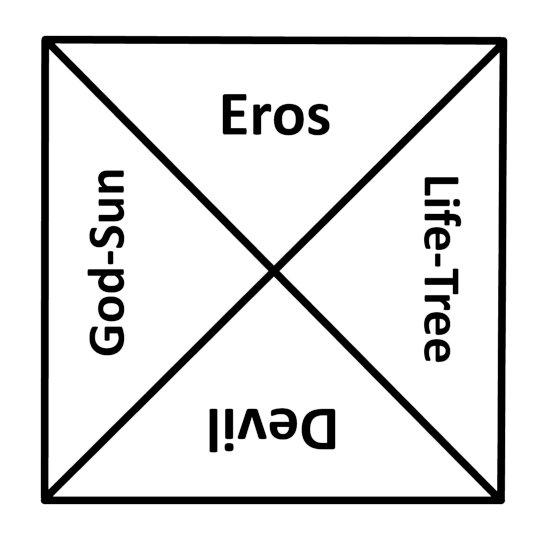
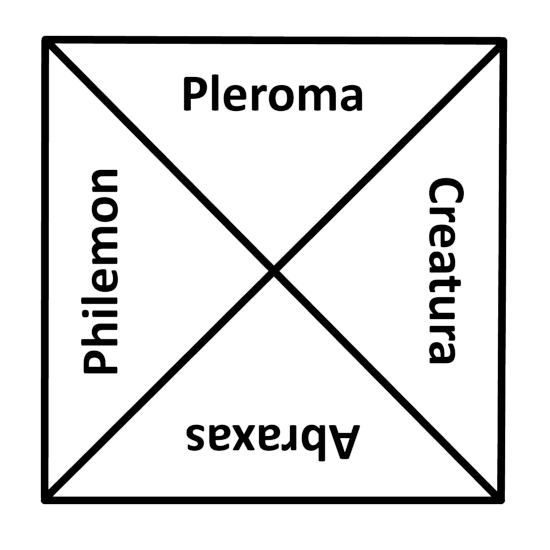
I previously mentioned two fourfolds which are perhaps better combined as an eightfold. These concepts or entities are from Carl Jung’s “Seven Sermons to the Dead”.

To the left are the “principal gods”, who are said to be in one-to-one correspondence with the “world’s measurements”. What then are these measurements? Are they the coordinates of relativistic Space-Time or something else?

  • The God-Sun: The beginning
  • Eros: Binding of two together, outspreading and brightening
  • The Tree of Life: Filling space with bodily forms
  • The Devil: The Void, opening all that is closed, dissolving all formed bodies, and destroyer of everything

And to the right we have:

  • The Pleroma: The spiritual universe as the abode of gods and of the totality of the divine powers and emanations.
  • The Creatura: The living world, subject to perceptual difference, distinction, and information
  • Abraxas: The supreme power of being transcending all divinities and demons and uniting all opposites into one
  • Philemon: Jung’s spiritual guide and the narrator, also said to be Simon Magus or Basilides

Further Reading:

http://gnosis.org/library/7Sermons.htm

https://en.wikipedia.org/wiki/Seven_Sermons_to_the_Dead

https://jungiangenealogy.weebly.com/seven-sermons.html

https://en.wikipedia.org/wiki/Tree_of_life

https://en.wikipedia.org/wiki/Pleroma

https://en.wikipedia.org/wiki/Abraxas

Who is Philemon?

Seven Sermons to the Dead

Seven Sermons to the Dead, Part 2

[*10.76, *11.49]

<>


The Visions of W. B. Yeats

William Butler Yeats published two editions of his book, “A Vision”, the first in 1925 and the second in 1937. They are interesting amalgamations of metaphysics, poetry and esoteric speculations. After years of neglect I return to mention these works briefly.

Previously I showed the fourfold of the Faculties (Creative Mind, Body of Fate, Mask, and Will), but ignored the complementary fourfold of the Principles (Spirit, Celestial Body, Passionate Body, and the Husk). Here I present an eightfold of both Faculties and Principles, and it makes a bit more sense with all its accompanying structure.

Each of these eight elements has certain dual properties which I have indicated by the second diagram: Primary (+) vs. Antithetical (/), Solar (Sun) vs. Lunar (Moon), Static (=) vs. Active (~). Primary is also called Objective, Antithetical is also called Subjective, Solar is also called Core, and Lunar is also called Changing.

In my diagram I have the Faculties as down-pointing triangles (+ and /) and the Principles as up-pointing triangles (Sun and Moon). Elements that are Active (~) are in the upper-left and lower-right squares and those that are Static (=) are in upper-right and lower-left. Since explanations of these elements usually involve interpenetrating cones and gyres and such, whether this diagram has any value is left for a later time.

I also just found out that Neil Mann, the author of the excellent and enduring web site about “A Vision”, has a new book out. It’s called “A Reader’s Guide to Yeats’s ‘A Vision'” and is published by Clemson University Press. It’s a bit pricey but I’m sure it’s full of valuable insights into these works. Perhaps I’ll just have to raid my piggy bank.

Further Reading:

http://www.yeatsvision.com/

http://www.yeatsvision.com/Yeats.html

https://en.wikipedia.org/wiki/A_Vision

https://global.oup.com/academic/product/a-readers-guide-to-yeatss-a-vision-9781942954620?cc=us&lang=en&#038;

A Vision by W. B. Yeats: The Four Faculties

[*7.199, *7.200, *8.1, *11.56]

<>

The Matrix of Four, the Philosophy of the Duality of Polarity

“The Matrix of Four, the Philosophy of the Duality of Polarity” by Ethan Indigo Smith is basically a book about four-folds, or two-by-two matrices. It’s always nice to see a book devoted to this subject, and Smith has written several other books as well. They seem to range from politics to environmentalism to meditation and spirituality, but they all appear to have a “new age” or esoteric flavor. “The Matrix of Four” claims to be philosophy and even meta-philosophy but how well does it succeed? Perhaps I’m not one to answer, having no definite philosophy, having written no books, and with only a smattering of blog entries for my efforts. However, I’d like to look at this work in depth because I do think it is worthwhile.

What is the Matrix of Four, the Philosophy of the Duality of Polarity? And why have such an awkward name that is completely written out 71 times? The abstract on Amazon states it is a formula for enhancing consciousness or our potential by exploring philosophical fundamentals. The abstract goes on to give as example the Yin Yang symbol consisting of four aspects of one entirety: positive, negative, positive in negative, and negative in positive. In fact, the icon I created (and use on various websites) tries to express this notion by dividing the Yin Yang symbol into four pieces.

In the “Introduction to Absolutes”, other examples suggest what the duality of polarity is. One example is that of planetary elliptical orbits, giving rise to two solstices and two equinoxes, the first pair the closest and furthest from the sun, and the second the positions halfway between the solstices. The tilt of the Earth’s axis gives rise to the four seasons: summer, fall, winter, spring. I can clearly see the concept of the duality of polarity here. Another is due to the Earth turning every day: the diurnal cycle of day, dusk, night, and dawn. The third is the set of four arithmetic operations, addition and subtraction, multiplication and division. Here I’m not sure how well the duality of polarity is shown. Multiplication is not “subtraction in addition”, but a repeated application of addition, just as exponentiation is repeated multiplication.

But perhaps the matrix of four, the philosophy of the duality of polarity is essentially just considering two associated pairs of opposites at once. I have said something similar in my notion of the Marriage of Opposites, that the way to solve the problem of dualities (Smith says polarities) is to consider two pairs at once. In the book’s eleven chapters, Smith looks at various subjects and their ubiquitous use of four-folds to conceptualize them.

In Chapter 1, “The Magic of Breath”, Smith discusses a subject that he has done extensive reading on, and from what I can tell, experience of: meditation and Buddhism. Matrices of Four mentioned include the Buddhist mantra “Aum mani paddle hum”, the four physical positions for meditation discussed in Angeles Arrien’s book “The Four Fold Way” (also called the four actions), and Buddhism’s Four Thoughts.

In Chapter 2, “The Riddle”, the Yin Yang symbol and its history is presented. It is perhaps the exemplary paradigm for his philosophy of the duality of polarity. Other matrices of four discussed are the four types of information (known knowns, unknown knowns, known unknowns, and unknown unknowns) and Buddhist mandalas.

Chapter 3, “The Cross”, discusses the symbolism of the cross throughout human history and religion. Other four-folds mentioned include ankhs, swastikas, the four Christian gospels, the Tetragrammaton, the four questions of Passover, the four forms of theological interpretation (literal, allegorical, comparative, and secretive), the Sufi four gates of speech, Buddhism’s Four Noble Truths, Four Immeasureables, and the Four Right Exertions, the Classical Four Elements, and the four cardinal directions.

“From Egyptian to Jungian”, Chapter 4, talks about the four humors or four vital fluids, the Classic four-fold hot/cold and moist/dry, the four temperaments, the four personality types of Plato and those of Aristotle, the Four Causes of Aristotle, the four forms of spiritual development due to G.I. Gurdjieff as presented by P.D. Ouspensky, psychologist Carl Jung and his four psychic functions, and the ancient Pythagorean symbol of the Tetraktys.

“The Exclusion of Four” is the title for Chapter 5. In this chapter, Smith returns to mathematical reasonings for his matrix of four. He also argues that the consideration of dualities of polarity is richer and more informative than merely thinking about polarities or opposites. Often triplets of things leave out a fourth that should be included. In some cultures the word death is a homonym for the word for four, giving rise to tetraphobia. The set of Three Monkeys (See No Evil, Hear No Evil, Speak No Evil) should include a fourth, Fear or Do No Evil. Does the common triple of mental, physical, and spiritual have a missing quarter-part of “natural”? Other matrices of four or four-folds described and expounded on come from classical philosophy: the Allegory of the Cave and the Divided Line.

Chapter 6 is “Questions and Answers”. The human body and certain of its organs are considered as four-part structures, for example the brain and heart. The physical universe can be carved into four parts in a variety of ways, e.g. four dimensions and four fundamental forces. Answers to questions have four truth claims (it is so, it is not so, it is both, it is neither), and so to the Hegelian synthesis, antithesis, synthesis can be added nullisis, or none (others have suggested anti-synthesis). Smith goes on to talk about various mythologies and religious systems that consider four important. Prejudice is discussed at length in relation to the matrix of four or the duality of polarity.

In Chapter 7, “Right and Rule”, Smith compares and contrasts legality and morality, human laws and human rights and wrongs. The matrix of four to be considered is legal/moral, illegal/moral, legal/immoral and illegal/immoral. In Chapter 8, “A Set of Reactions”, the freed prisoner in the Allegory of the Cave and the Wise Monkey that fears or does no evil are the best of their set, those that break harmful custom or immoral laws to do the right thing. Wu Wei, the concept of natural action, is discussed as a matrix of knowledge and action in relation to four cardinal “velocities” of thinking and being.

“Life and Literature” (Chapter 9), “The Matrix of Mind” (Chapter 10), and “The Final Chapter” (Chapter 11) explore miscellaneous topics using the concepts introduced so far. Many polarities are mentioned, and many dualities of polarity, such as the “Four Laws that Drive the Universe” by Peter Atkins. Even self-help and leadership books are mentioned. The Johari Window is discussed as well.

Perhaps I was overly harsh in my introduction of Smith’s book. I might have started reading it thinking that it was not going to be worthwhile. Instead, I learned of several four-folds that I was not aware of and different ways to think about them, and I enjoyed reading it on the whole. I’m excited that Smith is working to bring four-folds in all their fascination and generalization to the public. Plus, this was a good opportunity to go crazy and link many of my posts to this review.

So what exactly is the matrix of four, or the duality of polarity? There doesn’t seem to be a simple formula. Perhaps this sentence of Smith sums it up best: “There is polarity in practically all things and there is duality in practically all polarity and yet there is always more.”

Further Reading:

Ethan Indigo Smith / The Matrix of Four, the Philosophy of the Duality of Polarity

Author’s Facebook Page:

https://www.facebook.com/108Zone/

https://matrixof4.weebly.com/

[*9.129, *10.172]

<>
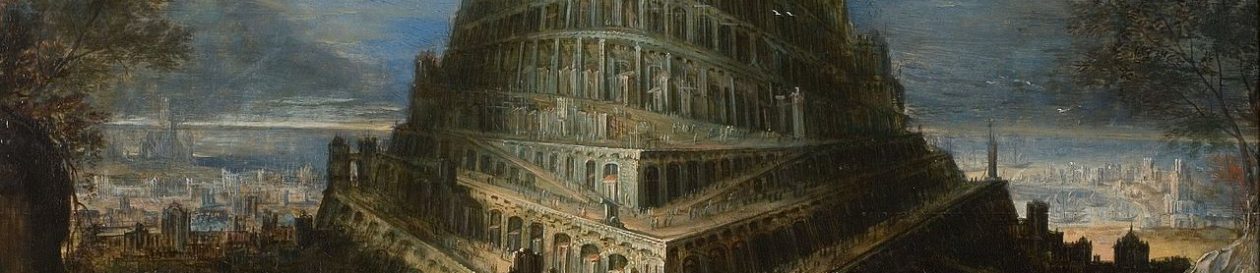
 

The Seasons and the Zodiac

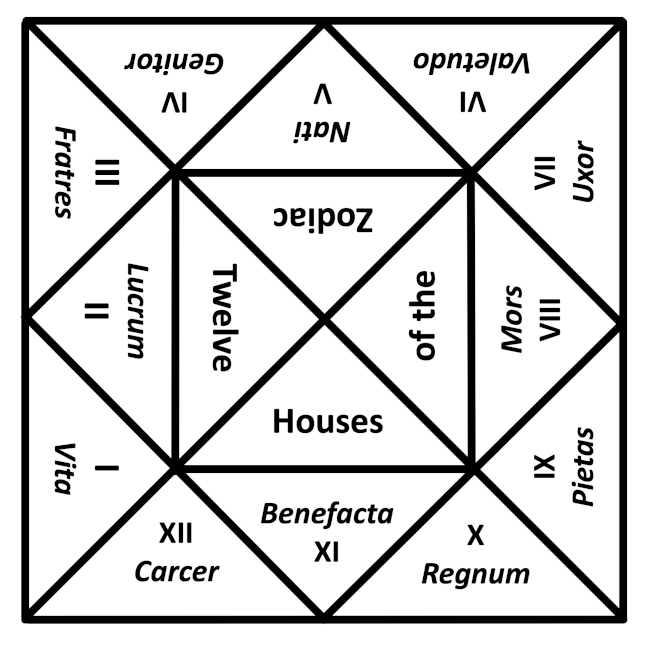
This isn’t a bad little diagram of the four seasons along with the twelve zodiac names and symbols. However, it might be oriented wrong by convention or going clockwise instead of counter-clockwise.  Interestingly, old horoscope charts that show what was in the sky (the positions of the zodiac stars and the eight or nine planets in regards to the twelve “astrological houses”) at the time of a person’s birth were shown using the outside ring of twelve triangles instead of the more familiar circle that is used today. The inner square might be for notes or some nice drawing.

Further Reading:

https://en.wikipedia.org/wiki/Zodiac

https://www.completehoroscope.org/envelope-diagram-horoscope.htm

The Four Seasons

[*10.145]

<>


Seven Sermons to the Dead, Part 2

Here with inadequate description is another fourfold of entities from Seven Sermons to the Dead.

  • The Pleroma: The spiritual universe as the abode of gods and of the totality of the divine powers and emanations.
  • The Creatura: The living world, subject to perceptual difference, distinction, and information
  • Abraxas: The supreme power of being transcending all divinities and demons and uniting all opposites into one
  • Philemon: Jung’s spiritual guide, the narrator

Further Reading:

https://en.wikipedia.org/wiki/Seven_Sermons_to_the_Dead

https://en.wikipedia.org/wiki/Pleroma

https://en.wikipedia.org/wiki/Abraxas

Who is Philemon?

[*10.76]

The Four Mythological Beasts

Another item for my fourfold menagerie is the four symbolic mythological beasts of China. They are associated with the Four Cardinal Directions and the Four Seasons.

  • The Vermilion Bird (South, Summer, named Zhūquè or Ling Guang)
  • The Azure Dragon (East, Spring, named Qīnglóng or Meng Zhang)
  • The Black Turtle (North, Winter, named Xuánwǔ or Zhi Ming)
  • The White Tiger (West, Fall, named Báihǔ or Jian Bing)

They are also part of Japanese folklore and I show the Japanese names of these four god beasts to the right, mostly because I am more familiar with them: Suzaku, Seiryu, Genbu, and Byakko.

Further Reading:

https://en.wikipedia.org/wiki/Four_Symbols_(China)

http://tvtropes.org/pmwiki/pmwiki.php/Main/TheFourGods

https://allthetropes.org/wiki/The_Four_Gods

http://readingjapanesehistory.blogspot.com/2010/03/four-gods-protecting-kyoto.html

http://koei.wikia.com/wiki/Four_Gods

https://en.wikipedia.org/wiki/Twenty-Eight_Mansions

Notes:

It was nice to see the Four Beasts in the opening ceremony at the 2018 Winter Olympics in South Korea.

[*8.104, *10.64]

<>


Simon Magus and the Six Roots of Boundless Power

As we had a taste of Christian Eschatology last time we now nibble on Christian Gnosticism. Simon was mentioned in the bible and in apocryphal works was purported to be a sorcerer of some renown. He developed a philosophically idealistic system wherein six roots of mental aspects issue from a fundamental principle of “Fire”:

  • Mind (Heaven)
  • Voice (Sun)
  • Reason (Air)
  • Reflection (Water)
  • Name (Moon)
  • Thought (Earth)

These six roots form three pairs:

  • Mind [Nous] – Thought [Epinoia]
  • Voice [Phone] – Name [Onoma]
  • Reason [Logismos] – Reflection [Enthumesis]

Above is a representation of these six roots forming their three pairs or syzygies. Most of Simon’s teachings have been either been lost or perhaps even degraded from their original meaning. Do I waste both my time as well as yours to perpetuate this esoteric nonsense? Or is there some merit in it, if only for idle amusement?

Further Reading:

https://en.wikipedia.org/wiki/Simon_Magus

https://en.wikipedia.org/wiki/Simonians

https://hermetic.com/sabazius/simon

http://gnosis.org/library/grs-mead/grsm_simon_magus.htm

http://www.katinkahesselink.net/his/Simon-Magnus.html

http://www.sacred-texts.com/gno/fff/fff21.htm

G. R. S. (George Robert Stow) Mead / Simon Magus: His Philosophy and Teachings

Notes:

Sometimes Mind is called Reason, and then Reason is called Judgment.

Greek philosopher Heraclitus also thought that fire was the fundamental element.

http://www.heraclitusfragments.com/categories/fire.html

Simon was thought to have written the book “The Four Quarters of the World”, now lost to us. Perhaps it was in the Library of Alexandria?

Compare the six roots to de Bono’s six thinking hats.

[*9.222, *9.223]

<>

A Vision by W. B. Yeats: The Four Faculties

A Vision by W. B. Yeats is the focus of a large amount of scholarship for a book on the occult. It looks interesting as a source of metaphor and symbolism, and I hope to return to it at another time. There is an excellent website devoted to Yeat’s Vision, the link of which is below.

Above I show the fourfold of the Faculties: Will, Body of Fate, Mask, and Creative Mind. It is not arranged as recommended by the four elements, but by my whim.

I saw a preview of the recent movie “Kill Your Darlings” which mentioned A Vision and showed the woodcut of the Cosmic Wheel.

Further Reading:

http://en.wikipedia.org/wiki/A_Vision

http://www.yeatsvision.com/

Neil Mann, Matthew Gibson, and Claire Nally, eds. / Yeats’s “A Vision”: Explications and Contexts

https://academic.oup.com/liverpool-scholarship-online/book/43466#login-purchase

[*7.200]

<>