Category Archives: eightfolds

The Eight Circuit Model of Consciousness

Timothy Leary’s dead…
No, no-no, he’s outside, looking in…

— The Moody Blues

Timothy Leary came up with this scheme of eight circuits of consciousness and Robert Anton Wilson expanded and renamed most of them. It’s basically a “great-chain” of evolutionary brain circuitry, leading from lower to higher states of consciousness.

labeled my diagram with RAW’s names, but below I also list Leary’s names in parentheses.

  • Oral Bio-survival (Vegetative-invertebrate)
  • Anal Territorial (Emotional-locomotion)
  • Semantic Time-binding (Laryngeal-manual Symbolic)
  • Socio-sexual (Socio-sexual Domestication)
  • Neurosomatic (Neurosomatic)
  • Metaprogramming (Neuro-electric)
  • Morphogenetic (Neurogenetic)
  • Non-local Quantum (Neuro-atomic Metaphysiological)

Pretty wild stuff!

Further Reading:

https://en.wikipedia.org/wiki/Eight-circuit_model_of_consciousness

http://www.phinnweb.org/neuro/8-circuit/

https://en.wikipedia.org/wiki/Timothy_Leary

https://en.wikipedia.org/wiki/Robert_Anton_Wilson

[*11.42]

<>

John Beebe’s Eight Function Model

After my last post about an ad-hoc eightfold metaphysics, I spent a few minutes trying to create an eightfold psychology. Feeling insufficient to the task, I quickly put this aside and instead wondered if there was any prior work for this, and lo and behold, I found a wealth of such things. Eight seems to be a popular number for the enumeration of the psyche and related subjects.

I’ve already mentioned Robert Plutchik’s Emotions and Mihaly Csikszentmihalyi’s Flow, which are both sort of psychological dissections. If you’re into Jung and related psychologies, Jungian analyst John Beebe developed his eight-function model of personality types that blends Jungian concepts together into an interesting system. The eight types are split into two sets of four: for every type in the first “positive” set (ego-syntonic) there is a corresponding type in a “shadow” set (ego-dystonic). Each set of four has a superior, an auxiliary, a tertiary, and an inferior function.

  • Hero/Heroine (superior function)
  • Father/Mother (auxiliary function) (or good parent)
  • Puer/Puella (tertiary function) (or eternal child)
  • Anima/Animus (inferior function)
  • Opposing persona (shadow of superior) (villain?)
  • Senex/Witch (shadow of auxiliary) (or critical parent)
  • Trickster (shadow of tertiary) (added deceiver for balance)
  • Demon/Daimon (shadow of inferior) (daemon?)

In my diagram, I’ve shown each function paired with its shadow function. And of course being Jungian, the terminology is full of gender distinctions, which could fairly easily be eliminated. There are also lots of arcane associations to MBTI and such, so this will take more than a quick look. Please just wait here, and I’ll be back with an update soon (or not)!

Further Reading:

The John Beebe 8 function model

Eight-Function Model

http://www.erictb.info/archetypes.html

https://www.careerplanner.com/8CognitiveFunctions/Cognitive-Functions-Simply-Explained.cfm

https://en.wikipedia.org/wiki/John_Beebe

Also see my posts:

Carl Jung’s Psychological Types

The Myers-Briggs Type Indicator

[*11.41, *11.43]

<>

An Eightfold Metaphysics

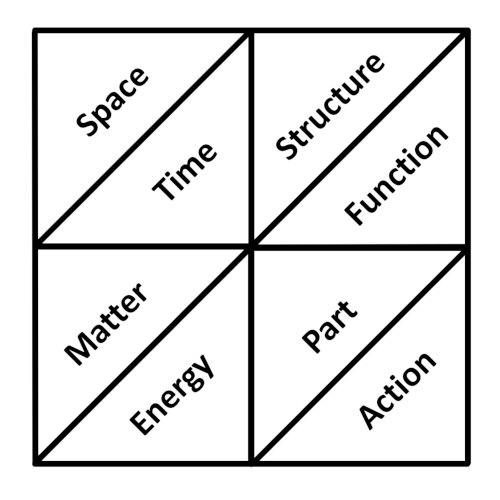
If one juxtaposes the fourfold Space-Time-Matter-Energy with the fourfold Structure-Function-Part-Action, one sees that there are several relations between them. These are simple common-sense relations, not modern-physics types of relations. Below they are listed by Space-type relations and Time-type relations.

Space is required for the extension of Structures.
Matter constitutes Structures.
Parts in an arrangement make up Structures.

Structures extend and are organized in Space.
Matter is located in Space.
Parts occupy Space.

Time allows the expression of Functions.
Energy is required for the operation of Functions.
Actions in a sequence constitute Functions.

Functions have duration and reoccur in Time.
Energy requires and is dependent on Time.
Actions take place within Time.

Several analogies are also evident in this diagram.

  1. Space : Structures :: Time : Functions
  2. Space : Parts :: Time : Actions
  3. Space : Matter :: Time : Energy
  4. Structures : Parts :: Functions : Actions
  5. Structures : Matter :: Functions : Energy
  6. Parts : Matter :: Actions : Energy

Notice that analogies 1.-3. are “contains” relations, and 4.-6. are “part of” relations. One obtains the nesting of entities:

Space > Structures > Parts > Matter
Time > Functions > Actions > Energy

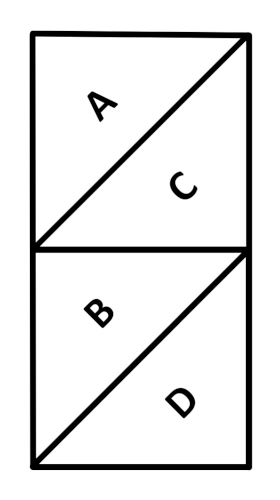
I suppose that any analogy could be shown in a figure like the one on the right (or even written as A / B // C / D) or with the two squares side by side, and that sets of four or six analogies that overlap could be nicely shown as above. If so, I wonder what can be gained by such representations? Probably individually not so much but with overlaps I think it would be interesting.

Further Reading:

The study of parts and wholes relations is called Mereology.

https://en.wikipedia.org/wiki/Mereology

https://plato.stanford.edu/entries/mereology/

[*10.157, *11.26, *11.34]

<>


Flow

Speaking of flow, I see that the psychological concept of flow is based around a distinction of low-to-high challenge vs. low-to-high skill. When both challenge and skill are high, an efficient mental state can be engaged. From Wikipedia:

“In positive psychology, flow, also known colloquially as being in the zone, is the mental state of operation in which a person performing an activity is fully immersed in a feeling of energized focus, full involvement, and enjoyment in the process of the activity. In essence, flow is characterized by complete absorption in what one does, and a resulting loss in one’s sense of space and time.”

  • Flow: high challenge and high skill
  • Control: medium challenge and high skill
  • Relaxation: low challenge and high skill
  • Boredom: low challenge and medium skill
  • Apathy: low challenge and low skill
  • Worry: medium challenge and low skill
  • Anxiety: high challenge and low skill
  • Arousal: high challenge and medium skill

Missing is medium challenge and medium skill. I wonder what that is?

Further Reading:

https://en.wikipedia.org/wiki/Flow_(psychology)

Mihaly Csikszentmihalyi / Flow: The Psychology of Optimal Experience

[*11.22]

<>


The Eight Planets

Now that Pluto has been kicked out of the League of Planets (poor Pluto!), with the eight remainders I can present the above diagram.

The Sun and the Moon, not planets either, are usually thought of as a pair. I’ll add them in by themselves for good measure.

Further Reading:

https://en.wikipedia.org/wiki/Planet

https://en.wikipedia.org/wiki/Planet_symbols

[*10.149]

<>


Fearless Living

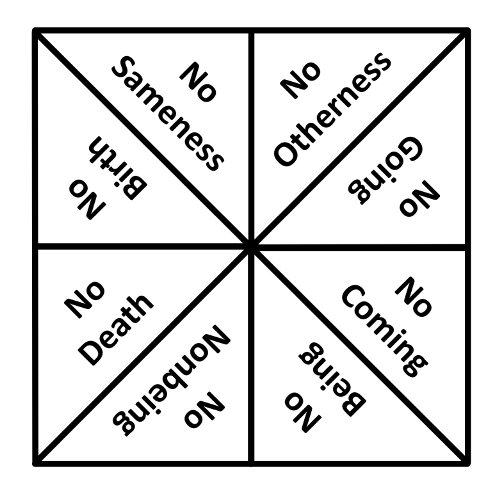
We can live with no fear if we remove these four pairs of opposites and have Right View.

— Thích Nhất Hạnh

  • No Birth
  • No Death
  • No Sameness
  • No Otherness
  • No Coming
  • No Going
  • No Being
  • No Non-being

Further Reading:

https://en.wikipedia.org/wiki/Th%C3%ADch_Nh%E1%BA%A5t_H%E1%BA%A1nh

https://tnhaudio.org/tag/pairs-of-opposites/

[*9.226]

<>

The Eightfold Path

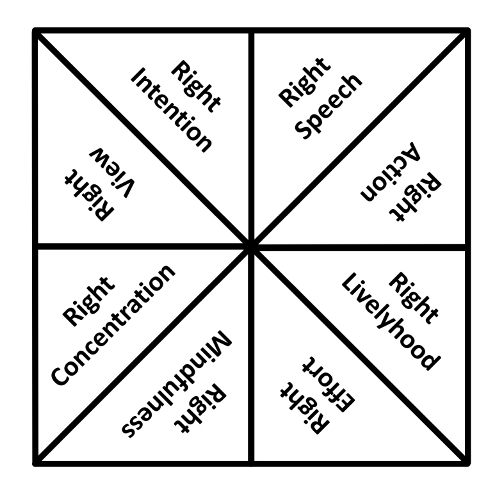
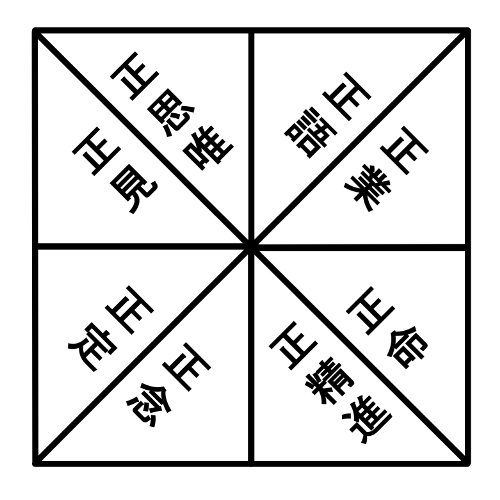
The Noble Eightfold Path of Buddhism (八正道):

  • Right View (also Understanding) (正見)
  • Right Intention (also Thought) (正思唯)
  • Right Speech (正語)
  • Right Action (正業)
  • Right Livelyhood (正命)
  • Right Effort (正精進)
  • Right Mindfulness (正念)
  • Right Concentration (正定)

I’ve also translated the diagram into Chinese.

Further Reading:

https://en.wikipedia.org/wiki/Noble_Eightfold_Path

The Noble Eightfold Path

https://www.buddha101.com/p_path.htm#The%20Eightfold%20Path

https://www.orientaloutpost.com/shufa.php?q=eightfold

Note:

In the anime “One Piece,” marines often have the characters 正義 on the back of their coats. This means “Seigi,” or Right Morality or Justice. Note that this isn’t part of the Eightfold Path.

https://onepiece.fandom.com/wiki/Justice

[*10.118]

<>

Edward T. Hall’s Map of Time

Quite by accident, I ran across anthropologist Edward T. Hall’s Map of Time in his book “The Dance of Life: the other dimension of time”. In it, he shows a mandala of different notions of time which tries to answer the question, “what is time”? The mandala consists of eight (or nine) different notions of time, organized as a fourfold of duals:

  • Physical / Metaphysical
  • Micro / Sync
  • Biological / Personal
  • Profane/ Sacred

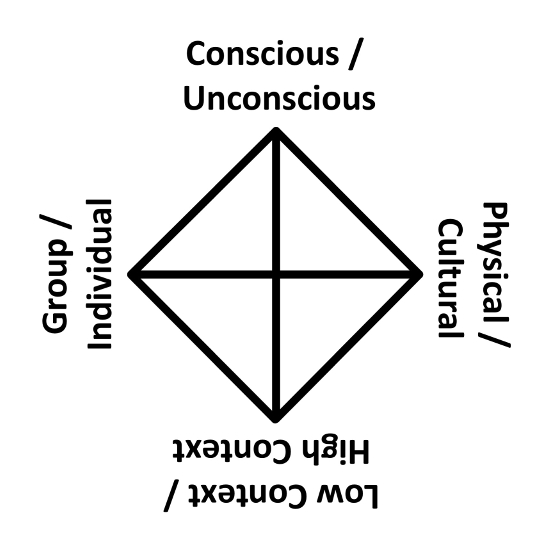
In addition, there are four duals of attributes:

  • Group / Individual
  • Cultural / Physical
  • Conscious/ Unconscious
  • Low Context / High Context

So that the different times have these attributes:

  • Physical: Low Context, Conscious, Physical, Group
  • Metaphysical: Low Context, Conscious, Cultural, Group
  • Micro: High Context, Unconscious, Cultural, Individual
  • Sync: High Context, Unconscious, Physical, Individual
  • Biological: Low Context, Unconscious, Physical, Group
  • Personal: Low Context, Unconscious, Physical, Individual
  • Profane: High Context, Conscious, Cultural, Individual
  • Sacred: High Context, Conscious, Cultural, Group

And the different attributes belong to these notions of time:

  • Physical: Physical, Biological, Personal, Sync
  • Cultural: Metaphysical, Sacred, Profane, Micro
  • Group: Biological, Physical, Metaphysical, Sacred
  • Individual: Profane, Micro, Sync, Personal
  • Conscious: Physical, Metaphysical, Sacred, Profane
  • Unconscious: Micro, Sync, Personal, Biological
  • Low Context: Personal, Biological, Physical, Metaphysical
  • High Context: Sacred, Profane, Micro, Sync

The ninth notion of time is a synthesis of all eight which he calls meta-time.

Further Reading:

https://en.wikipedia.org/wiki/Edward_T._Hall

http://people.brunel.ac.uk/bst/vol0202/robdoyle.html

[*10.4]

<>

The Eight Worldly Winds

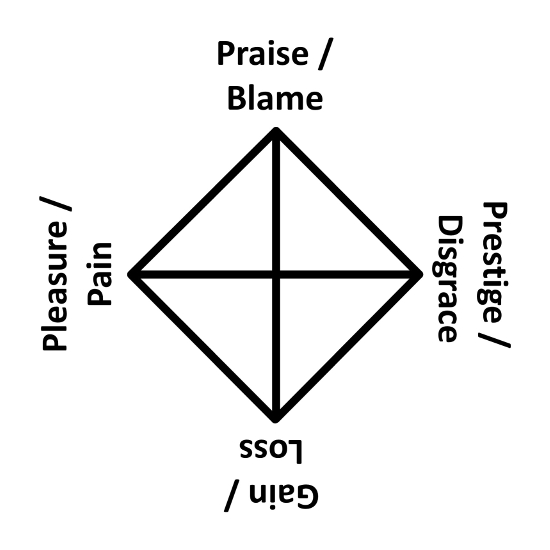
This fourfold of duals from Buddhism lists the hopes and fears that bind us to the world and our culture. They are known as the eight worldly winds, concerns, or dharmas. Both hopes and fears, wanting and not wanting, can be seen as negative.

  • Hope for Pleasure and Fear of Pain
  • Hope for Gain and Fear of Loss
  • Hope for Praise and Fear of Blame
  • Hope for Prestige and Fear of Disgrace

Further Reading:

http://stefnoble.blogspot.com/2011/11/buddhas-eight-worldly-winds.html

HEALING THE EFFECTS OF EVIL

http://www.rigpawiki.org/index.php?title=Eight_worldly_preoccupations

https://www.lionsroar.com/buddhism-by-the-numbers-the-eight-worldly-concerns/

[*9.227]

<+>


The Eight Trigrams of the Bagua

What can be said of the Eight Trigrams of Taoist cosmology, also known as the Bagua, that hasn’t already been said on ten thousand other web sites? Here I show the trigrams and their duals together in an arrangement that places one or two of them at a site of the four elements.

When considering the binary values of the trigrams, this arrangement is reminiscent of my Marriage of Opposites, Part 2. In doing this each link between them represents a common value for a trigram line. For example between Heaven / Earth and Water / Fire the 2nd line is yang for both Heaven and Water, and the 2nd line is yin for both Earth and Fire. Opposite this link is its reverse: the 2nd line is yin for both Thunder and Mountain, and yang for both Wind and Lake. All six links have this quality.

Two smaller diagrams show the common English names as well as the corresponding attributes of the trigrams. Interestingly, if Heaven and Wind are considered Air, Lake is considered Water, Mountain is considered Earth, and Thunder is considered Fire, then you have each element mentioned twice, once above and once below, and a crossed loop of pairs: Air / Earth, Fire / Air, Water / Fire, Earth / Water, and then back to Air / Earth. Nice!

Further Reading:

https://en.wikipedia.org/wiki/Bagua

https://malankazlev.com/kheper/topics/I_Ching/trigrams.htm

https://www.nationsonline.org/oneworld/Chinese_Customs/bagua.htm

https://www.risingmoontaichi.net/the-eight-trigrams

[*9.234, *9.235]

<+>