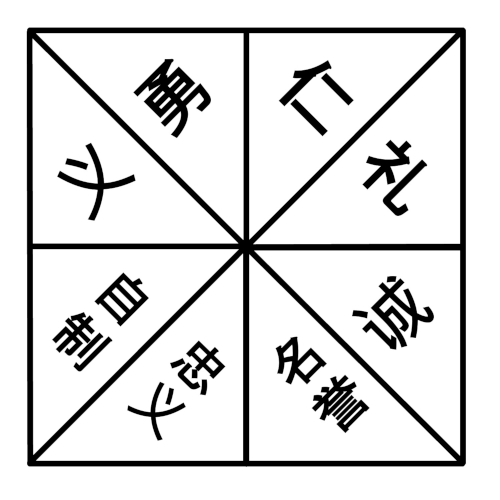
Bushido was a moral code followed by the Samurai class that arose during the Edo period of Japan. The origins of this ethos are generally agreed to be a syncretism arising from various religious and cultural institutions that were extant during that time. Even though the idea of a set number of principles may be questionable, a modern, formalized list of eight was largely popularized in 1900 by Inazo Nitobe in his controversial book “Bushido: The Soul of Japan”. It argued that Bushido was very similar to the Medieval ethos of Western Chivalry.
Core Sources and Influences:
- Confucianism: Provided the backbone of the code, emphasizing loyalty to the master, duty, and benevolence.
- Zen Buddhism: Contributed to self-control, mental discipline, and overcoming the fear of death.
- Shintoism: Cultivated loyalty to the Emperor and respect for ancestors.
- Feudal Law (Edo Period): The Tokugawa shogunate formally codified these previously unwritten customs into laws, demanding loyalty and strict conduct from the samurai class.
- “Hagakure” by Yamamoto Tsunetomo: While not listing eight principles specifically, this text is a primary source for the samurai mindset, emphasizing the “secret” rule of not fearing death.
- Inazo Nitobe (“Bushido: The Soul of Japan”): Defines the eight core virtues as the cornerstone of samurai ethics to explain Japanese culture to the West.
The Eight Principles (per Nitobe):
- Righteousness/Justice (义, Gi)
- Heroic Courage (勇, Yū)
- Benevolence/Compassion (仁, Jin)
- Respect/Politeness (礼, Rei)
- Integrity/Honesty (诚, Makoto)
- Honor (名誉, Meiyo)
- Duty and Loyalty (忠义, Chūgi)
- Self-Control (自制, Jisei)
Further Reading:
https://en.wikipedia.org/wiki/Bushido
https://en.wikipedia.org/wiki/Nitobe_Inaz%C5%8D
https://www.tofugu.com/japan/bushido/
https://en.wikipedia.org/wiki/Hagakure
https://en.wikipedia.org/wiki/Bushido:_The_Soul_of_Japan
<>