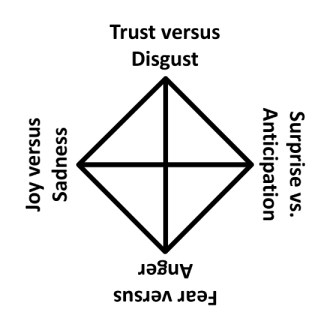
 Robert Plutchik devised a schema for eight basic emotions, divided into four pairs of opposites. Each of these also has a weaker and a stronger version (but not shown here).
- Trust vs. Disgust
- Joy vs. Sadness
- Fear vs. Anger
- Surprise vs. Anticipation
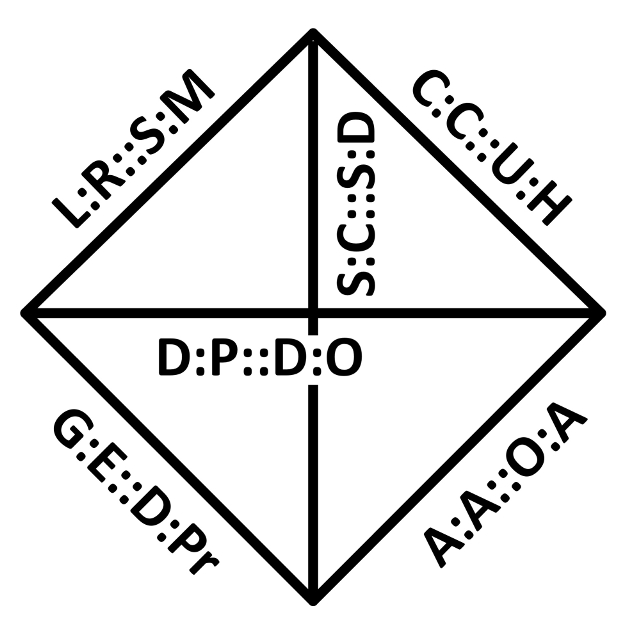
In addition, emotions called dyads can be built by non-opposed combinations of the basic emotions , and each of these twelve dyads has a reverse or opposite emotion, making 24 total. Between any two opposite pairs, two dyads may be considered covariant, and the other two may be considered contravariant. So for the two pairs of opposites A + A’ and B + B’, we have covariant A*B and A’*B’, which are opposite, say C and C’, and contravariant A*B’ and A’*B, which are also opposite, say D and D’. These four dyads are labeled in the diagram as C:C’::D:D’, which I hope is not too confusing.
- [L:R] Love (Joy * Trust) : Remorse (Sadness * Disgust)
- [S:M] Sentimentality (Trust * Sadness) : Morbidness (Joy * Disgust)
- [G:E] Guilt (Joy * Fear) : Envy (Sadness * Anger)
- [D:Pr] Despair (Fear * Sadness) : Pride (Joy * Anger)
- [C:C] Curiosity (Trust * Surprise) : Cynicism (Disgust * Anticipation)
- [U:H] Unbelief (Surprise * Disgust) : Hope (Trust * Anticipation)
- [A:A] Awe (Fear * Surprise) : Aggression (Anger * Anticipation)
- [O:A] Outrage (Surprise * Anger) : Anxiety (Fear * Anticipation)
- [D:P] Delight (Joy * Surprise) : Pessimism (Sadness * Anticipation)
- [D:O] Disappointment (Surprise * Sadness) : Optimism (Joy * Anticipation)
- [S:C] Submission (Trust * Fear) : Contempt (Disgust * Anger)
- [S:D] Shame (Fear * Disgust) : Dominance (Trust * Anger)
Further Reading:
https://en.wikipedia.org/wiki/Robert_Plutchik
https://en.wikipedia.org/wiki/Contrasting_and_categorization_of_emotions#Plutchik.27s_wheel_of_emotions
http://www.personalityresearch.org/basicemotions.html
http://www.personalityresearch.org/basicemotions/plutchik.html
Plutchik’s Wheel of Emotions
[*9.224, *9.225, *9.230, *9.231]
<>

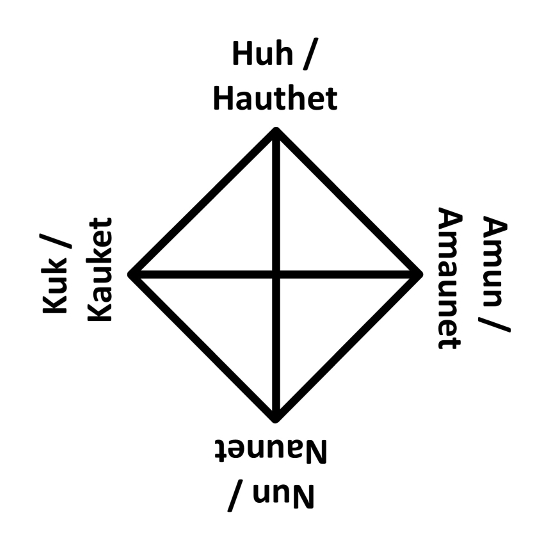 Here’s a notable fourfold of dualities: the Ogdoad, or eightfold of deities. I usually don’t stray into ancient mythology but this cosmological system evidently led the Greeks to their idea of the four elements. These paired male and female deities were personifications of certain metaphysical concepts and their opposites.