 Every physics undergraduate (and science buff) learns about the arrow of time: entropy increases, disorder accumulates, the universe runs down. It is the directionality that explains why eggs don’t unscramble and why coffee cools to room temperature rather than the reverse. Robert Hazen and Eric Wong’s book Time’s Second Arrow takes its title from a less determined but no less universal counter-tendency; the fact that, locally and persistently, the universe often builds things up. Stars, planets, minerals, molecules… and even perhaps cells, ecosystems, civilizations: each a pocket of accumulating complexity riding against the entropic tide. The book’s project is to advocate that this “second arrow” be given a law of its own, with the same generality that the Second Law of Thermodynamics gives its First.
Their proposal, building on Nobel laureate Jack Szostak’s notion of functional information, is stated plainly:
The Law of Increasing Functional Information: The functional information of a system will increase (i.e., the system will “evolve”) if many different configurations of the system are subjected to selection for one or more functions.
And later, the law is decomposed into three necessary ingredients. They write that evolving systems are:
(1) formed from numerous interacting building blocks with vast numbers of possible configurations, (2) [subject to] processes [that] generate many of those configurations, and (3) [such that] newly generated configurations are subjected to selection.
It is a clean, minimal, and — to a reader who has spent any time with the architecture of evolutionary thought — strikingly familiar structure. It is essentially Darwin’s three-part braid of variation, generation (or propagation), and selection, lifted out of biology entirely and set down as a law for systems of matter and energy.
I had encountered this same three-part braid before, in Tyler Volk’s Quarks to Culture, which describes what he calls combogenesis — the bottom-up construction of ever-higher levels of organization, from quarks to nucleons to atoms to molecules to cells to societies, each level built from combinations of the elements below it. My post Combogenesis and Evolution discusses Volk’s own three-part formulation: propagation, variation, and (natural) selection.
Hazen and Wong’s law, then, is not merely like Volk’s combogenesis — it is close to a formal restatement of it, with one significant addition: functional information gives the third term, selection, an actual unit of measure. Where Volk and Darwin alike leave “selection” as a qualitative filter, Hazen and Wong propose that we can quantify how much information a selected configuration encodes about the function it was selected for. This is a genuine advance, not just a re-description: it turns a metaphor about fitness into something with a number attached, which it critical for science.
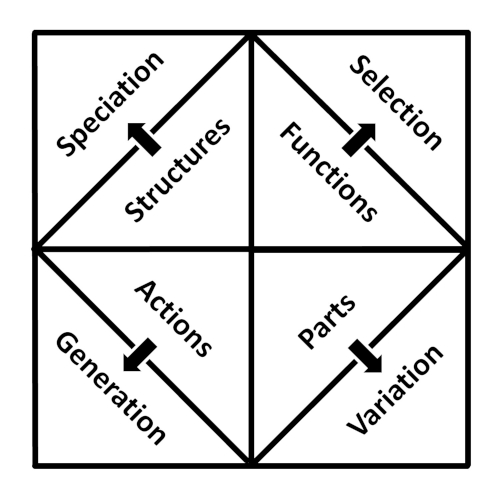
And here is where I think the comparison is valuable, rather than just being a pleasant coincidence of vocabulary. Some years ago I proposed a fourfold model of evolution— generation, variation, speciation, and selection — built by analogy to my notion of Structure-Function (action, part, structure, function) and, more distantly, to Aristotle’s four causes: efficient, material, formal, and final.
Hazen and Wong’s three ingredients map cleanly onto three of these four terms:
| Hazen & Wong | Struction-Function | “My Evolution” | Four Causes |
| Building blocks, elements | Parts | Variation | Material |
| Generative processes |
Actions | Generation | Efficient |
| Selection for function |
Functions | Selection | Final |
| No explicit term |
Structures | Speciation | Formal |
What’s missing is *structure* — the term in my fourfold that corresponds to Aristotle’s formal cause, and in evolutionary biology to speciation: the process by which generated and selected configurations become somewhat stabilized into discrete, separated, and semi-persistent kinds, rather than remaining a single continuously varying population.
This is not a small omission, and I don’t think it’s a flaw in Hazen and Wong’s law so much as a genuinely open question their law surfaces. Variation, generation, and selection together can in principle produce a population in continuous flux — configurations being generated, tested, and culled, endlessly, without ever crystallizing into distinct, bounded kinds. What additionally has to happen for *species* of mineral, or *species* of organism, to exist as separated, namable categories, rather than a smear of intermediate forms? In biology, the answer involves reproductive isolation, geography, genetic incompatibility — barriers that *structure* the space of variation into discrete clusters. Does mineralogy have an analogue to this? Does any sufficiently general law of evolving systems need one?
This is where the book’s most novel empirical move becomes philosophically interesting, and not just scientifically. Hazen and Wong calculate functional information for naturally occurring minerals — a domain where, unlike biology, there is no reproduction, no heredity in any genetic sense, and yet there is unmistakably *selection*: certain atomic configurations are stable under given conditions of temperature, pressure, and chemical environment, and others are not. The configurations that persist are, in their framework, of higher functional information than configurations that don’t.
Minerals make an excellent test case for the law precisely because they strip selection down to something close to its physical bedrock — thermodynamic stability — before the added complications of biological selection (predation, mating, competition) enter the picture. But minerals also, conveniently for my purposes, are organized into a taxonomy of discrete *mineral species* — distinct kinds with sharp boundaries, not a continuum. Quartz is quartz; it is not on a sliding scale toward feldspar. If the Law of Increasing Functional Information is sufficient to explain why mineral diversity increases over geological time, does it also explain why minerals fall into discrete kinds at all, or is that an independent fact about crystal chemistry that the law simply inherits for free?
I don’t have a settled answer. But it’s the kind of question that, once you’ve spent time with a four-term model instead of a three-term one, you can’t help but ask.
Thanks to Claude for help in writing this post (and all the em-dashes).
Further Reading:
Robert Hazen, Eric Wong / Time’s Second Arrow
Tyler Volk / Quarks to Culture
https://en.wikipedia.org/wiki/Functional_information
https://en.wikipedia.org/wiki/Eric_Chaisson
<>

