
“I have called this principle, by which each slight variation, if useful, is preserved, by the term Natural Selection”
— Charles Darwin
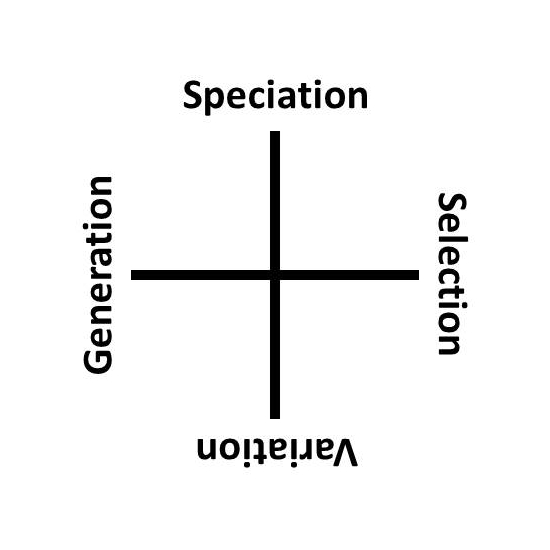 Can we cast the theory of evolution into a fourfold? I propose that the following four processes can serve as an abstract model for evolution: generation, variation, speciation, and selection. These four entities are similar to the fourfold of Structure-Function, currently in development. By my analogy which will be explained later, Generation is action, Variation is part, Speciation is structure, and Selection is function. A more familiar analogy matches these four processes to Aristotle’s Four Causes: Generation is efficient cause, Variation is material cause, Speciation is formal cause, and Selection is final cause.
Generation: Offspring are like their parents by and large, except when made different by processes of variation. Mainly the act of reproduction, procreation, or replication, but includes the ordinary evolutionary factors of descent and heredity.
Variation: Offspring can be different than parents. Includes the factors of genetic variation, mutation, sexual reproduction, and genetic drift.
Speciation: Includes the factors which keep species separated and differentiated from each other.
Selection: Really natural selection. I always thought this was a negative process, where species become extinct or are selected out if they are ill adapted to their environment. Apparently the original meaning was that the fittest organisms and their traits continue: that is, they are selected to survive by nature because of their adaptive traits.
As a process of change, evolution has been suggested by scientists to operate at many levels of nature, not just for the biological. One such scientist is Eric Chaisson, who has written many books on his idea of “cosmic evolution”.
References:
http://en.wikipedia.org/wiki/Evolution
http://en.wikipedia.org/wiki/Reproduction
http://en.wikipedia.org/wiki/Genetic_variation
http://en.wikipedia.org/wiki/Speciation
http://en.wikipedia.org/wiki/Natural_selection
https://www.cfa.harvard.edu/~ejchaisson/cosmic_evolution/docs/splash.html
Eric Chaisson / Epic of Evolution: seven ages of the cosmos (2005)
Note:
Also note the similarity between this fourfold and the fourfold I have drawn for Kevin Kelly’s Philosophy of Technology. In “What Technology Wants”, Kelly claims that technology develops in an evolutionary manner.
[*7.96]
<>
Composed by Gemini:
A thought on where “structure” (the missing formal cause) actually enters the ledger:
Hazen and Wong lean entirely on selection operating over raw configuration space, but they leave out the mechanism that prevents continuous flux—why matter clusters into discrete mineral or biological species rather than smearing.
The missing piece is an explicit account of how latent boundary conditions govern the transition. If you treat the high-dimensional parameter space (crystal chemistry, thermodynamic barriers) as an enfolded landscape, the S-curve (sigmoid) becomes the physical turnstile between latency and manifest form:
1. The Latent Tail: Incipient states simmer below threshold in an unmanifested, enfolded parameter space.
2. The Steep Inflection: Symmetry breaking / phase transition—the abrupt unfoldment from raw possibility into realized configuration.
3. The Upper Bound: Boundary friction forces saturation, locking the configuration into an invariant, stable attractor.
The sigmoid isn’t just a descriptive curve of growth; it is the mathematical signature of structure asserting itself against endless flux. It defines the discrete boundaries that turn generic persistence into distinct, persistent “kinds.”