Category Archives: Science

The Four Bases of DNA

DNA neither cares nor knows. DNA just is. And we dance to its music.

Richard Dawkins

DNA, the genetic code and biological machinery all life on earth shares, has been in the news lately. It was once thought that much of our DNA was useless junk, but recent research reveals that this portion of our DNA is very important to the operation of epigenesis. This portion of DNA could be called dark bio-matter, or better dark bio-information or even dark bio-code, since it contains switches and instructions that guide each individual organism’s developmental growth through time.

Previously, the parts of DNA thought to be important were those regions that define the proteins that assemble to form our tissues. Mutations in the DNA that specify proteins can lead to disease because the mutated proteins cannot perform the functions that they need to. Of course, mutated proteins can also be improved and increase health. Comparing protein sequences across species shows that we have many commonalities as well as important differences with our animal cousins. What was once considered a “great chain of being” is now thought to be a great tree of life, all shown by DNA.

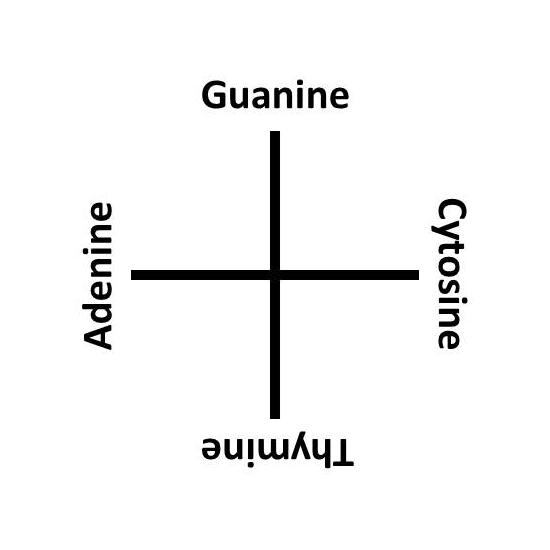
DNA is also a fourfold, and a double dual as well, since for the four bases Adenine (A), Thymine (T), Guanine (G), and Cytosine (C): A pairs with T, and G with C. I am not saying that DNA is analogous to the other fourfolds presented here, but it makes a nice diagram.

Questions:

Why does DNA have four bases and not two, like binary computer code?

Even more of DNA determines our health and variation, the things that make us who we are. Does that constrain us even more, or will this knowledge make us more free?

Further Reading:

http://en.wikipedia.org/wiki/DNA

[*7.112]

<>


Epistemic Virtues of Objectivity

I recently finished reading Lorraine Daston and Peter Galison’s “Objectivity”. In this very interesting book, the authors argue that the notion of scientific objectivity has evolved over time. They have divided the course of this evolution into three main phases: truth-to-nature, mechanical objectivity, and trained judgement. During each phase, the main view of objectivity is dominant, but previous phases are still important to the overall idea of what objectivity means in the scientific community.

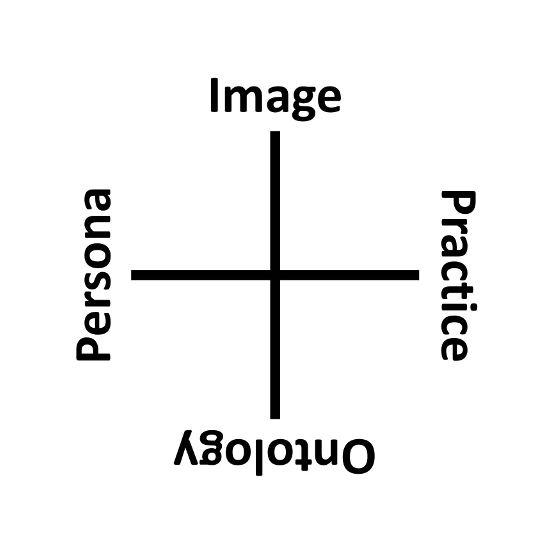
The epistemological virtues of objectivity can be divided into four major aspects: persona, ontology, image, and practice. For each phase of objectivity, each aspect has different qualities. For instance, the scientific persona becomes a sage during the truth-to-nature phase, a worker during the mechanical objectivity phase, and an expert during the trained judgement phase. Similarly, the ontology aspect passed through the qualities of universals-particulars-families, the image aspect passed through reasoned-mechanical-interpreted, and practice  passed through the stages selection and synthesis-automated transfer-pattern recognition.

The evolutionary phases of objectivity, as well as the qualities of the epistemological virtues seen as the four aspects, is beautifully shown by many examples from a collection of scientific atlases. Anyone interested in the history of science as well as the notion of scientific objectivity should enjoy this book.

I thought it was also remarkable that these four aspects of objectivity were very similar to the four aspects of the Archic Matrix of Watson and Dilworth.

Further Reading:

Lorraine Daston and Peter Galison / Objectivity

[*7.106]

<>


The Curry-Howard Correspondence

The Curry-Howard Correspondence reveals a close correspondence between the constituents of Logic and of Programming. Also known as the Formulas as Types and the Proofs as Programs interpretations.

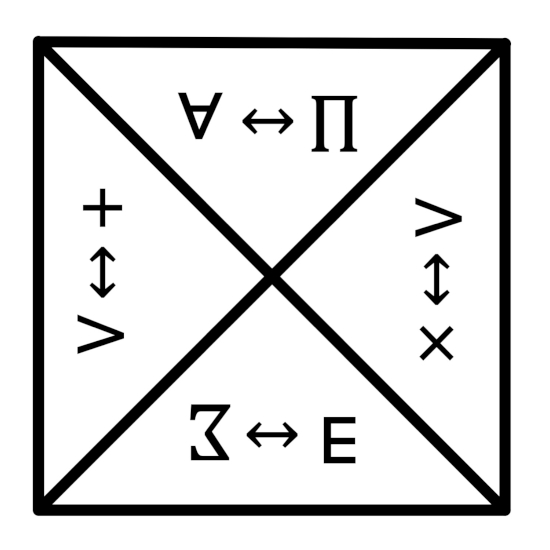
Existential Quantification (∃) of Logic corresponds to the Generalized Disjoint Sum Type (∑) of Programming. Universal Quantification (∀) of Logic corresponds to the Generalized Cartesian Product Type (∏) of Programming. Conjunction (⋀) of Logic corresponds to the Product type (×) of Programming. Disjunction (⋁) of Logic corresponds to the Sum type (+) of Programming.

There are associations between the Curry-Howard Correspondence and the fourfolds of the Square of Opposition, Attraction and Repulsion, and of course Linear Logic.

Further Reading:

http://en.wikipedia.org/wiki/Curry-Howard_correspondence

<>


The Physical Force Carriers

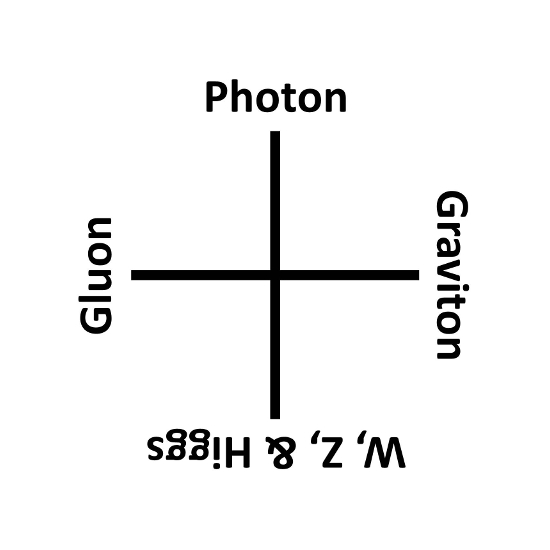
The probable discovery of the Higgs Boson was announced recently. I was initially confused about the difference between the Higgs and the yet to be discovered Graviton. After some reading on the internet, I’m still confused, but they are theorized to be two different particles, since the Graviton is the quantum manifestation of the force of gravity, and the Higgs is the quantum manifestation of the field that gives certain particles mass. Since the Graviton can effect Photons, and the Higgs can’t, they must be different.

You would think that since particles have to have mass to be effected by gravity, they would have to be related. I guess there are some theories out there that do that, but none have been validated. Additionally, the Higgs Boson is part of the Standard Model, and the Graviton isn’t, even though the Higgs doesn’t seem to fit nicely into those 4 x 4 matrices.

The above fourfold is patterned after the Four Fundamental Forces of Physics.

http://en.wikipedia.org/wiki/Quantum_gravity

http://en.wikipedia.org/wiki/Higgs_boson

http://en.wikipedia.org/wiki/Standard_model

<>

Structure-Function

Aristotle’s Four Causes is an important fourfold that seems to be the basis for many of the fourfolds, both original and not, presented in this blog. Two of the causes, efficient and material, are acceptable to modern scientific inquiry because they can be thought of as motion and matter, respectively, but the other two causes, formal and final, are not. Why is that?

The formal cause is problematic because the formal is usually considered to be an abstract concept, a construction of universals that may only exist in the human mind. The final cause is also problematic because it is associated with the concept of telos or purpose. There, too, only human or cognitive agents are allowed to have goals or ends. So for two causes, efficient and material, all things may participate in them, but for the two remaining, formal and final, only agents with minds may.

These problems may be due to the pervasive influence of what the recent philosophical movement of Object Oriented Philosophy calls correlationism: ontology or the existence of things is limited to human knowledge of them, or epistemology. The Four Causes as usually described becomes restricted to the human creation and purpose of things. Heidegger’s Tool Analysis or Fourfold, which also appears to have been derived from the Four Causes, is usually explained in terms of the human use of human made things: bridges, hammers, pitchers. Even scientific knowledge is claimed to be just human knowledge, because only humans participate in the making of this knowledge as well as its usage.

Graham Harman, one of the founders of Speculative Realism of which his Object Oriented Ontology is a result, has transformed Heidegger’s Fourfold so that it operates for all things, and so the correlationism that restricts ontology to human knowledge becomes a relationism that informs the ontology for all things. Instead of this limiting our knowledge even more, it is surprising what can be said about the relations between all things when every thing’s access is as limited as human access. However, this transformation is into the realm of the phenomenological, which is not easily accessible to rational inquiry.

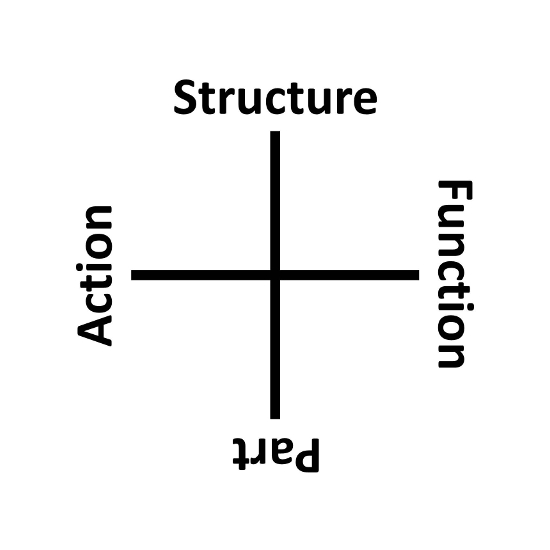
I wish to update the Four Causes, and claim that they can be recast into a completely naturalistic fourfold operating for all things. This new version was inspired by the Four Operators of Linear Logic. Structure and function are commonplace terms in scientific discourse, and I wish to replace formal and final causes with them. It may be argued that what is obtained can no longer be properly called the Four Causes, and that may indeed be correct.

First, let us rename the efficient cause to be action, but not simply a motion that something can perform. I’m not concerned at the moment with whether the action is intentional or random, but it must not be wholly deterministic. Thus there are at least two alternatives to an action. I’m also not determining whether one alternative is better than the other, so there is no normative judgement. An action is such that something could have done something differently in the same situation. This is usually called external choice in Linear Logic (although it makes more sense to me to call it internal choice: please see silly link below).

Second, let us call the material cause part, but not simply a piece of something. Instead of the material or substance that something is composed of, let us first consider the parts that constitute it. However, a part is not merely a piece that can be removed. A part is such that something different could be substituted for it in the same structure, but not by one’s choice. Like an action, I am not concerned whether one of the alternatives is better than the other, but only that the thing is still the thing regardless of the alternative. This is usually called internal choice.

Next, we will relabel the formal cause to be structure, but not simply the structure of the thing under consideration. Ordinarily structure is not a mere list of parts, or a set of parts, or even a sum or integral of parts, but an ordered assembly of parts that shapes a form. Ideally structure is an arrangement of parts in space. However, in this conceptualization, structure will be only an unordered list of parts with duplications allowed.

Last, instead of final cause we will say function, but not simply the function of the thing as determined by humans. Ordinarily function is not a mere list of actions, or a set of actions, or a sum or integral of actions, but an ordered aggregate of actions that enables a functionality. Ideally function is an arrangement of actions in time. However, like structure, function will be only an unordered list of actions with duplications allowed.

As we transform the Four Causes from made things to all things, both natural and human-made, we will later examine how that changes them.

References:

http://en.wikipedia.org/wiki/Speculative_realism

http://en.wikipedia.org/wiki/Object-oriented_ontology

http://en.wikipedia.org/wiki/Graham_Harman

http://wiki.cmukgb.org/index.php/Internal_and_External_Choice

[*6.144, *7.32, *7.97]

<>

 

The Theory of Evolution

“I have called this principle, by which each slight variation, if useful, is preserved, by the term Natural Selection”

— Charles Darwin

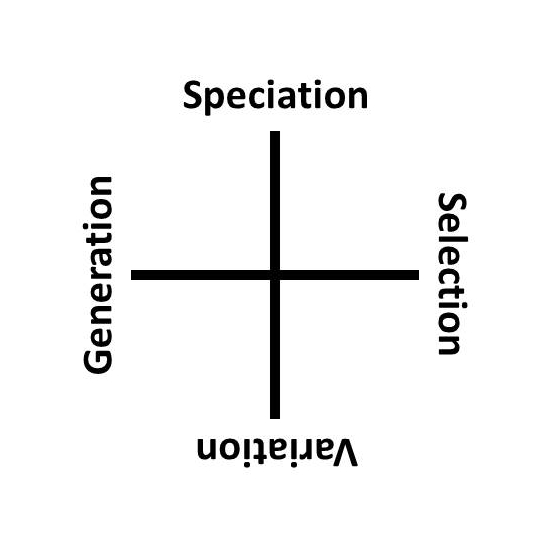
Can we cast the theory of evolution into a fourfold? I propose that the following four processes can serve as an abstract model for evolution: generation, variation, speciation, and selection. These four entities are similar to the fourfold of Structure-Function, currently in development. By my analogy which will be explained later, Generation is action, Variation is part, Speciation is structure, and Selection is function. A more familiar analogy matches these four processes to Aristotle’s Four Causes: Generation is efficient cause, Variation is material cause, Speciation is formal cause, and Selection is final cause.

Generation: Offspring are like their parents by and large, except when made different by processes of variation. Mainly the act of reproduction, procreation, or replication, but includes the ordinary evolutionary factors of descent and heredity.

Variation: Offspring can be different than parents. Includes the factors of genetic variation, mutation, sexual reproduction, and genetic drift.

Speciation: Includes the factors which keep species separated and differentiated from each other.

Selection: Really natural selection. I always thought this was a negative process, where species become extinct or are selected out if they are ill adapted to their environment. Apparently the original meaning was that the fittest organisms and their traits continue: that is, they are selected to survive by nature because of their adaptive traits.

As a process of change, evolution has been suggested by scientists to operate at many levels of nature, not just for the biological. One such scientist is Eric Chaisson, who has written many books on his idea of “cosmic evolution”.

References:

http://en.wikipedia.org/wiki/Evolution

http://en.wikipedia.org/wiki/Reproduction

http://en.wikipedia.org/wiki/Genetic_variation

http://en.wikipedia.org/wiki/Speciation

http://en.wikipedia.org/wiki/Natural_selection

https://www.cfa.harvard.edu/~ejchaisson/cosmic_evolution/docs/splash.html

Eric Chaisson / Epic of Evolution: seven ages of the cosmos (2005)

Note:

Also note the similarity between this fourfold and the fourfold I have drawn for Kevin Kelly’s Philosophy of Technology. In “What Technology Wants”, Kelly claims that technology develops in an evolutionary manner.

[*7.96]

<>

Attraction and Repulsion

Gravity is Love.

 — Brian Swimme

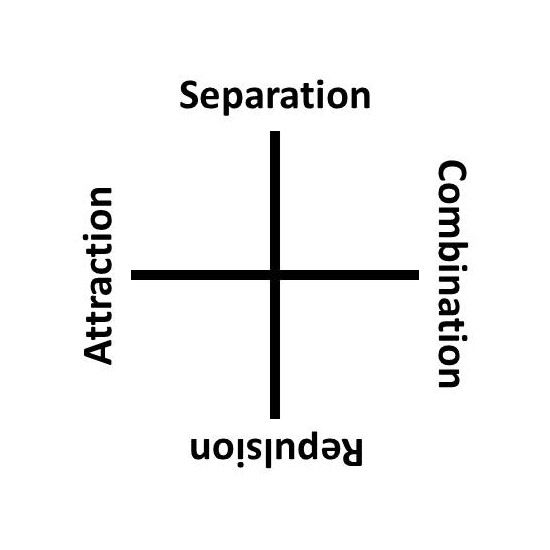
The principle of attraction and its opposite repulsion is pervasive throughout the conceptualization of modern physics. Even ancient Empedocles, of the four elements fame, thought that in all nature the force of attraction and combination was Love or Philia, and that the force of repulsion and separation was Strife or Neikos. These forces have now been depersonalized and mathematized, but still inhabit natural laws which must be obeyed. (See the Four Fundamental Forces of Physics.)

At all levels of matter and energy, from the lowest atomic interactions to the highest cosmic forces, the duality of attraction and repulsion are everywhere. In atoms, there is the strong force and the weak force that respectively pull nuclei together or push them apart. In and between atoms and molecules, covalent bonds, magnetic polarities, electric charges, hydrogen bonds, salt bridges, and hydrophobic effects gather and scatter and even make life possible. In the large-scale macro world, electromagnetism and gravity extend their influence. And in the cosmic arena, the mysterious effects of dark matter and dark energy perform without our current understanding.

In the biological world, attraction and repulsion are seen in the action of plants and animals. The plant is attracted to light and moisture, and repulsed by darkness and dryness. The animal is attracted to food and safety, and repulsed by lack and danger. Plants and animals are also attracted to their kin, and repulsed by their non-kin, because there is strength in commonality. However, too much sameness becomes toxic. It is the dynamic between attraction and repulsion that creates much of the living world and its richness.

In the human world, culture and language enable the forces of attraction and repulsion. Known culture and language is attractive; unknown culture and language is repulsive. But the human mind also craves newness. Interactions between the same and the different have been a great source of the creative drive which fuels the human spirit.

Note:

The sums of attractions are combinations. The sums of repulsions are separations.

References:

http://en.wikipedia.org/wiki/Empedocles

http://www.npr.org/blogs/13.7/2010/10/21/130724690/gravity-is-love

[*7.92]

<>

Noether’s Theorem

Nature is thrifty in all its actions.

    — Pierre Louis Maupertuis

From Wikipedia:

Noether’s (first) theorem states that any differentiable symmetry of the action of a physical system has a corresponding conservation law. The theorem was proved by German mathematician Emmy Noether in 1915 and published in 1918. The action of a physical system is the integral over time of a Lagrangian function (which may or may not be an integral over space of a Lagrangian density function), from which the system’s behavior can be determined by the principle of least action.

Noether’s theorem can be stated informally:

If a system has a continuous symmetry property, then there are corresponding quantities whose values are conserved in time.

Note:

Symmetries are transformations or exchanges in space or time that leave systems structurally or functionally equivalent to what they were before. The equivalence may or may not be an identity, but only the same in appearance or behavior.

Conservation laws are equivalences for quantitative properties of systems. A given property of matter or energy is quantitatively the same before and after, or continuously through space or time. The functional measure of this property remains constant.

So consider an analogy between Noether’s Theorem and the concept of Equivalent Exchange: for (symmetrical, differentiable) exchanges, there are properties that are equivalent (conserved)!

http://en.wikipedia.org/wiki/Noether’s_theorem

http://en.wikipedia.org/wiki/Action_%28physics%29

http://en.wikipedia.org/wiki/Lagrangian

http://en.wikipedia.org/wiki/Principle_of_least_action

http://math.ucr.edu/home/baez/noether.html

<>

A Digital Universe

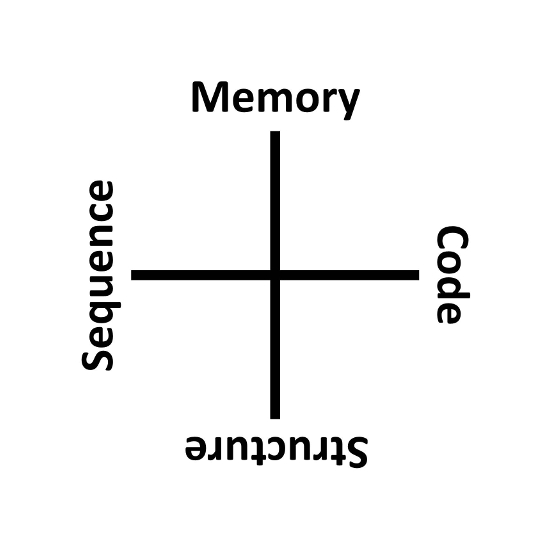
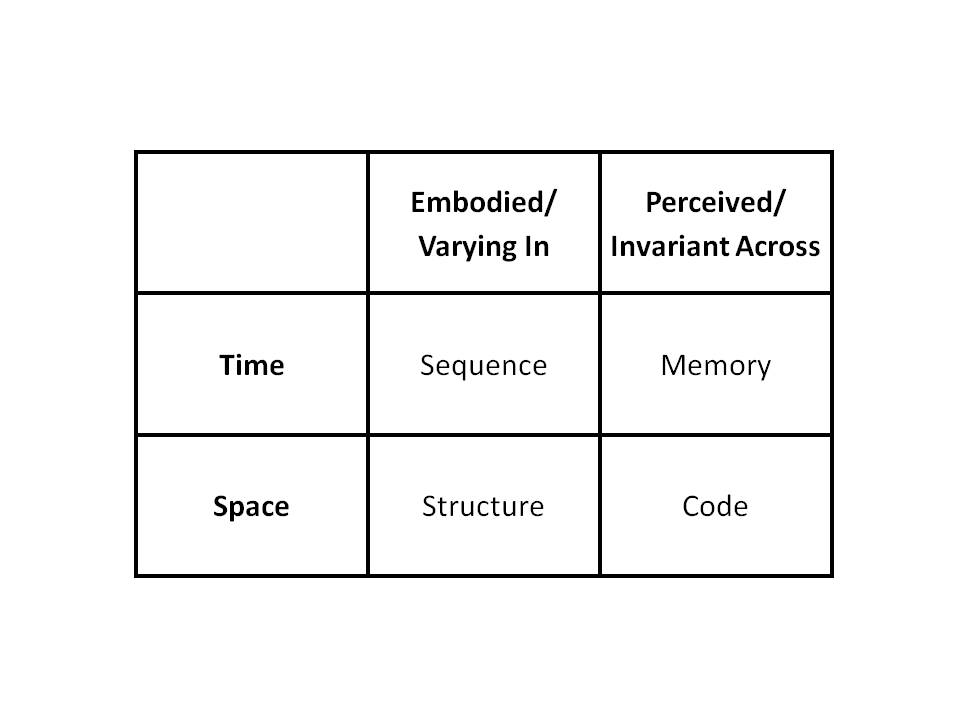
A digital universe – whether 5 kilobytes or the entire Internet – consists of two species of bits: differences in space, and differences in time. Digital computers translate between these two forms of information – structure and sequence – according to definite rules. Bits that are embodied as structure (varying in space, invariant across time) we perceive as memory, and bits that are embodied as sequence (varying in time, invariant across space) we perceive as code. Gates are the intersections where bits span both worlds at the moments of transition from one instant to the next.

— George Dyson, from Turing’s Cathedral

Further Reading:

George Dyson / Turing’s Cathedral: the origins of the digital universe

[*7.82, *7.83, *7.153]

<>

Systems Dynamics

Another interesting fourfold that I discovered while reading mathematical physicist John C. Baez’s blogs Azimuth and This Week’s Finds in Mathematical Physics concerns the notions of system dynamics and bond graphs. These concepts generalize the fourfold of the basic electronic components into other types of physical systems, such as mechanics, hydraulics, and to some extent even thermodynamics and chemistry.

The types of systems that can be modeled by system dynamics are described by two variables that vary functionally over time and their corresponding integrals. These four functions can be thought of as flow and effort and their respective integrals displacement and momentum.

  Displace-
ment
Flow Momentum Effort
Mechanics of translation Position Velocity Momentum Force
Mechanics of rotation Angle Angular velocity Angular momentum Torque
Electronics Charge Current Flux Voltage
Hydraulics Volume Flow Pressure momentum Pressure
Thermo-dynamics Entropy Entropy flow Temperature momentum Temperature
Chemistry Moles Molar flow Chemical momentum Chemical potential


Further Reading:

http://johncarlosbaez.wordpress.com/2012/02/02/quantizing-electrical-circuits/

http://math.ucr.edu/home/baez/week288.html

http://math.ucr.edu/home/baez/week292.html

http://ncatlab.org/johnbaez/show/Diagrams

http://magisciences.tuxfamily.org/BondGraph/co/03%20Passive%20elements.html

Dean C. Karnopp, Donald L. Margolis, Ronald C. Rosenberg / System Dynamics: modeling and simulation of mechatronic systems

[*7.60, *7.61]

<>