Category Archives: Science

Ohm’s Law

Charts for the equations of Ohm’s Law usually consist of the fourfold relation between Voltage (Volts), Current (Amps), Resistance (Ohms), and Power (Watts). For each electrical quantity, there are three equations that represent it in terms of two others, making twelve equations total.

Ohm’s Law is really only between voltage, current, and resistance. Apparently, power is more correctly introduced by the formula for “Joule heating”.

Both voltage and current have been in two fourfolds previously (Four Basic Electrical Components and System Dynamics) but not power and resistance. Well, resistance did make an appearance as a relation between current and voltage.

The twelve equations can be generated by the following identities (where E = voltage, I = current, R = resistance, and P = power):

I*R/E = P/(I*E) = P*R/E^2 = R*I^2/P = 1

http://en.wikipedia.org/wiki/Ohm%27s_law

http://en.wikipedia.org/wiki/Joule%27s_first_law

Google search for images for Ohm’s Law.

[*8.4, *8.5, *8.8, *8.9, *8.10]

<>


States of Matter

The four most familiar states of matter are solid, liquid, gas, and plasma. Other states exist (such as Bose-Einstein condensates), but if I talk about them I couldn’t put them into a nice fourfold.

Note that the sequence of plasma, gas, liquid, and solid is arranged in the order of highest to lowest temperature (usually). Compare this to the classical Four Elements of Empedocles (Fire, Air, Water, and Earth) and to the made-up fourfold of Bright-to-Dark, based on light.

http://en.wikipedia.org/wiki/State_of_matter

http://www.chem4kids.com/files/matter_states.html

http://gizmodo.com/there-are-way-more-than-three-states-of-matter-1182677930

<>


Human Limitations

 Everything existing in the universe is the fruit of chance and necessity.

Democritus

What are humans limited by? We are limited by time and by space.

We are limited in time because we are mortal beings, bound to the past by our birth and to the future by our death, delimiting the short interval of our lifetimes.

We are limited in space because we are finite beings. At each point of time we are constrained by what we are and what we might become. We are bound both by our actuality and our possibility. Our nature defines our actuality and our nurture sets our possibility.

Certainly, we can transcend our limitations, but this just means they weren’t really the true limits after all. We can’t say for certain what our real limits are, so that’s a good thing.

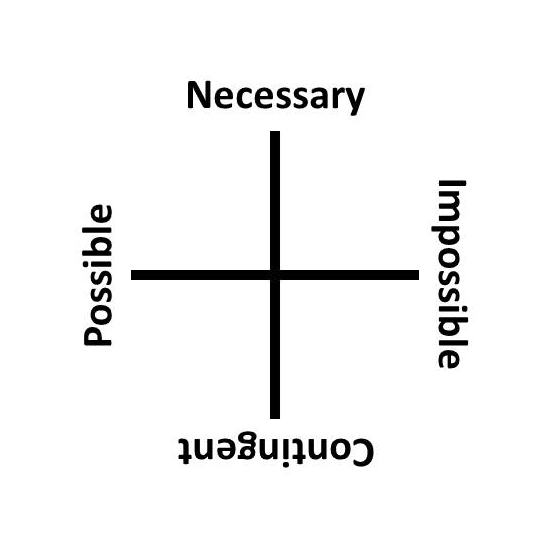
This fourfold also reminds me of the following modal square of opposition. At birth, much is possible. At death, all becomes impossible. Nurture is contingent and Nature is necessary.

References:

http://plato.stanford.edu/entries/logic-deontic/

http://en.wikipedia.org/wiki/Chance_and_Necessity

[*7.174]

<>


Light and Dark: Matter and Energy

What are dark matter and dark energy? We do not know; we just know of them by their effects.

Dark matter is thought to be present in halos around galaxies since the estimated amount of matter is too small to keep the galaxies rotating at their measured rate. Dark energy is thought to be present in the empty spaces between galaxies pushing them apart because the velocities separating them are actually increasing instead of slowing down. Nobody knows what dark matter and dark energy really are, but new theories are often being suggested. Perhaps one of these theories will be tested soon and we will have a better idea of what these mysterious materials and forces are.

Could it be that dark matter and dark energy are linked by an equation, like normal “light” matter and “light” energy? For ordinary matter and energy, which are really two aspects of the same thing, it is Einstein’s famous equation: E= m*c^2. But since we have no idea what the dark stuff is, we can only conjecture.

Why should we care what these things are that are so difficult to characterize? In any scientific investigation, if we have gaps and inconsistencies in our knowledge and our theories it just bothers us to no end. We’re just not happy until we figure out the puzzle. In this case, the universe is almost completely made up of these dark parts, so it seems pretty important.

Unfortunately in my diagram the horizontal axis is light energy-dark energy, which is separating, and the vertical axis is dark matter-light matter, which is combining. In many of my fourfolds the horizontal axis is combining or conjunctive and the vertical axis is separating or disjunctive. Is the energy-matter dual more important than the conjunctive-disjunctive dual? Perhaps this fourfold doesn’t really fit but I like it anyway.

Further Reading:

http://en.wikipedia.org/wiki/Dark_matter

http://en.wikipedia.org/wiki/Dark_energy

http://science.nasa.gov/astrophysics/focus-areas/what-is-dark-energy/

Eric Chaisson / Epic of Evolution

<>


The Four Laws of Thermodynamics

0th Law: Heat doesn’t flow between objects of the same temperature.

1st Law: Heat cannot be created or destroyed.

2nd Law: Entropy increases by the flow of heat in a closed system not in equilibrium.

3rd Law: Entropy approaches a constant minimum in a system as temperature approaches absolute zero.

Further Reading:

http://www.physicsforidiots.com/thermodynamics.html

http://en.wikipedia.org/wiki/Laws_of_thermodynamics

Peter Atkins / Four Laws That Drive the Universe

[*3.169, *7.164]

<>


The Duality of Time and Information, V2

The states of a computing system bear information and change time, while its events bear time and change information.

from The Duality of Time and Information by Vaughan Pratt

The most promising transformational logic seems to us to be Girard’s linear logic.

— from Rational Mechanics and Natural Mathematics by Vaughan Pratt

Here we have three duals: information – time, state – event, and bear – change.

References:

Vaughan Pratt / The Duality of Time and Information http://boole.stanford.edu/pub/dti.pdf

Vaughan Pratt / Time and Information in Sequential and Concurrent Computation http://boole.stanford.edu/pub/tppp.pdf

Vaughan Pratt / Rational Mechanics and Natural Mathematics http://chu.stanford.edu/guide.html#ratmech

[*5.170]

<>

The Space-Time Tetrahedron

In honor of April Fool’s Day, I present the Space-Time Tetrahedron.

The Internet is full of crackpot and nutty websites, and one of the most famous concerns the so-called Time Cube.

Since the ideas expressed on this website are pretty much ignored, it is hoped that it could at least find some recognition as being slightly crackpot or somewhat nutty.

Let’s examine the similarities between Time Cube theory and my theory.

The number four is very important in each. In fact, the Time Cube is a fourfold, although quite a puzzling one.

The notions of space and time are crucial to Time Cube; many of my fourfolds involve some aspect of space and time or spacetime.

How about the differences? I don’t think one can find any common claims between the two theories. At least I hope not!

References:

http://en.wikipedia.org/wiki/Time_Cube

http://knowyourmeme.com/memes/the-time-cube

[*7.150]

<>

Equivalent Exchange

There is an old riddle that asks, what is the value of a human body? It goes on to enumerate the quantities of the various chemicals that constitute an average body, and then price those chemicals to come up with a total material value. This might come as a shock to the one who tried to answer the riddle, because the value is so low.

Of course that analysis ignores the real value of the body because it ignores the spatial arrangement of those chemicals in the various tissues and organs of the body. It ignores the form of the body as an hierarchical arrangement of structured parts. These parts are very valuable for someone needing an organ donation, for example.

This static analysis is lacking as well because it neglects the dynamic actions that a body can perform. Taken as a set of discrete individual acts, this is like considering the individual chemicals that constitute a body. One can enumerate the acts too, as in counting the number of breaths or the number of heart beats over a lifetime.

But we are still not finished, because this enumeration of actions also overlooks the functions that a body can perform, as arrangements of actions in time. These functions are the most important value of a body because they include but are not limited to being alive, thinking, and feeling.

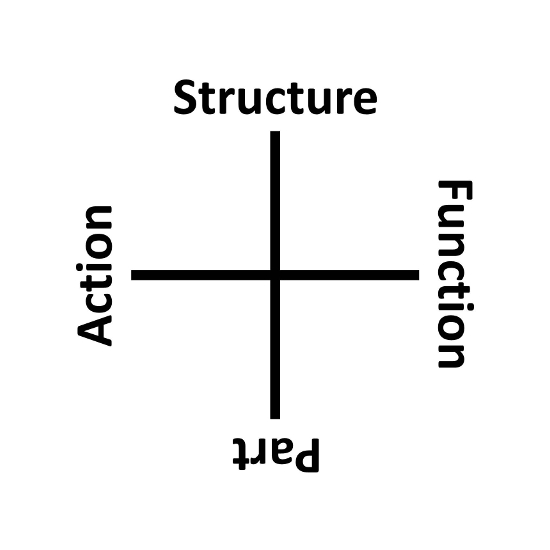
So it seems to me that there is a heirarchy here, that goes from parts to structure to actions to function, with parts being at the lowest level and function being at the highest. Each level of the hierarchy is dependent on the level below, but the nature of a level is fundamentally different from the level below it, as well as the level above it. Please see my previous post Structure-Function.

The term “equivalent exchange” comes from an alchemy-centric anime, where through a process called “human transmutation” it is attempted to recreate a body starting from a pile of the basic chemicals that constitute it. Even with some high-powered magic, the attempt fails due to the fact that much more is required to fashion a body or even a living, breathing person.

Further Reading:

http://chemistry.about.com/b/2011/02/06/how-much-are-the-elements-in-your-body-worth.htm

http://www.datagenetics.com/blog/april12011/index.html

https://briankoberlein.com/post/four-elements/

<>

Schrödinger’s Cat

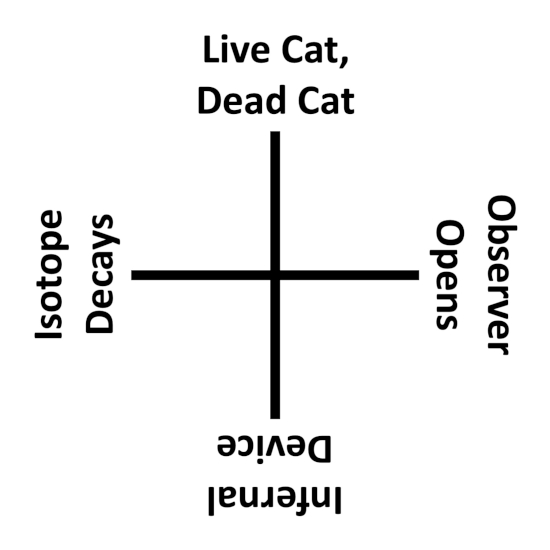
Now let’s look at another thought experiment, that of Schrödinger’s Cat. This thought experiment is supposed to confound the micro and macro worlds of quantum physics and ordinary, human-size physics. A cruel device is built consisting of a closed box which contains a sample of radioactive material, a mechanism to release poison into the box if an atom of the radioactive material decays, a living cat, and a door that must be opened to reveal the condition of the cat to an external observer.

The story of the experiment goes that if the observer waits to open the box until there is a 50% probability that an atom decays, the state of the cat (hidden in the unopened box) to the observer will be both alive and dead. The cat’s so-called wave-function will be a superposition of the wave-function of a live cat and that of a dead cat, which will collapse into one or the other only by the opening of the door and the observation of the actual condition of the cat. This is called the Copenhagen Interpretation.

Some say that the detector of the poison release mechanism will be the true observer in this experiment, and before the external observer opens the door the cat will be definitely alive or dead because of the action of the mechanism. This might be considered the objective collapse theory. Others say that the world splits in two between a world where the cat is alive and one where the cat is dead. This is called a many-worlds interpretation.

There seems to me a similarity between Maxwell’s Demon and Schrödinger’s Cat. The fourfold elements of the experiment are shown above, but now consider these elements in a system in terms of Aristotles’s Four Causes. The material causes are the discreet constituents of the experiment, everything from box to atoms to cat to observer. The efficient cause is the decay or non-decay of a radioactive atom. The final cause is action of the observer in opening the box. The formal cause is the poor cat in its ambiguous state, simultaneously both dead or alive.

It doesn’t make too much common sense to say that the opening of the box and the observing of the cat “causes” the atom to have really decayed or not, and so concretize the past and the cat into a certain way of being, but that is mostly what the Copenhagen Interpretation is saying. Indeed, Linear Logic, which has been described many times on this blog, has been used to describe aspects of quantum physics for decades.

References:

http://en.wikipedia.org/wiki/Schr%C3%B6dinger%27s_Cat

http://en.wikipedia.org/wiki/Copenhagen_interpretation

[*7.138]

<>

Maxwell’s Demon

I am currently reading Tor Norretranders “The User Illusion”, and he opens the book with chapters on information theory and thermodynamics. His description of the thought experiment “Maxwell’s Demon” made me realize that this system has all the ingredients of a fourfold: the two chambers, the demon, the door between the two chambers that the demon operates, and the molecules that the demon allows to or prevents from passing through the door from one chamber to another. The only way between the two chambers is through the door. The molecules are in a gaseous state, with a distribution of velocities, so some are moving faster than others.

The major physical action that the demon can perform is to open or close the door. If the demon did this randomly, it would accomplish nothing, and the system would ultimately evolve the same as one without door or demon. Instead the demon is able to open and close the door so as to allow faster molecules to collect in one chamber and slower molecules to collect in the other. The demon doesn’t touch the molecules, but he is somehow able to tell whether a molecule is fast or slow so he can decide whether to open or close the door.

The purpose of the thought experiment is to suggest that this system could violate the second law of thermodynamics by increasing order. By letting faster molecules move to one chamber, the system would then be able to do work by, for example, powering an engine. Perhaps the temperature differential is also able to power the demon itself. We would then have a perpetual motion machine, one that could give us unlimited energy, as long as there was a surplus of energy after the needs of the demon.

However, the modern analysis of the thought experiment shows that entropy does indeed increase within this system because the demon would eventually have to forget information about the molecules, and his forgetting would increase entropy. The demon would have to be an irreversible process.

References:

http://en.wikipedia.org/wiki/Maxwell%27s_demon

Tor Norretranders / The User Illusion: Cutting Consciousness Down to Size

[*7.130]

<>