Category Archives: Science

Systems Dynamics

Another interesting fourfold that I discovered while reading mathematical physicist John C. Baez’s blogs Azimuth and This Week’s Finds in Mathematical Physics concerns the notions of system dynamics and bond graphs. These concepts generalize the fourfold of the basic electronic components into other types of physical systems, such as mechanics, hydraulics, and to some extent even thermodynamics and chemistry.

The types of systems that can be modeled by system dynamics are described by two variables that vary functionally over time and their corresponding integrals. These four functions can be thought of as flow and effort and their respective integrals displacement and momentum.

  Displace-
ment
Flow Momentum Effort
Mechanics of translation Position Velocity Momentum Force
Mechanics of rotation Angle Angular velocity Angular momentum Torque
Electronics Charge Current Flux Voltage
Hydraulics Volume Flow Pressure momentum Pressure
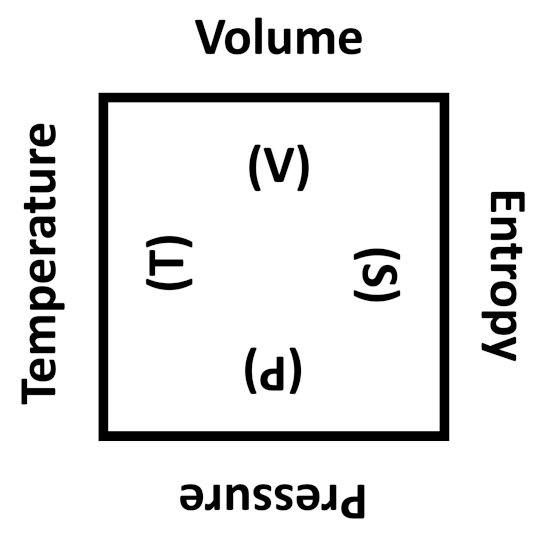
Thermo-dynamics Entropy Entropy flow Temperature momentum Temperature
Chemistry Moles Molar flow Chemical momentum Chemical potential


Further Reading:

http://johncarlosbaez.wordpress.com/2012/02/02/quantizing-electrical-circuits/

http://math.ucr.edu/home/baez/week288.html

http://math.ucr.edu/home/baez/week292.html

http://ncatlab.org/johnbaez/show/Diagrams

http://magisciences.tuxfamily.org/BondGraph/co/03%20Passive%20elements.html

Dean C. Karnopp, Donald L. Margolis, Ronald C. Rosenberg / System Dynamics: modeling and simulation of mechatronic systems

[*7.60, *7.61]

<>

The Four Fundamental Forces of Physics

References:

http://en.wikipedia.org/wiki/Fundamental_interaction

http://www.the-electric-universe.info/welcome.html

http://hyperphysics.phy-astr.gsu.edu/hbase/forces/funfor.html

http://www.pbs.org/wgbh/nova/teachers/activities/3012_elegant_09.html

[*7.52]

<>

Thermodynamics and the Four Thermodynamic Potentials

References:

http://johncarlosbaez.wordpress.com/2012/01/23/classical-mechanics-versus-thermodynamics-part-2/

http://en.wikipedia.org/wiki/Thermodynamic_potential

http://en.wikipedia.org/wiki/Maxwell_relations

http://hyperphysics.phy-astr.gsu.edu/hbase/thermo/thepot.html

[*7.80]

<>

The Scientific Method

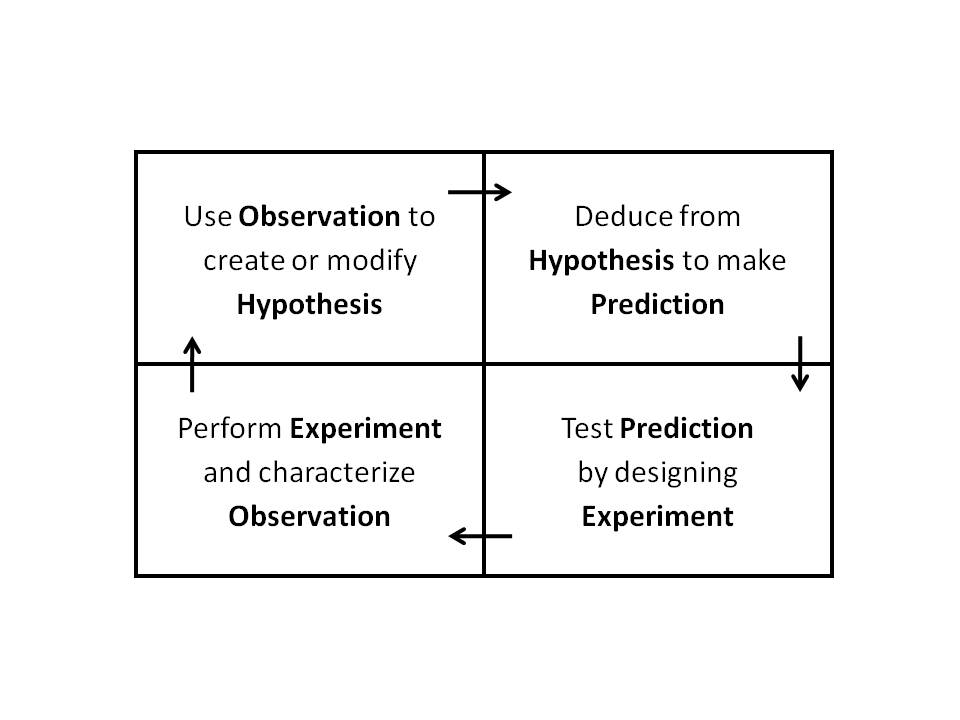
The Scientific Method (SM) is often shown as a cycle of four steps: Observation, Hypothesis, Prediction, and Experiment. This cycle is somewhat similar to Kolb’s Learning Cycle, but there are important differences. Experiment is in both, but in Kolb Experience is the result of Experiment, and in the SM, Experiment follows Prediction. I think that Prediction would ideally be a part of both, and in the SM, Experience could be included in Observation.  Perhaps Kolb’s Active Experimentation is really SM’s Prediction and Kolb’s Experience is SM’s Experiment.

References:

http://en.wikipedia.org/wiki/Scientific_method

[*6.24, *7.26]

<>

Spacetime

What is space? Is space merely extension? What makes up extension, but a set of locations?

What is time? Is time merely duration? What makes up duration, but a series of successions?

Is space a void for things to be located in, or do things create the space between them?

Is time a continuance for events to happen in, or do events create the time that joins them?

Does space and time exist objectively, or only subjectively? Are they absolute or are they relative?

Does space and time enframe all that exists? Does anything exist outside of space or time? How could we know if it did?

What is spacetime? Is it space plus time, disjoint, or is it a reciprocal enfolding of space and time, so that neither can exist without the other?

[*7.4]

<>

The Four Conic Sections

To teach superstitions as truth is a most terrible thing.

– Hypatia of Alexandria

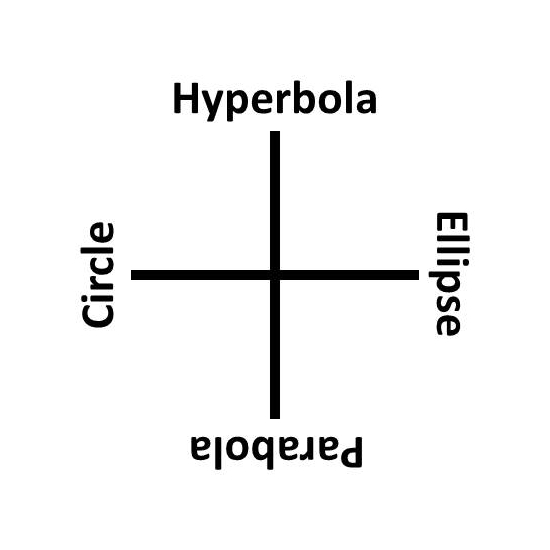
In mathematics, the four conic sections are the different shapes that can be formed by the intersection of a three dimensional right double cone and a plane: the circle, the ellipse, the parabola, and the hyperbola. The conics have been studied since the dawn of Greek mathematics. These shapes have interest as pure mathematical constructions, as well as many practical uses in applied mathematics.

Special points (focus or foci, plural) and lines (directrix or directrices, plural) can also be used to generate the conic sections in analytic geometry. A circle or parabola has one focus; the ellipse or hyperbola has two. The circle is a special case of the ellipse, one whose two foci coincide at a unique center, and in a different sense, the parabola can also be considered as a special case of the ellipse, having one of its foci at infinity. All circles can be transformed into each other by uniform scaling, a property shared by all parabolas. Thus the circle can be considered to be a singular shape, as well as the parabola. In contrast, ellipses and hyperbolas have a multitude of shapes and cannot be transformed into others of the same kind by uniform scaling. However, a nonuniform scaling or affine transformation can be used to achieve this goal. In even more abstract projective geometry, one could consider that all the conics are the same.

If the double cone is considered as the so-called light cone in Minkowski Space-time, many interesting concepts in special relativity can be considered. In this simplified model, space has two dimensions and time has one. The light cone divides all of space-time into four parts: the past, the present, the future, and the rest. The observer is located in time and space at the common apex of the two cones. Light travels on the surface of the cones, in straight lines towards and away from the observer. Anything traveling strictly within the space-time of a cone must necessarily be traveling slower than the speed of light. One cone can be thought of as the past: the interior of which contains all space-time that could have been observed by the observer, bounded by the circles of light traveling towards her. The second cone can be thought of as the future: the interior of which contains all space-time that could possibly be observed by the observer, bounded by the circles of other observers observing her light. Everything outside of the light cone cannot be observed or influenced by the observer at that instant, since light from it would have to travel faster than the speed of light in order to be seen or acted on by the observer.

Letting my analogical thinking run rampant, I can think of several associations with other fourfolds presented here. The circle is the shape of perfection, of identity and wholeness. It has one center or focus. In Minkowski Space-time, it is formed by the plane cutting the light cone at a constant time, so that all light arrives at the observer simultaneously from the past. Thus it is the shape of the knower or perspective. The parabola has the shape of gravity, the arc of an object thrown from and falling towards the earth. The shape reminds me of a reality that flies up from the opaque depths of the knowable only to fall away again. Numbers that are perfect squares may have started ancient mathematicians thinking about arithmetic. The ellipse has the shape of cosmology. Once astronomers could consider orbits of planets not to be circles or epicycles, only then science changed from idealism to empiricism. The hyperbola’s asymptotes form the crossed lines of my ever-present double duals, dividing yet unifying, as well as the profile of Minkowski Space-time. In fact, space and time occur over and over in many of the fourfolds I have considered.

Circles and ellipses could be considered the shapes of time, subjectivity, conjunction, and content: closed, finite, and bounded, yet cyclic. Parabolas and hyperbolas could be considered the shapes of space, objectivity, disjunction, and expression: open, infinite, and unbounded, acyclic.

In the recent movie Agora, the main character is Hypatia, the daughter of the last librarian of the great Library of Alexandria. A mathematician, astronomer, and philosopher, only fragments of Hypatia’s writings are available to us today. After the sack of the library, Hypatia is shown in her new study with a beautiful wooden model of the conics that she saved from destruction. For any that love wisdom over superstition, the movie is heartbreaking. As an echo to the loss of the contents of the library, it is offered (without any proof) that she considered the truth of the Heliocentric model of the solar system with the planets moving in elliptical orbits. Her senseless murder meant her insights were destroyed without legacy, falling away into the gravity of the dark unknown. Fortunately, even if she had, Copernicus and Kepler rediscovered these insights well over a thousand years later and brought them to light. The library’s loss will never be recovered.

References:

http://en.wikipedia.org/wiki/Conic_section

http://www.npr.org/blogs/13.7/2011/07/11/137743796/agora-most-intelligent-movie-on-science-and-religion-ever?ft=1&f=114424647

http://babelniche.wordpress.com/2010/09/28/more-on-agora-and-hypatia/

http://www.skepticforum.com/viewtopic.php?f=85&t=14979

[*6.170, *6.172]

<>

The Medieval Quadrivium

As Proclus wrote:  The Pythagoreans considered all mathematical science to be divided into four parts: one half they marked off as concerned with quantity, the other half with magnitude; and each of these they posited as twofold. A quantity can be considered in regard to its character by itself or in its relation to another quantity, magnitudes as either stationary or in motion. Arithmetic, then, studies quantities as such, music the relations between quantities, geometry magnitude at rest, spherics [astronomy] magnitude inherently moving.

Thus arithmetic is number in itself, music is number in time, geometry is number in space, and cosmology is number in space and time.

References:

http://en.wikipedia.org/wiki/Quadrivium

http://quadriformisratio.wordpress.com/2013/07/01/the-curriculum-in-ancient-times/

[*6.66, *7.40]

<>

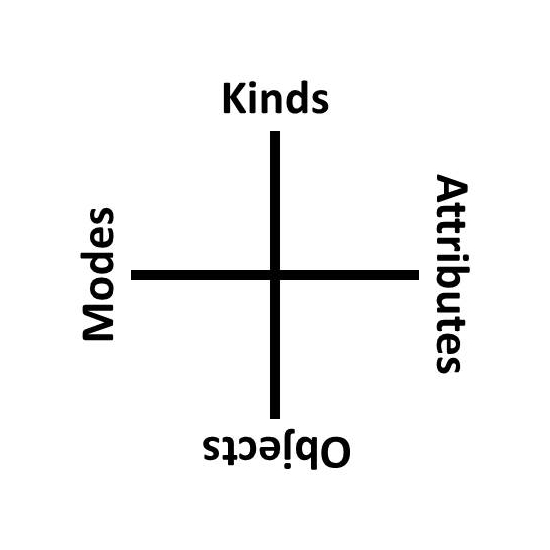
E. J. Lowe’s Four Category Ontology

References:

E. J. Lowe / The Four-Category Ontology: a metaphysical foundation for natural science

http://en.wikipedia.org/wiki/E.J._Lowe

https://ndpr.nd.edu/reviews/the-four-category-ontology-a-metaphysical-foundation-for-natural-science/

Lowe, Edward Jonathan

http://www.informationphilosopher.com/solutions/philosophers/lowe/

[*4.94, *6.98]

<>

The Four Basic Electronic Components

A fourfold has recently been in the news. The physical realization of the memristor completes the four basic electronic components, along with the resistor, capacitor, and inductor. Theorized to exist since 1971, the memristor may revolutionize computational devices.

References:

http://en.wikipedia.org/wiki/Memristor

[*6.126-*6.128]

<>

A Story for Everyone

Wouldn’t it be nice if everyone had a common story we could all learn and share? A story about who we are, what we are, and maybe even a little about the how and the why. Could it be told in such a way that each of us could accept it as our very own? A film and companion book coming out soon will attempt just that, titled Journey of the Universe.

Previous books by Loyal Rue and Brian Swimme have tried to achieve this ideal. Swimme is involved in this new movie, and is the narrator. Rue’s book is a personal favorite. Astrophysicist Eric J. Chaisson has written many books on this topic. Their common theme is evolution, expanded from the biological to encompass the cosmos. Cosmic evolution, if you will.

Evolution merely means change over time, i.e. transformation. Most people agree that things have changed over time, but many disagree on how much, how long, and how come. How can we decide what information to accept, and what to reject? The great unifier of human knowledge is science, yet science is often disparaged even while making the modern world possible. Partially, I’m sure, for that very reason.

Different cultures have had their own creation stories since the very beginning of humanity. Many have said that a large part of being human is the impulse to tell and the need to hear stories. All narratives are built from atomic parts that answer questions: who, what, how, and why. Or, to cast them into modal verbs: may, can, must, and should. Who may? Intention or agency: the characters. What can? Chance or contingency: the setting. How must? Structure or necessity: the plot. Why should? Obligation or responsibility: the theme.

Would a story simplistic enough for everyone to accept be so dilute as to be worthless? All life as we know it requires water, and pure water is ultimately ‘diluted’. But water is certainly not worthless. Daniel Dennett calls the concept of evolution the ‘universal acid’, an alchemical alkahest. Can we replace the corrosive acid in his metaphor with sustaining and nurturing water?

http://www.npr.org/blogs/13.7/2011/03/31/135008214/journey-of-the-universe-the-challenge-of-telling-everybodys-story

http://www.journeyoftheuniverse.org/

Loyal Rue / Everybody’s Story: Wising Up to the Epic of Evolution

Brian Swimme / The Universe Story: From the Primordial Flaring Forth to the Ecozoic Era–A Celebration of the Unfolding of the Cosmos

Daniel Dennett / Darwin’s Dangerous Idea: evolution and the meaning of life

Eric J. Chaisson / Epic of Evolution: seven ages of the cosmos

Marjolein Groefsema / Can, May, Must and Should: A Relevance Theoretic Account, in Journal of Linguistics, Vol. 31, No. 1 (Mar., 1995), pp. 53-79

<>