Category Archives: Philosophy

Bending the Elements

You and your forefathers have devastated the balance of this world. And now, you shall pay the ultimate price!

— From Avatar: the Last Airbender

I recently finished watching the animated series “Avatar: the Last Airbender”. I know I’m a bit late with my praise, but I thought this was an excellent series. It had fascinating world-building, well thought-out plotting, and believable characterization. It had humor, drama, fantasy, even teen romance. Something for all ages!

It could be because I’ve been thinking alot about the Four Elements and how I view them as analogies for the four relations I’ve been discussing for some time on this blog. In Avatar, they are literally the four elements of the world: fire, earth, water, and air. But in addition, these elements correspond to the four peoples of this world. The people of the Fire Nation are willful, the people of the Earth Kingdom are resolute, the people of the Water Tribe are empathic, and the people of the Air Nomads are reflective. Some individuals are able to “bend” the element that is associated with the people they are born into, so that for example a member of the Fire Nation might be able to produce and control fire with thought and gesture. Not everyone has this ability, however.

The Avatar is a continuously reincarnated individual that embodies the spirit of the world. He or she is born into each of the four peoples in a repeating cycle, but the Avatar is also the only individual that can learn to bend all four elements, and even all at the same time. Because of his or her unique powers, the Avatar is known to be able to bring and restore balance to the world, and to tie the real world to another, spiritual world. Avatar: the Last Airbender is the story of Aang, a descendent of the Air Nomads, but the last of his people due to genocide. He has been in a state of suspended animation for the last 100 years and awakes to a troubled world of war and turmoil. Can Aang save his world?

Hopefully I’m not spoiling anything in saying that he does. Indeed a sequel is currently being produced called “The Legend of Korra” that is planned to run 52 episodes. This sequel takes place a number of years after the end of Avatar, and the next Avatar after Aang is Korra from the Southern Water Tribe. The world is now somewhat more advanced technologically than it was during Aang’s time, and although not at war because it is still enjoying the peace that Aang initiated, there is still some strife and unrest for Korra to eventually bring the Avatar’s balance to. I am enjoying it also!

http://en.wikipedia.org/wiki/Avatar:_The_Last_Airbender

http://en.wikipedia.org/wiki/The_Legend_of_Korra

Note:

It is interesting to note that fire is the only element that can be generated by the will ex nihilo. With enough skill, water can be extracted from living matter and the air. Of course, air is ever present and earth is seldom far away.

<>
Structure-Function

Aristotle’s Four Causes is an important fourfold that seems to be the basis for many of the fourfolds, both original and not, presented in this blog. Two of the causes, efficient and material, are acceptable to modern scientific inquiry because they can be thought of as motion and matter, respectively, but the other two causes, formal and final, are not. Why is that?

The formal cause is problematic because the formal is usually considered to be an abstract concept, a construction of universals that may only exist in the human mind. The final cause is also problematic because it is associated with the concept of telos or purpose. There, too, only human or cognitive agents are allowed to have goals or ends. So for two causes, efficient and material, all things may participate in them, but for the two remaining, formal and final, only agents with minds may.

These problems may be due to the pervasive influence of what the recent philosophical movement of Object Oriented Philosophy calls correlationism: ontology or the existence of things is limited to human knowledge of them, or epistemology. The Four Causes as usually described becomes restricted to the human creation and purpose of things. Heidegger’s Tool Analysis or Fourfold, which also appears to have been derived from the Four Causes, is usually explained in terms of the human use of human made things: bridges, hammers, pitchers. Even scientific knowledge is claimed to be just human knowledge, because only humans participate in the making of this knowledge as well as its usage.

Graham Harman, one of the founders of Speculative Realism of which his Object Oriented Ontology is a result, has transformed Heidegger’s Fourfold so that it operates for all things, and so the correlationism that restricts ontology to human knowledge becomes a relationism that informs the ontology for all things. Instead of this limiting our knowledge even more, it is surprising what can be said about the relations between all things when every thing’s access is as limited as human access. However, this transformation is into the realm of the phenomenological, which is not easily accessible to rational inquiry.

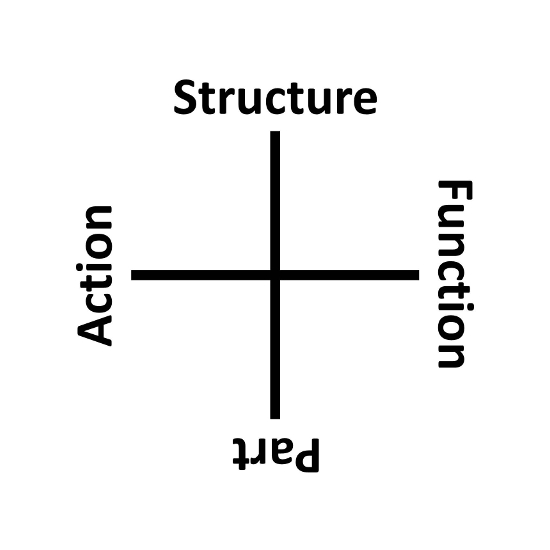
I wish to update the Four Causes, and claim that they can be recast into a completely naturalistic fourfold operating for all things. This new version was inspired by the Four Operators of Linear Logic. Structure and function are commonplace terms in scientific discourse, and I wish to replace formal and final causes with them. It may be argued that what is obtained can no longer be properly called the Four Causes, and that may indeed be correct.

First, let us rename the efficient cause to be action, but not simply a motion that something can perform. I’m not concerned at the moment with whether the action is intentional or random, but it must not be wholly deterministic. Thus there are at least two alternatives to an action. I’m also not determining whether one alternative is better than the other, so there is no normative judgement. An action is such that something could have done something differently in the same situation. This is usually called external choice in Linear Logic (although it makes more sense to me to call it internal choice: please see silly link below).

Second, let us call the material cause part, but not simply a piece of something. Instead of the material or substance that something is composed of, let us first consider the parts that constitute it. However, a part is not merely a piece that can be removed. A part is such that something different could be substituted for it in the same structure, but not by one’s choice. Like an action, I am not concerned whether one of the alternatives is better than the other, but only that the thing is still the thing regardless of the alternative. This is usually called internal choice.

Next, we will relabel the formal cause to be structure, but not simply the structure of the thing under consideration. Ordinarily structure is not a mere list of parts, or a set of parts, or even a sum or integral of parts, but an ordered assembly of parts that shapes a form. Ideally structure is an arrangement of parts in space. However, in this conceptualization, structure will be only an unordered list of parts with duplications allowed.

Last, instead of final cause we will say function, but not simply the function of the thing as determined by humans. Ordinarily function is not a mere list of actions, or a set of actions, or a sum or integral of actions, but an ordered aggregate of actions that enables a functionality. Ideally function is an arrangement of actions in time. However, like structure, function will be only an unordered list of actions with duplications allowed.

As we transform the Four Causes from made things to all things, both natural and human-made, we will later examine how that changes them.

References:

http://en.wikipedia.org/wiki/Speculative_realism

http://en.wikipedia.org/wiki/Object-oriented_ontology

http://en.wikipedia.org/wiki/Graham_Harman

http://wiki.cmukgb.org/index.php/Internal_and_External_Choice

[*6.144, *7.32, *7.97]

<>


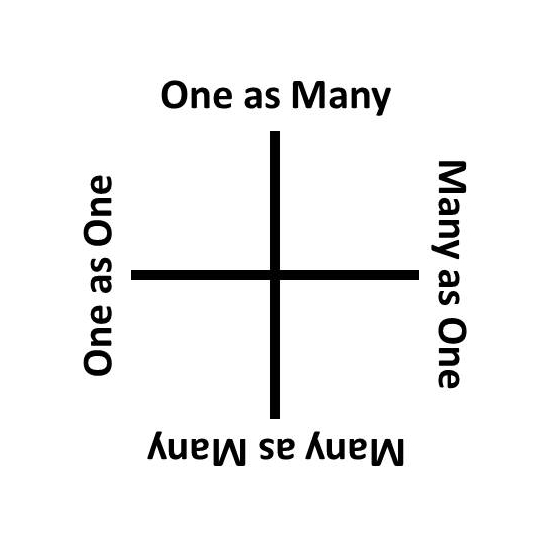
The One and the Many

A set is a Many that allows itself to be thought of as a One.

— Georg Cantor

How to solve the ancient problem of the one and the many?

Is the one just one, and the many merely many? Or can the one contain the many, and the many reveal the one?

Many fourfolds have been shown here. Are they different aspects of  one, greater fourfold?

Or are they completely separate, incomparable and  incommensurate, except for their common cardinality?

http://plato.stanford.edu/entries/problem-of-many/

[*4.84]

<>

Kant’s Reflective Perspectives on Experience

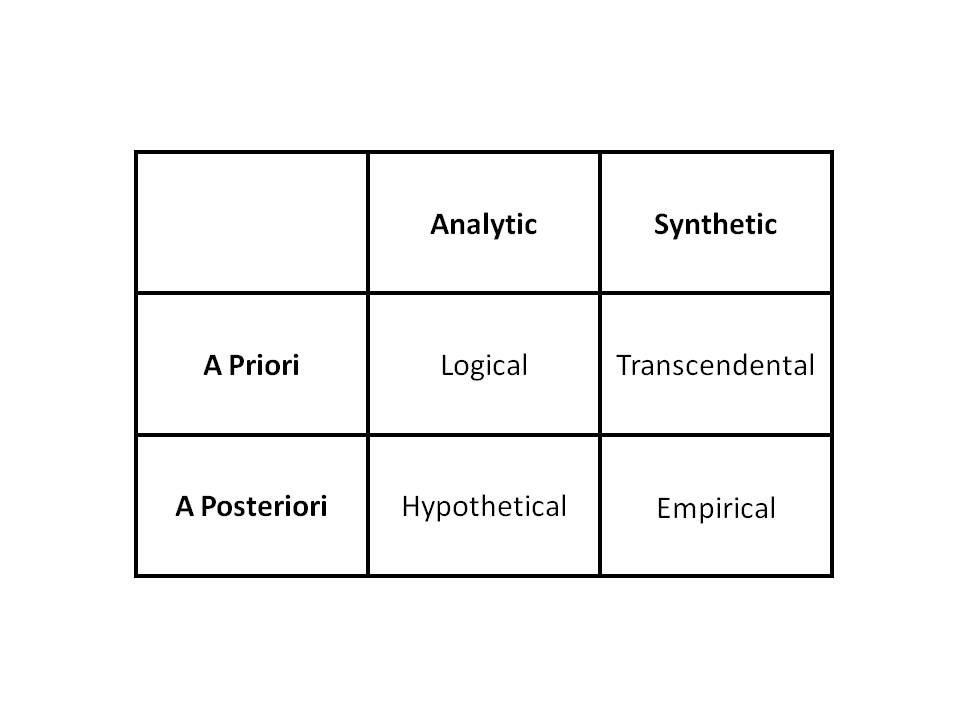
The web site of Stephen R. Palmquist has a great wealth of material on fourfolds in relation to Kant’s as well as his own philosophy. From my own initial reading of his extensive material I have tried to choose a canonical Kantian fourfold which has the most relevance to my project.

The fourfold shown above Dr. Palmquist calls Kant’s “reflective perspectives on experience”. Consisting of the logical, the empirical, the transcendental, and the hypothetical, these facets bear a close analogical likeness to many of the fourfolds presented here.

Logical: Analytic a priori
Transcendental: Synthetic a priori
Hypothetical: Analytic a posteriori
Empirical: Synthetic a posteriori

Dr. Palmquist also has many of his own books available on his web site for the interested reader. I will certainly be returning to his web site in the future for much enjoyable study.

References:

http://www.hkbu.edu.hk/~ppp/

http://www.hkbu.edu.hk/~ppp/ksp2/KCR3.htm

[*7.68, *7.84]

<>

J.-Y. Girard’s Transcendental Syntax

With the recent release of the paper found at the link below, logician Jean-Yves Girard has updated his program for a transcendental syntax to version 2.0. The first version was available last year only in French, but this new manuscript is available in English. Girard is known for his refinement of classical and intuitionistic logic, Linear Logic, and his exploration into the mechanisms of logic, Ludics.

In this new paper, Girard describes four levels of semantics, his infernos: alethic, functional, interactive, and deontic. They descend into the depths of meaning, and thus are numbered from -1 to -4. The negatively first, alethic, is the layer of truth or models. The negatively second, functional, is the layer of functions or categories. The negatively third, interaction, is the layer of games or game semantics. The negatively fourth, deontic, is the layer of normativity or formatting.

Further Reading:

https://girard.perso.math.cnrs.fr/Archives.html

[*7.34]

<>

Philippe Descola’s Four Ontologies

References:

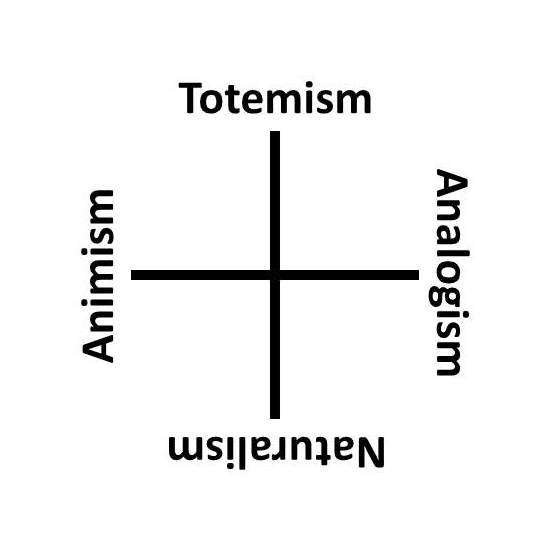
Philippe Descola / Par-delà nature et culture

Structuralist Diagram of Philippe Descola’s Lecture, “Anthropology and Ontology”

[*7.42, *7.43, *7.44]

<>

Stances Towards Truth

What are the different stances towards truth? I can think of four: relativism, pluralism, dogmatism, and skepticism.

In Relativism, truths are relative to the individual, and may be associated with their personal perspective. Truths are necessarily different as individuals are different and cannot be ranked as to their correctness between individuals.

In Pluralism, truths are separate and may be combined but usually cannot be unified under one overarching truth. Truths are pragmatically different and are true in principle or function.

In Dogmatism or Absolutism, there is one truth, whether we have access to it or not. Truth is absolute and necessarily consistent with itself.

In Skepticism, there may be no absolute truths. Truth is always in doubt and there is no certainty.

I believe that few if any of us are purists with respect to any of these stances towards truth. Each of us combines these four stances into a filter that we use to adopt and maintain our personal ensemble of truths. Some of us may be highly skeptical, with a little dogmatism about our skepticism, plus a bit of relativism and pluralism thrown in for good measure. And so on. Our filter will change depending on how we perceive the current truth of those stances.

Similarly, social organizations may also operate the same way as individuals in constructing a filter towards truth. Whether the organization’s filter arises as an average of the individual’s filters, or from some inherent property of the organization, remains open.

Whether there is one transcendent truth or possibly no absolute truths depends on your valuation of dogmatism and skepticism, respectively. And thus it doesn’t depend on what you or anyone thinks at all.

Notes:

Perhaps Absolutism would be a better choice than dogmatism in the diagram.

The post The One and the Many may be used to develop these stances better.

[*7.30]

<>

Walter Watson and David Dilworth’s Archic Matrix

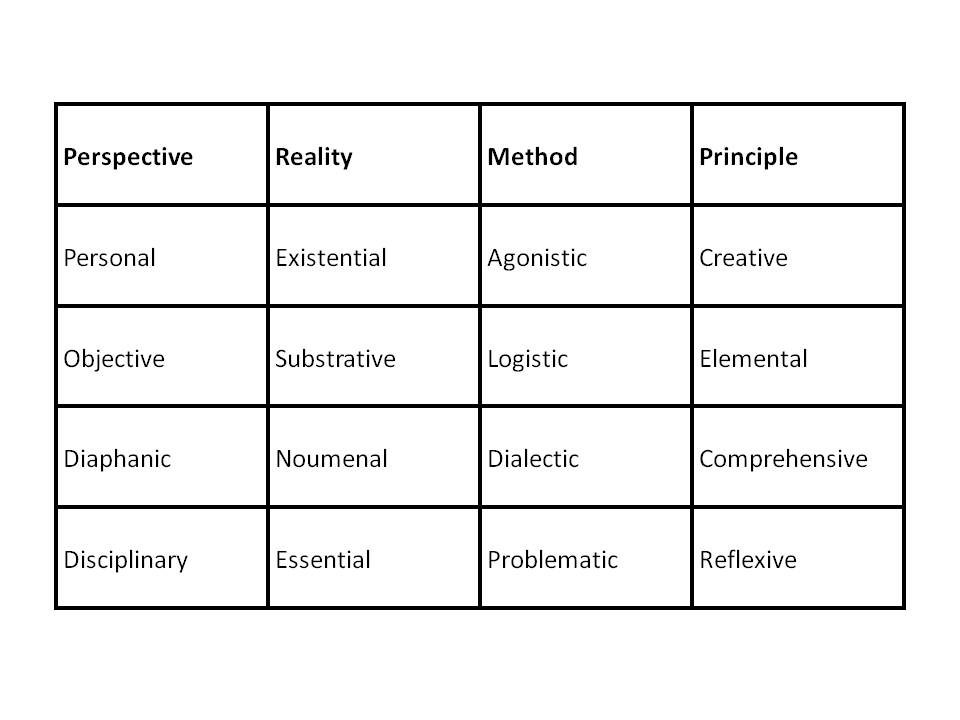
Throughout the history of philosophy, there have been many conflicting stances both towards claiming what exists (ontology), and how we can know our claims are valid (epistemology). There are the oppositions between idealism and realism, between rationalism and empiricism, between thinking all is change and all is changeless, between all is many and all is one, and so on. One approach to overcome these oppositions is to combine them to form their Hegelian synthesis. Another is to deconstruct them à la Derrida. Another pluralistic approach is to consider that there is a germ of truth on each side of the conflicting stance, an aspect of reality for which that stance is valid. Some might think that pluralism is the same as relativism, but it is not. Relativism and pluralism form yet another philosophical opposition like others mentioned above.

Regardless of the validity of pluralism, it can be very useful to analyze what philosophical stances are possible and how they relate to one another. The philosopher Richard McKeon created a rich schema for philosophical semantics that deserves greater recognition. This schema was both simplified and elaborated on by Walter Watson and David Dilworth in their books about the Archic Matrix. There are four main aspects, all exemplified by ancient philosophers: the Sophists, Democritus, Plato, and Aristotle. Everything else is a combination of these original aspects, or essentially a rehashing of them. The main aspects are perspective from the Sophists, reality from Democritus, method from Plato, and principle from Aristotle. These partition “what is”, however it is conceived, into four aspects, each of which can be interpreted in four different ways.

Considering Whitehead’s Criteria, note that perspective has consistency, method has coherency, reality has applicability, and principle has adequacy.

Further Reading:

Walter Watson / The Architectonics of Meaning: foundations of the new pluralism

David A. Dilworth / Philosophy in World Perspective: a comparative hermeneutic of the major theories

http://www.philosophicalprofile.org/test/index.php

http://wwwhistoricalthreads.blogspot.com/2010/07/walter-watson-architectonics-of-meaning.html

https://www.ottobwiersma.nl/philosophy/archic_matrix.php

[*4.112]

<>

The Cynefin Framework

From Wikipedia:

The Cynefin framework is a model used to describe problems, situations and systems. The model provides a typology of contexts that guides what sort of explanations and/or solutions may apply.

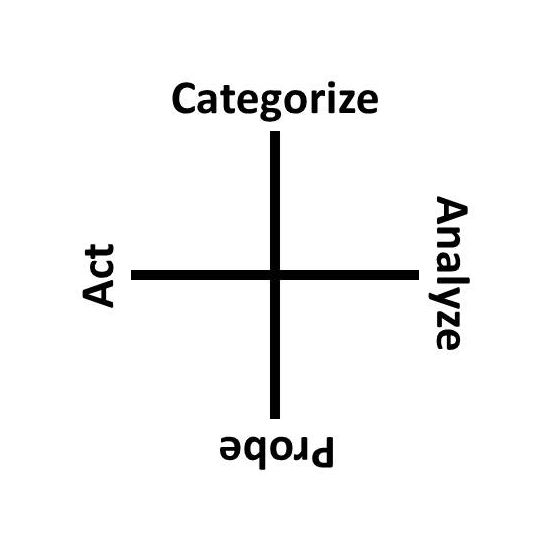
There are actually five domains in the framework, with the fifth one being disorder. It is not shown here. The domains are different in how cause and effect relate to one another within them. They are in the order of light transmission through the four elements: bright, light, dim, and dark.

For each domain, there is a common approach, each containing sense and respond. Simple: Sense – Categorize – Respond. Complicated: Sense – Analyze – Respond. Complex: Probe – Sense – Respond. Chaos: Act – Sense – Respond. For Simple and Complicated, sense comes first, and for Complex and Chaos, sense comes second. Respond ends the approach for each domain. Can one say the Simple and Complicated are a priori, and Complex and Chaos are a posteriori? Or that Simple and Complicated are rational, and Complex and Chaos are empirical?

Interestingly, if we examine the element of the approach that is not sense or respond, they have a close approximation to the fourfold of the Scientific Method.

References:

http://en.wikipedia.org/wiki/Cynefin

[*7.24]

<>

Lucretius: On the Nature of Things

But, now again to weave the tale begun,
All nature, then, as self-sustained, consists
Of twain of things: of bodies and of void
In which they’re set, and where they’re moved around.
For common instinct of our race declares
That body of itself exists: unless
This primal faith, deep-founded, fail us not,
Naught will there be whereunto to appeal
On things occult when seeking aught to prove
By reasonings of mind. Again, without
That place and room, which we do call the inane,
Nowhere could bodies then be set, nor go
Hither or thither at all- as shown before.

—  From On the Nature of Things by Lucretius

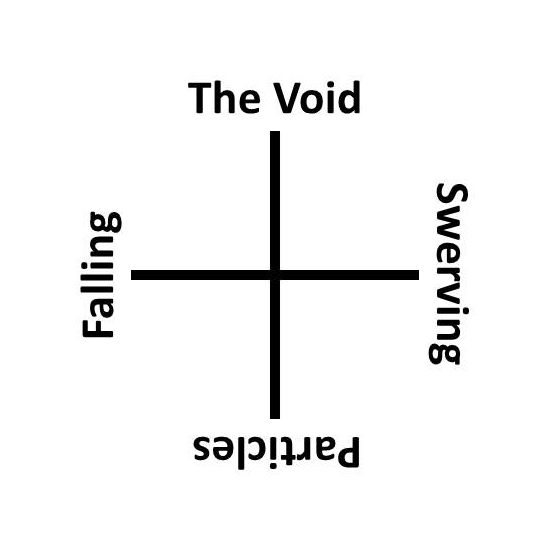
A book on the  rediscovery of  the ancient Epicurean poem “On the Nature of Things” by Lucretius has recently been published. “The Swerve: how the world became modern” by Stephen Greenblatt looks quite interesting. The fourfold above was inspired by the previous fourfold Spacetime. A very nice NPR review can be found below.

Further Reading:

http://www.npr.org/books/titles/140464239/the-swerve-how-the-world-became-modern

http://classics.mit.edu/Carus/nature_things.1.i.html

To Do:

Change swerving to veering.

[*7.18]

<>