Category Archives: Philosophy

Graham Harman’s Quadruple Object, V2

The world is made up of a basic set of polarities – four of them, it turns out. They cannot be derived from a single radical root, but neither do they exist as incorruptible elements untransmutable into one another in the manner of the Empedoclean air, earth, fire and water.

— From Prince of Networks by Graham Harman

sq_harman

Objects exist as autonous units, but they also exist in conjunction with their qualities, accidents, relations, and moments without being reducible to these. To show how these terms can convert into one another is the alchemical mission of the object-oriented thinker.

— From Prince of Networks by Graham Harman

sq_harman2

I have made an attempt at orienting Graham Harman’s fourfold of real object, sensual object, real qualities, and sensual qualities with respect to the other fourfolds presented here. The fourfold object emerges from Harman’s analysis of Heidegger’s das Geviert.

References:

Graham Harman / Guerrilla Metaphysics: phenomenology and the carpentry of things

Graham Harman / Prince of Networks: Bruno Latour and metaphysics

Graham Harman / The Quadruple Object

[*6.46, *6.48, *6.62, *7.40, *7.132, *7.133]

<>

Relations All the Way Down

There is nothing to be known about anything except an initially large, and forever expandable, web of relations to other things. Everything that can serve as a term of relation can be dissolved into another set of relations, and so on for ever. There are, so to speak, relations all the way down, all the way up, and all the way out in every direction: you never reach something which is not just one more nexus of relations.

— Richard Rorty from Philosophy and Social Hope

sq_ll2

The ancient Greek philosopher Empedocles somehow reasoned that the world was made entirely from four basic elements: fire, earth, water, and air. Science as we know it has disproved this from being the case, but this idea still has a rich symbolic meaning even today that informs our popular culture.

A recent philosophical stance called “ontic structural realism” argues that science suggests that only relations between things are of lasting importance, that is the structural relationships within and between things, not the things themselves that bracket the relations. What we call a quark for instance is just the relations it has with other quarks and the other entities that have relationships with quarks. Perhaps then the world consists of “relations all the way down”, instead of stopping at some point on the lowest level with the things that constitute the world.

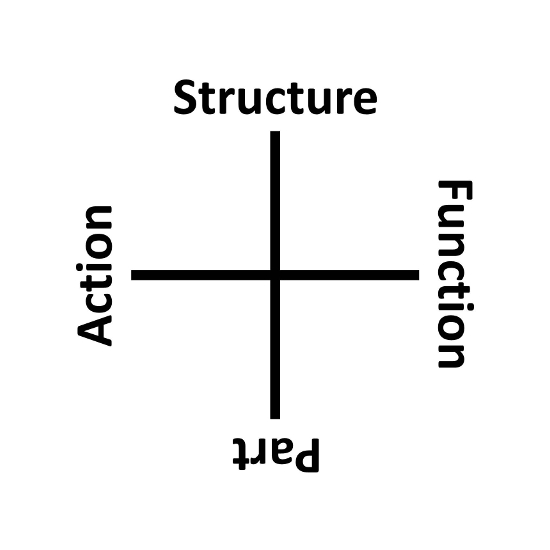
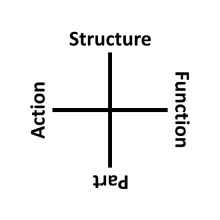
If this is so, what if the world was made completely from four basic relations, instead of four basic things? sq_structure_functionCould they be something like the four binary operators of linear logic? I have likened these four basic operators of Linear Logic to my fourfold Structure-Function, where in addition to Structures, we also have Functions, Actions, and Parts. But these three other relations are also structural, in that only the relation something has to another something makes it structural, functional, actional, or a part of a something.
Book Description for Every Thing Must Go:

Every Thing Must Go argues that the only kind of metaphysics that can contribute to objective knowledge is one based specifically on contemporary science as it really is, and not on philosophers’ a priori intuitions, common sense, or simplifications of science. In addition to showing how recent metaphysics has drifted away from connection with all other serious scholarly inquiry as a result of not heeding this restriction, they demonstrate how to build a metaphysics compatible with current fundamental physics (“ontic structural realism”), which, when combined with their metaphysics of the special sciences (“rainforest realism”), can be used to unify physics with the other sciences without reducing these sciences to physics itself. Taking science metaphysically seriously, Ladyman and Ross argue, means that metaphysicians must abandon the picture of the world as composed of self-subsistent individual objects, and the paradigm of causation as the collision of such objects. Every Thing Must Go also assesses the role of information theory and complex systems theory in attempts to explain the relationship between the special sciences and physics, treading a middle road between the grand synthesis of thermodynamics and information, and eliminativism about information. The consequences of the author’s metaphysical theory for central issues in the philosophy of science are explored, including the implications for the realism vs. empiricism debate, the role of causation in scientific explanations, the nature of causation and laws, the status of abstract and virtual objects, and the objective reality of natural kinds.

Stuff I need to read:

James Ladyman, Don Ross / Every Thing Must Go: Metaphysics Naturalized

http://plato.stanford.edu/entries/structural-realism/

Jason D. Taylor / Relations all the way down? Exploring the relata of Ontic Structural Realism

http://hdl.handle.net/10402/era.27885

Relations All the Way Down

https://ndpr.nd.edu/reviews/every-thing-must-go-metaphysics-naturalized/

<>

 

Knowledge and Its Limits

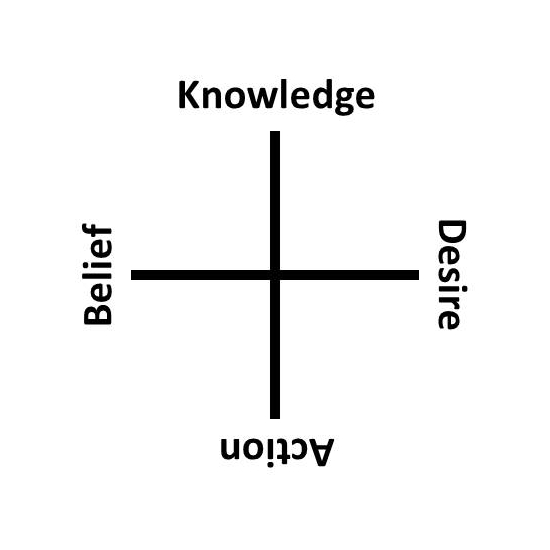
Knowledge and action are the central relations between mind and world. In action, world is adapted to mind. In knowledge, mind is adapted to world. When world is maladapted to mind, there is a residue of desire. When mind is maladapted to world, there is a residue of belief. Desire aspires to action; belief aspires to knowledge. The point of desire is action; the point of belief is knowledge.

— From Knowledge and Its Limits by Timothy Williamson

sq_knowledge_limits

Or with some substitutions:

Theory and practice are the central relations between the mental and the physical. In practice, the physical is shaped to the mental. In theory, the mental is shaped to the physical. When the physical is misshaped to the mental, there is a residue of intention. When the mental is misshaped to the physical, there is a residue of attention. Intention aspires to practice; attention aspires to theory. The point of intention is practice; the point of attention is theory.

sq_knowledge_limits2

Also, note the similarity to The Scientific Method.

Further Reading:

Timothy Williamson / Knowledge and Its Limits

[*6.24, *6.32, *8.22]

<>

Schopenhauer’s Fourfold Root of the Principle of Sufficient Reason

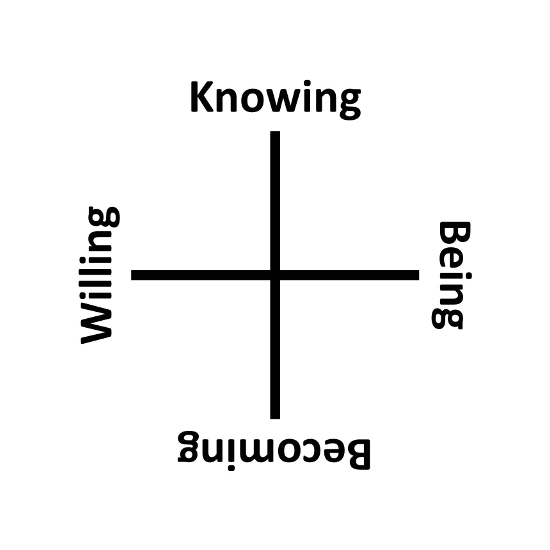
Schopenhauer’s Four Classes that comprise his Fourfold Root of the Principle of Sufficient Reason are diagrammed above. Becoming, Knowing, Being, and Willing are these classes.

From Wikipedia:

In his Translator’s Introduction to Schopenhauer’s The World as Will and Representation, E. F. J. Payne concisely summarized the Fourfold Root.

Our knowing consciousness…is divisible solely into subject and object. To be object for the subject and to be our representation or mental picture are one and the same. All our representations are objects for the subject, and all objects of the subject are our representations. These stand to one another in a regulated connection which in form is determinable a priori, and by virtue of this connection nothing existing by itself and independent, nothing single and detached, can become an object for us. …The first aspect of this principle is that of becoming, where it appears as the law of causality and is applicable only to changes. Thus if the cause is given, the effect must of necessity follow. The second aspect [knowing] deals with concepts or abstract representations, which are themselves drawn from representations of intuitive perception, and here the principle of sufficient reason states that, if certain premises are given, the conclusion must follow. The third aspect of the principle is concerned with being in space and time, and shows that the existence of one relation inevitably implies the other, thus that the equality of the angles of a triangle necessarily implies the equality of its sides and vice versa. Finally, the fourth aspect [willing] deals with actions, and the principle appears as the law of motivation, which states that a definite course of action inevitably ensues on a given character and motive.

Further Reading:

http://en.wikipedia.org/wiki/On_the_Fourfold_Root_of_the_Principle_of_Sufficient_Reason

http://en.wikipedia.org/wiki/The_World_as_Will_and_Representation

http://plato.stanford.edu/entries/sufficient-reason/

Notes:

Replace “Willing” with “Acting”

[*4.106, *7.188]

<>

E. F. Schumacher’s Four Fields of Knowledge

This fourfold is created from the product of two duals: Self & World, and Inner Experience & Outer Appearance.

  • The Inner Experience of Self is Experience.
  • The Outer Appearance of Self is Behavior.
  • The Inner Experience of World is Communication.
  • The Outer Appearance of World is Science.

The first fourfold is very similar to Hjelmslev’s Net, where Content is Inner Experience, Expression is Outer Appearance, Substance is unitary “Self”, and Form is multiplicity “World”.

It is also almost identical to Ken Wilbur’s AQAL as presented here.

References:

E. F. Schumacher / A Guide for the Perplexed

http://en.wikipedia.org/wiki/A_Guide_for_the_Perplexed

http://www.integralworld.net/edwards2.html

[*7.88, *7.174, *7.176]

<>


Things, Thoughts, Words, and Actions

Here are some additional fourfolds from philosopher Richard McKeon.

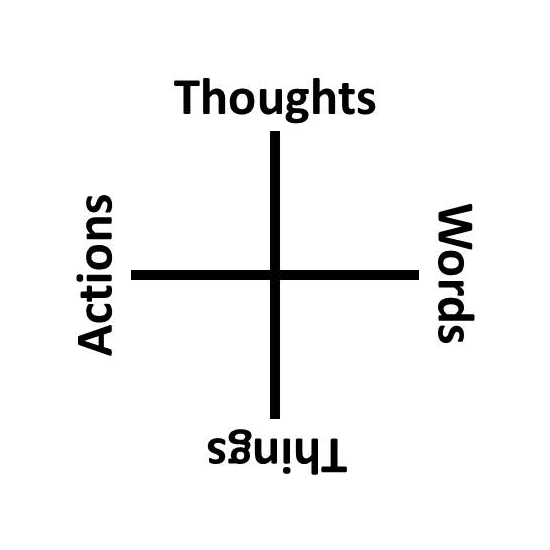
McKeon wrote much on the subject of rhetoric. A favorite fourfold of concepts was that of Things, Thoughts, Words, and Actions. He called these “commonplaces of inquiry” or “places of invention and memory”. Two rhetorical devices he used were amplification and schematization. Amplification can extend the scope of, for example, words to the other three, similar to the principle of indifference. “Objectivity is the inclusive principle of indifference by which it is recognized that being is grasped only in what we think, and say, and do about it.” [1] Schematization was used to identify and distiguish, for example, commonplaces. Thus I think amplification is a conjunctive device, and schematization is a disjunctive device.

Another fourfold of subjects by McKeon was Topics, Themes, Theses, and Hypotheses. McKeon wrote, “Speculation concerning discourse must avoid the fixities of categories, doctrines, methods, and assumptions which discourse assumes in any one form of philosophy or inquiry, if it is to include all the forms which discourse takes in philosophy and in inquiry, action, and production. This is possible because the variety of categories or elements is approached in discourse by way of common topics or ‘commonplaces’; the variety of facts or statements of what is the case by way of common hypotheses; the variety of arts or methods of treating problems by way of common themes; and the variety of assumptions or principles by way of common theses.” [2]

Are both these fourfolds aligned correctly with the previous Knowable, Knowledge, Known, and Knower? McKeon’s use of terms in his rhetoric was very fluid, perhaps to prevent systemization or to promote pluralism. However, his main reference to fourfolds was Aristotle’s four scientific questions, or Four Causes, which we can use to try to understand his fourfolds.

References:

Theresa Enos (ed.) / Encyclopedia of Rhetoric and Composition: Communication from Ancient Times to the Information Age

[1] Richard McKeon / Selected Writings of Richard McKeon: Volume One: Philosophy, Science, and Culture

[2] Richard McKeon / Selected Writings of Richard McKeon, Volume Two: Culture, Education, and the Arts

Click to access McKNotes-Semantics&Inquiry_Intro.pdf

H. L. Ulman / Things, Thoughts, Words, and Actions: the problem of language in late Eighteenth-Century British rhetorical theory

[*5.197, *6.140, *7.162, *7.165]

<>


The Stone Gamut

Our thesis is that the category Set is the ultimate abstraction of body, and that Set^op, equivalent to the category of complete atomic Boolean algebras (i.e. power sets), which we shall advocate thinking of as antisets, is dually the ultimate abstraction of mind.

— From Chu Spaces: automata with quantum aspects by Vaughan Pratt

Reflecting an era of reduced expectations for the superiority of humans, we have implemented causal interaction not with the pineal gland but with machinery freely available to all classical entities, whether newt, pet rock, electron, or theorem (but not quantum mechanical wavefunction, which is sibling to if not an actual instance of our machinery).

— From Rational Mechanics and Natural Mathematics by Vaughan Pratt

http://en.wikipedia.org/wiki/Boolean_algebra

http://en.wikipedia.org/wiki/Distributive_lattice

http://en.wikipedia.org/wiki/Vector_space

http://en.wikipedia.org/wiki/Partially_ordered_set

http://en.wikipedia.org/wiki/Set_%28mathematics%29

References:

Click to access ph94.pdf

Click to access ratmech.pdf

http://chu.stanford.edu/

http://en.wikipedia.org/wiki/Chu_space

Vaughan Pratt / The Stone Gamut: a coordinatization of mathematics

https://ieeexplore.ieee.org/document/523278

[*7.140]

<>

The Archic Philosophers

In a word, the Sophist begins from man, the Democritean from matter, the Platonist from form, and the Aristotelian from functioning.

— From The Architectonics of Meaning, by Walter Watson

Inspired by philosopher Richard McKeon, I believe that philosophy as a whole is encompassed by four main philosophical stances, exemplified by four ancient philosophers: the Sophists (as a group), Democritus, Plato, and Aristotle. Their four systems of thought lay out principal philosophical directions, much like the compass directions east, south, north, and west lay out a complete set of primary directions.

Of course the compass directions can be subdivided into north-east, or south-south-west, and so on, and similarly each of these philosophical systems can be divided into four parts. This division into a four-by-four matrix is called the Archic Matrix and was written about at length in the separate but complementary works of Walter Watson and David Dilworth.

Watson and Dilworth described the four main philosophical directions to be perspective, reality, method, and principle: perspective for the Sophists, reality for Democritus, method for Plato, and principle for Aristotle. I have written about these philosophical perspectives previously in several ways.

Thus philosophy as a practice goes around and around and revisits the same ideas over and over. Perhaps McKeon thought his philosophical system followed in the footsteps of Aristotle, and probably Watson and Dilworth had a similar view.

Likewise, I believe that my fourfold of Structure-Function represents these four philosophical directions in the following way: Action(s) for the Sophists, Part(s) for Democritus, Structure for Plato, and Function for Aristotle.

[*6.108]
<>


The Duality of Time and Information, V2

The states of a computing system bear information and change time, while its events bear time and change information.

from The Duality of Time and Information by Vaughan Pratt

The most promising transformational logic seems to us to be Girard’s linear logic.

— from Rational Mechanics and Natural Mathematics by Vaughan Pratt

Here we have three duals: information – time, state – event, and bear – change.

References:

Vaughan Pratt / The Duality of Time and Information http://boole.stanford.edu/pub/dti.pdf

Vaughan Pratt / Time and Information in Sequential and Concurrent Computation http://boole.stanford.edu/pub/tppp.pdf

Vaughan Pratt / Rational Mechanics and Natural Mathematics http://chu.stanford.edu/guide.html#ratmech

[*5.170]

<>

Epistemic Virtues of Objectivity

I recently finished reading Lorraine Daston and Peter Galison’s “Objectivity”. In this very interesting book, the authors argue that the notion of scientific objectivity has evolved over time. They have divided the course of this evolution into three main phases: truth-to-nature, mechanical objectivity, and trained judgement. During each phase, the main view of objectivity is dominant, but previous phases are still important to the overall idea of what objectivity means in the scientific community.

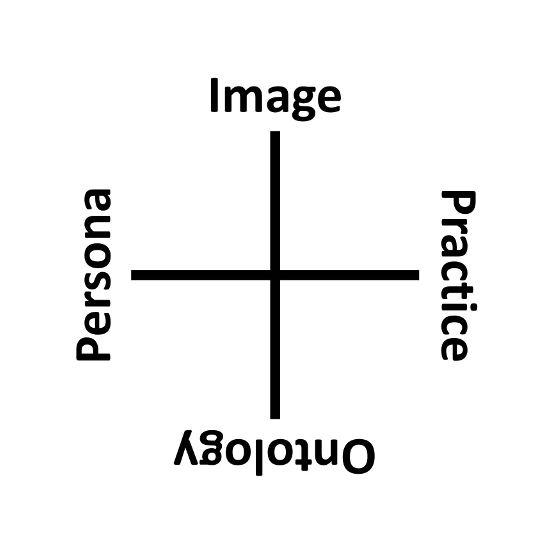
The epistemological virtues of objectivity can be divided into four major aspects: persona, ontology, image, and practice. For each phase of objectivity, each aspect has different qualities. For instance, the scientific persona becomes a sage during the truth-to-nature phase, a worker during the mechanical objectivity phase, and an expert during the trained judgement phase. Similarly, the ontology aspect passed through the qualities of universals-particulars-families, the image aspect passed through reasoned-mechanical-interpreted, and practice  passed through the stages selection and synthesis-automated transfer-pattern recognition.

The evolutionary phases of objectivity, as well as the qualities of the epistemological virtues seen as the four aspects, is beautifully shown by many examples from a collection of scientific atlases. Anyone interested in the history of science as well as the notion of scientific objectivity should enjoy this book.

I thought it was also remarkable that these four aspects of objectivity were very similar to the four aspects of the Archic Matrix of Watson and Dilworth.

Further Reading:

Lorraine Daston and Peter Galison / Objectivity

[*7.106]

<>