Humankind’s Main Feature

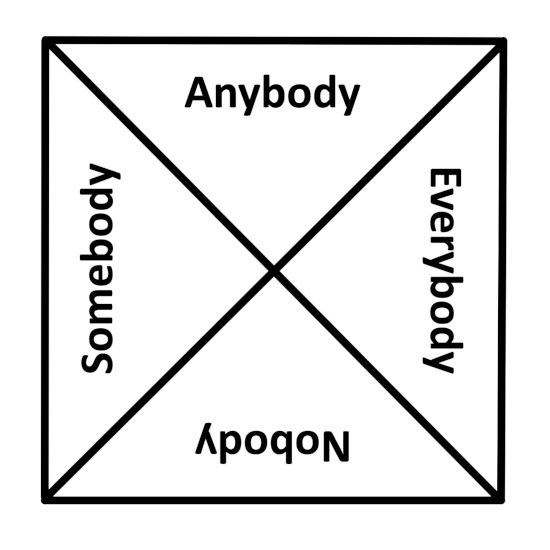
What is the most distinctive attribute of the human species? What will be our legacy? Is it…

Further Reading:

https://en.wikipedia.org/wiki/Homo_Ludens

https://en.wikipedia.org/wiki/Homo_faber

https://en.wikipedia.org/wiki/Homo_sapiens

https://en.wikipedia.org/wiki/Homo_Necans

https://en.wikipedia.org/wiki/Names_for_the_human_species

I kind of like Homo Occisor for “Man the Killer”, but Homo Necans is already out there.

Also see:

https://en.wikipedia.org/wiki/Quiddity

[*8.135, *11.139]

<>


Writing the Book of the World

If one was writing a book that described the entire world or universe as it is, how should that book present the world to us? It is not enough to speak truly, itemizing “all that is the case”, one must also use the right notions while doing so.

Philosopher Theodore Sider wants us to accept structure as the all important fundamental notion of how to talk about the world. His idea of structure is that it reveals where the joints or articulations of the world can be carved, and that the structure of the world is real and it is objective. Structure is the right and proper way to find these joints, and go about this carving.

(Of course the structure that Sider promotes is not to be confused with the structuralism of linguistics and anthropology that was so popular before deconstruction and post-modernism critiqued it nearly to death. This post is not about structuralism because its structure is a reflection of language and the mind itself, not an attribute of the actual world.)

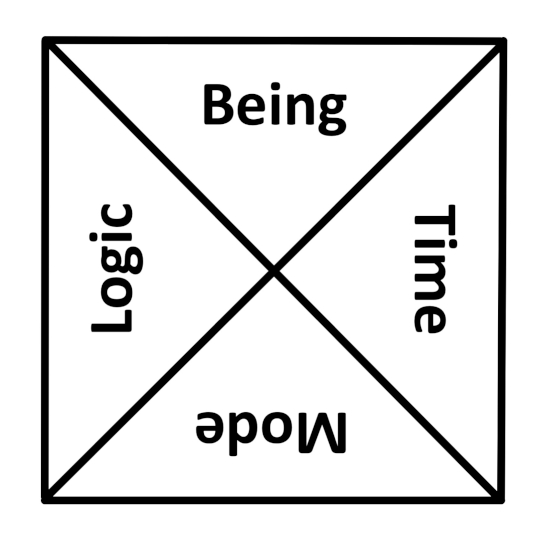
Chapters 1-8 are titled: Structure, Primitivism, Connections, Substantivity, Metametaphysics, Beyond the Predicate, Questions, and Rivals. Chapters 9-12 are devoted to ontology, logic, time, and modality (because I guess these are favorite topics in metaphysics) and what structure tells us about them. I don’t think Sider is saying that reality is carved naturally into these four domains, but I think it makes a rather nice fourfold.

In Metaphysics, Ontology is another word for Being, but it can also mean a classification system for the different kinds of things that exist (but I guess that’s not metaphysical). Modality is the Metaphysical or Epistemic study of necessity and possibility, so it is certainly related to time. There are also modal logics which have quantifiers for modalities such as necessity and possibility.

I closing I must say that once you carve up some structure by its joints, then you are left with parts, which may be structures in their own right. And as I’ve posited elsewhere, functions and actions are the structures and parts of time. I also wonder if there is a comparison of Sider’s structure to the metaphysics of E. J. Lowe, but perhaps I should just read each of their work.

Further Reading:

Theodore Sider / Writing the Book of the World

http://tedsider.org/

Some reviews:
http://ndpr.nd.edu/news/writing-the-book-of-the-world/

Click to access 12-05-wtbotw-review.pdf

https://en.wikipedia.org/wiki/Ontology

https://plato.stanford.edu/entries/modality-varieties/

https://plato.stanford.edu/entries/modality-epistemology/

https://en.wikipedia.org/wiki/Structuralism

Review that needs registration to read:
https://www.lrb.co.uk/v34/n16/aw-moore/carving-at-the-joints

[*9.8, *11.112]

<>


The Four Types of Knowledge

What types of knowledge are there?

In his Nicomachean Ethics (Book VI), Aristotle famously describes several intellectual virtues. There is Techne, or Art; Episteme, or Knowledge, Phronesis, or Prudence, Sophia, or Wisdom, and Nous, or Intellect. He considered Sophia a combination of Nous and Episteme, but some others think it stands alone. Nous also seems to be more subjective, as well as supplying Phronesis with its aims, but is complicated. So are there three types, or five? I would like there to be four, thank you very much.

In Venharanta and Markopoulos’s paper, Phronesis seems to be the balance or sum of Techne, Episteme, and Sophia. In Carsten Pedersen’s web article, Techne, Episteme, Sophia, and Phronesis form a fourfold, with Nous in the center. Jon Alan Schmidt, a member of Virtuous Engineers, distinguishes between kinds of knowledge (Techne, Episteme, and Phronesis) and forms of human activity associated with them (Poiesis, Theoria, and Praxis). I like this distinction. What is the activity associated with Sophia?

Not knowing any Greek puts me at a disadvantage. Nous is linked to Noesis as a type of knowledge and Noein which seems to be the activity. I will present the following table and see how I like it!

Forms of
Human Activity
Types of
Knowledge
Theoria Episteme Science
Praxis Phronesis Prudence
Poiesis Techne Craft
Noein Sophia Wisdom

Further Reading:

https://en.wikipedia.org/wiki/Nicomachean_Ethics

https://plato.stanford.edu/entries/episteme-techne/

https://en.wikipedia.org/wiki/Nous

https://www.age-of-the-sage.org/nous-noesis-noetic.html

https://www.psychsoma.co.za/learning_in_vivo/2009/09/techne-episteme-poiesis-praxis.html

https://sites.google.com/site/praxisandtechne/Home/architecture/knowledge/episteme

http://ian.umces.edu/blog/2013/08/29/its-all-greek-to-me-the-terms-praxis-and-phronesis-in-environmental-philosophy/

Knowledge for Aristotle & Plato


Kurt von Fritz / ΝΟΥΣ, Noein, and Their Derivatives in Pre-Socratic Philosophy (Excluding Anaxagoras):
Part I. From the Beginnings to Parmenides, Classical Philology, Vol. 40, No. 4 (Oct., 1945), pp. 223-242 https://www.jstor.org/stable/265805

Kurt von Fritz / ΝΟΥΣ, Noein, and Their Derivatives in Pre-Socratic Philosophy (Excluding Anaxagoras):
Part II. The Post-Parmenidean Period, Classical Philology, Vol. 41, No. 1 (Jan., 1946), pp. 12-34
https://www.jstor.org/stable/267530

Vanharanta H., Markopoulos E. / Visualization of the Wisdom Cube Scientific Knowledge Space for Management and Leadership. In: Kantola J., Nazir S. (eds) Advances in Human Factors, Business Management and Leadership. AHFE 2019. Advances in Intelligent Systems and Computing, vol 961. Springer https://doi.org/10.1007
https://link.springer.com/chapter/10.1007/978-3-030-20154-8_2

In Danish (English via Chrome translation):
http://omsigt.dk/hvad-er-praksisfilosofi/

Bent Flyvjerg / Making Social Science Matter: Why Social Inquiry Fails and How it Can Succeed Again
https://www.librarything.com/work/185825/reviews/11378122

Interesting Anime:
https://en.wikipedia.org/wiki/Noein:_To_Your_Other_Self

[*3.34, *11.130]

<>

Conflict Management and Conflict Resolution

There seems to be rather a lot written about Conflict Management (CM) and Conflict Resolution (CR). CM is a key activity in the business world, as conflict arises both within a business between the individuals that comprise it and without a business when they compete with each other.

CM realizes the grim reality that conflict will always be with us, whereas CR at least hopes for an end of the particular disagreement. CM tries to investigate and detail how one can learn from conflict, and reduce its disruptive forces or use it to advantage. As we know, capitalism is chock-full of aggressive metaphors and ideologies.

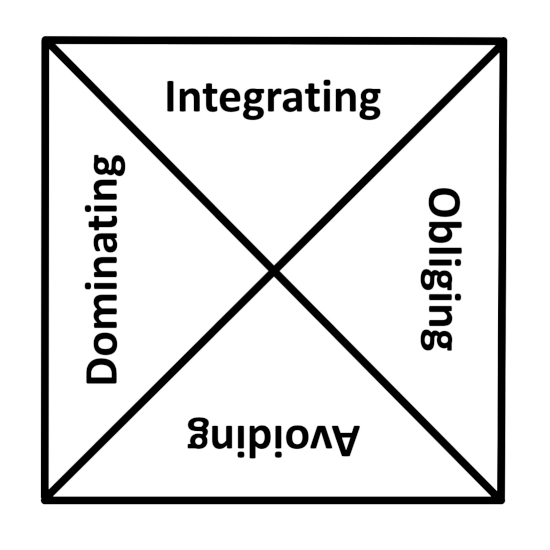
There are several models of conflict but they mostly have two measures: assertiveness or “concern for self”, and cooperativeness or “concern for others”. The models usually place a fifth term in the middle, labeled “compromising”.

  • Low assertiveness, low cooperativeness: Avoiding
  • High assertiveness, low cooperativeness: Dominating
  • Low assertiveness, high cooperativeness: Obliging
  • High assertiveness, high cooperativeness: Integrating

It would be interesting at this time to say how this subject matter relates to the fourfold Means and Ends, since they are obviously connected and even share several of the same terms. However, I just can’t seem to inspire myself to investigate and say anything worthwhile right now.

I haven’t disentangled the history of the subject, so I’m not going to name originators or contributors just yet. I guess I really don’t like conflict and it just makes me generally tired to contemplate it, even in the abstract. I guess you can just put me in the “avoiding” pigeonhole.

Avoiding this subject has lead me to another one, that of Gregory Bateson and his schismogenesis. Perhaps the opposite of combogenesis (mentioned previously), this concept seems to be helpful in understanding conflict escalation. Would this idea help in thinking about division of cultural groups (discussed here)?

Further Reading:

https://en.wikipedia.org/wiki/Conflict_management

https://en.wikipedia.org/wiki/Conflict_resolution

Means and Ends

https://aeon.co/essays/gregory-bateson-changed-the-way-we-think-about-changing-ourselves

https://en.wikipedia.org/wiki/Schismogenesis

http://www.anecologyofmind.com/

[*11.116]

<>


The Known Knowns of Donald Rumsfeld

The stars madden, and satellites hum silently
Where no sound can awaken a sleeper. She dreams
A language which cannot trouble her, a vocabulary

Without voice. She has forgotten the ugly grammar,
The deformed sentences. She has forgotten
The irregularities of memory, the unknown knowns,

The can-no-longer-remembers, the slow impeachment
Of experience. She rises, stunned and serene,
Toward the promise of nothing.

— From Sad-faced Men, by William Logan

  • Known Knowns: what we know we know
  • Known Unknowns: what we know we don’t know
  • Unknown Unknowns: what we don’t know we don’t know
  • Unknown Knowns: what we don’t know that we know

Further Reading:

https://en.wikipedia.org/wiki/There_are_known_knowns

https://academic.oup.com/jxb/article/60/3/712/453685

https://english.stackexchange.com/questions/35284/known-unknown-vs-unknown-known

The Known Unknowns Matrix

The Rumsfeldian Knowledge Matrix

https://www.google.com/search?sa=X&q=known+unknown+matrix&tbm=isch

Also see:

The Johari Window

The Quadralectics of Marten Kuilman

[*11.121]

<>


The Arcane Arts of Ramon Llull : the Dignities

Let us calculate!

— Gottfried Wilhelm Leibniz

Oh, Ramon Llull, where have you been all my life? I’m sure he’s been there all along, death now over seven hundred years in the past, just like always. His legacy seems at first glance to be quite the essence of medieval religion and scholastic philosophy, but still significantly and obscurely different to be enticing to this one. And on further examination, much more.

My schema above has little to do with his grand elaborate figures, except for listing the sixteen attributes he called “dignities”. Llull’s diagrams are full of clock-like wheels within wheels, complicated tableau, and combinatorial patterns. He wished to create a universal model to understand reality, and who wouldn’t want to discover the same? It is said that his methods are akin to an early computer science, and I’m just now starting to understand why.

The magister based the substance of his methods on his Christian faith, although he converted in midlife from Islam. Living in Barcelona, it was probably a good place to make such a change, but felt his calling was to convert others as well, so traveling he went. The methods he developed to convince others of their errors in belief were quite remarkable, as were the volume of his writing.

Like Gottfried Wilhelm Leibniz, who lived four hundred years later and was influenced by him, Llull wished to automate reasoning. But instead of building mechanical devices, Llull built computers from paper and ink, rulers and drawing compasses, scissors and glue. And instead of numbers as the smallest tokens of his computer, he used abstractions (i.e. words) that he felt would be understood by everyone in exactly the same way.

For example, he enumerated these sixteen dignities or aspects of his Christian diety, although sometimes he used the first nine. His constructions allowed one to pose questions and then obtain answers mechanistically that would be convincing to all observers of the correctness of the result. Too bad he was ultimately stoned to death while on his missionary work, although he lived to be eighty two.

Llull’s devices remind me of some of my pitiful charts and diagrams, and make me wonder if I may either adapt some of his techniques to my own use, or be inspired to develop others. I suspect I have locked myself into limitations by my approach, or are these constraints to my advantage? It might be hard to have spinning elements, but I can envision sliding elements like Napier’s Bones, origami-style folding and pleating, and even physical constructions like linkages and abacuses.

Now a martyr within the Franciscan Order, Llull’s feast day is June 30, which I’ve now missed. I hope to remember him to repost or improve on this by next year.

Further Reading:

https://en.wikipedia.org/wiki/Ramon_Llull

https://plato.stanford.edu/entries/llull/

http://trepanatus.blogspot.com/2007/06/ramon-llull.html

https://history-computer.com/Dreamers/Llull.html

https://publicdomainreview.org/2016/11/10/let-us-calculate-leibniz-llull-and-computational-imagination/

http://www.ncregister.com/blog/astagnaro/bl.-raymond-lull-and-the-worlds-first-computer

https://dangerousminds.net/comments/the_13th_century_thinking_machine_of_ramon_llull

The memory wheel

https://www.google.com/search?q=ars+magna+llull&tbm=isch

[*11.118]

<>


Tanabata, V2

Soon it will be Tanabata (七夕) in Japan on July 7th.

Make a wish!

  • Orihime : Vega
  • Hikoboshi : Altair
  • Bridge of Birds : Deneb
  • Silver River : Milky Way

Further Reading:

https://en.wikipedia.org/wiki/Tanabata

http://www.iromegane.com/japan/make-a-wish-for-tanabata/

https://en.wikipedia.org/wiki/Summer_Triangle

[*10.48, *11.114]

<>

Richard McKeon’s Aspects of Knowing, Part 3

Previously on this blog:

Each method can be associated with a discursive process: operational with debate, dialectical with dialogue, logistic with proof, and problematic with inquiry. Each method is also associated with a mode of thought which in turn has two moments and one dependency or assumption: the operational method is debate by discrimination and postulation dependent on chosen theses, the dialectical method is dialogue by assimilation and exemplification dependent on changeless models, the logistic method is proof by construction and decomposition dependent on indivisible constituents, and the problematic method is inquiry by resolution and question dependent on discoverable causes.

For this diagram, the four dependencies or assumptions are in the center, and the associated methods are adjacent to them. Filling out the outer edge are the four pairs of moments. Listed, these facets are:

  • Methods (associated discursive process): Operational (Debate), Dialectical (Dialogue), Logistic (Proof), Problematic (Inquiry)
  • Assumptions: Chosen Theses, Changeless Models, Indivisible Constituents, Discoverable Causes
  • Modes of Thought: discrimination and postulation, assimilation and exemplification, construction and decomposition, resolution and question

The second diagram comes from a chart in McKeon’s “Philosophic Semantics and Philosophic Inquiry”. Here, the four methods are in the upper left corner (Universal) and lower right corner (Particular), and four principles are in the lower left corner (Meroscopic) and upper right corner (Holoscopic). Four interpretations are in the center (the vertical pair is Ontic, and the horizontal pair is Phenomenal), and four selections are adjacent to them. Listed, these facets are:

  • Methods: Operational, Dialectical, Logistic, Problematic
  • Principles: Simple, Actional, Comprehensive, Reflexive
  • Interpretations: Existentialist, Entitative, Ontological, Essentialist
  • Selections: Knower (Types), Knowable (Matters), Knowledge (Hierarchies), Known (Kinds)

Note that the Archic Matrix of Watson and Dilworth is essentially derived from this, and even has many of the same terms. However and obviously, the sixteen-fold arrangements of the two diagrams are different.

Further Reading:

http://www.richardmckeon.org

Richard McKeon’s Aspects of Knowing

Richard McKeon’s Aspects of Knowing, Part 2, V3

The Archic Matrix

[*5.184, *5.185, *6.20, *11.102, *11.106]

<>


Combogenesis and Evolution

There is grandeur in this view of life, with its several powers, having been originally breathed into a few forms or into one; and that, whilst this planet has gone cycling on according to the fixed law of gravity, from so simple a beginning endless forms most beautiful and most wonderful have been, and are being, evolved.

— Charles Darwin, from The Origin of Species

Another important part of Tyler Volk’s theory of combogenesis that I didn’t mention previously is the role that evolution plays in the dynamical realms of biology and culture. He even illustrates evolution as a three-part braid where the strands are the processes of propagation, variation, and (natural) selection. He argues that these processes are fundamental to an abstract notion of meta-evolution that can be seen working to cause change in both of these different domains.

I don’t think that there is anything controversial in listing these three processes as being essential for biological evolution. Other diagrams and schemas available on-line also mention overproduction or fecundity, or having more off-spring than is strictly needed to continue the population, and heredity or heritability, or the ability to pass on special traits from parents to children.

Overproduction not only allows for greater survival chances for the organism but also gives genetic variation a better chance at producing something beneficial or interesting. This depends on what your chance of variation is, of course, but it seems that it is just a facet of propagation. Likewise, heredity seems like it is also included in propagation, as the continuance of the same or similar attributes to one’s descendants.

I previously proposed that four processes were essential to the workings of evolution: generation, variation, selection, and speciation. Generation is basically another word for propagation, although propagation might more clearly suggest having same or similar dependents, whereas generation just means having descendants. Overproduction can also be combined into either of these aspects if so desired. But I’ll say that (at least in my mind) generation and propagation are roughly the same.

But what about the process of speciation? Is it as fundamental to biological evolution as we see it working on our planet today as the other three processes? Speciation only means the formation of new and distinct species by evolutionary process. So generation, variation, and selection don’t really allow for the “endless forms most beautiful” in the famous quote of Darwin, or do they? Speciation also implies the heritability attribute of evolution, so maybe both generation and speciation subsume the aspect of propagation in most biologists or at least Volk’s mind.

But an important question is, is specification implied by the other three, like three mathematical axioms implying a theorem, or is it independent of them? If you don’t have speciation, don’t you essentially just have one type of organism? Or would you just have a continuum of variation within the population, without any barriers for reproduction between them? I’ll admit that these questions are too complicated for me to answer at this time.

Getting back to Volk and combogenesis, he and others have argued that cultural change is an evolutionary process as well. Another important question then is, if speciation is fundamental to evolution, then is the differentiation of cultures fundamental to the evolutionary process of culture? If so, culture may never be ‘one thing’, and we will always have different cultures competing for dominance.

The competition of different cultures isn’t necessarily a bad thing, as perhaps they can also be pluralistically cooperative. And perhaps having multiple cultures are best in case the society heads down an evolutionary dead-end, longevity-wise. But still, this might be the reason that we will always have multiple cultures that just can’t agree, can’t get along, and can’t really live together.

You might hope that by language and reason, different societies and ideologies can bridge gaps in understanding. You might hope that good-will and morality might win out, and destructive vitriol will be held in check. You might indeed hope. But research has shown that people are very resistant to changing their minds once they think they are right. I think it has been shown that new types of media (I’m looking at you, internet) has exacerbated this problem to the n-th degree.

There is the fourfold Means and Ends (of course there is) that includes cooperation and competition, as well as conflict and coalition. It is based on looking at the compatibility and incompatibility of different means and ends. Even if you can’t have full cooperation, perhaps you can have (mere) competition or coalition within cultures, instead of out-and-out conflict. Perhaps the key is to find those common goals, and even those common values that might allow our factious society to move forward. But many others have said these types of things.

Interestingly, there are also four types of geographic biological speciation, so looking at these might give us clues as to what might be occurring for our speciation in cultural evolution (there’s a nice diagram at the Wikipedia entry). Do the same processes that produce species in the biological world also produce societal divergences in the cultural world? Are these processes the origins of tribes, nations, and even wars? Are there analogues of allopatric, peripatetic, parapatric, and sympatric speciation when considering different cultures and their conflict and cooperation?

Further Reading:

https://en.wikipedia.org/wiki/Speciation

https://sciencing.com/four-factors-natural-selection-8140305.html

https://metapatterns.wikidot.com/nyusjm1-1:flott-evolution

https://evolution.berkeley.edu/evolibrary/article/evo_43

https://www.ncbi.nlm.nih.gov/pmc/articles/PMC4816541/

https://www.nature.com/scitable/definition/speciation-183

The Theory of Evolution

Means and Ends

https://www.newyorker.com/magazine/2017/02/27/why-facts-dont-change-our-minds

Continue reading Combogenesis and Evolution

Four Sociological Traditions

A blurb found on the web for this 1994 book:

The updated version of Collins’s critically-acclaimed Three Sociological Traditions, this text presents a concise intellectual history of sociology organized around the development of four classic schools of thought: the conflict tradition of Marx and Weber, the ritual solidarity of Durkheim,the microinteractionist tradition of Mead, Blumer, and Garfinkel, and–new to this edition–the utilitarian/rational choice tradition. Collins, one of the liveliest and most exciting writers in sociology today, traces the intellectual highlights of these four main schools from classical theories to current developments, introducing the roots of sociology and indicating the areas where progress has been made in our understanding, the areas where controversy still exists, and the direction in which sociology is headed.

Further Reading:

Randall Collins / Four Sociological Traditions

https://en.wikipedia.org/wiki/Randall_Collins

The Four Requisites of Randall Collins

[*4.6, *11.110]

Continue reading Four Sociological Traditions

Every Fourth Thing

Daydream Tourist

Because there are way more than seven wonders in the world.

The Digital Ambler

Always Forward Between Heaven and Earth

The Mouse Trap

Psychological Musings

Wrong Every Time

Critiquing anime and everything else

The Chrysalis

"For man has closed himself up, till he sees all things thro' narrow chinks of his cavern" -- William Blake

  Bartosz Milewski's Programming Cafe

Category Theory, Haskell, Concurrency, C++

The Inquisitive Biologist

Reviewing fascinating science books since 2017

Gizmodo

Every Fourth Thing

Simplicity

Derek Wise's blog: Mathematics, Physics, Computing and other fun stuff.

COMPLEMENTARY 4x

integrating 4 binary opposites in life, learning, art, science and architecture

INTEGRATED 4x

integrating 4 binary opposites in life, learning, art, science and architecture

Playful Bookbinding and Paper Works

Chasing the Paper Rabbit

Antinomia Imediata

experiments in a reaction from the left

Digital Minds

A blog about computers, evolution, complexity, cells, intelligence, brains, and minds.

philosophy maps

mind maps, infographics, and expositions

hyde and rugg

neat ideas from unusual places

Visions of Four Notions

Introduction to a Quadralectic Epistomology

Explaining Science

Astronomy, space and space travel for the non scientist

Log24

Every Fourth Thing

Ideas Without End

A Serious Look at Trivial Things

Quadralectic Architecture

A Survey of Tetradic Testimonials in Architecture

Minds and Brains

Musings from a Naturalist

Why Evolution Is True

Why Evolution is True is a blog written by Jerry Coyne, centered on evolution and biology but also dealing with diverse topics like politics, culture, and cats.

Quadriformisratio

Four-fold thinking4you

Multisense Realism

Craig Weinberg's Cosmology of Sense

RABUJOI - An Anime Blog

Purveyors of Fine Anime Reviews and Ratings Since 2010

Intra-Being

Between Subject and Object

The Woodring Monitor

Every Fourth Thing

FORM &amp; FORMALISM

Every Fourth Thing

Log24

Every Fourth Thing

The n-Category Café

Every Fourth Thing

THIS IS NOT A BLOG

Every Fourth Thing

PHILOSOPHY IN A TIME OF ERROR

Sometimes those Sticking their Heads in the Sand are Looking for Something Deep

Networkologies

Online Home of Christopher Vitale, Associate Professor of Media Studies, The Graduate Program in Media Studies, Pratt Institute, Brooklyn, NY.

Hyper tiling

Linking Ideas

DEONTOLOGISTICS

RESEARCHING THE DEMANDS OF THOUGHT

Incognitions

Explorations in the Paradoxes of Meaning

Object-Oriented Philosophy

"The centaur of classical metaphysics shall be mated with the cheetah of actor-network theory."

Objects & Things

objects & things, design, art & technology