Category Archives: Science

Flowing and Falling

Some philosophers say everything is process. From the cosmic scale of the universe to the submicroscopic scale of atoms, physical forces marshal matters and energies to and fro. In between these at the human scale, biology is ruled by flows of energy from the sun and nutrients from the environment as well as from other living beings. Dynamical forces such as temperature, weather and tides also affect biology and even the cultural processes of higher lifeforms.

At the scale of the solar system, gravity collects gases to ignite stars and form planets. Once stars reach their limits to burn, gravity can collapse them to dense cinders and black holes or even to rebound and spread their atomic matters in novas and supernovas. Even light spread by the stars can be gathered together into gravity wells such as black holes. Stars in turn are gathered into galaxies by the gravity of black holes and even unknown dark matters.

At the scale of atoms and molecules, temperature differentials and water can partition certain types of elementary constituents to form membranes and segregate insides from outsides. If an inside is protected sufficiently, then there is time and the conditions to harbor and perpetuate the delicate structures and processes that form cells. Cells can even gather together and continue as multicellular communities, or only temporarily to fruit and disperse again as simple creatures known as slime molds.

At the individual human or societal scale, there are flows for nutrients and excreta, materials for habitation and the manufacture of tools, distributed energies such as electricity, fossil fuels, and information for learning, work, and civic participation. Even speech and writing can be thought as flows of information. But just as flows of nutrients and materials and energies can prove toxic to biological health or ecologies, so can information.

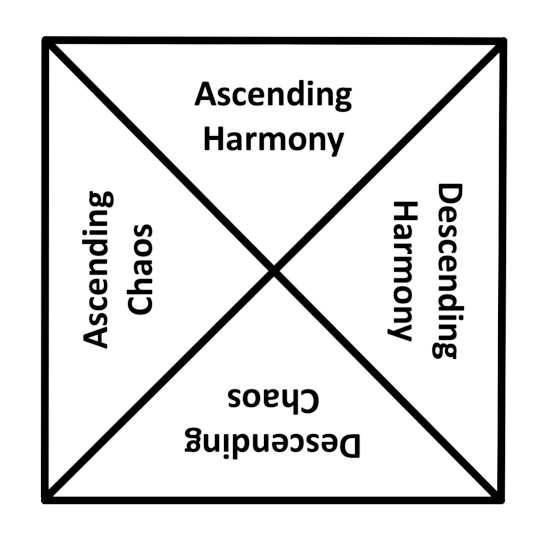
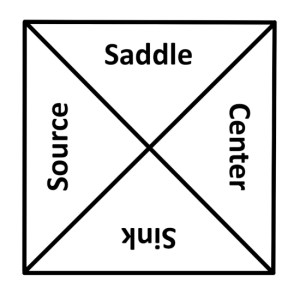
For two-dimensional dynamical systems, certain common elements can be mapped out: sources and sinks, saddles and centers. Sources have flows out from a point or region, and sinks have flows in. Saddles have a roughly stationary center, due to balanced flows in and out at (not necessarily) right angles. Centers are circular vortexes about a stationary point or region. Sources and sinks can spiral, saddles can twist, centers can become eccentric or elliptical.

For example, think about everyday weather forecasts. The atmosphere is relatively thin compared to the earth and so the flows of air can be considered two-dimensional, at least at the ordinary strata of human habitation. There are air pressure highs and lows (sources and sinks), and air temperature cold and warm fronts (usually not saddles though), stationary fronts (centers?), and even circulations (hurricanes are spiraling sinks I guess).

Ordinary, human-sized change has conditioned many of our intuitions and insights about the way the universe works. Heraclitus famously said that all was change, and so he thought fire was the primal element. His predecessor Thales thought that water was instead the basic element, and it is pretty mutable also. Lucretius, inspired by Empedocles, thought none of the four classical elements were foundational, but all were composed of tiny bits that fell and bounced against each other through an endless void.

As earth is in opposition to air, and fire to water, the seasonal changes of temperature and moisture were considered by Hippocrates. Heat gains dominion over cold in Spring and Summer, but cold replaces it in Fall and Winter. Similarly wet and dry quarters cycle through the seasons. These oppositions gave rise to the theory of the four temperaments or humourism. Even to this day these considerations have inspired various theories of personality, like the Myers-Briggs Assessment.

Is everything a struggle of opposites? Empedocles, already mentioned, thought love and strife were the relations that respectively attracted and repelled all matter in their dance and change. Now we know that things fall towards the earth, not for the love of it, but because of the shape of space that the earth’s mass makes. Heat flows into the cold because both even up. Order dissolves into chaos since the latter is more likely, unless fed by other sources of order turning to disorder.

Is everything a flow between opposites? Light spreads out and diminishes into darkness, but gravity gathers matter together. Enough gravity can even gather light and bind it into the darkness of a black hole. A drop of ink spreads out in a glass of water, never to return to that inky state, unless the glass sits and the water evaporates until only a drop remains. Even epidemics and pandemics can be thought to be flows of transmission and contagion. Here, the small becomes the large, and the few the many.

Further Reading:

https://en.wikipedia.org/wiki/Stability_theory

https://en.wikipedia.org/wiki/Four_temperaments

https://en.wikipedia.org/wiki/Process_philosophy

Also note that these four classifications are somewhat analogous to four valued logic: True is Source, False is Sink, None is Center, Both is Saddle.

[*12.52, *12.56]

<>
 

Conditional Branching is Not Necessary

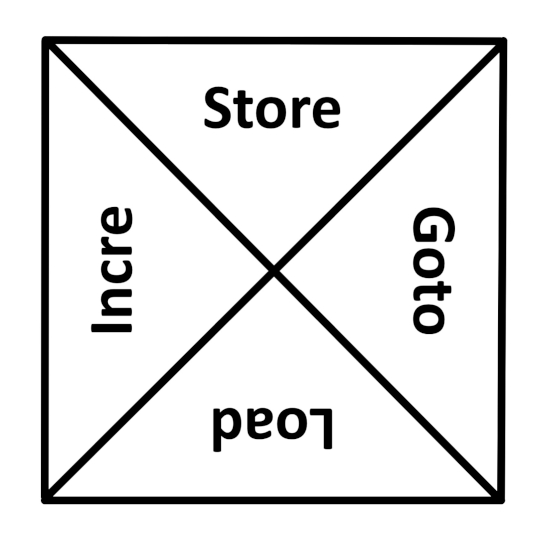
Four simple instructions are sufficient to evaluate any Turing computable function using self-modifying programs: LOAD, STORE, GOTO, INCREment.

Further Reading:

Raul Rojas / Conditional Branching is Not Necessary for Universal Computation in von Neuman Computers, Journal of Universal Computer Science 2,11 (1996) 756-768

William F. Gilreath, Phillip A. Laplante / Computer Architecture: A Minimalist Perspective

[*11.65]

<>

Scenario Thinking and Covid-19

Scenario Planning, Analysis, or Thinking is a technique for probing into possible futures when you are anticipating or overwhelmed by tumultuous challenges. One often starts by examining two factors that have both great Importance and Uncertainty and then considering two extremes of each. For their four different mixtures, you can posit causes, how to recover from bad outcomes, what actions would be favorable for all scenarios, etc. In other words, one can develop related stories about these different futures.

In these slides by authors Steven Weber and Arik Ben-Zvi, the two important and uncertain factors are Public Health and Economics, both affected by the Covid-19 pandemic, and for their initial purposes independent of each other. For public health, the disease could kill far more than estimated (a secondary wave) or kill less (vanish like a miracle). For the economic impact, the toll could be sustained (a long term depression) or the recovery could be relatively quick (v-shaped). So the two factors and their extremes are

    • Economic recovery is slow (depression, recession), or fast (v-shaped)
    • Health and death toll is worse (than estimates), or better (yay)

The four scenarios that are named are basically

    • Economy good, Health good: Americans Win
    • Economy bad, Health good: Fractured USA
    • Economy good, Health bad: Resilient USA
    • Economy bad, Health bad: Coronavirus Wins

and the scenario stories are told with respect to January of 2021 at the next state of the union address. Each of these scenarios are quite detailed and then followed by Insights and Implications for all. Often Scenario Thinking is used for more distant future analysis, but this shows it can be used for a mere nine months as well.

Further Reading:

https://www.linkedin.com/feed/update/urn:li:activity:6663482861041012737/

https://en.wikipedia.org/wiki/Scenario_planning

Continue reading Scenario Thinking and Covid-19

The Pi Calculus

My previous post on Wolfram’s physics mentioned the Pi calculus, but I liked this little diagram so much I decided to let it have its own mention. The rules aren’t really four in number, but oh well.

  • (νx)P: create a channel named x, then do P
  • x(y).P: receive y over channel x, then do P
  • x‾<y>.P: send y over channel x, then do P
  • P|Q: do P and Q at the same time
  • !P: do P over and over until stopped
  • 0: stop

Further Reading:

https://en.wikipedia.org/wiki/%CE%A0-calculus

https://en.wikipedia.org/wiki/Process_calculus

https://en.wikipedia.org/wiki/Game_semantics

https://golem.ph.utexas.edu/category/2009/08/the_pi_calculus.html

[*12.34]

<>


The Wolfram Physics Project

When I first started looking at Stephen Wolfram’s latest proposal to solve physics, I was somewhat disappointed. I was rather fond of his previous “New Kind of Science” based on the structural rigidity of cellular automata. However, I am now intrigued by his latest ideas, based on the looser but more flexible basis of networks.

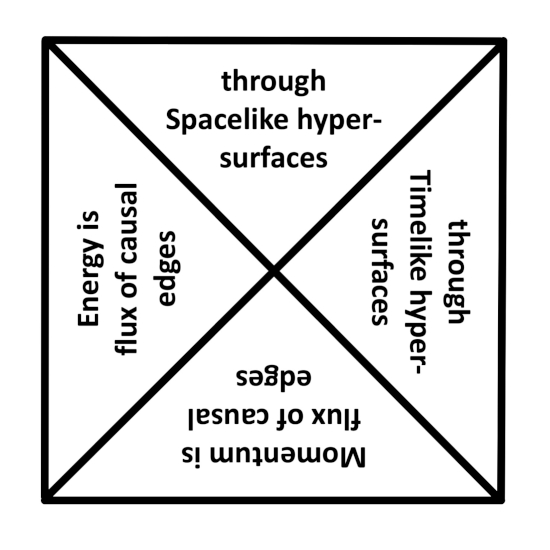
And once you have pithy statements with space, time, energy, and matter (as momenta), you catch my attention:

  • Energy is flux of causal edges
  • through Spacelike hypersurfaces
  • Momentum is flux of causal edges
  • through Timelike hypersurfaces

I confess I haven’t read much about the project yet, but it seems to be using rewriting rules, perhaps similar to the notion of rewriting in Wolfram’s previous framework, cellular automata. Of course, cellular automata and also rewriting rule systems can be computationally universal or Turing complete.

Another idea might be to try some sort of computational metaphysics between nodes like the pi-calculus (or some other process calculus). After all, you have to support quantum entanglement! However if you can encode everything with simpler structures then do it!

Further Reading:

https://www.wolframphysics.org/

https://www.wired.com/story/stephen-wolfram-invites-you-to-solve-physics/

How We Got Here: The Backstory of the Wolfram Physics Project

https://en.wikipedia.org/wiki/Digital_physics

https://www.scientificamerican.com/article/physicists-criticize-stephen-wolframs-theory-of-everything/

https://turingchurch.net/computational-irreducibility-in-wolframs-digital-physics-and-free-will-e413e496eb0a

View at Medium.com

Cellular automata:

https://en.wikipedia.org/wiki/Cellular_automaton

Note this quote for future reference:

The primary classifications of cellular automata, as outlined by Wolfram, are numbered one to four. They are, in order, automata in which patterns generally stabilize into homogeneity, automata in which patterns evolve into mostly stable or oscillating structures, automata in which patterns evolve in a seemingly chaotic fashion, and automata in which patterns become extremely complex and may last for a long time, with stable local structures. This last class are thought to be computationally universal, or capable of simulating a Turing machine.

Rewriting:

https://en.wikipedia.org/wiki/Rewriting

https://en.wikipedia.org/wiki/Semi-Thue_system

[*12.32]

<>

The Adaptive Cycle

As we all wonder how the current world order will be transformed by the Covid-19 pandemic, perhaps now would be a good time to read up on the Adaptive Cycle. Worried about societal and economic collapse, I was originally thinking about the notion of social cycles, but came across this more general notion of cycles within ecological systems. It is also applicable to insightful investigation of social institutions and organizations.

The Adaptive Cycle is usually shown as a figure-eight loop, with four main segments (Growth, Maturity, Release, and Renewal), inhabiting a space of two or three variables (Potential, Complexity, and Resilience):

  • Growth or Exploitation: (r)
  • Maturity or Conservation: (K)
  • Release or Collapse: (Ω)
  • Renewal or Reorganization: (α)

Thus these charts indicate a closed trajectory of a system’s state within a state space over time. This concept was originally applied to cycles within ecological systems, measuring certain attributes of systems in order to predict their ability to handle, recover, and adapt from significant disruptive changes in environment, species populations, genetic landscape, etc.

These cycles can form steps on chains of greater systems where an individual cycle is a quasi-stable element but the overall state can jump and grow to higher forms of complexity and potential, or indeed collapse and fall to lower forms if the resilience is weak. As well, the multiplicities of cycles can represent a range of spacial scales for systems that have smaller cycles nested within them, operating concurrently.

This greater notion of change within systems has been called Panarchy. In contrast to hierarchy or even anarchy, Panarchy is neither the top-down or bottom-up of the other two. Panarchy tries to describe how actual ecological and social systems can change and transform yet endure and return to similar states, across scales of space and time.

Further Reading:

https://en.wikipedia.org/wiki/C._S._Holling

https://en.wikipedia.org/wiki/Adaptive_capacity

https://en.wikipedia.org/wiki/Panarchy

https://www.resalliance.org/

https://www.resalliance.org/panarchy

https://www.sciencedirect.com/science/article/pii/S1476945X1830165X

View at Medium.com

Images of the Adaptive Cycle:

https://www.google.com/search?q=adaptive+cycle&tbm=isch

Images of Panarchy:

https://www.google.com/search?q=panarchy&tbm=isch

Social Cycle Theory

https://en.wikipedia.org/wiki/Societal_collapse

https://en.wikipedia.org/wiki/Social_cycle_theory

[*12.24]

<>

The Genetic Code

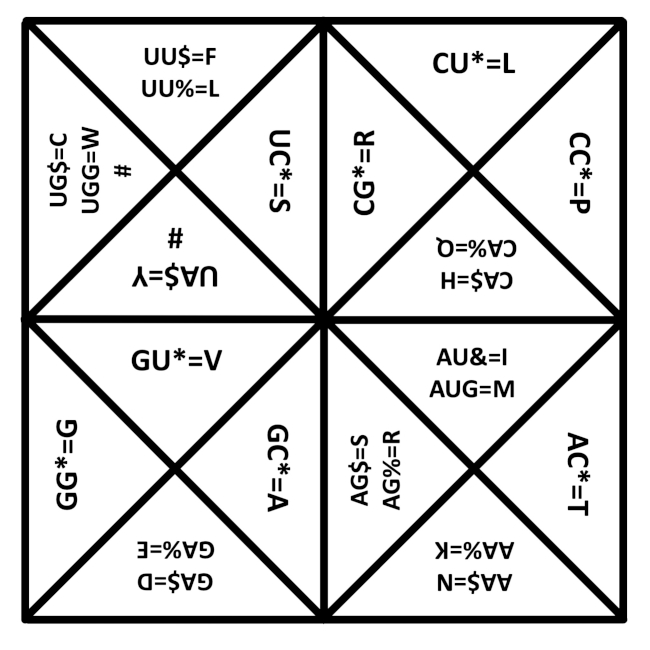
There are many ways to show the genetic code, the map between triplets of nucleotides and the amino acids of proteins. Here is one that may be a bit awkward to understand, but other more standard ones are easily found.

 First, here are the codes for the four nucleotides:

  • U = Uracil
  • C = Cytosine
  • A = Adenine
  • G = Guanine

As well, let

  • $ = U or C
  • % = A or G
  • & = U or C or A
  • * = U or C or A or G

And so, here are the amino acids and their nucleotide codes

A = Ala = Alanine = GC*
C = Cys = Cysteine = UG$
D = Asp = Aspartic Acid = GA$
E = Glu = Glutamic Acid = GA%
F = Phe = Phenylalanine = UU$
G = Gly = Glycine = GG*
H = His = Histidine = CA$
I = Ile = Isoleucine = AU&
K = Lys = Lysine = AA%
L = Leu = Leucine = UU% + CU*
M = Met = Methionine = AUG
N = Asn = Asparagine = AA$
P = Pro = Proline = CC*
Q = Gln = Glutamine = CA%
R = Arg = Arginine = CG* + AG%
S = Ser = Serine = UC* + AG$
T = Thr = Threonine = AC*
V = Val = Valine = GU*
W = Typ = Tryptophan = UGG
Y = Tyr = Tyrosine = UA$
# = Stop = UA% + UGA

Note that some letters encode both nucleotides as well as amino acids, which might be confusing.

Further Reading:

https://en.wikipedia.org/wiki/Genetic_code

[*10.146, *10.147]

<>

A Crystal Structure of the Main Protease of COVID-19

One can gain knowledge from words, but wisdom only from things.

— George Wald, Harvard biochemist and 1967 Nobel Laureate

Many images of the coronavirus SARS-CoV-2 (a.k.a. 2019/nCoV a.k.a. COVID-19) are in the media, with the colorful spiky ball motif being the most frequent. Above is a representation of one of its proteins, its main protease, which allows the virus to process the proteins created after it splices its own RNA genetic material into your cells.

The larger three lobed spiky proteins from which these types of viruses gets the name “corona” are responsible for grabbing onto and opening up the surface of (in this case) lung cells, so that this smaller protein can perform its function within the cell. In more detailed images, you may have seen it as small pairs of spheres on the viral surface.

Several different crystal structures of  various proteins of COVID-19 have been solved and released recently, including this main protease and the spiky protein peplomers. Studies of these structures will hopefully lead scientists to discover inhibitors to their functions and thus treatments and preventive measures. Go science!

Unfortunately, these results will come much too late for many of us. Science could have also helped us with the initial defense against this deadly virus, but the powers that be deigned to consider the gravity of our plight. And even today many such leaders and spokespersons are ignoring important information and spreading misinformation.

Further Reading:

https://www.rcsb.org/structure/6M03

https://pdb101.rcsb.org/motm/242

https://science.sciencemag.org/content/early/2020/03/19/science.abb3405

COVID-19: Main protease of SARS-CoV-2 decoded

https://en.wikipedia.org/wiki/Coronavirus

https://en.wikipedia.org/wiki/Coronavirus_disease_2019

https://en.wikipedia.org/wiki/Portal:Coronavirus_disease_2019

https://www.theatlantic.com/health/archive/2020/03/how-will-coronavirus-end/608719/

<>


The Frauchiger-Renner Paradox

“The new experiment shows that, in a quantum world, two people can end up disagreeing about a seemingly irrefutable result, such as the outcome of a coin toss, suggesting something is amiss with the assumptions we make about quantum reality.”

— From the Quanta article by Anil Ananthaswamy

As above, so below.

As we face the deadly onslaught of electron-microscopy-sized agents, remember to wash your hands for twenty seconds, follow physical distancing rules of six feet or more, and please be safe.

Further Reading:

https://www.quantamagazine.org/frauchiger-renner-paradox-clarifies-where-our-views-of-reality-go-wrong-20181203/

https://algassert.com/post/1904

https://arxiv.org/abs/2002.01456

https://www.scientificamerican.com/article/reimagining-of-schroedingers-cat-breaks-quantum-mechanics-mdash-and-stumps-physicists1/

https://en.wikipedia.org/wiki/Wigner%27s_friend

Schrödinger’s Cat

[*11.12]

<>

The Prospect Theory of Kahneman and Tversky

Like it or not, we are all betting individuals. But what interactions are there between the perceived and actual probabilities of things happening and the choices made for or against them? The likelihood of their occurrence, coupled with the size of the gains or losses from anticipating and acting on them, show that people are not entirely the rational agents that we think they are.

Instead of armchair introspection, careful experimental methods were used to give us these (not so) unexpected results. What is demonstrated is that deciding individuals make asymmetric choices based on their poor understanding of relative likelihoods. All sorts of biases and poor thinking on our part contribute to non-rational evaluations of how we end up choosing between alternatives.

The findings are that the near certainty of events happening is undervalued in our estimation, and the merely possible is overvalued. So those things very likely to occur have a diminished weight in our minds, and those things unlikely but possible have an increased weight. These are called the certainty effect and the possibility effect, respectively.

  • Likely Gain (Fear)
  • Likely Loss (Hope)
  • Maybe Gain (Hope)
  • Maybe Loss (Fear)

This asymmetry in valuation leads fearful individuals to accept early settlements and buy too much insurance, or hopeful individuals to buy lottery tickets and play the casino more often then they should if choosing optimally. What factors contribute to this behavior? Emotions, beliefs, and biases, probably all play a role in these perceived payoffs between dread and excitement.

In some “Dirty Harry” movie, the lead character essentially asks “do you feel lucky, punk?”, to goad another into taking a risk. In the movie “War Games”, the supercomputer more or less temptingly asks, “would you like to play a game?”, to encourage the playing of unwinnable matches. Watch out for those that know how to play the odds of hope and fear to manipulate our prospects and decisions.

Further Reading:

https://theoryofself.com/the-four-fold-pattern-decisions-under-risk-e4e634eefc61

https://en.wikipedia.org/wiki/Prospect_theory

View at Medium.com

Daniel Kahneman / Thinking Fast and Slow

[*11.180]

<>