Category Archives: Philosophy

Schopenhauer’s Fourfold Root of the Principle of Sufficient Reason

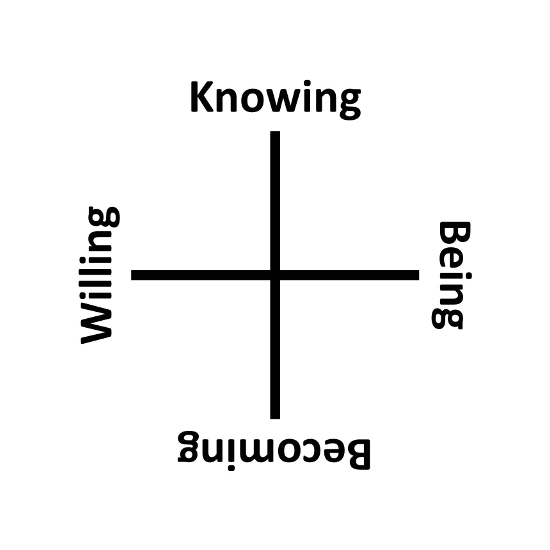
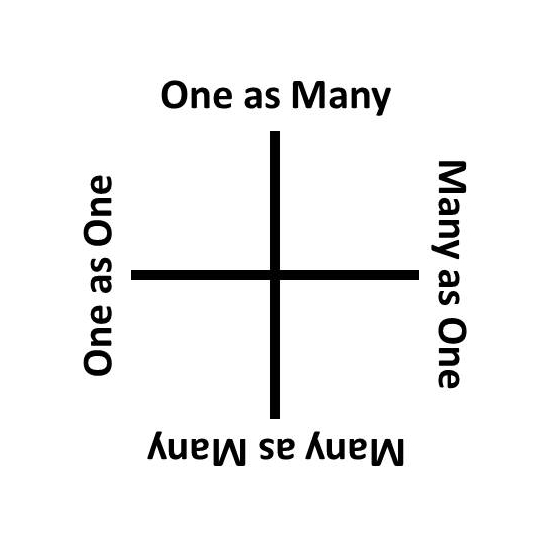
Schopenhauer’s Four Classes that comprise his Fourfold Root of the Principle of Sufficient Reason are diagrammed above. Becoming, Knowing, Being, and Willing are these classes.

From Wikipedia:

In his Translator’s Introduction to Schopenhauer’s The World as Will and Representation, E. F. J. Payne concisely summarized the Fourfold Root.

Our knowing consciousness…is divisible solely into subject and object. To be object for the subject and to be our representation or mental picture are one and the same. All our representations are objects for the subject, and all objects of the subject are our representations. These stand to one another in a regulated connection which in form is determinable a priori, and by virtue of this connection nothing existing by itself and independent, nothing single and detached, can become an object for us. …The first aspect of this principle is that of becoming, where it appears as the law of causality and is applicable only to changes. Thus if the cause is given, the effect must of necessity follow. The second aspect [knowing] deals with concepts or abstract representations, which are themselves drawn from representations of intuitive perception, and here the principle of sufficient reason states that, if certain premises are given, the conclusion must follow. The third aspect of the principle is concerned with being in space and time, and shows that the existence of one relation inevitably implies the other, thus that the equality of the angles of a triangle necessarily implies the equality of its sides and vice versa. Finally, the fourth aspect [willing] deals with actions, and the principle appears as the law of motivation, which states that a definite course of action inevitably ensues on a given character and motive.

Further Reading:

http://en.wikipedia.org/wiki/On_the_Fourfold_Root_of_the_Principle_of_Sufficient_Reason

http://en.wikipedia.org/wiki/The_World_as_Will_and_Representation

http://plato.stanford.edu/entries/sufficient-reason/

Notes:

Replace “Willing” with “Acting”

[*4.106, *7.188]

<>

E. F. Schumacher’s Four Fields of Knowledge

This fourfold is created from the product of two duals: Self & World, and Inner Experience & Outer Appearance.

  • The Inner Experience of Self is Experience.
  • The Outer Appearance of Self is Behavior.
  • The Inner Experience of World is Communication.
  • The Outer Appearance of World is Science.

The first fourfold is very similar to Hjelmslev’s Net, where Content is Inner Experience, Expression is Outer Appearance, Substance is unitary “Self”, and Form is multiplicity “World”.

It is also almost identical to Ken Wilbur’s AQAL as presented here.

References:

E. F. Schumacher / A Guide for the Perplexed

http://en.wikipedia.org/wiki/A_Guide_for_the_Perplexed

http://www.integralworld.net/edwards2.html

[*7.88, *7.174, *7.176]

<>


Things, Thoughts, Words, and Actions

Here are some additional fourfolds from philosopher Richard McKeon.

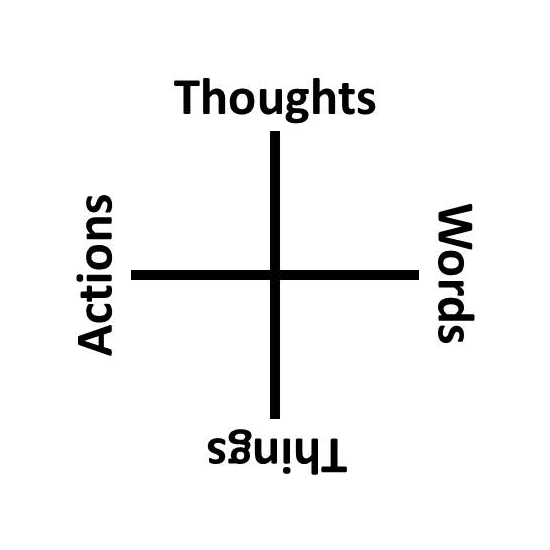
McKeon wrote much on the subject of rhetoric. A favorite fourfold of concepts was that of Things, Thoughts, Words, and Actions. He called these “commonplaces of inquiry” or “places of invention and memory”. Two rhetorical devices he used were amplification and schematization. Amplification can extend the scope of, for example, words to the other three, similar to the principle of indifference. “Objectivity is the inclusive principle of indifference by which it is recognized that being is grasped only in what we think, and say, and do about it.” [1] Schematization was used to identify and distiguish, for example, commonplaces. Thus I think amplification is a conjunctive device, and schematization is a disjunctive device.

Another fourfold of subjects by McKeon was Topics, Themes, Theses, and Hypotheses. McKeon wrote, “Speculation concerning discourse must avoid the fixities of categories, doctrines, methods, and assumptions which discourse assumes in any one form of philosophy or inquiry, if it is to include all the forms which discourse takes in philosophy and in inquiry, action, and production. This is possible because the variety of categories or elements is approached in discourse by way of common topics or ‘commonplaces’; the variety of facts or statements of what is the case by way of common hypotheses; the variety of arts or methods of treating problems by way of common themes; and the variety of assumptions or principles by way of common theses.” [2]

Are both these fourfolds aligned correctly with the previous Knowable, Knowledge, Known, and Knower? McKeon’s use of terms in his rhetoric was very fluid, perhaps to prevent systemization or to promote pluralism. However, his main reference to fourfolds was Aristotle’s four scientific questions, or Four Causes, which we can use to try to understand his fourfolds.

References:

Theresa Enos (ed.) / Encyclopedia of Rhetoric and Composition: Communication from Ancient Times to the Information Age

[1] Richard McKeon / Selected Writings of Richard McKeon: Volume One: Philosophy, Science, and Culture

[2] Richard McKeon / Selected Writings of Richard McKeon, Volume Two: Culture, Education, and the Arts

Click to access McKNotes-Semantics&Inquiry_Intro.pdf

H. L. Ulman / Things, Thoughts, Words, and Actions: the problem of language in late Eighteenth-Century British rhetorical theory

[*5.197, *6.140, *7.162, *7.165]

<>


The Stone Gamut

Our thesis is that the category Set is the ultimate abstraction of body, and that Set^op, equivalent to the category of complete atomic Boolean algebras (i.e. power sets), which we shall advocate thinking of as antisets, is dually the ultimate abstraction of mind.

— From Chu Spaces: automata with quantum aspects by Vaughan Pratt

Reflecting an era of reduced expectations for the superiority of humans, we have implemented causal interaction not with the pineal gland but with machinery freely available to all classical entities, whether newt, pet rock, electron, or theorem (but not quantum mechanical wavefunction, which is sibling to if not an actual instance of our machinery).

— From Rational Mechanics and Natural Mathematics by Vaughan Pratt

http://en.wikipedia.org/wiki/Boolean_algebra

http://en.wikipedia.org/wiki/Distributive_lattice

http://en.wikipedia.org/wiki/Vector_space

http://en.wikipedia.org/wiki/Partially_ordered_set

http://en.wikipedia.org/wiki/Set_%28mathematics%29

References:

Click to access ph94.pdf

Click to access ratmech.pdf

http://chu.stanford.edu/

http://en.wikipedia.org/wiki/Chu_space

Vaughan Pratt / The Stone Gamut: a coordinatization of mathematics

https://ieeexplore.ieee.org/document/523278

[*7.140]

<>

The Archic Philosophers

In a word, the Sophist begins from man, the Democritean from matter, the Platonist from form, and the Aristotelian from functioning.

— From The Architectonics of Meaning, by Walter Watson

Inspired by philosopher Richard McKeon, I believe that philosophy as a whole is encompassed by four main philosophical stances, exemplified by four ancient philosophers: the Sophists (as a group), Democritus, Plato, and Aristotle. Their four systems of thought lay out principal philosophical directions, much like the compass directions east, south, north, and west lay out a complete set of primary directions.

Of course the compass directions can be subdivided into north-east, or south-south-west, and so on, and similarly each of these philosophical systems can be divided into four parts. This division into a four-by-four matrix is called the Archic Matrix and was written about at length in the separate but complementary works of Walter Watson and David Dilworth.

Watson and Dilworth described the four main philosophical directions to be perspective, reality, method, and principle: perspective for the Sophists, reality for Democritus, method for Plato, and principle for Aristotle. I have written about these philosophical perspectives previously in several ways.

Thus philosophy as a practice goes around and around and revisits the same ideas over and over. Perhaps McKeon thought his philosophical system followed in the footsteps of Aristotle, and probably Watson and Dilworth had a similar view.

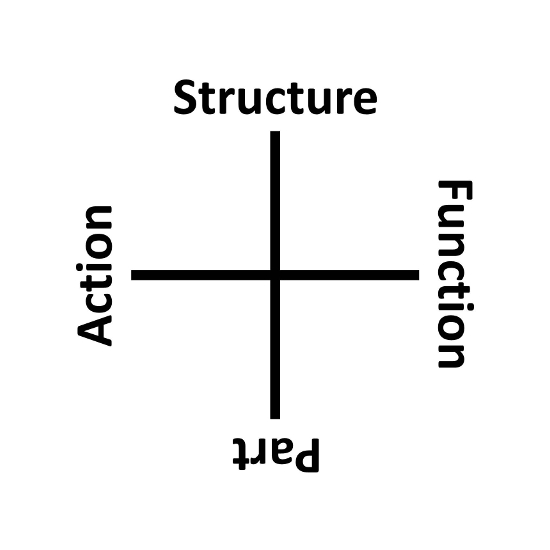
Likewise, I believe that my fourfold of Structure-Function represents these four philosophical directions in the following way: Action(s) for the Sophists, Part(s) for Democritus, Structure for Plato, and Function for Aristotle.

[*6.108]
<>


The Duality of Time and Information, V2

The states of a computing system bear information and change time, while its events bear time and change information.

from The Duality of Time and Information by Vaughan Pratt

The most promising transformational logic seems to us to be Girard’s linear logic.

— from Rational Mechanics and Natural Mathematics by Vaughan Pratt

Here we have three duals: information – time, state – event, and bear – change.

References:

Vaughan Pratt / The Duality of Time and Information http://boole.stanford.edu/pub/dti.pdf

Vaughan Pratt / Time and Information in Sequential and Concurrent Computation http://boole.stanford.edu/pub/tppp.pdf

Vaughan Pratt / Rational Mechanics and Natural Mathematics http://chu.stanford.edu/guide.html#ratmech

[*5.170]

<>

Epistemic Virtues of Objectivity

I recently finished reading Lorraine Daston and Peter Galison’s “Objectivity”. In this very interesting book, the authors argue that the notion of scientific objectivity has evolved over time. They have divided the course of this evolution into three main phases: truth-to-nature, mechanical objectivity, and trained judgement. During each phase, the main view of objectivity is dominant, but previous phases are still important to the overall idea of what objectivity means in the scientific community.

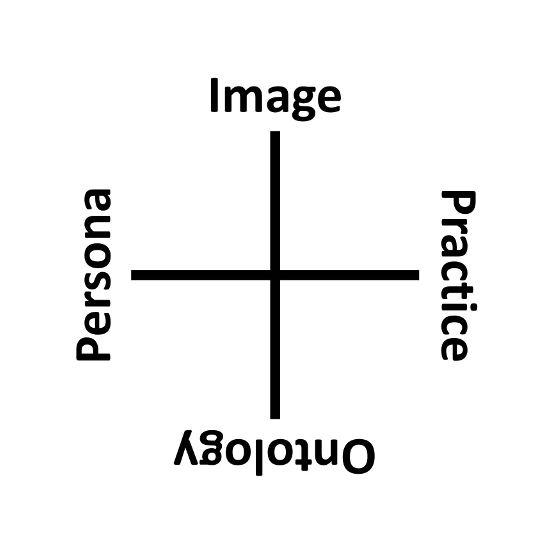
The epistemological virtues of objectivity can be divided into four major aspects: persona, ontology, image, and practice. For each phase of objectivity, each aspect has different qualities. For instance, the scientific persona becomes a sage during the truth-to-nature phase, a worker during the mechanical objectivity phase, and an expert during the trained judgement phase. Similarly, the ontology aspect passed through the qualities of universals-particulars-families, the image aspect passed through reasoned-mechanical-interpreted, and practice  passed through the stages selection and synthesis-automated transfer-pattern recognition.

The evolutionary phases of objectivity, as well as the qualities of the epistemological virtues seen as the four aspects, is beautifully shown by many examples from a collection of scientific atlases. Anyone interested in the history of science as well as the notion of scientific objectivity should enjoy this book.

I thought it was also remarkable that these four aspects of objectivity were very similar to the four aspects of the Archic Matrix of Watson and Dilworth.

Further Reading:

Lorraine Daston and Peter Galison / Objectivity

[*7.106]

<>


Bending the Elements

You and your forefathers have devastated the balance of this world. And now, you shall pay the ultimate price!

— From Avatar: the Last Airbender

I recently finished watching the animated series “Avatar: the Last Airbender”. I know I’m a bit late with my praise, but I thought this was an excellent series. It had fascinating world-building, well thought-out plotting, and believable characterization. It had humor, drama, fantasy, even teen romance. Something for all ages!

It could be because I’ve been thinking alot about the Four Elements and how I view them as analogies for the four relations I’ve been discussing for some time on this blog. In Avatar, they are literally the four elements of the world: fire, earth, water, and air. But in addition, these elements correspond to the four peoples of this world. The people of the Fire Nation are willful, the people of the Earth Kingdom are resolute, the people of the Water Tribe are empathic, and the people of the Air Nomads are reflective. Some individuals are able to “bend” the element that is associated with the people they are born into, so that for example a member of the Fire Nation might be able to produce and control fire with thought and gesture. Not everyone has this ability, however.

The Avatar is a continuously reincarnated individual that embodies the spirit of the world. He or she is born into each of the four peoples in a repeating cycle, but the Avatar is also the only individual that can learn to bend all four elements, and even all at the same time. Because of his or her unique powers, the Avatar is known to be able to bring and restore balance to the world, and to tie the real world to another, spiritual world. Avatar: the Last Airbender is the story of Aang, a descendent of the Air Nomads, but the last of his people due to genocide. He has been in a state of suspended animation for the last 100 years and awakes to a troubled world of war and turmoil. Can Aang save his world?

Hopefully I’m not spoiling anything in saying that he does. Indeed a sequel is currently being produced called “The Legend of Korra” that is planned to run 52 episodes. This sequel takes place a number of years after the end of Avatar, and the next Avatar after Aang is Korra from the Southern Water Tribe. The world is now somewhat more advanced technologically than it was during Aang’s time, and although not at war because it is still enjoying the peace that Aang initiated, there is still some strife and unrest for Korra to eventually bring the Avatar’s balance to. I am enjoying it also!

http://en.wikipedia.org/wiki/Avatar:_The_Last_Airbender

http://en.wikipedia.org/wiki/The_Legend_of_Korra

Note:

It is interesting to note that fire is the only element that can be generated by the will ex nihilo. With enough skill, water can be extracted from living matter and the air. Of course, air is ever present and earth is seldom far away.

<>

Structure-Function

Aristotle’s Four Causes is an important fourfold that seems to be the basis for many of the fourfolds, both original and not, presented in this blog. Two of the causes, efficient and material, are acceptable to modern scientific inquiry because they can be thought of as motion and matter, respectively, but the other two causes, formal and final, are not. Why is that?

The formal cause is problematic because the formal is usually considered to be an abstract concept, a construction of universals that may only exist in the human mind. The final cause is also problematic because it is associated with the concept of telos or purpose. There, too, only human or cognitive agents are allowed to have goals or ends. So for two causes, efficient and material, all things may participate in them, but for the two remaining, formal and final, only agents with minds may.

These problems may be due to the pervasive influence of what the recent philosophical movement of Object Oriented Philosophy calls correlationism: ontology or the existence of things is limited to human knowledge of them, or epistemology. The Four Causes as usually described becomes restricted to the human creation and purpose of things. Heidegger’s Tool Analysis or Fourfold, which also appears to have been derived from the Four Causes, is usually explained in terms of the human use of human made things: bridges, hammers, pitchers. Even scientific knowledge is claimed to be just human knowledge, because only humans participate in the making of this knowledge as well as its usage.

Graham Harman, one of the founders of Speculative Realism of which his Object Oriented Ontology is a result, has transformed Heidegger’s Fourfold so that it operates for all things, and so the correlationism that restricts ontology to human knowledge becomes a relationism that informs the ontology for all things. Instead of this limiting our knowledge even more, it is surprising what can be said about the relations between all things when every thing’s access is as limited as human access. However, this transformation is into the realm of the phenomenological, which is not easily accessible to rational inquiry.

I wish to update the Four Causes, and claim that they can be recast into a completely naturalistic fourfold operating for all things. This new version was inspired by the Four Operators of Linear Logic. Structure and function are commonplace terms in scientific discourse, and I wish to replace formal and final causes with them. It may be argued that what is obtained can no longer be properly called the Four Causes, and that may indeed be correct.

First, let us rename the efficient cause to be action, but not simply a motion that something can perform. I’m not concerned at the moment with whether the action is intentional or random, but it must not be wholly deterministic. Thus there are at least two alternatives to an action. I’m also not determining whether one alternative is better than the other, so there is no normative judgement. An action is such that something could have done something differently in the same situation. This is usually called external choice in Linear Logic (although it makes more sense to me to call it internal choice: please see silly link below).

Second, let us call the material cause part, but not simply a piece of something. Instead of the material or substance that something is composed of, let us first consider the parts that constitute it. However, a part is not merely a piece that can be removed. A part is such that something different could be substituted for it in the same structure, but not by one’s choice. Like an action, I am not concerned whether one of the alternatives is better than the other, but only that the thing is still the thing regardless of the alternative. This is usually called internal choice.

Next, we will relabel the formal cause to be structure, but not simply the structure of the thing under consideration. Ordinarily structure is not a mere list of parts, or a set of parts, or even a sum or integral of parts, but an ordered assembly of parts that shapes a form. Ideally structure is an arrangement of parts in space. However, in this conceptualization, structure will be only an unordered list of parts with duplications allowed.

Last, instead of final cause we will say function, but not simply the function of the thing as determined by humans. Ordinarily function is not a mere list of actions, or a set of actions, or a sum or integral of actions, but an ordered aggregate of actions that enables a functionality. Ideally function is an arrangement of actions in time. However, like structure, function will be only an unordered list of actions with duplications allowed.

As we transform the Four Causes from made things to all things, both natural and human-made, we will later examine how that changes them.

References:

http://en.wikipedia.org/wiki/Speculative_realism

http://en.wikipedia.org/wiki/Object-oriented_ontology

http://en.wikipedia.org/wiki/Graham_Harman

http://wiki.cmukgb.org/index.php/Internal_and_External_Choice

[*6.144, *7.32, *7.97]

<>
 

The One and the Many

A set is a Many that allows itself to be thought of as a One.

— Georg Cantor

How to solve the ancient problem of the one and the many?

Is the one just one, and the many merely many? Or can the one contain the many, and the many reveal the one?

Many fourfolds have been shown here. Are they different aspects of  one, greater fourfold?

Or are they completely separate, incomparable and  incommensurate, except for their common cardinality?

http://plato.stanford.edu/entries/problem-of-many/

[*4.84]

<>