Category Archives: Philosophy

Richard McKeon’s Aspects of Knowing, Part 2

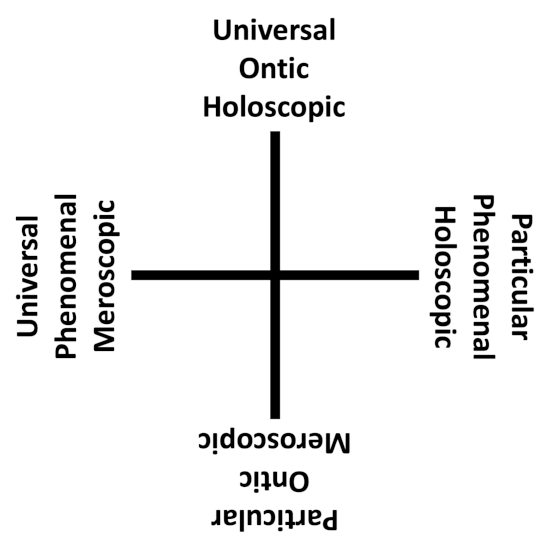
The duals in Richard McKeon’s system of Philosophical Semantics can also be arranged in a three-dimensional tetrahedron, where the dual pairs are on opposing edges. The universal and particular methods, the phenomenal and ontic interpretations, and the meroscopic and holoscopic principles are shown above.

Universal methods, between knower and knowledge, are applicable to all problems and all subject matters. Particular methods, between the knowable and the known, require distinct methodological procedures for different problems or subject matters.

Holoscopic principles, looking at or seeing the whole, provide a coincidence of knowledge and known. Meroscopic principles, looking at or seeing the parts, separate the knower and the knowable from each other and from influence between each other.

Ontic interpretations, between the knowable and knowledge, derive their character from a reality assumed to transcend or to underlie phenomena and statements. Phenomenal interpretations, between knower and the known, may reduce reality and values to aspects or consequences of phenomena.

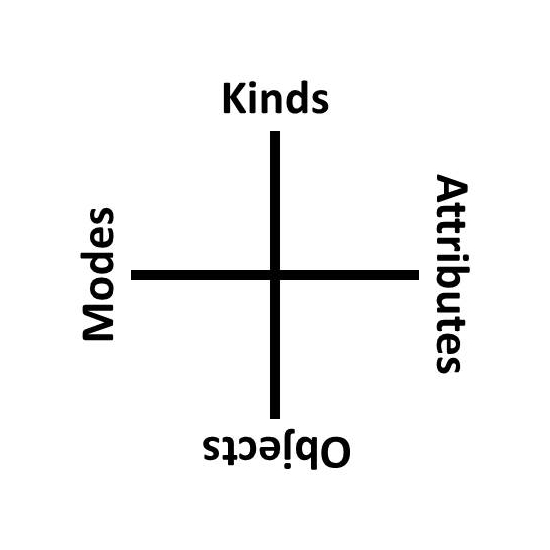
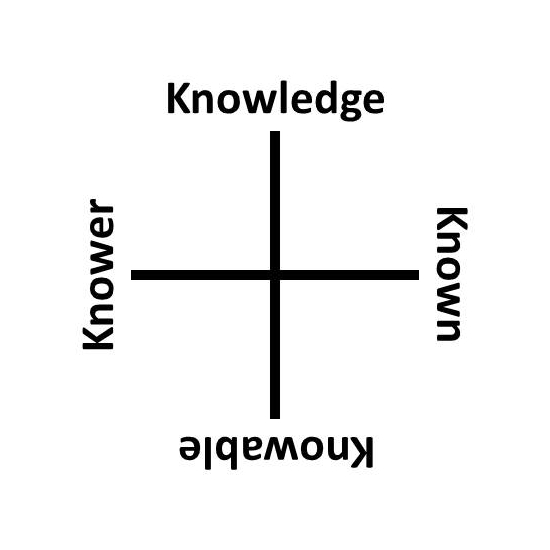
Alternatively, the four vertices of  knower, knowledge, known, and knowable can be labeled by their method, principle, and interpretation as shown below.

References:

http://www.richardmckeon.org/

http://en.wikipedia.org/wiki/Richard_McKeon

[*6.136]

<>

Graham Harman’s Quadruple Object

Graham Harman’s book The Quadruple Object is now available in English, and hopefully it will clarify some of the questions I have about his metaphysics. I have made an attempt at orienting his fourfold of real object, sensual object, real qualities, and sensual qualities with respect to the other fourfolds presented here. The fourfold object emerges from Harman’s analysis of Heidegger’s das Geviert.

Further Reading:

Graham Harman / Guerrilla Metaphysics: phenomenology and the carpentry of things

Graham Harman / Prince of Networks: Bruno Latour and metaphysics

Graham Harman / The Quadruple Object

<>

E. J. Lowe’s Four Category Ontology

References:

E. J. Lowe / The Four-Category Ontology: a metaphysical foundation for natural science

http://en.wikipedia.org/wiki/E.J._Lowe

https://ndpr.nd.edu/reviews/the-four-category-ontology-a-metaphysical-foundation-for-natural-science/

Lowe, Edward Jonathan

http://www.informationphilosopher.com/solutions/philosophers/lowe/

[*4.94, *6.98]

<>

John R. Searle’s Epistemological and Ontological Senses of Objective and Subjective

References:

John R. Searle / The Construction of Social Reality

http://lafavephilosophy.x10host.com/subjective_objective.html

[*5.198]

<>

Kolb’s Learning Cycle

There seems to be many different so-called learning cycles, but I think Kolb’s matches my other double duals most closely.

David A. Kolb / Experiential Learning : experience as the source of learning and development

References:

http://www.businessballs.com/kolblearningstyles.htm

[*6.38, *6.88, *6.134, *8.93]

<>


Richard McKeon’s Aspects of Knowing

Richard McKeon’s system of Philosophical Semantics arises from the sixteen pairwise and ordered relations between his four aspects of knowing or cognates: knower, knowledge, the known, and the knowable. These sixteen relations can be sorted in four groups of four elements each: methods, interpretations, principles, and selections.

Between knower and knowledge, and between the knowable and the known, arise the four methods of two each: the universal and the particular.

  • From knower to knowledge, the operational method.
  • From knowledge to knower, the dialectical method.
  • From the knowable to the known, the logistic method.
  • From the known to the knowable, the problematic method.

Between knower and the known, and between the knowable and knowledge, arise the four interpretations of two each: the phenomenal and the ontic.

  • From knower to the known, the existential interpretation.
  • From the known to knower, the essential interpretation.
  • From the knowable to knowledge, the entitative interpretation.
  • From knowledge to the knowable, the ontological interpretation.

Between knower and the knowable, and between knowledge and the known, arise the four principles of two each: the meroscopic and the holoscopic.

  • From knower to the knowable, the actional principle.
  • From the knowable to knower, the simple principle.
  • From knowledge to the known, the comprehensive principle.
  • From the known to knowledge, the reflexive principle.

Between each of the aspects of knowing with itself, arise the four selections.

  • From knower to itself, the perspectival selection.
  • From knowledge to itself, the transcendental selection.
  • From the knowable to itself, the reductive selection.
  • From the known to itself, the functional selection.

Each method can be associated with a discursive process: operational with debate, dialectical with dialogue, logistic with proof, and problematic with inquiry. Each method is also associated with a mode of thought which in turn has two moments and one dependency or assumption: the operational method is debate by discrimination and postulation dependent on chosen theses, the dialectical method is dialogue by assimilation and exemplification dependent on changeless models, the logistic method is proof by construction and decomposition dependent on indivisible constituents, and the problematic method is inquiry by resolution and question dependent on discoverable causes.

References:

Richard McKeon / On Knowing–The Natural Sciences

Richard McKeon / Freedom and History and Other Essays: an introduction to the thought of Richard McKeon

Sadly, the following pages are no longer available:

http://net-prophet.net/mckeon/mckeon.htm

http://forums.abrahadabra.com/showthread.php?2331-Unifying-Astrology-and-I-Ching

[*4.47, *5.184-*5.187, *6.20, *6.106]

<>


Arthur M. Young’s Fourfold Theory of Process

I have recently come across the philosophical work of Arthur M. Young (AMY). This is an initial impression of that work since I have only read what is available from the web links below, and even then there is a great deal to digest. In addition, there is difficulty in presenting a summary of his theory because of similarities to my ideas as well as substantial differences. I am sure I will need to return to AMY’s theory after more consideration.

I have hinted at a correspondence between several double duals presented in this blog, but I have steered away from claiming that they are all linked to each other – that they are essentially equivalently exchangeable. AMY’s theory links the four elements, the four causes, Jung’s functions of the psyche, geometrical elements and transformations, as well as several other fourfolds into a cosmic theory of reality.

Some of these same fourfolds are present in my theory, and I am considering how others may be introduced. Some not mentioned by AMY are only mentioned in earlier entries on this blog, without presentation. However, from many of these same fourfolds I have reached substantially different conclusions from AMY. I believe this is because AMY’s theory of process is essentially dualistic, whereas my theory appears to be physicalistic, although one might also say it is a process and/or relational theory.

Below is a table of some of the correspondences for AMY’s theory of process:

Aristotle’s
Four
Causes
Jung’s
Functions
of the Psyche
Four
Elements of
Empedocles
Geometric
Transform-
ations
Purpose Final Intuition Fire Rotation Spirit
Value Material Emotion Water Scale Soul
Form Formal Intellect Air Inversion Mind
Object Efficient Sensation Earth Translation Body

Below is a table of some of the correspondences for my theory:

Four Elements
of Empedocles
The Here and
the Now
Aristotle’s
Four Causes
Duality of
Time and
Information
Hjelmslev’s
Net
Fire Before Efficient Change time Substance
of content
Water After Final Bear time Form of
content
Air Above Formal Bear
information
Form of
expression
Earth Below Material Change
information
Substance
of expression

References:

Arthur M. Young / The Reflexive Universe

Arthur M. Young / The Geometry of Meaning

http://www.arthuryoung.com/barr.html

http://www.arthuryoung.com/4levels.html

http://www.arthuryoung.com/the2exc.html

[*6.84-*6.89, *7.78, *7.79, *8.2, *8.62, *8.63]

<>

Hjelmslev’s Net

“God is a lobster, or a double pincer, a double bind.”

— From A Thousand Plateaus by Deleuze and Guattari
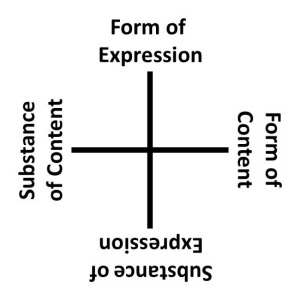
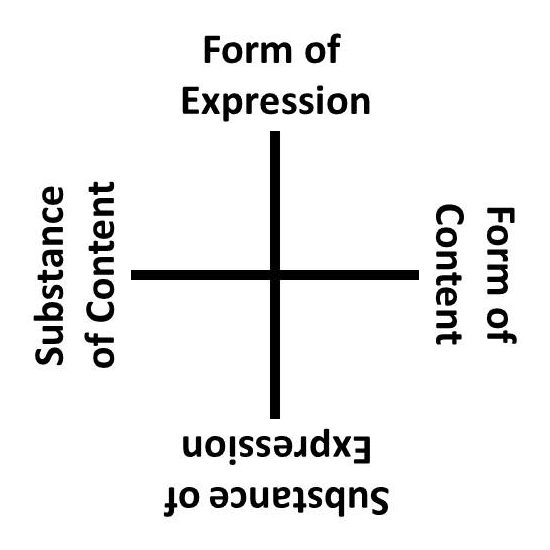
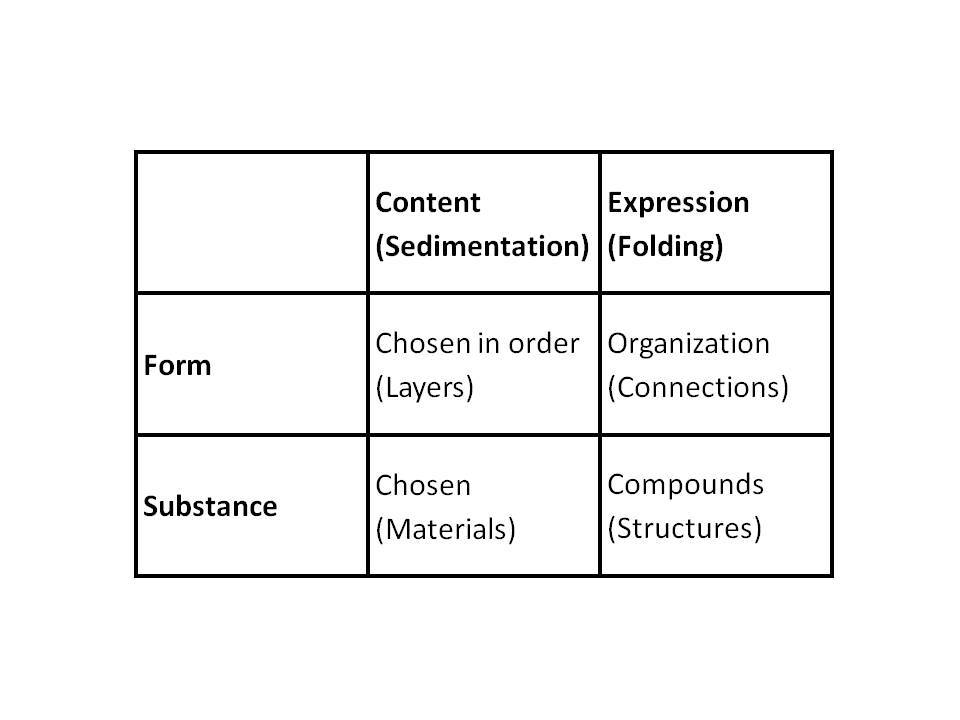
Linguist Louis Hjelmslev developed a semiotic model which elaborated Saussure’s two part signifier and signified into the double dual of the substance of content, the form of content, the substance of expression, and the form of expression. Contents are “formed matters”, and expressions are “functional structures”. Both are further separated into a substance and a form. The original signifier can be considered the form of expression, while the original signified can be considered the form of content. The two types of forms are like a net of warp and woof (why else a net?), dividing an undifferentiated unformed matter (Earth, purport) into two types of substances.

Deleuze and Guattari cast this net from Hjelmslev’s use in language into universal application by way of examples in geology and biology: sedimentation/folding and molecular genetics. The two planes of content and expression are the First Articulation and Second Articulation, respectively, the first of which “chooses or deducts”, and the second of which establishes “functional, compact, stable structures”. In their geology example, the First Articulation is the process of sedimentation, and the Second, folding. Generally, the two substances deal with territorialization, deterrritorialization, and reterritorialization, and the two forms are concerned with coding and decoding (and recoding?).

Additionally, there is talk of the molar versus the molecular (as continuous/discrete or unity/multiplicity?) but the molar is not form, nor is the molecular substance, nor vice versa. The First Articulation moves from molecular substances to molar forms; the Second Articulation moves from molecular forms to molar substances. How confusing! What does it all mean? One could spend a lifetime lost in these fun-house reflections!

I propose that the four basic logical operators of Linear Logic are in correspondence to the double articulation of Hjelmslev’s Net.  Content is Conjunction, Expression is Disjunction, Substance is Additive, and Form is Multiplicative. Content and Expression is Substance or Form; Conjunction and Disjunction is Additive or Multiplicative.

References:

Gilles Deleuze and Felix Guattari / A Thousand Plateaus: capitalism and schizophrenia

Manuel De Landa / The Geology of Morals: a neo-materialist interpretation http://www.t0.or.at/delanda/geology.htm

Luke Feast / The Science of Multiplicities: post-structuralism and ecological complexities in design http://researcharchive.vuw.ac.nz/handle/10063/142

[*3.170, *4.46, *4.88, *4.112, *4.146, *5.70, *5.174, *6.10]

<>

Monism = Pluralism

PLURALISM = MONISM

– From A Thousand Plateaus by Deleuze and Guattari
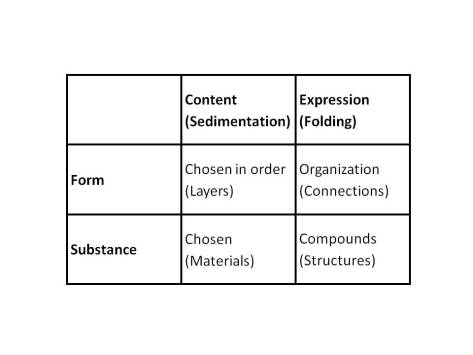
Jeffrey Bell’s blog entry about William James’ radical empiricism reveals relations between Hjelmslev’s Net and Linear Logic. To begin with, Hume was concerned with disjunctive relations (of expression) to the exclusion of conjunctive relations (of content). In addition, James sought the solution to the problem that consciousness (here content) has between the “one and the many”, one consciousness in relation to many consciousnesses. Unable to resolve this problem, James did not realize that conjunction can come in two modes, an additive one and a multiplicative one, a substance and a form.

The substance of content (here consciousness, agency, …) is constituted incrementally from choices between actions, either thoughts (thoughts-as-action) or actual actions (actions-as-action). This is additive AND. The form of content (essence, existence) is assembled by the ordering of those choices, a multiple choice of choices. This is multiplicative AND. These are the powers of AND.

However, Hume’s disjunction (expression) also comes in two flavors: additive and multiplicative (substance and form). It also has a problem with the “one and the many”. The substance of expression is either identity or generation (accident, substance). This is additive OR. The form of expression doesn’t seem like much in Linear Logic, but it is the very form of the logic, invertible with the connective tissue of the calculus (the comma). This is multiplicative OR. These are the powers of OR.

Content and expression are dual to each other, as conjunction is logically dual to disjunction. Is content the “subjective” and expression the “objective”? Is substance the “one” and form the “many”? Each is dual to the other, not distinguishable except by perspective. Perhaps these double duals are like a Mobius Strip, which only has one side, weaving in and out and forming a unity out of multiplicity.

Note that the elements of the double dual shown here are taken from the Protreptikos page “Monism and Pluralism”. The fourfold is made up of different “compositions in being”, each in two parts. There are many echoes to other double duals in these compositions, such as potency/actuality (existence) and substance/form.

References:

Gilles Deleuze and Felix Guattari / A Thousand Plateaus: capitalism and schizophrenia

http://schizosoph.wordpress.com/2010/08/11/monism-pluralism/

Further Reading:

https://en.wikipedia.org/wiki/Potentiality_and_actuality

https://iep.utm.edu/aq-meta/

https://plato.stanford.edu/entries/aristotle-metaphysics/

https://plato.stanford.edu/entries/form-matter/

https://ndpr.nd.edu/news/form-matter-substance/

https://heightsforum.org/series_post/matter-form-substance-accidents/

[*6.40]

<>

The Duality of Time and Information

The states of a computing system bear information and change time, while its events bear time and change information.

from The Duality of Time and Information by Vaughan Pratt

The most promising transformational logic seems to us to be Girard’s linear logic.

— from Rational Mechanics and Natural Mathematics by Vaughan Pratt

References:

Vaughan Pratt / The Duality of Time and Information http://boole.stanford.edu/pub/dti.pdf

Vaughan Pratt / Time and Information in Sequential and Concurrent Computation http://boole.stanford.edu/pub/tppp.pdf

Vaughan Pratt / Rational Mechanics and Natural Mathematics http://chu.stanford.edu/guide.html#ratmech

 [*5.170]

<>