 References:
E. J. Lowe / The Four-Category Ontology: a metaphysical foundation for natural science
http://en.wikipedia.org/wiki/E.J._Lowe
http://www.informationphilosopher.com/solutions/philosophers/lowe/
[*4.94, *6.98]
<>

References:
E. J. Lowe / The Four-Category Ontology: a metaphysical foundation for natural science
http://en.wikipedia.org/wiki/E.J._Lowe
http://www.informationphilosopher.com/solutions/philosophers/lowe/
[*4.94, *6.98]
<>
I have recently come across the philosophical work of Arthur M. Young (AMY). This is an initial impression of that work since I have only read what is available from the web links below, and even then there is a great deal to digest. In addition, there is difficulty in presenting a summary of his theory because of similarities to my ideas as well as substantial differences. I am sure I will need to return to AMY’s theory after more consideration.
I have hinted at a correspondence between several double duals presented in this blog, but I have steered away from claiming that they are all linked to each other – that they are essentially equivalently exchangeable. AMY’s theory links the four elements, the four causes, Jung’s functions of the psyche, geometrical elements and transformations, as well as several other fourfolds into a cosmic theory of reality.
Some of these same fourfolds are present in my theory, and I am considering how others may be introduced. Some not mentioned by AMY are only mentioned in earlier entries on this blog, without presentation. However, from many of these same fourfolds I have reached substantially different conclusions from AMY. I believe this is because AMY’s theory of process is essentially dualistic, whereas my theory appears to be physicalistic, although one might also say it is a process and/or relational theory.
Below is a table of some of the correspondences for AMY’s theory of process:
| Aristotle’s Four Causes |
Jung’s Functions of the Psyche |
Four Elements of Empedocles |
Geometric Transform- ations |
||
| Purpose | Final | Intuition | Fire | Rotation | Spirit |
| Value | Material | Emotion | Water | Scale | Soul |
| Form | Formal | Intellect | Air | Inversion | Mind |
| Object | Efficient | Sensation | Earth | Translation | Body |
Below is a table of some of the correspondences for my theory:
| Four Elements of Empedocles |
The Here and the Now |
Aristotle’s Four Causes |
Duality of Time and Information |
Hjelmslev’s Net |
| Fire | Before | Efficient | Change time | Substance of content |
| Water | After | Final | Bear time | Form of content |
| Air | Above | Formal | Bear information |
Form of expression |
| Earth | Below | Material | Change information |
Substance of expression |
References:
Arthur M. Young / The Reflexive Universe
Arthur M. Young / The Geometry of Meaning
http://www.arthuryoung.com/barr.html
http://www.arthuryoung.com/4levels.html
http://www.arthuryoung.com/the2exc.html
[*6.84-*6.89, *7.78, *7.79, *8.2, *8.62, *8.63]
<>
PLURALISM = MONISM
– From A Thousand Plateaus by Deleuze and Guattari
 Jeffrey Bell’s blog entry about William James’ radical empiricism reveals relations between Hjelmslev’s Net and Linear Logic. To begin with, Hume was concerned with disjunctive relations (of expression) to the exclusion of conjunctive relations (of content). In addition, James sought the solution to the problem that consciousness (here content) has between the “one and the many”, one consciousness in relation to many consciousnesses. Unable to resolve this problem, James did not realize that conjunction can come in two modes, an additive one and a multiplicative one, a substance and a form.
The substance of content (here consciousness, agency, …) is constituted incrementally from choices between actions, either thoughts (thoughts-as-action) or actual actions (actions-as-action). This is additive AND. The form of content (essence, existence) is assembled by the ordering of those choices, a multiple choice of choices. This is multiplicative AND. These are the powers of AND.
However, Hume’s disjunction (expression) also comes in two flavors: additive and multiplicative (substance and form). It also has a problem with the “one and the many”. The substance of expression is either identity or generation (accident, substance). This is additive OR. The form of expression doesn’t seem like much in Linear Logic, but it is the very form of the logic, invertible with the connective tissue of the calculus (the comma). This is multiplicative OR. These are the powers of OR.
Content and expression are dual to each other, as conjunction is logically dual to disjunction. Is content the “subjective” and expression the “objective”? Is substance the “one” and form the “many”? Each is dual to the other, not distinguishable except by perspective. Perhaps these double duals are like a Mobius Strip, which only has one side, weaving in and out and forming a unity out of multiplicity.
Note that the elements of the double dual shown here are taken from the Protreptikos page “Monism and Pluralism”. The fourfold is made up of different “compositions in being”, each in two parts. There are many echoes to other double duals in these compositions, such as potency/actuality (existence) and substance/form.
References:
Gilles Deleuze and Felix Guattari / A Thousand Plateaus: capitalism and schizophrenia
http://schizosoph.wordpress.com/2010/08/11/monism-pluralism/
Further Reading:
https://en.wikipedia.org/wiki/Potentiality_and_actuality
https://plato.stanford.edu/entries/aristotle-metaphysics/
https://plato.stanford.edu/entries/form-matter/
https://ndpr.nd.edu/news/form-matter-substance/
https://heightsforum.org/series_post/matter-form-substance-accidents/
[*6.40]
<>
Whosoever speculated on these four things, it were better for him if he had not come into the world —
— From the Mishnah (Hagigah 2:1)
All things have a root and a top; all events an end and a beginning. Whoever understands correctly what comes first and what follows draws nearer the Dao.
— From T’ai Hioh by Confucius
As above, so below.
— From The Emerald Tablet
 I like these quotes because they show that Above, Below, Before and After are linked together. The first quote gives a warning about thinking about these concepts, but the second, encouragement. Above and below, or higher and lower, can be thought of as directions in space, but also as terms of hierarchy. Before and after can be thought of as directions in time, but also as beginnings and endings, causes and results.
Every individual is situated in space and time (see SpaceTime). Every perspective is due to expression and content (see Hjelmslev’s Net). Here is space, now is time.
References:
http://en.wikipedia.org/wiki/Emerald_Tablet
[*5.160, *6.30]
<>
Into this wilde Abyss,
The Womb of nature and perhaps her Grave,
Of neither Sea, nor Shore, nor Air, nor Fire,
But all these in their pregnant causes mixt
Confus’dly, and which thus must ever fight,
Unless th’ Almighty Maker them ordain
His dark materials to create more Worlds,
Into this wilde Abyss the warie fiend
Stood on the brink of Hell and look’d a while,
Pondering his Voyage; for no narrow frith
He had to cross.
— From Paradise Lost by John Milton

The Four Elements of Empedocles is one of the earliest ontologies. While not of special interest in itself (except of course to alchemy), other double duals are comparable to it, such as the The Here and the Now and Heidegger’s Fourfold. Additionally, it is interesting to remember that it was thought that the four elements were the primitives of which everything is composed; for example bone was fire, air, water, and earth blended in a certain proportion. I am unsure of the origin of the choice of the elements: why these four and not others?
Also, note that with respect to light transmission, the four elements can be arranged in the sequence of bright, light, dim, and dark. This is not to say that fire is “good” and earth “bad”, or that fire and earth are the most different from each other. Perhaps this distinction will have some meaning later.
 [*5.188, *6.32, *6.56, *7.194]
<>

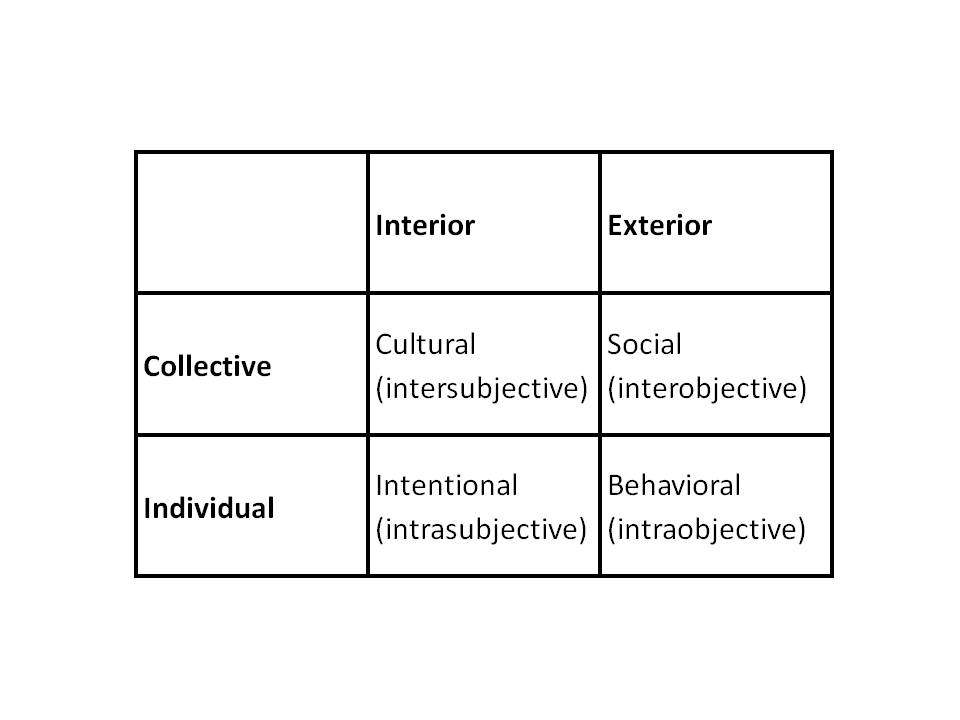
References:
http://en.wikipedia.org/wiki/Ken_Wilber
https://malankazlev.com/kheper/topics/Wilber/Wilber_IV.html
http://tetrast4.blogspot.com/2008/12/wilber.html
[*5.190-*5.192, *6.58]
<>
 Note that consistency and coherency are considered rational, and that applicability and adequacy are considered empirical. This has importance for Heideggar’s Fourfold since the rational is revealed, and the empirical is concealed. For Linear Logic, additive conjunction and multiplicative disjunction are reversible, yet additive disjunction and multiplicative conjunction are irreversible.
References:
Alfred North Whitehead / Process and Reality
Frederick Ferre / Being and Value: toward a constructive postmodern metaphysics
Mark Graves / Mind, Brain, and Elusive Soul: human systems of cognitive science and religion
Paul Reid-Bowen / Goddess as Nature: towards a philosophical theology
[*6.12, *6.70]
<>
We are too late for the gods and too early for Being. Being’s poem, just begun, is man.
— From Thinker as Poet by Martin Heidegger
“Every man makes a god of his own desire.”
— Virgil

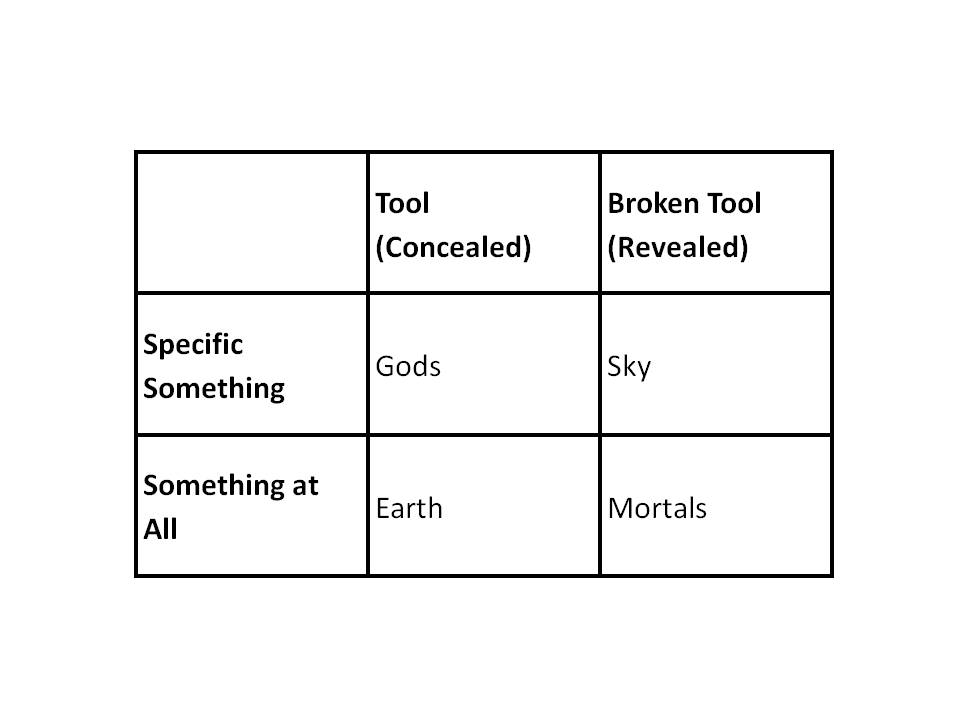
Note that Heidegger’s Fourfold is a perfect schema for the Tower of Babel: while mortals strive to join the earth and sky, the gods undo their efforts by turning their unity into multiplicity.
References:
Graham Harman / Tool-Being: Heidegger and the Metaphysics of Objects
http://en.wikipedia.org/wiki/Speculative_realism
http://culturalstudiesnow.blogspot.com/2011/05/martin-heidegger-building-dwelling.html
Also:
Andrew J. Mitchell / The Fourfold: Reading the Late Heidegger (Studies in Phenomenology and Existential Philosophy)
https://jeanpaulmartinon.net/martin-heideggers-gods/
[*6.2, *6.3, *6.56, *6.62, *9.163]
<>