Category Archives: eightfolds

Tractatus Logico-Philosophicus

Just the facts, ma’am.

— Detective Joe Friday

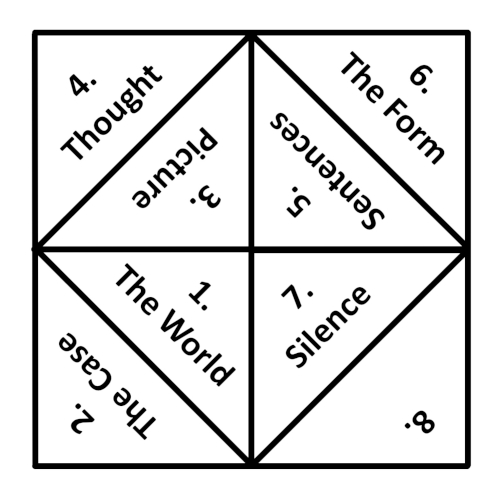
  1. The World (Die Welt): The world is everything that is the case.
  2. The Case (Der Fall): What is the case, the fact, is the existence of atomic facts.
  3. The Picture (Das Bild): The logical picture of the facts is the thought.
  4. Thought (Gedanke): The thought is the significant proposition.
  5. Propositions (Der Satz): Propositions are truth-functions of elementary propositions.
  6. The Form (Die Form): The general form of truth-function is: [p-bar, xi-bar, N(xi-bar)].
  7. Silence (Schweigen): Whereof one cannot speak, thereof one must be silent.
  8. ( ):

The Tractatus has seven propositions, most with sub-propositions and sub-sub-propositions, etc. I have added the eighth, which is the actual silence of all one cannot speak of. Quite a large section, for all its emptiness.

I also thought it would be nice to have an internet version where you could click and expand down through the sub-sentences. There are already many such versions available for your enjoyment.

I can’t decide whether I like the English or the German version better, so here are both.

Further Reading:

https://en.wikipedia.org/wiki/Tractatus_Logico-Philosophicus

http://www.bazzocchi.com/wittgenstein/tractatus/eng/index.htm

http://www.kfs.org/jonathan/witt/ten.html

https://pbellon.github.io/tractatus-tree/#/

http://daxoliver.com/tractatus/

http://people.umass.edu/klement/tlp/

The Tricky Truth about Tractatus Trees (updated)

[*11.170]

<>

Tanabata, V2

Soon it will be Tanabata (七夕) in Japan on July 7th.

Make a wish!

  • Orihime : Vega
  • Hikoboshi : Altair
  • Bridge of Birds : Deneb
  • Silver River : Milky Way

Further Reading:

https://en.wikipedia.org/wiki/Tanabata

http://www.iromegane.com/japan/make-a-wish-for-tanabata/

https://en.wikipedia.org/wiki/Summer_Triangle

[*10.48, *11.114]

<>

Patrick Geddes and the Notation of Life

Over the last few decades, there has been renewed interest in the work of biologist, sociologist, and city planner Patrick Geddes [1]. This is due to his efforts for holistic considerations for the entirety of the modes of human life and the facilities appropriate for their function. That is, he asked what makes a city or a town ideal for life, and how can we plan to bring this ideality into being? To this day, cities fail in many important ways.

Geddes embraced the new (at the time) Victorian notion of evolution in his work and thought of how cities could and should evolve to meet their shortcomings as well as provide environments for future developments. For example, common institutions such as schools, churches, and governments (polity) need to cooperate with family dwellings to provide for synergy and functional enrichment.

Geddes often used grids of words to explore relations between concepts, such as place, work, and folk. Placing these words along the diagonal of a square allowed one to consider the paired concepts of place-work, work-place, place-folk, etc. For example, how does the place-work compare with the work-place? His “notation of life” was a complicated schematic for exploring relations between a city’s facilities and the activities that they should promote.

  • Town / Acts : place, work, folk
  • School / Facts : sense, experience, feeling (alt. lore, learn, love)
  • City / Deeds : ethno-polity, synergy, achievement (alt. polity, culture art)
  • Cloister / Dreams (Thoughts) : emotion, ideation, imagery (alt. ideals, ideas, imagery)

Two locales are objective, two are subjective, two are passive, and two are active:

  • In-World (Subjective) : School and Cloister
  • Out-World (Objective) : Town and City
  • Passive : Town and School
  • Active : City and Cloister

And so:

  • Passive & Subjective : School
  • Active & Subjective : Cloister
  • Passive & Objective : Town
  • Active & Objective : City

Any important thinker is inspired and influenced by those that were previous or are contemporary to them and in turn is inspiration to those that follow. James H. Cousins was an important syncronic influence on Geddes, and please see [2] and [3] for information about him. The integral theory of Ken Wilber [4] is also compared to Geddes in [5]. I understand architect Lewis Mumford was a disciple of Geddes and I hope to find out more at a future time, perhaps by reading my copy of [6].

References:

[1] https://en.wikipedia.org/wiki/Patrick_Geddes

[2] http://hodgers.com/mike/patrickgeddes/feature.html

[3] https://equivalentexchange.blog/2017/07/13/a-study-in-synthesis/

[4] https://equivalentexchange.blog/2010/06/10/ken-wilbers-aqal/

[5] Theodore S. Eisenman, Tom Murray / An Integral Lens on Patrick Geddes, Landscape and Urban Planning,
http://dx.doi.org/10.1016/j.landurbplan.2017.05.011

[6] Donald T. Miller / Lewis Mumford, a Life

Further Reading:

http://architectureandurbanism.blogspot.com/2010/10/volker-m-welter-biopolis-patrick-geddes.html

https://www.dundee.ac.uk/geddesinstitute/projects/citythink/

http ://medium.com/@designforsustainability/design-and-planning-for-people-in-place-sir-patrick-geddes-1854-1932-and-the-emergence-of-2efa4886317e

View at Medium.com

4.1.4.1. The Ideal City

Patrick Geddes / Cities in Evolution

https://archive.org/details/citiesinevolutio00gedduoft/page/n10

[*9.12, *9.14, *11.92]

<>
 

The Lambda Cube

More or less from Wikipedia:

In mathematical logic and type theory, the λ-cube is a framework introduced by Henk Barendregt to investigate the different dimensions in which the calculus of constructions is a generalization of the simply typed λ-calculus. Each dimension of the cube corresponds to a new way of making objects depend on other objects, namely

    1. terms allowed to depend on types, corresponding to polymorphism.
    2. types depending on terms, corresponding to dependent types.
    3. types depending on types, corresponding to type operators.

The different ways to combine these three dimensions yield the 8 vertices of the cube, each corresponding to a different kind of typed system.

So in the diagram above, we have emblazoned the names of these type systems ordered from lower left to upper right:

  • λ→: the simply typed lambda calculus, our base system
  • λ2: add 1. above to λ→, giving what is also known as System F or the Girard–Reynolds polymorphic lambda calculus
  • λP: add 2. above to λ→
  • λ_ω_: add 3. above to λ→
  • λP2: combine 1. and 2., λ2 and λP
  • λω: combine 1. and 3., λ2 and λ_ω_
  • λP_ω_: combine 2. and 3., λP and λ_ω_
  • λC: combine 1., 2., and 3., giving the calculus of constructions

Further Reading:

https://en.wikipedia.org/wiki/Lambda_cube

http://www.rbjones.com/rbjpub/logic/cl/tlc001.htm

https://en.wikipedia.org/wiki/Calculus_of_constructions

https://en.wikipedia.org/wiki/System_F

[* 11.86, *11.87]

<>

Noether-Pauli-Jung, V2

What happens when the fourfold of Noether’s Theorem is spliced together with the fourfold of Pauli-Jung? Both have Space-Time and Matter-Energy. The former has Conservation and Symmetry, and the latter has Causality and Synchronicity. And if Space-Time and Matter-Energy are both divided into Space and Time and Matter and Energy, one obtains this eight-fold.

Causality means that some action or cause in time (say a process) of things in space can have an effect (another process, say) on different things in space, and Synchronicity means that different events (say processes) separated in space can have non-causal relationships between them.  Conservation means the consistency of a quantity of matter or energy or matter-energy through time, and Symmetry means the consistency of a measure of a structure or form through space.

I am reminded of my fourfold Four Bindings, consisting of Chains, Grids, Blocks, and Cycles. Causality and Synchronicity are Chains (or non-chains for the latter) Space and Time are Grids (or flexible meshes), Matter and Energy are Blocks (or chunks of stuff), and Symmetry or Conservation are Cycles (of the group-theoretic kind or the equivalence class kind or just loops).

Further Reading:

https://en.wikipedia.org/wiki/Causality

https://en.wikipedia.org/wiki/Synchronicity

https://en.wikipedia.org/wiki/Symmetry

https://equivalentexchange.wordpress.com/2012/05/04/noethers-theorem/

https://equivalentexchange.wordpress.com/2018/01/23/atom-and-archetype/

Four Bindings

This is a reworking of a previous six-fold diagram that I believe is served better as an eight-fold.

Noether-Pauli-Jung

[*10.68, *10.155, *11.55]

<>

The Four Binary Operators of Linear Logic, Part 2

Ordinarily, inference rules in natural deduction are written using a horizontal line, with the known, true, assumed or proven things written above the line and the inferred things written below the line. Here I’ve taken the artistic liberty to use diagonal lines instead of horizontal ones, and so tried to represent the introduction rules for the four binary operators of Linear Logic. In order to fit additive disjunction “plus” into this schema, I’ve broken the inference rule diagonal and written the duplicate inferred introduction below only once. I’m sure no self-respecting logician would do such a thing.

Further Reading:

https://en.wikipedia.org/wiki/Linear_logic

https://plato.stanford.edu/entries/logic-linear/

https://en.wikipedia.org/wiki/Natural_deduction

The Four Binary Operators of Linear Logic

J.-Y. Girard’s Linear Logic

[*11.60]

<>


Colors of Light and Matter

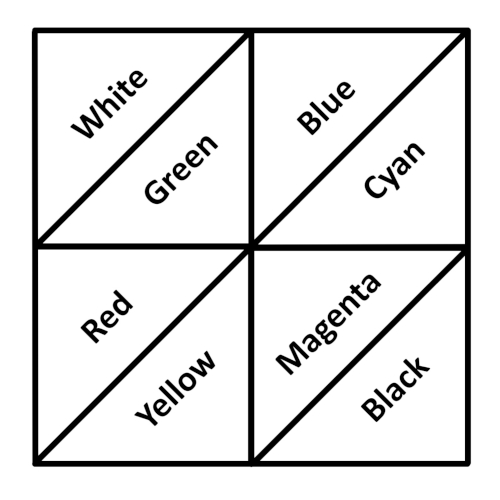
Colors of light and colors of matter operate somewhat differently from each other. Colors of lights are additive, but colors of material pigments are subtractive. Of course, they both are conditioned by the biology of the human eye and cultural preferences. Above I have tried to create a synthesis of sorts for both types, and whereas it is pleasing in some ways, it is lacking in others.

White light is combined red, green, and blue light, and combinations of green and red light yield yellow light, combinations of red and blue light yield magenta light, and combinations of green and blue light yield cyan light. Similarly, black is mixed yellow, magenta, and cyan pigments, mixing cyan and magenta pigments produce blue pigment, mixing cyan and yellow pigments produce green pigment, and mixing yellow and magenta pigments produce red pigment.

Further Reading:

Primary Colors of Light and Pigment

[*11.63]

<>


Degen’s Eight-square Identity

Here is another identity but this time corresponding to an eight-fold: the Eight-square identity of Ferdinand Degen found about 1818. You know the drill: it states that a product of two numbers that are each the sum of eight squares is itself the sum of eight squares!

(a12 + a22 + a32 + a42 + a52 + a62 + a72 + a82)(b12 + b22 + b32 + b42 + b52 + b62 + b72 + b82) =

…The sum of the expressions in the eight triangles written in the diagram above. (Please consult the Wikipedia entry below for the textual formulas, as it’s too hard to write in HTML.)

Note that the expressions above have an interesting symmetry, aside from the one on the upper left. Indeed, Euler’s Four-square Identity has a similar simpler symmetry. There is also a connection with Octonions if you are interested in digging for it. If you are anticipating that there is such a formula for sums of sixteen squares, there is, but not a bilinear one, and it is much more complicated!

Further Reading:

https://en.wikipedia.org/wiki/Degen%27s_eight-square_identity

https://en.wikipedia.org/wiki/Pfister%27s_sixteen-square_identity

[*11.64]

<>


Seven Sermons to the Dead, V2

We must, therefore, distinguish the qualities of the pleroma. The qualities are pairs of opposites, such as—

The Effective and the Ineffective.
Fullness and Emptiness.
Living and Dead.
Difference and Sameness.
Light and Darkness.
The Hot and the Cold.
Force and Matter.
Time and Space.
Good and Evil.
Beauty and Ugliness.
The One and the Many. etc.

— Carl Jung, from Seven Sermons to the Dead

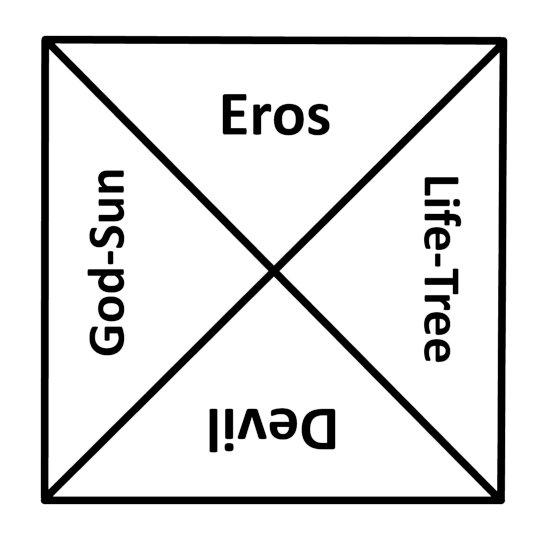
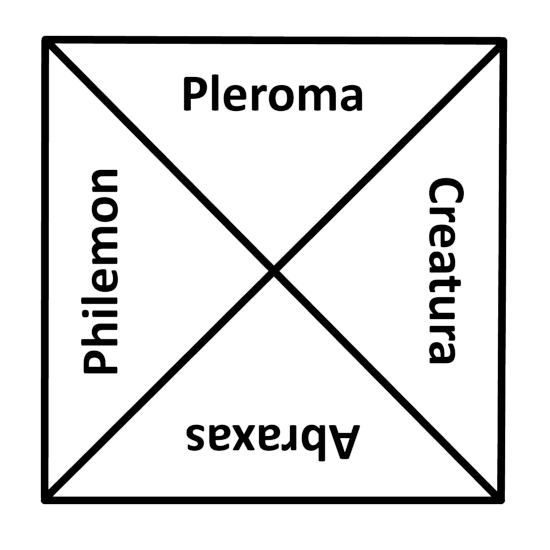
I previously mentioned two fourfolds which are perhaps better combined as an eightfold. These concepts or entities are from Carl Jung’s “Seven Sermons to the Dead”.

To the left are the “principal gods”, who are said to be in one-to-one correspondence with the “world’s measurements”. What then are these measurements? Are they the coordinates of relativistic Space-Time or something else?

  • The God-Sun: The beginning
  • Eros: Binding of two together, outspreading and brightening
  • The Tree of Life: Filling space with bodily forms
  • The Devil: The Void, opening all that is closed, dissolving all formed bodies, and destroyer of everything

And to the right we have:

  • The Pleroma: The spiritual universe as the abode of gods and of the totality of the divine powers and emanations.
  • The Creatura: The living world, subject to perceptual difference, distinction, and information
  • Abraxas: The supreme power of being transcending all divinities and demons and uniting all opposites into one
  • Philemon: Jung’s spiritual guide and the narrator, also said to be Simon Magus or Basilides

Further Reading:

http://gnosis.org/library/7Sermons.htm

https://en.wikipedia.org/wiki/Seven_Sermons_to_the_Dead

https://jungiangenealogy.weebly.com/seven-sermons.html

https://en.wikipedia.org/wiki/Tree_of_life

https://en.wikipedia.org/wiki/Pleroma

https://en.wikipedia.org/wiki/Abraxas

Who is Philemon?

Seven Sermons to the Dead

Seven Sermons to the Dead, Part 2

[*10.76, *11.49]

<>


The Visions of W. B. Yeats

William Butler Yeats published two editions of his book, “A Vision”, the first in 1925 and the second in 1937. They are interesting amalgamations of metaphysics, poetry and esoteric speculations. After years of neglect I return to mention these works briefly.

Previously I showed the fourfold of the Faculties (Creative Mind, Body of Fate, Mask, and Will), but ignored the complementary fourfold of the Principles (Spirit, Celestial Body, Passionate Body, and the Husk). Here I present an eightfold of both Faculties and Principles, and it makes a bit more sense with all its accompanying structure.

Each of these eight elements has certain dual properties which I have indicated by the second diagram: Primary (+) vs. Antithetical (/), Solar (Sun) vs. Lunar (Moon), Static (=) vs. Active (~). Primary is also called Objective, Antithetical is also called Subjective, Solar is also called Core, and Lunar is also called Changing.

In my diagram I have the Faculties as down-pointing triangles (+ and /) and the Principles as up-pointing triangles (Sun and Moon). Elements that are Active (~) are in the upper-left and lower-right squares and those that are Static (=) are in upper-right and lower-left. Since explanations of these elements usually involve interpenetrating cones and gyres and such, whether this diagram has any value is left for a later time.

I also just found out that Neil Mann, the author of the excellent and enduring web site about “A Vision”, has a new book out. It’s called “A Reader’s Guide to Yeats’s ‘A Vision'” and is published by Clemson University Press. It’s a bit pricey but I’m sure it’s full of valuable insights into these works. Perhaps I’ll just have to raid my piggy bank.

Further Reading:

http://www.yeatsvision.com/

http://www.yeatsvision.com/Yeats.html

https://en.wikipedia.org/wiki/A_Vision

https://global.oup.com/academic/product/a-readers-guide-to-yeatss-a-vision-9781942954620?cc=us&lang=en&#038;

A Vision by W. B. Yeats: The Four Faculties

[*7.199, *7.200, *8.1, *11.56]

<>