https://en.wikipedia.org/wiki/Quark
https://en.wikipedia.org/wiki/Eightfold_way_(physics)
[*13.8]
According to the Vedanta, the 4 major margas (paths) are Jnana Yoga (the path of wisdom and knowledge), Bhakti Yoga (the path of devotion), Karma Yoga (path of selfless action or service) and Raja Yoga (path of self-discipline):
Further Reading:
https://en.wikipedia.org/wiki/Three_Yogas
https://en.wikipedia.org/wiki/Jnana_yoga
https://en.wikipedia.org/wiki/Karma_yoga
https://en.wikipedia.org/wiki/Bhakti_yoga
https://en.wikipedia.org/wiki/R%C4%81ja_yoga
https://artsandculture.google.com/story/the-four-paths-of-yoga/QQURiPuOVM2eIw#
https://chopra.com/articles/the-4-paths-of-yoga
<>
In Atomic Habits, author James Clear describes the behavior of making and breaking habits in four stages:
Further Reading:
James Clear / Atomic Habits: An Easy & Proven Way to Build Good Habits & Break Bad Ones
https://aliabdaal.com/book-notes/atomic-habits-summary/
Atomic Habits: An Easy & Proven Way to Build Good Habits & Break Bad Ones
[*13.86]
<>
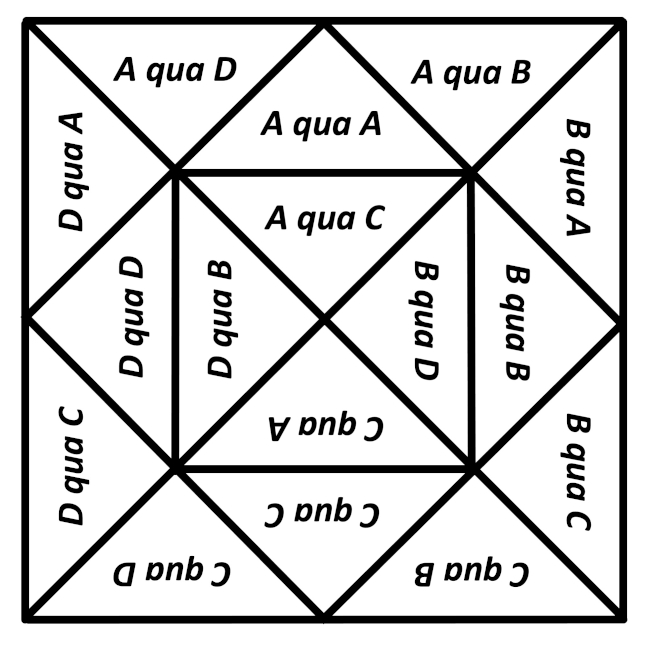
Here is a diagram for a set of four things standing in for each other, as in their being, character, function, or capacity. Qua is a proper English word (from Latin) meaning “as” or “as being” but also “in the function of” or “in the capacity of”. Often used as “A qua A” rather than “A qua B”.
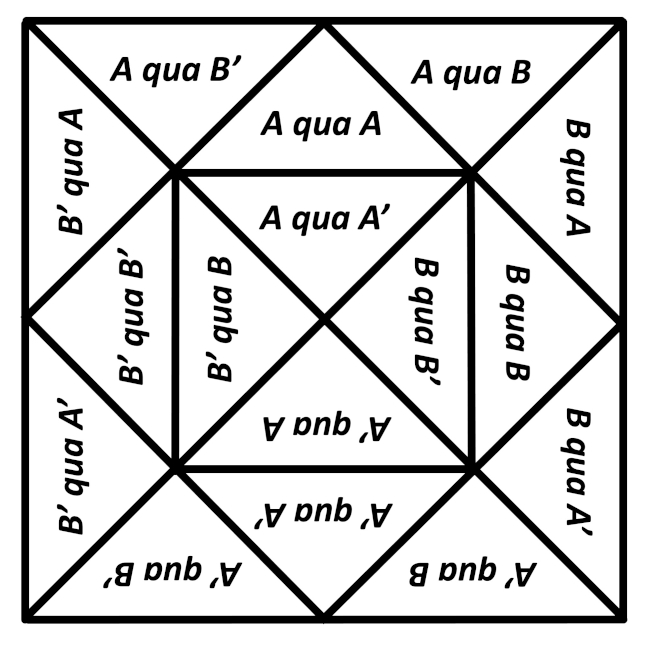
I suppose the diagram could be altered to be four things qua four other things, with apostrophes or something. It could also be altered for a double duality, as shown below, with some nice symmetries.
It is somewhat similar to my diagram of the Tetrameria, but of course arranged differently. The only other example that I can think of as being “Four qua Four” is the Archic Matrix.
Further Reading:
https://www.explainxkcd.com/wiki/index.php/2591:_Qua
https://latin-dictionary.net/definition/32572/quaqua
https://en.wikipedia.org/wiki/Sine_qua_non
[*13.90]
<>
Here’s another modern-day take on the Four Temperaments, a popular book series by Thomas Erikson called “Surrounded by Idiots.” After the original which is subtitled “The Four Types of Human Behavior and How to Effectively Communicate with Each in Business (and in Life),” he has written sequels titled “Surrounded by Narcissists,” “… by Psychopaths,” “… by Bad Bosses,” and “… by Setbacks”.
I have found a simple chart explaining his original four types using a two-by-two matrix of introvert vs. extrovert and task or issue-oriented vs. relation-oriented, and a review I read indicates that the DISC Theory of personality is the main influence for the author (and which is also related to humorism.)
Notably the cover art for the series uses four colors for the different types of people: Red, Yellow, Green, and Blue. These colors are sometimes also used by others to denote the Four Temperaments. These four colors are often used for other classification schemes, and even for corporate logos. Also, these four colors are the set union of the three primary colors of light and the (traditional) three primary pigments.
Further Reading:
Thomas Erikson: Surrounded by Idiots
https://www.businessinsider.com/guides/learning/surrounded-by-idiots-book-review
https://en.wikipedia.org/wiki/Humorism
[*13.87]
<>
Georgia Guidestones
Born: March 22, 1980
Died: July 6, 2022
Let These Be
Guidestones
to an Age
of Reason (*)
Capstone with (*) written in Four Ancient Languages
Ten Recommendations (**) about
Four Upright Stones with (**) written in Eight Modern Languages
One Center Stone supporting Capstone for Three Astronometries
Fear no more the heat o’ the sun,
Nor the furious winter’s rages;
Thou thy worldly task hast done,
Home art gone, and ta’en thy wages:
Golden lads and girls all must,
As chimney-sweepers, come to dust.
–– William Shakespeare (from Cymbeline)
Further Reading:
https://en.wikipedia.org/wiki/Georgia_Guidestones
https://www.wired.com/2009/04/ff-guidestones/
https://www.poetryfoundation.org/poems/50428/song-fear-no-more-the-heat-o-the-sun-
<>
The Four-Drive Theory of Lawrence and Nohria of the Harvard Business School is a popular model for the motivations of employees within a work environment. They list four drives which need to be in balance for worker happiness and productivity:
Further Reading:
Paul R. Lawrence, Nitin Nohria / Driven: how human nature shapes our choices
http://changingminds.org/explanations/needs/lawrence_nohria.htm
https://blogresellerprofits.com/2020/02/14/four-drive-model-theory/
Images for Four Drive Theory:
https://www.google.com/search?q=four+drive+theory&tbm=isch
Also:
http://changingminds.org/explanations/needs/needs.htm
https://en.wikipedia.org/wiki/Four_Fs_(evolution)
https://en.wikipedia.org/wiki/Leadership
(Where’s a Wikipedia Page?)
[*13.92, *13.93]
<>
Here is an alignment between two of my favorite topics, the four operators of linear logic and the four elements.
I’ve been wanting to create this eight-fold for a while, and so here it is. I think it looks rather nice.
At this point I should present my reasons for this symbolic amalgam, but I leave it up to you, dear reader.
However, I will write the names of the symbols starting with the upper left and going widdershins…
[*5.188, *11.26, *13.82]
<>
Again, I have taken a diagram and bent it into my preferred vision. At least the original figures have isosceles right triangles to begin with. However, they were in a left-to-right sequence (ordered by time) instead of a cycle as I have done. On many diagrams of the diamond approach there are indeed loops that return the user to positions earlier in the sequence so I don’t feel too bad.
The steps that are part of the diamond approach are reminiscent of other learning cycles, such as that of Kolb. The original left-to-right sequence emphasizes the order, as well as showing that steps may be divergent or convergent (analytic or synthetic) in their methods. Instead I have denoted divergence by arrows facing away from each other and convergence by arrows facing towards each other.
The main creator of the Diamond Approach is A. H. Almaas, who has written many books on spirituality or esoteric subjects such as the Enneagram. Being a skeptical sort, I have no idea if the notions and methods in these books are worth your time, but the goals indeed sound laudable. How do they differ from psychoanalysis, psychotherapy, or other techniques to improve mental health? Further reading may be required before you pay for classes and retreats.
Further Reading:
https://www.diamondapproach.org/home
https://www.diamondapproach.org/almaas
https://en.wikipedia.org/wiki/A._H._Almaas
https://www.google.com/search?q=the+diamond+approach+design+method&tbm=isch
[*13.74, *13.75]
<>
Because there are way more than seven wonders in the world.
Always Forward Between Heaven and Earth
Psychological Musings
Critiquing anime and everything else
"For man has closed himself up, till he sees all things thro' narrow chinks of his cavern" -- William Blake
Category Theory, Haskell, Concurrency, C++
Reviewing fascinating science books since 2017
Every Fourth Thing
Derek Wise's blog: Mathematics, Physics, Computing and other fun stuff.
integrating 4 binary opposites in life, learning, art, science and architecture
Chasing the Paper Rabbit
experiments in a reaction from the left
A blog about computers, evolution, complexity, cells, intelligence, brains, and minds.
mind maps, infographics, and expositions
neat ideas from unusual places
Introduction to a Quadralectic Epistomology
Astronomy, space and space travel for the non scientist
Every Fourth Thing
A Serious Look at Trivial Things
A Survey of Tetradic Testimonials in Architecture
Musings from a Naturalist
Why Evolution is True is a blog written by Jerry Coyne, centered on evolution and biology but also dealing with diverse topics like politics, culture, and cats.
Four-fold thinking4you
Craig Weinberg's Cosmology of Sense
Purveyors of Fine Anime Reviews and Ratings Since 2010
Between Subject and Object
Every Fourth Thing
Every Fourth Thing
Every Fourth Thing
Every Fourth Thing
Every Fourth Thing
Sometimes those Sticking their Heads in the Sand are Looking for Something Deep
Online Home of Christopher Vitale, Associate Professor of Media Studies, The Graduate Program in Media Studies, Pratt Institute, Brooklyn, NY.
Linking Ideas
RESEARCHING THE DEMANDS OF THOUGHT
Explorations in the Paradoxes of Meaning
"The centaur of classical metaphysics shall be mated with the cheetah of actor-network theory."
objects & things, design, art & technology