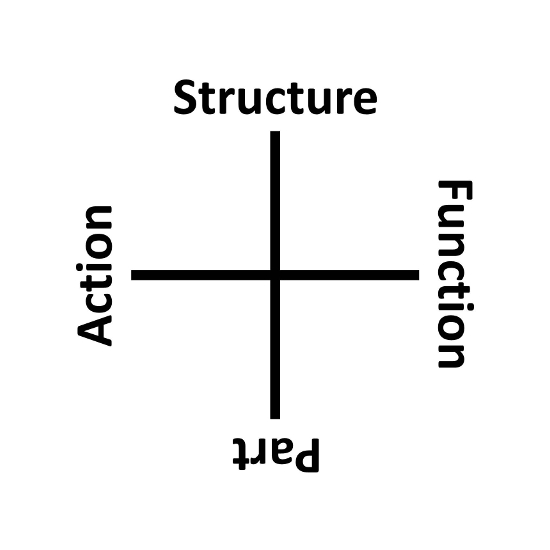
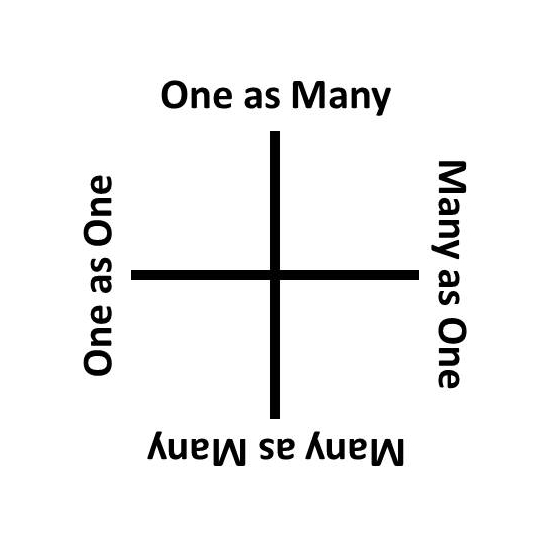
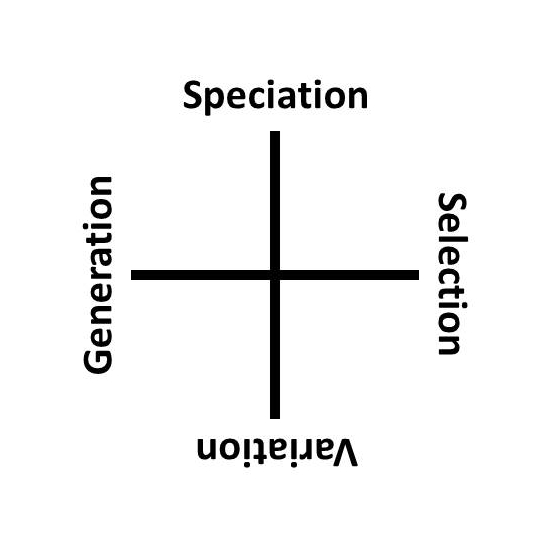
The Square of Opposition

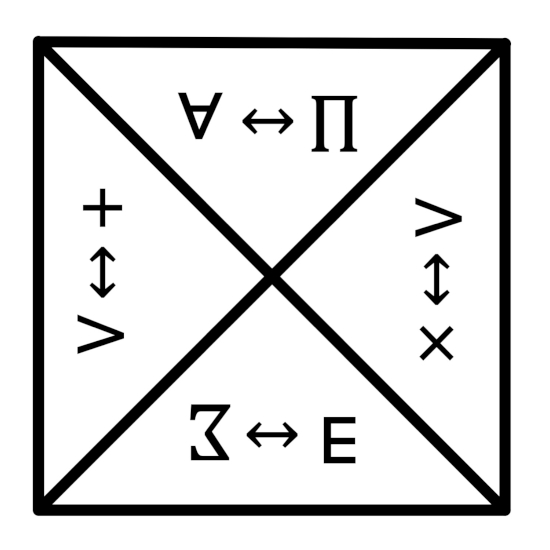
Some readers may think I’ve never met a fourfold I didn’t like. However, there are several that I haven’t presented here because they don’t seem to play well with the others. The Square of Opposition, created by Aristotle, is one such fourfold. The four logical forms of the square are relations between a subject and predicate, S and P, and supposedly exhaust the possibilities of belonging: Some S are P, Some S are not P, All S are P, and No S are P (or All S are not P).

In the diagram I have removed the S and P, and the logical forms become spare and like a Zen Koan or nursery rhyme: Some Are, Some Are Not, All Are, and None Are (or All Are Not). By doing so, they resonate more brightly with the other fourfolds and how they are presented herein. Now, the logical forms can be about existence, or the subject and predicate withdraw and become implicit to the thought.

Note:

Compare and contrast the Square of Opposition to the Tetralemma and the Semiotic Square.

The 3rd World Congress on the Square of Opposition is soon to convene. May the meeting be rewarding!

References:

http://en.wikipedia.org/wiki/Square_of_opposition

http://plato.stanford.edu/entries/square

http://www.iep.utm.edu/sqr-opp/

http://www.square-of-opposition.org/

[*4.84, *5.82, *7.70, *7.90]

<>

Attraction and Repulsion

Gravity is Love.

 — Brian Swimme

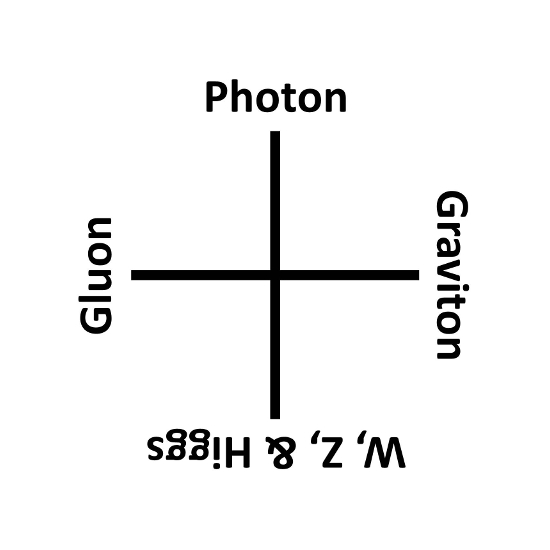
The principle of attraction and its opposite repulsion is pervasive throughout the conceptualization of modern physics. Even ancient Empedocles, of the four elements fame, thought that in all nature the force of attraction and combination was Love or Philia, and that the force of repulsion and separation was Strife or Neikos. These forces have now been depersonalized and mathematized, but still inhabit natural laws which must be obeyed. (See the Four Fundamental Forces of Physics.)

At all levels of matter and energy, from the lowest atomic interactions to the highest cosmic forces, the duality of attraction and repulsion are everywhere. In atoms, there is the strong force and the weak force that respectively pull nuclei together or push them apart. In and between atoms and molecules, covalent bonds, magnetic polarities, electric charges, hydrogen bonds, salt bridges, and hydrophobic effects gather and scatter and even make life possible. In the large-scale macro world, electromagnetism and gravity extend their influence. And in the cosmic arena, the mysterious effects of dark matter and dark energy perform without our current understanding.

In the biological world, attraction and repulsion are seen in the action of plants and animals. The plant is attracted to light and moisture, and repulsed by darkness and dryness. The animal is attracted to food and safety, and repulsed by lack and danger. Plants and animals are also attracted to their kin, and repulsed by their non-kin, because there is strength in commonality. However, too much sameness becomes toxic. It is the dynamic between attraction and repulsion that creates much of the living world and its richness.

In the human world, culture and language enable the forces of attraction and repulsion. Known culture and language is attractive; unknown culture and language is repulsive. But the human mind also craves newness. Interactions between the same and the different have been a great source of the creative drive which fuels the human spirit.

Note:

The sums of attractions are combinations. The sums of repulsions are separations.

References:

http://en.wikipedia.org/wiki/Empedocles

http://www.npr.org/blogs/13.7/2010/10/21/130724690/gravity-is-love

[*7.92]

<>

Wu Wei or Natural Action

The sage does nothing, and yet everything is done.

— Lao Tzu from Tao te Ching

The principle of least action (or stationary action) seen in the previous entry Noether’s Theorem immediately makes me think of the Taoist concept of wu wei – literally no action or effortless action. It consists of knowing when to act and knowing when not to act (or perhaps even not knowing to act). It also means natural action, or the action of natural physical or biological systems. In Western culture, such action is considered bad and “mechanical” because physical systems are thought to be like clockwork, but in Eastern culture, it is sagelike and enlightened, harmonious. Very often intention, or conscious action, gets in the way and impedes our effort.

Another example that comes to mind is the short story “On the Marionette Theatre” by Heinrich von Kleist. In the story, one of the characters comment that marionettes possess a grace humans do not, a view which contradicts ordinary aesthetics. It is claimed that our consciousness and capacity for reflection cause us to doubt ourselves or become self-conscious, and prevent us from acting with the singlemindedness and purity of an animal or a puppet. For example, a bear in the story is able to successfully fence with the narrator, by deflecting every thrust towards him seemingly without effort. And all feints are ignored, as if the bear is reading the narrator’s mind or knowing the future before it happens.

Also note:

Philip Pullman, author of the fantasy trilogy “His Dark Materials”, was inspired by von Kleist’s story.

The character Forrest Gump, of book and movie fame, could be considered a Taoist. Be like a feather on the wind…

http://en.wikipedia.org/wiki/Wu_wei

http://www.his.com/~merkin/daoGloss.html

http://en.wikipedia.org/wiki/Heinrich_von_Kleist

Edward Slingerland / Effortless Action: Wu-wei As Conceptual Metaphor and Spiritual Ideal in Early China

[*7.91, *8.66]

<>

Noether’s Theorem

Nature is thrifty in all its actions.

    — Pierre Louis Maupertuis

From Wikipedia:

Noether’s (first) theorem states that any differentiable symmetry of the action of a physical system has a corresponding conservation law. The theorem was proved by German mathematician Emmy Noether in 1915 and published in 1918. The action of a physical system is the integral over time of a Lagrangian function (which may or may not be an integral over space of a Lagrangian density function), from which the system’s behavior can be determined by the principle of least action.

Noether’s theorem can be stated informally:

If a system has a continuous symmetry property, then there are corresponding quantities whose values are conserved in time.

Note:

Symmetries are transformations or exchanges in space or time that leave systems structurally or functionally equivalent to what they were before. The equivalence may or may not be an identity, but only the same in appearance or behavior.

Conservation laws are equivalences for quantitative properties of systems. A given property of matter or energy is quantitatively the same before and after, or continuously through space or time. The functional measure of this property remains constant.

So consider an analogy between Noether’s Theorem and the concept of Equivalent Exchange: for (symmetrical, differentiable) exchanges, there are properties that are equivalent (conserved)!

http://en.wikipedia.org/wiki/Noether’s_theorem

http://en.wikipedia.org/wiki/Action_%28physics%29

http://en.wikipedia.org/wiki/Lagrangian

http://en.wikipedia.org/wiki/Principle_of_least_action

http://math.ucr.edu/home/baez/noether.html

<>

Kant’s Reflective Perspectives on Experience

The web site of Stephen R. Palmquist has a great wealth of material on fourfolds in relation to Kant’s as well as his own philosophy. From my own initial reading of his extensive material I have tried to choose a canonical Kantian fourfold which has the most relevance to my project.

The fourfold shown above Dr. Palmquist calls Kant’s “reflective perspectives on experience”. Consisting of the logical, the empirical, the transcendental, and the hypothetical, these facets bear a close analogical likeness to many of the fourfolds presented here.

Logical: Analytic a priori
Transcendental: Synthetic a priori
Hypothetical: Analytic a posteriori
Empirical: Synthetic a posteriori

Dr. Palmquist also has many of his own books available on his web site for the interested reader. I will certainly be returning to his web site in the future for much enjoyable study.

References:

http://www.hkbu.edu.hk/~ppp/

http://www.hkbu.edu.hk/~ppp/ksp2/KCR3.htm

[*7.68, *7.84]

<>

The Four Binary Operators of Linear Logic


The four binary operators for Linear Logic can be described by their logical sequents, or inference rules (shown above in the table). Note that in the rules for the operators, the operator appears below and not above the horizontal line. Thus the sequents can be considered in two ways: moving from top to bottom, the operator is introduced, and moving from bottom to top, the operator is eliminated. As operators are introduced the rules deduce a formula containing instances of them, and as operators are eliminated the rules construct a proof of that formula without them. Also note that in the sequents the symbols A and B denote formula in our logic, and the symbols Γ and Δ are finite (possibly empty) sequences of formulae (but the order of the formulae do not matter), called contexts.

The rule for the operator & (with), additive conjunction, says that if A obtains along with the context Γ, and if B obtains also along with Γ, then A & B obtains along with Γ.

The rule for the operator (plus), additive disjunction, says that if A obtains along with the context Γ, or if B obtains along with Γ, then A B obtains along with Γ.

The rule for the operator (par), multiplicative disjunction, says that if the combination A,B obtains along with the context Γ, then A B obtains along with Γ.

The rule for the operator (tensor), multiplicative conjunction, says that if A obtains along with context Γ, and if B obtains along with context Δ, then A B obtains along with the combined context Γ,Δ.

There are several immediate observations we can make about these rules.

First, note that for operators & and , they are reversible. That is, if one obtains A & B or A B, then one knows exactly what the previous step had to be to introduce the operator. In contrast, and are not reversible. If one has A B, one doesn’t know if we started with A or with B. If one has A B, one doesn’t know what was the context of A or what was the context of B.

For this reason, I will consider & and to be rational, and and to be empirical.

Second, note that all of the parts of the multiplicative sequents for and are the same above and below the horizontal line. In contrast, the parts of the additive sequents for & and are different above and below the line. For &, a duplicated context is eliminated even as the operator is introduced. For , a new formula is introduced along with the introduction of the operator.

For this reason, I will consider & and to be discrete, and and to be continuous.

References:

http://en.wikipedia.org/wiki/Sequent_calculus

http://en.wikipedia.org/wiki/Linear_logic

http://www.uni-obuda.hu/journal/Mihalyi_Novitzka_42.pdf

[*6.38, *6.40]

<>

A Digital Universe

A digital universe – whether 5 kilobytes or the entire Internet – consists of two species of bits: differences in space, and differences in time. Digital computers translate between these two forms of information – structure and sequence – according to definite rules. Bits that are embodied as structure (varying in space, invariant across time) we perceive as memory, and bits that are embodied as sequence (varying in time, invariant across space) we perceive as code. Gates are the intersections where bits span both worlds at the moments of transition from one instant to the next.

— George Dyson, from Turing’s Cathedral

Further Reading:

George Dyson / Turing’s Cathedral: the origins of the digital universe

[*7.82, *7.83, *7.153]

<>

The Four Freedoms

From Wikipedia:

The Four Freedoms were goals articulated by US President Franklin D. Roosevelt on January 6, 1941. In an address known as the Four Freedoms speech (technically the 1941 State of the Union address), he proposed four fundamental freedoms that people “everywhere in the world” ought to enjoy:

  •     Freedom of speech
  •     Freedom of worship
  •     Freedom from want
  •     Freedom from fear

His inclusion of the latter two freedoms went beyond the traditional US Constitutional values protected by its First Amendment, and endorsed a right to economic security and an internationalist view of foreign policy. They also anticipated what would become known decades later as the “human security” paradigm in social science and economic development.

References:

http://en.wikipedia.org/wiki/Four_Freedoms

http://www.americanrhetoric.com/speeches/fdrthefourfreedoms.htm

Update:

Homepage

https://en.wikipedia.org/wiki/Franklin_D._Roosevelt_Four_Freedoms_Park

[*7.76]

<>

Systems Dynamics

Another interesting fourfold that I discovered while reading mathematical physicist John C. Baez’s blogs Azimuth and This Week’s Finds in Mathematical Physics concerns the notions of system dynamics and bond graphs. These concepts generalize the fourfold of the basic electronic components into other types of physical systems, such as mechanics, hydraulics, and to some extent even thermodynamics and chemistry.

The types of systems that can be modeled by system dynamics are described by two variables that vary functionally over time and their corresponding integrals. These four functions can be thought of as flow and effort and their respective integrals displacement and momentum.

  Displace-
ment
Flow Momentum Effort
Mechanics of translation Position Velocity Momentum Force
Mechanics of rotation Angle Angular velocity Angular momentum Torque
Electronics Charge Current Flux Voltage
Hydraulics Volume Flow Pressure momentum Pressure
Thermo-dynamics Entropy Entropy flow Temperature momentum Temperature
Chemistry Moles Molar flow Chemical momentum Chemical potential


Further Reading:

http://johncarlosbaez.wordpress.com/2012/02/02/quantizing-electrical-circuits/

http://math.ucr.edu/home/baez/week288.html

http://math.ucr.edu/home/baez/week292.html

http://ncatlab.org/johnbaez/show/Diagrams

http://magisciences.tuxfamily.org/BondGraph/co/03%20Passive%20elements.html

Dean C. Karnopp, Donald L. Margolis, Ronald C. Rosenberg / System Dynamics: modeling and simulation of mechatronic systems

[*7.60, *7.61]

<>

Relational Models Theory

The Relational Models Theory (RMT) of Alan Fiske is a framework for social relations that details four major types of interpersonal interactions: Communal Sharing (CS), Authority Ranking (AR), Equality Matching (EM), and Market Pricing (MP). These four types can also be combined and nested to form more complex social relations. Thus they are presented to be the elementary building blocks out of which all social relations are made.

John Bolender expounds on Fiske’s theory, by arguing that the four relationships are each described by the inherent mathematical symmetry of the social relation, and that all four can be ordered: in one way by inclusion (in the sense of mathematical group theory) and the opposite way by symmetry breaking (usually considered in physics). The symmetries are viewed as transformations which when applied, like a reorganization of the relationship, do not alter the substance or content of the relationship. CS is more symmetric than AR, which in turn is more symmetric than EM, which lastly is more symmetric than MP. For inclusion, the symmetries of MP are included in the symmetries of EM, those of EM in AR, and AR in CS. For symmetry breaking, a symmetry of CS can be broken to form AR, which in turn has a symmetry that can be broken to form EM, and so on to MP. Thus CS > AR > EM > MP in terms of transformations that preserve symmetry.

As we move from CS to MP, we add increasing structure to a social relation, a greater number of constraints. Additionally, consider symmetry operations in general in the context of equivalent exchange: symmetry by definition is an exchange of participants in a relation, a permutation such that the relation itself is unchanged, that is, equivalent.

References:

Alan Page Fiske / Structures of social life: the four elementary forms of human relations

John Bolender / The Self-Organizing Social Mind

http://www.rmt.ucla.edu/

http://fuquaccl.wordpress.com/tag/relational-models-theory/

http://www.sscnet.ucla.edu/anthro/faculty/fiske/RM_PDFs/Fiske_Haslam_Four_Basic_Bonds_2005.pdf

http://www.sscnet.ucla.edu/anthro/faculty/fiske/relmodov.htm

http://ndpr.nd.edu/news/24644-the-self-organizing-social-mind/

http://www.iep.utm.edu/r-models/

Notes:

Some changes: replacing the diagram and removing reference to J.-Y. Girard’s infernos of semantics. Also the very important insight from IEP: “The symmetries of solid matter form a subset of the symmetries of liquid matter which form a subset of the symmetries of gaseous matter which form a subset of the symmetries of plasma.”

[*6.110]

<>

Every Fourth Thing

Daydream Tourist

Because there are way more than seven wonders in the world.

The Digital Ambler

Always Forward Between Heaven and Earth

The Mouse Trap

Psychological Musings

Wrong Every Time

Critiquing anime and everything else

The Chrysalis

"For man has closed himself up, till he sees all things thro' narrow chinks of his cavern" -- William Blake

  Bartosz Milewski's Programming Cafe

Category Theory, Haskell, Concurrency, C++

The Inquisitive Biologist

Reviewing fascinating science books since 2017

Gizmodo

Every Fourth Thing

Simplicity

Derek Wise's blog: Mathematics, Physics, Computing and other fun stuff.

COMPLEMENTARY 4x

integrating 4 binary opposites in life, learning, art, science and architecture

INTEGRATED 4x

integrating 4 binary opposites in life, learning, art, science and architecture

Playful Bookbinding and Paper Works

Chasing the Paper Rabbit

Antinomia Imediata

experiments in a reaction from the left

Digital Minds

A blog about computers, evolution, complexity, cells, intelligence, brains, and minds.

philosophy maps

mind maps, infographics, and expositions

hyde and rugg

neat ideas from unusual places

Visions of Four Notions

Introduction to a Quadralectic Epistomology

Explaining Science

Astronomy, space and space travel for the non scientist

Log24

Every Fourth Thing

Ideas Without End

A Serious Look at Trivial Things

Quadralectic Architecture

A Survey of Tetradic Testimonials in Architecture

Minds and Brains

Musings from a Naturalist

Why Evolution Is True

Why Evolution is True is a blog written by Jerry Coyne, centered on evolution and biology but also dealing with diverse topics like politics, culture, and cats.

Quadriformisratio

Four-fold thinking4you

Multisense Realism

Craig Weinberg's Cosmology of Sense

RABUJOI - An Anime Blog

Purveyors of Fine Anime Reviews and Ratings Since 2010

Intra-Being

Between Subject and Object

The Woodring Monitor

Every Fourth Thing

FORM &amp; FORMALISM

Every Fourth Thing

Log24

Every Fourth Thing

The n-Category Café

Every Fourth Thing

THIS IS NOT A BLOG

Every Fourth Thing

PHILOSOPHY IN A TIME OF ERROR

Sometimes those Sticking their Heads in the Sand are Looking for Something Deep

Networkologies

Online Home of Christopher Vitale, Associate Professor of Media Studies, The Graduate Program in Media Studies, Pratt Institute, Brooklyn, NY.

Hyper tiling

Linking Ideas

DEONTOLOGISTICS

RESEARCHING THE DEMANDS OF THOUGHT

Incognitions

Explorations in the Paradoxes of Meaning

Object-Oriented Philosophy

"The centaur of classical metaphysics shall be mated with the cheetah of actor-network theory."

Objects & Things

objects & things, design, art & technology