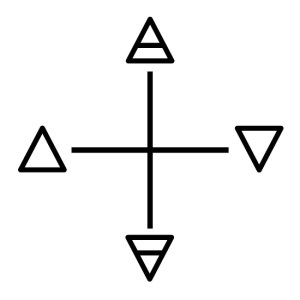
Antisynthesis

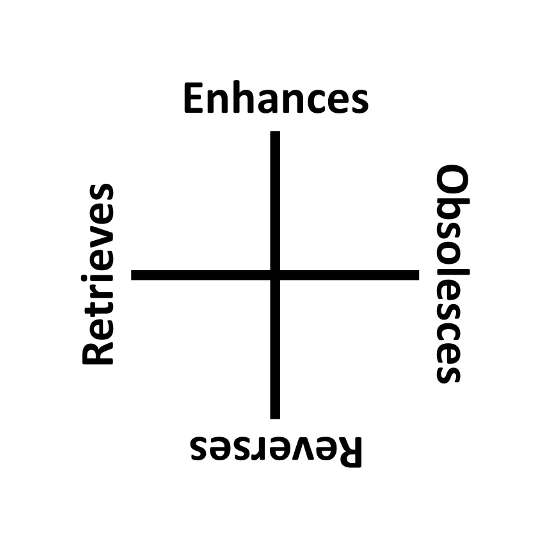
In a mechanism, analysis coincides with antisynthesis.

— From Life Itself, by Robert Rosen

The triad thesis-antithesis-synthesis has been erroneously credited to Hegel, but it still widely mentioned. What if the triad becomes a fourfold? Then the first term that comes to mind to turn three into four is antisynthesis. The writer most familiar to me who used this term was Robert Rosen, a theoretical biologist.

Rosen thought that antisynthesis was analysis for what he calls mechanisms. Mechanisms are natural systems such that every one of its models is simulable, that is, computable as in a computer. One of Rosen’s main claims in his research was that living systems were natural systems but not reducible to mechanisms. His argument depended on an analysis of the causation or entailments in such systems.

Because so many of the fourfolds presented here are linked to Aristotles’s Four Causes, I feel that I may need to revisit Rosen’s Theory in a separate entry to do it justice. This entry was merely about the term antisynthesis and its relation to the original triad.

Notes:

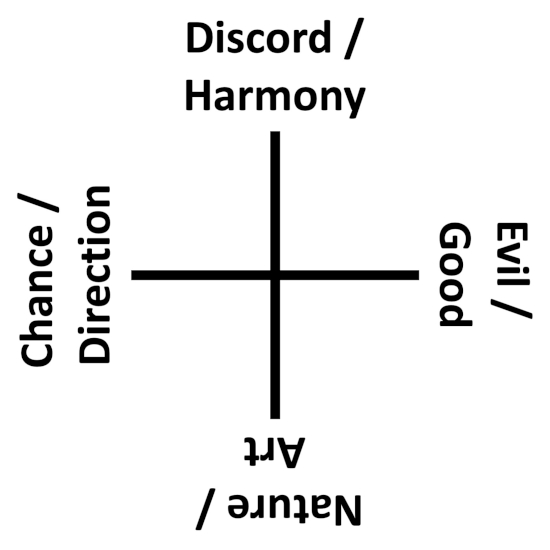
In this fourfold there are two negations and two affirmations.

Hegel instead used concrete, abstract, absolute. To complete the four: bounded, partial, uncertain, finite?

References:

http://en.wikipedia.org/wiki/Thesis,_antithesis,_synthesis

Robert Rosen / Life Itself: A Comprehensive Inquiry into the Nature, Origin, and Fabrication of Life

[*7.119]

<>


The Four Bases of DNA

DNA neither cares nor knows. DNA just is. And we dance to its music.

Richard Dawkins

DNA, the genetic code and biological machinery all life on earth shares, has been in the news lately. It was once thought that much of our DNA was useless junk, but recent research reveals that this portion of our DNA is very important to the operation of epigenesis. This portion of DNA could be called dark bio-matter, or better dark bio-information or even dark bio-code, since it contains switches and instructions that guide each individual organism’s developmental growth through time.

Previously, the parts of DNA thought to be important were those regions that define the proteins that assemble to form our tissues. Mutations in the DNA that specify proteins can lead to disease because the mutated proteins cannot perform the functions that they need to. Of course, mutated proteins can also be improved and increase health. Comparing protein sequences across species shows that we have many commonalities as well as important differences with our animal cousins. What was once considered a “great chain of being” is now thought to be a great tree of life, all shown by DNA.

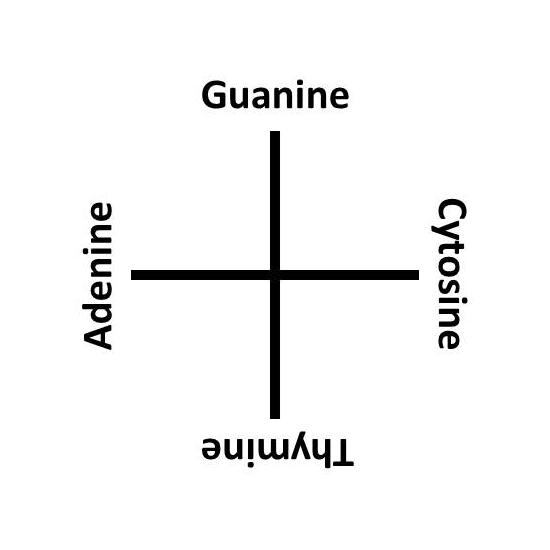
DNA is also a fourfold, and a double dual as well, since for the four bases Adenine (A), Thymine (T), Guanine (G), and Cytosine (C): A pairs with T, and G with C. I am not saying that DNA is analogous to the other fourfolds presented here, but it makes a nice diagram.

Questions:

Why does DNA have four bases and not two, like binary computer code?

Even more of DNA determines our health and variation, the things that make us who we are. Does that constrain us even more, or will this knowledge make us more free?

Further Reading:

http://en.wikipedia.org/wiki/DNA

[*7.112]

<>


Epistemic Virtues of Objectivity

I recently finished reading Lorraine Daston and Peter Galison’s “Objectivity”. In this very interesting book, the authors argue that the notion of scientific objectivity has evolved over time. They have divided the course of this evolution into three main phases: truth-to-nature, mechanical objectivity, and trained judgement. During each phase, the main view of objectivity is dominant, but previous phases are still important to the overall idea of what objectivity means in the scientific community.

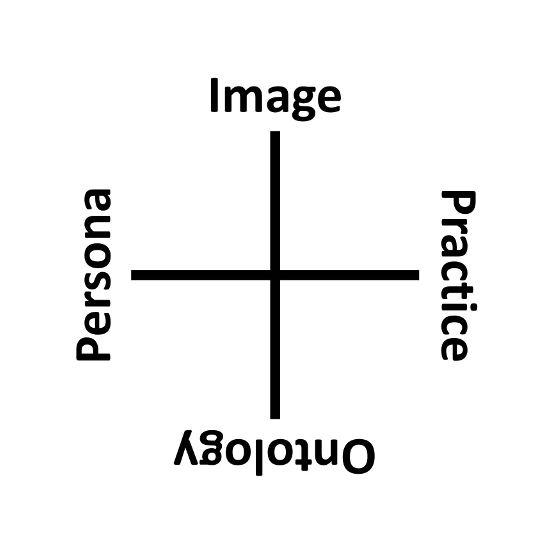
The epistemological virtues of objectivity can be divided into four major aspects: persona, ontology, image, and practice. For each phase of objectivity, each aspect has different qualities. For instance, the scientific persona becomes a sage during the truth-to-nature phase, a worker during the mechanical objectivity phase, and an expert during the trained judgement phase. Similarly, the ontology aspect passed through the qualities of universals-particulars-families, the image aspect passed through reasoned-mechanical-interpreted, and practice  passed through the stages selection and synthesis-automated transfer-pattern recognition.

The evolutionary phases of objectivity, as well as the qualities of the epistemological virtues seen as the four aspects, is beautifully shown by many examples from a collection of scientific atlases. Anyone interested in the history of science as well as the notion of scientific objectivity should enjoy this book.

I thought it was also remarkable that these four aspects of objectivity were very similar to the four aspects of the Archic Matrix of Watson and Dilworth.

Further Reading:

Lorraine Daston and Peter Galison / Objectivity

[*7.106]

<>


The Curry-Howard Correspondence

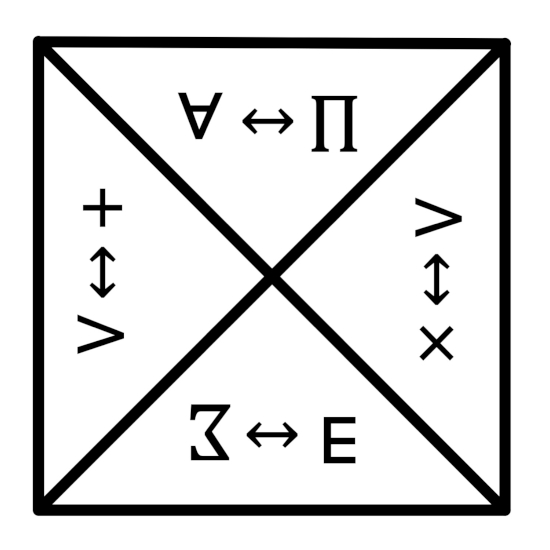
The Curry-Howard Correspondence reveals a close correspondence between the constituents of Logic and of Programming. Also known as the Formulas as Types and the Proofs as Programs interpretations.

Existential Quantification (∃) of Logic corresponds to the Generalized Disjoint Sum Type (∑) of Programming. Universal Quantification (∀) of Logic corresponds to the Generalized Cartesian Product Type (∏) of Programming. Conjunction (⋀) of Logic corresponds to the Product type (×) of Programming. Disjunction (⋁) of Logic corresponds to the Sum type (+) of Programming.

There are associations between the Curry-Howard Correspondence and the fourfolds of the Square of Opposition, Attraction and Repulsion, and of course Linear Logic.

Further Reading:

http://en.wikipedia.org/wiki/Curry-Howard_correspondence

<>


Bending the Elements

You and your forefathers have devastated the balance of this world. And now, you shall pay the ultimate price!

— From Avatar: the Last Airbender

I recently finished watching the animated series “Avatar: the Last Airbender”. I know I’m a bit late with my praise, but I thought this was an excellent series. It had fascinating world-building, well thought-out plotting, and believable characterization. It had humor, drama, fantasy, even teen romance. Something for all ages!

It could be because I’ve been thinking alot about the Four Elements and how I view them as analogies for the four relations I’ve been discussing for some time on this blog. In Avatar, they are literally the four elements of the world: fire, earth, water, and air. But in addition, these elements correspond to the four peoples of this world. The people of the Fire Nation are willful, the people of the Earth Kingdom are resolute, the people of the Water Tribe are empathic, and the people of the Air Nomads are reflective. Some individuals are able to “bend” the element that is associated with the people they are born into, so that for example a member of the Fire Nation might be able to produce and control fire with thought and gesture. Not everyone has this ability, however.

The Avatar is a continuously reincarnated individual that embodies the spirit of the world. He or she is born into each of the four peoples in a repeating cycle, but the Avatar is also the only individual that can learn to bend all four elements, and even all at the same time. Because of his or her unique powers, the Avatar is known to be able to bring and restore balance to the world, and to tie the real world to another, spiritual world. Avatar: the Last Airbender is the story of Aang, a descendent of the Air Nomads, but the last of his people due to genocide. He has been in a state of suspended animation for the last 100 years and awakes to a troubled world of war and turmoil. Can Aang save his world?

Hopefully I’m not spoiling anything in saying that he does. Indeed a sequel is currently being produced called “The Legend of Korra” that is planned to run 52 episodes. This sequel takes place a number of years after the end of Avatar, and the next Avatar after Aang is Korra from the Southern Water Tribe. The world is now somewhat more advanced technologically than it was during Aang’s time, and although not at war because it is still enjoying the peace that Aang initiated, there is still some strife and unrest for Korra to eventually bring the Avatar’s balance to. I am enjoying it also!

http://en.wikipedia.org/wiki/Avatar:_The_Last_Airbender

http://en.wikipedia.org/wiki/The_Legend_of_Korra

Note:

It is interesting to note that fire is the only element that can be generated by the will ex nihilo. With enough skill, water can be extracted from living matter and the air. Of course, air is ever present and earth is seldom far away.

<>

The Physical Force Carriers

The probable discovery of the Higgs Boson was announced recently. I was initially confused about the difference between the Higgs and the yet to be discovered Graviton. After some reading on the internet, I’m still confused, but they are theorized to be two different particles, since the Graviton is the quantum manifestation of the force of gravity, and the Higgs is the quantum manifestation of the field that gives certain particles mass. Since the Graviton can effect Photons, and the Higgs can’t, they must be different.

You would think that since particles have to have mass to be effected by gravity, they would have to be related. I guess there are some theories out there that do that, but none have been validated. Additionally, the Higgs Boson is part of the Standard Model, and the Graviton isn’t, even though the Higgs doesn’t seem to fit nicely into those 4 x 4 matrices.

The above fourfold is patterned after the Four Fundamental Forces of Physics.

http://en.wikipedia.org/wiki/Quantum_gravity

http://en.wikipedia.org/wiki/Higgs_boson

http://en.wikipedia.org/wiki/Standard_model

<>

Structure-Function

Aristotle’s Four Causes is an important fourfold that seems to be the basis for many of the fourfolds, both original and not, presented in this blog. Two of the causes, efficient and material, are acceptable to modern scientific inquiry because they can be thought of as motion and matter, respectively, but the other two causes, formal and final, are not. Why is that?

The formal cause is problematic because the formal is usually considered to be an abstract concept, a construction of universals that may only exist in the human mind. The final cause is also problematic because it is associated with the concept of telos or purpose. There, too, only human or cognitive agents are allowed to have goals or ends. So for two causes, efficient and material, all things may participate in them, but for the two remaining, formal and final, only agents with minds may.

These problems may be due to the pervasive influence of what the recent philosophical movement of Object Oriented Philosophy calls correlationism: ontology or the existence of things is limited to human knowledge of them, or epistemology. The Four Causes as usually described becomes restricted to the human creation and purpose of things. Heidegger’s Tool Analysis or Fourfold, which also appears to have been derived from the Four Causes, is usually explained in terms of the human use of human made things: bridges, hammers, pitchers. Even scientific knowledge is claimed to be just human knowledge, because only humans participate in the making of this knowledge as well as its usage.

Graham Harman, one of the founders of Speculative Realism of which his Object Oriented Ontology is a result, has transformed Heidegger’s Fourfold so that it operates for all things, and so the correlationism that restricts ontology to human knowledge becomes a relationism that informs the ontology for all things. Instead of this limiting our knowledge even more, it is surprising what can be said about the relations between all things when every thing’s access is as limited as human access. However, this transformation is into the realm of the phenomenological, which is not easily accessible to rational inquiry.

I wish to update the Four Causes, and claim that they can be recast into a completely naturalistic fourfold operating for all things. This new version was inspired by the Four Operators of Linear Logic. Structure and function are commonplace terms in scientific discourse, and I wish to replace formal and final causes with them. It may be argued that what is obtained can no longer be properly called the Four Causes, and that may indeed be correct.

First, let us rename the efficient cause to be action, but not simply a motion that something can perform. I’m not concerned at the moment with whether the action is intentional or random, but it must not be wholly deterministic. Thus there are at least two alternatives to an action. I’m also not determining whether one alternative is better than the other, so there is no normative judgement. An action is such that something could have done something differently in the same situation. This is usually called external choice in Linear Logic (although it makes more sense to me to call it internal choice: please see silly link below).

Second, let us call the material cause part, but not simply a piece of something. Instead of the material or substance that something is composed of, let us first consider the parts that constitute it. However, a part is not merely a piece that can be removed. A part is such that something different could be substituted for it in the same structure, but not by one’s choice. Like an action, I am not concerned whether one of the alternatives is better than the other, but only that the thing is still the thing regardless of the alternative. This is usually called internal choice.

Next, we will relabel the formal cause to be structure, but not simply the structure of the thing under consideration. Ordinarily structure is not a mere list of parts, or a set of parts, or even a sum or integral of parts, but an ordered assembly of parts that shapes a form. Ideally structure is an arrangement of parts in space. However, in this conceptualization, structure will be only an unordered list of parts with duplications allowed.

Last, instead of final cause we will say function, but not simply the function of the thing as determined by humans. Ordinarily function is not a mere list of actions, or a set of actions, or a sum or integral of actions, but an ordered aggregate of actions that enables a functionality. Ideally function is an arrangement of actions in time. However, like structure, function will be only an unordered list of actions with duplications allowed.

As we transform the Four Causes from made things to all things, both natural and human-made, we will later examine how that changes them.

References:

http://en.wikipedia.org/wiki/Speculative_realism

http://en.wikipedia.org/wiki/Object-oriented_ontology

http://en.wikipedia.org/wiki/Graham_Harman

http://wiki.cmukgb.org/index.php/Internal_and_External_Choice

[*6.144, *7.32, *7.97]

<>


The One and the Many

A set is a Many that allows itself to be thought of as a One.

— Georg Cantor

How to solve the ancient problem of the one and the many?

Is the one just one, and the many merely many? Or can the one contain the many, and the many reveal the one?

Many fourfolds have been shown here. Are they different aspects of  one, greater fourfold?

Or are they completely separate, incomparable and  incommensurate, except for their common cardinality?

http://plato.stanford.edu/entries/problem-of-many/

[*4.84]

<>

Fourier Analysis

Here is another example of a fourfold, in the mathematics of Fourier Analysis. Here the four elements of our investigation resolve into Discrete Time, Continuous Time, the Fourier Series, and the Fourier Transform.

From the three dualities of Time – Frequency, Periodic – Aperiodic, and Discrete – Continuous, we obtain the four combinations Discrete Time/Periodic Frequency, Continuous Time/Aperiodic Frequency, the Fourier Series (Periodic Time/Discrete Frequency), and the Fourier Transform (Aperiodic Time/Continuous Frequency).

In the table below, T stands for Time and f for Frequency. The subscripts denote the attributes of each: D for Discrete, C for Continuous, P for Periodic, and A for Aperiodic. So T subscript C,  f subscript A means that when Time is Continuous, Frequency is Aperiodic, etc. Please see Steve Tjoa’s web site for the equations for the Fourier Series and the Fourier Transform in Continuous and Discrete Time.

References:

http://stevetjoa.com/633

http://en.wikipedia.org/wiki/Fourier_analysis

http://en.wikipedia.org/wiki/Fourier_series

http://en.wikipedia.org/wiki/Fourier_transform

[*7.74, *7.108]

<>

The Theory of Evolution

“I have called this principle, by which each slight variation, if useful, is preserved, by the term Natural Selection”

— Charles Darwin

Can we cast the theory of evolution into a fourfold? I propose that the following four processes can serve as an abstract model for evolution: generation, variation, speciation, and selection. These four entities are similar to the fourfold of Structure-Function, currently in development. By my analogy which will be explained later, Generation is action, Variation is part, Speciation is structure, and Selection is function. A more familiar analogy matches these four processes to Aristotle’s Four Causes: Generation is efficient cause, Variation is material cause, Speciation is formal cause, and Selection is final cause.

Generation: Offspring are like their parents by and large, except when made different by processes of variation. Mainly the act of reproduction, procreation, or replication, but includes the ordinary evolutionary factors of descent and heredity.

Variation: Offspring can be different than parents. Includes the factors of genetic variation, mutation, sexual reproduction, and genetic drift.

Speciation: Includes the factors which keep species separated and differentiated from each other.

Selection: Really natural selection. I always thought this was a negative process, where species become extinct or are selected out if they are ill adapted to their environment. Apparently the original meaning was that the fittest organisms and their traits continue: that is, they are selected to survive by nature because of their adaptive traits.

As a process of change, evolution has been suggested by scientists to operate at many levels of nature, not just for the biological. One such scientist is Eric Chaisson, who has written many books on his idea of “cosmic evolution”.

References:

http://en.wikipedia.org/wiki/Evolution

http://en.wikipedia.org/wiki/Reproduction

http://en.wikipedia.org/wiki/Genetic_variation

http://en.wikipedia.org/wiki/Speciation

http://en.wikipedia.org/wiki/Natural_selection

https://www.cfa.harvard.edu/~ejchaisson/cosmic_evolution/docs/splash.html

Eric Chaisson / Epic of Evolution: seven ages of the cosmos (2005)

Note:

Also note the similarity between this fourfold and the fourfold I have drawn for Kevin Kelly’s Philosophy of Technology. In “What Technology Wants”, Kelly claims that technology develops in an evolutionary manner.

[*7.96]

<>

Every Fourth Thing

Daydream Tourist

Because there are way more than seven wonders in the world.

The Digital Ambler

Always Forward Between Heaven and Earth

The Mouse Trap

Psychological Musings

Wrong Every Time

Critiquing anime and everything else

The Chrysalis

"For man has closed himself up, till he sees all things thro' narrow chinks of his cavern" -- William Blake

  Bartosz Milewski's Programming Cafe

Category Theory, Haskell, Concurrency, C++

The Inquisitive Biologist

Reviewing fascinating science books since 2017

Gizmodo

Every Fourth Thing

Simplicity

Derek Wise's blog: Mathematics, Physics, Computing and other fun stuff.

COMPLEMENTARY 4x

integrating 4 binary opposites in life, learning, art, science and architecture

INTEGRATED 4x

integrating 4 binary opposites in life, learning, art, science and architecture

Playful Bookbinding and Paper Works

Chasing the Paper Rabbit

Antinomia Imediata

experiments in a reaction from the left

Digital Minds

A blog about computers, evolution, complexity, cells, intelligence, brains, and minds.

philosophy maps

mind maps, infographics, and expositions

hyde and rugg

neat ideas from unusual places

Visions of Four Notions

Introduction to a Quadralectic Epistomology

Explaining Science

Astronomy, space and space travel for the non scientist

Log24

Every Fourth Thing

Ideas Without End

A Serious Look at Trivial Things

Quadralectic Architecture

A Survey of Tetradic Testimonials in Architecture

Minds and Brains

Musings from a Naturalist

Why Evolution Is True

Why Evolution is True is a blog written by Jerry Coyne, centered on evolution and biology but also dealing with diverse topics like politics, culture, and cats.

Quadriformisratio

Four-fold thinking4you

Multisense Realism

Craig Weinberg's Cosmology of Sense

RABUJOI - An Anime Blog

Purveyors of Fine Anime Reviews and Ratings Since 2010

Intra-Being

Between Subject and Object

The Woodring Monitor

Every Fourth Thing

FORM &amp; FORMALISM

Every Fourth Thing

Log24

Every Fourth Thing

The n-Category Café

Every Fourth Thing

THIS IS NOT A BLOG

Every Fourth Thing

PHILOSOPHY IN A TIME OF ERROR

Sometimes those Sticking their Heads in the Sand are Looking for Something Deep

Networkologies

Online Home of Christopher Vitale, Associate Professor of Media Studies, The Graduate Program in Media Studies, Pratt Institute, Brooklyn, NY.

Hyper tiling

Linking Ideas

DEONTOLOGISTICS

RESEARCHING THE DEMANDS OF THOUGHT

Incognitions

Explorations in the Paradoxes of Meaning

Object-Oriented Philosophy

"The centaur of classical metaphysics shall be mated with the cheetah of actor-network theory."

Objects & Things

objects & things, design, art & technology