Things, Thoughts, Words, and Actions

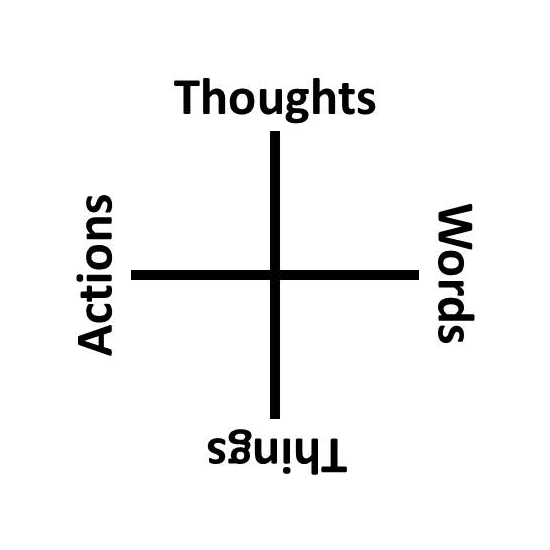
Here are some additional fourfolds from philosopher Richard McKeon.

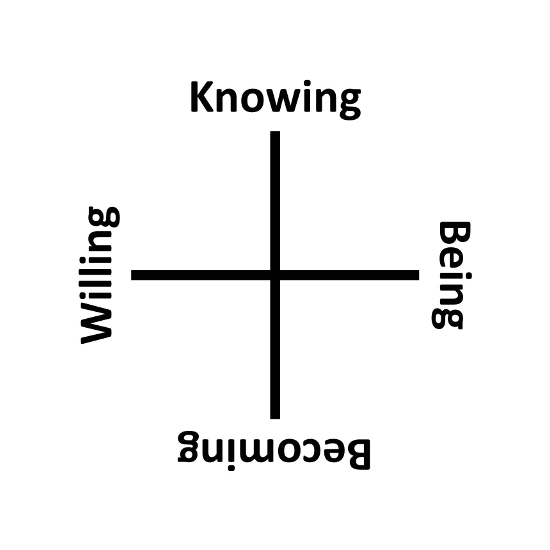
McKeon wrote much on the subject of rhetoric. A favorite fourfold of concepts was that of Things, Thoughts, Words, and Actions. He called these “commonplaces of inquiry” or “places of invention and memory”. Two rhetorical devices he used were amplification and schematization. Amplification can extend the scope of, for example, words to the other three, similar to the principle of indifference. “Objectivity is the inclusive principle of indifference by which it is recognized that being is grasped only in what we think, and say, and do about it.” [1] Schematization was used to identify and distiguish, for example, commonplaces. Thus I think amplification is a conjunctive device, and schematization is a disjunctive device.

Another fourfold of subjects by McKeon was Topics, Themes, Theses, and Hypotheses. McKeon wrote, “Speculation concerning discourse must avoid the fixities of categories, doctrines, methods, and assumptions which discourse assumes in any one form of philosophy or inquiry, if it is to include all the forms which discourse takes in philosophy and in inquiry, action, and production. This is possible because the variety of categories or elements is approached in discourse by way of common topics or ‘commonplaces’; the variety of facts or statements of what is the case by way of common hypotheses; the variety of arts or methods of treating problems by way of common themes; and the variety of assumptions or principles by way of common theses.” [2]

Are both these fourfolds aligned correctly with the previous Knowable, Knowledge, Known, and Knower? McKeon’s use of terms in his rhetoric was very fluid, perhaps to prevent systemization or to promote pluralism. However, his main reference to fourfolds was Aristotle’s four scientific questions, or Four Causes, which we can use to try to understand his fourfolds.

References:

Theresa Enos (ed.) / Encyclopedia of Rhetoric and Composition: Communication from Ancient Times to the Information Age

[1] Richard McKeon / Selected Writings of Richard McKeon: Volume One: Philosophy, Science, and Culture

[2] Richard McKeon / Selected Writings of Richard McKeon, Volume Two: Culture, Education, and the Arts

Click to access McKNotes-Semantics&Inquiry_Intro.pdf

H. L. Ulman / Things, Thoughts, Words, and Actions: the problem of language in late Eighteenth-Century British rhetorical theory

[*5.197, *6.140, *7.162, *7.165]

<>


The Four Laws of Thermodynamics

0th Law: Heat doesn’t flow between objects of the same temperature.

1st Law: Heat cannot be created or destroyed.

2nd Law: Entropy increases by the flow of heat in a closed system not in equilibrium.

3rd Law: Entropy approaches a constant minimum in a system as temperature approaches absolute zero.

Further Reading:

http://www.physicsforidiots.com/thermodynamics.html

http://en.wikipedia.org/wiki/Laws_of_thermodynamics

Peter Atkins / Four Laws That Drive the Universe

[*3.169, *7.164]

<>


The Stone Gamut

Our thesis is that the category Set is the ultimate abstraction of body, and that Set^op, equivalent to the category of complete atomic Boolean algebras (i.e. power sets), which we shall advocate thinking of as antisets, is dually the ultimate abstraction of mind.

— From Chu Spaces: automata with quantum aspects by Vaughan Pratt

Reflecting an era of reduced expectations for the superiority of humans, we have implemented causal interaction not with the pineal gland but with machinery freely available to all classical entities, whether newt, pet rock, electron, or theorem (but not quantum mechanical wavefunction, which is sibling to if not an actual instance of our machinery).

— From Rational Mechanics and Natural Mathematics by Vaughan Pratt

http://en.wikipedia.org/wiki/Boolean_algebra

http://en.wikipedia.org/wiki/Distributive_lattice

http://en.wikipedia.org/wiki/Vector_space

http://en.wikipedia.org/wiki/Partially_ordered_set

http://en.wikipedia.org/wiki/Set_%28mathematics%29

References:

Click to access ph94.pdf

Click to access ratmech.pdf

http://chu.stanford.edu/

http://en.wikipedia.org/wiki/Chu_space

Vaughan Pratt / The Stone Gamut: a coordinatization of mathematics

https://ieeexplore.ieee.org/document/523278

[*7.140]

<>

The Archic Philosophers

In a word, the Sophist begins from man, the Democritean from matter, the Platonist from form, and the Aristotelian from functioning.

— From The Architectonics of Meaning, by Walter Watson

Inspired by philosopher Richard McKeon, I believe that philosophy as a whole is encompassed by four main philosophical stances, exemplified by four ancient philosophers: the Sophists (as a group), Democritus, Plato, and Aristotle. Their four systems of thought lay out principal philosophical directions, much like the compass directions east, south, north, and west lay out a complete set of primary directions.

Of course the compass directions can be subdivided into north-east, or south-south-west, and so on, and similarly each of these philosophical systems can be divided into four parts. This division into a four-by-four matrix is called the Archic Matrix and was written about at length in the separate but complementary works of Walter Watson and David Dilworth.

Watson and Dilworth described the four main philosophical directions to be perspective, reality, method, and principle: perspective for the Sophists, reality for Democritus, method for Plato, and principle for Aristotle. I have written about these philosophical perspectives previously in several ways.

Thus philosophy as a practice goes around and around and revisits the same ideas over and over. Perhaps McKeon thought his philosophical system followed in the footsteps of Aristotle, and probably Watson and Dilworth had a similar view.

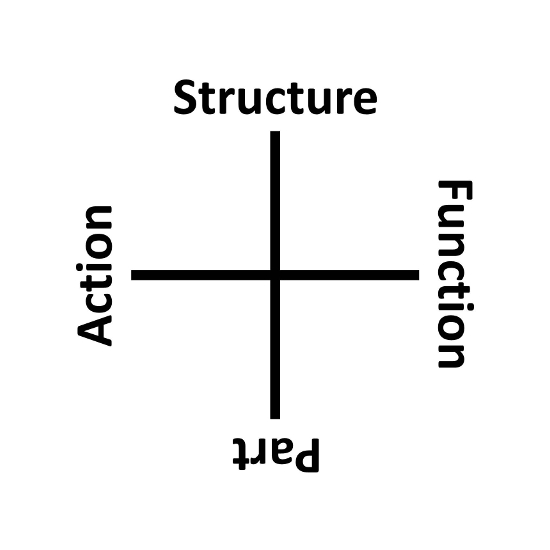
Likewise, I believe that my fourfold of Structure-Function represents these four philosophical directions in the following way: Action(s) for the Sophists, Part(s) for Democritus, Structure for Plato, and Function for Aristotle.

[*6.108]
<>


The Duality of Time and Information, V2

The states of a computing system bear information and change time, while its events bear time and change information.

from The Duality of Time and Information by Vaughan Pratt

The most promising transformational logic seems to us to be Girard’s linear logic.

— from Rational Mechanics and Natural Mathematics by Vaughan Pratt

Here we have three duals: information – time, state – event, and bear – change.

References:

Vaughan Pratt / The Duality of Time and Information http://boole.stanford.edu/pub/dti.pdf

Vaughan Pratt / Time and Information in Sequential and Concurrent Computation http://boole.stanford.edu/pub/tppp.pdf

Vaughan Pratt / Rational Mechanics and Natural Mathematics http://chu.stanford.edu/guide.html#ratmech

[*5.170]

<>

Wheel of Fortuna

O Fortune, like the moon you are changable,
ever waxing and waning, hateful life,
first oppresses and then soothes as fancy takes it;
poverty and power it melts them like ice.

— From Carmina Burana

References:

http://en.wikipedia.org/wiki/Carmina_Burana

http://en.wikipedia.org/wiki/Carmina_Burana_%28Orff%29

http://en.wikipedia.org/wiki/Rota_Fortunae

http://quadriformisratio.wordpress.com/2013/07/01/the-rule-of-four/

[*7.156]

<>

Falls the Shadow

Between the idea
And the reality
Between the motion
And the act
Falls the Shadow

— From “The Hollow Men” by T. S. Eliot

References:

http://en.wikipedia.org/wiki/The_Hollow_Men

https://allpoetry.com/the-hollow-men

[*7.158]

<>


The Space-Time Tetrahedron

In honor of April Fool’s Day, I present the Space-Time Tetrahedron.

The Internet is full of crackpot and nutty websites, and one of the most famous concerns the so-called Time Cube.

Since the ideas expressed on this website are pretty much ignored, it is hoped that it could at least find some recognition as being slightly crackpot or somewhat nutty.

Let’s examine the similarities between Time Cube theory and my theory.

The number four is very important in each. In fact, the Time Cube is a fourfold, although quite a puzzling one.

The notions of space and time are crucial to Time Cube; many of my fourfolds involve some aspect of space and time or spacetime.

How about the differences? I don’t think one can find any common claims between the two theories. At least I hope not!

References:

http://en.wikipedia.org/wiki/Time_Cube

http://knowyourmeme.com/memes/the-time-cube

[*7.150]

<>

The Four Treasures, Part 3

What else has Four Treasures? Interestingly, calligraphy and painting in Chinese and other East Asian traditions calls four important tools the “Four Treasures of the Study”. The ink stone, the ink stick, the paper, and the brush are these four treasures or jewels.

References:

http://en.wikipedia.org/wiki/Four_Treasures_of_the_Study

[*7.158]

<>


The Four Treasures, Part 2

I refute it thus!

— Samuel Johnson

This famous quote from Samuel Johnson was the verbal part to his simple refutation of George Berkeley’s idealism, whose gestural accompaniment was the kicking of a large stone to demonstrate its raw physicality. The ‘thusness’ of the stone is in contrast to the gyrations and perambulations that idealists perform to unmake the stone into mere phenomenal sensation and/or mental or social constructions.

Sure, the stone is mysterious. It is hard to the touch and opaque to vision. Physics demonstrates to us that the atoms that constitute it are almost all empty space. Geology explains to us that stones come in many different varieties, with many different chemical components. What you and I call a stone can completely differ, but usually not. Many tiny stones can make up a seashore, or many large ones a world. One stone usually is as good as another, unless you are trying to build a wall, select a king, or decorate yourself with shiny ones.

A specific legendary stone is one of the Four Treasures of Ireland. The other treasures are a special spear, an esteemed sword, and a distinguished cauldron, all whose unique qualities will not be described. But consider the general features of each item in relation to the Archic Matrix and the four operators of Linear Logic.

The spear is an extention of the pointing finger. The act of pointing is indication, selection, choice, and direction. The spear can be used to pierce, or to combine by piercing multiple items as on a shish-kabob. It is the treasure of perspective. Thus it represents Linear Logic’s with.

The sword is useful for piercing, but its chief purpose is to cleave and divide. It creates space between two parts of something, often at their structural joints where they are weakest. It is the treasure of method. Thus it represents Linear Logic’s par.

The basin or cauldron is for sorting and combining. The sorting is what goes into the cauldron and what remains outside. The combining is of everything in the cauldron in the proportions selected, for the desired functionality of the mixture. It is the treasure of principle. Thus it represents Linear Logic’s tensor.

The stone just is, and its uses have been listed above. Can we access the stone as it is given, the stone in itself? No, but that does not turn it into a ghost. It is the treasure of reality. Thus it represents Linear Logic’s plus.

<>


Every Fourth Thing

Daydream Tourist

Because there are way more than seven wonders in the world.

The Digital Ambler

Always Forward Between Heaven and Earth

The Mouse Trap

Psychological Musings

Wrong Every Time

Critiquing anime and everything else

The Chrysalis

"For man has closed himself up, till he sees all things thro' narrow chinks of his cavern" -- William Blake

  Bartosz Milewski's Programming Cafe

Category Theory, Haskell, Concurrency, C++

The Inquisitive Biologist

Reviewing fascinating science books since 2017

Gizmodo

Every Fourth Thing

Simplicity

Derek Wise's blog: Mathematics, Physics, Computing and other fun stuff.

COMPLEMENTARY 4x

integrating 4 binary opposites in life, learning, art, science and architecture

INTEGRATED 4x

integrating 4 binary opposites in life, learning, art, science and architecture

Playful Bookbinding and Paper Works

Chasing the Paper Rabbit

Antinomia Imediata

experiments in a reaction from the left

Digital Minds

A blog about computers, evolution, complexity, cells, intelligence, brains, and minds.

philosophy maps

mind maps, infographics, and expositions

hyde and rugg

neat ideas from unusual places

Visions of Four Notions

Introduction to a Quadralectic Epistomology

Explaining Science

Astronomy, space and space travel for the non scientist

Log24

Every Fourth Thing

Ideas Without End

A Serious Look at Trivial Things

Quadralectic Architecture

A Survey of Tetradic Testimonials in Architecture

Minds and Brains

Musings from a Naturalist

Why Evolution Is True

Why Evolution is True is a blog written by Jerry Coyne, centered on evolution and biology but also dealing with diverse topics like politics, culture, and cats.

Quadriformisratio

Four-fold thinking4you

Multisense Realism

Craig Weinberg's Cosmology of Sense

RABUJOI - An Anime Blog

Purveyors of Fine Anime Reviews and Ratings Since 2010

Intra-Being

Between Subject and Object

The Woodring Monitor

Every Fourth Thing

FORM &amp; FORMALISM

Every Fourth Thing

Log24

Every Fourth Thing

The n-Category Café

Every Fourth Thing

THIS IS NOT A BLOG

Every Fourth Thing

PHILOSOPHY IN A TIME OF ERROR

Sometimes those Sticking their Heads in the Sand are Looking for Something Deep

Networkologies

Online Home of Christopher Vitale, Associate Professor of Media Studies, The Graduate Program in Media Studies, Pratt Institute, Brooklyn, NY.

Hyper tiling

Linking Ideas

DEONTOLOGISTICS

RESEARCHING THE DEMANDS OF THOUGHT

Incognitions

Explorations in the Paradoxes of Meaning

Object-Oriented Philosophy

"The centaur of classical metaphysics shall be mated with the cheetah of actor-network theory."

Objects & Things

objects & things, design, art & technology