A Four-fold Riddle

sq_roses_dogs_stars_stonesA rose I give to you
This rose so fresh with fragrance rare,
Its petals bringing joy to you
The fairest of the fair.
Oh roses are like memories
They fade and pass above
But you dear heart will e’er remain
My fading flower of forgotten love.

Fading Flower of Forgotten Love by Agnes Ellicott Strong

John Crowley (author of the AEgypt Tetralogy) has mentioned several times in his books a curious list: dogs, stones, stars, and roses. What can he mean by this?

I propose this is a metaphor (Meta-four?) for the four colors of the Magnum Opus: yellow dogs, black stones, white stars, and red roses.

At least until I find out otherwise!

References:

http://watershade.net/wmcclain/AEgypt.html

http://watershade.net/wmcclain/love_sleep.html

http://watershade.net/wmcclain/jc-daemonomania.html

https://www.imayberry.com/tagsrwc/wbmutbb/anewsome/private/songs2.htm

[*8.13, *9.116]

<>


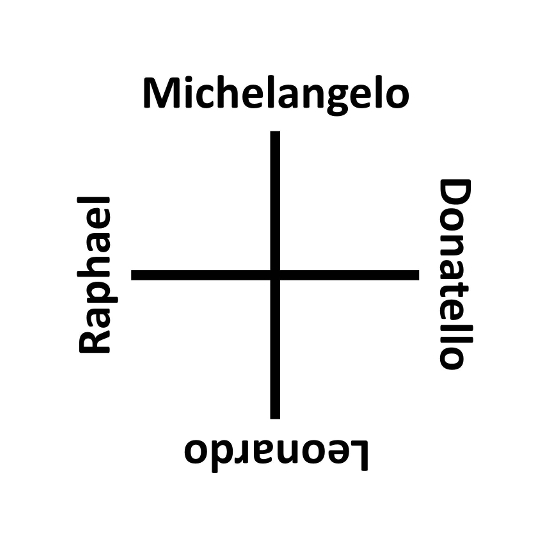
Teenage Mutant Ninja Turtles

sq_TMNTIt’s turtles all the way down!

— See Wikipedia.

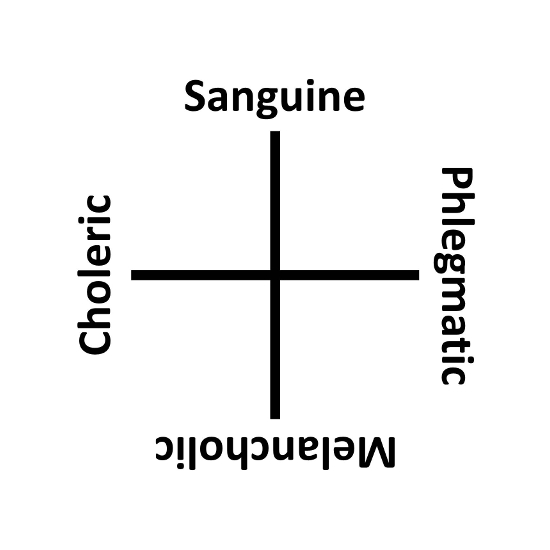
sq_four_temperamentsCowabunga!

Even the personalities of the Teenage Mutant Ninja Turtles can be put in correspondence with the Four Temperaments!

.

.

.

Links:

http://en.wikipedia.org/wiki/Teenage_Mutant_Ninja_Turtles

http://tvtropes.org/pmwiki/pmwiki.php/Main/FourTemperamentEnsemble

[*7.194, *8.127, *8.156]

<>

Magnum Opus

sq_great_workThe Magnum Opussq_magnum_opus, or Great Work, is a term from alchemy for the process of creating the Philosopher’s Stone, which is a substance that was purported to be able to turn stuff into gold, like King Midas’s Touch. Work and Stone can also be metaphors for perfecting the individual self, as gold was considered the perfect material.

.

Tsq_RWBYbhe Great Work is often broken into four stages, identified by different colors also seen in the Medicine Wheel of Native Americans. Red is Rubedo or Iosis, White is Albedo or Leukosis, Black is Nigredo or Melanosis, and Yellow is Citrinitas or Xanthosis. The order is usually Black, White, Yellow, and then Red, through beginning to ending stages of the work.

.

Is this my Great Work? Will I create a Philosopher’s Stone?

Links:

http://en.wikipedia.org/wiki/Magnum_opus_%28alchemy%29

http://en.wikipedia.org/wiki/Philosopher%27s_stone

[*6.182, *8.12, *8.13, *8.124]

<>

Kant’s Analytic-Synthetic Distinction

One of the oldest and most problematic philosophical questions is the comparison of the a prioria posteriori distinction with that of the analyticsynthetic distinction. Both are used in epistemology to divide knowledge, or true statements, between the innate and the learned, or the immediate and the earned, so they might even be considered the same. A priori and a posteriori statements are before “experience” and after it, respectively. Analytic statements are true only by their “meaning”, whereas synthetic statements are true only when facts about the world are combined consistently with that meaning.

It seems we have complicated the issue because now we must define and understand “experience” and “meaning”. However, these concepts are not independent because we must experience meaning, and meaning in turn conditions experience. In addition, even the a priori or the analytic are not innate or immediately obvious because deductions and the rules of logic require effort just like inductions do. Otherwise we would have Fitch’s Paradox: all truths are in fact known. What a muddle! So both experience and meaning are necessarily locked into a cooperative spiral dance to improve each other.

Even so, these two distinctions can be distinguished and combined into a fourfold.

The web site of Stephen R. Palmquist has a great wealth of material on fourfolds in relation to Kant’s as well as his own philosophy. From my own initial reading of his extensive material I have tried to choose a canonical Kantian fourfold which has the most relevance to my project.

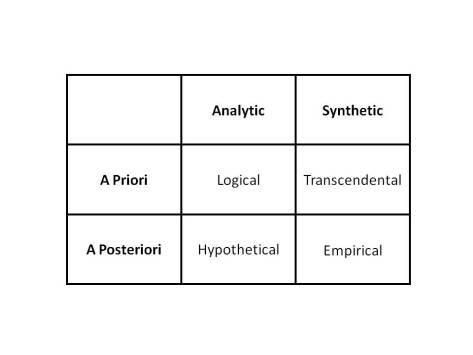
The fourfold shown to the right Dr. Palmquist calls Kant’s “reflective perspectives on experience”. Consisting of the logical, the empirical, the transcendental, and the hypothetical, these facets bear a close analogical likeness to many of the fourfolds presented here.

Logical: Analytic a priori
Transcendental: Synthetic a priori
Hypothetical: Analytic a posteriori
Empirical: Synthetic a posteriorikant_table

Dr. Palmquist also has many of his own books available on his web site for the interested reader. I will certainly be returning to his web site in the future for much enjoyable study.

Links:

http://en.wikipedia.org/wiki/Analytic-synthetic_distinction

http://en.wikipedia.org/wiki/A_priori_and_a_posteriori

http://plato.stanford.edu/entries/analytic-synthetic/

A Priori and A Posteriori

http://plato.stanford.edu/entries/fitch-paradox/

http://www.philosophypages.com/hy/5f.htm

http://www.hkbu.edu.hk/~ppp/

http://www.hkbu.edu.hk/~ppp/ksp2/KCR3.htm

[*8.126]

<>


Off to See the Wizard

sq_wizard_ozIf the Wizard is a Wizard who will serve.
Then I’m sure to get a brain; a heart; a home; the nerve!

From the film The Wizard of Oz

Links:

http://en.wikipedia.org/wiki/If_I_Only_Had_a_Brain

Brains, heart, courage and home: Principles to live by

[*8.124]

<>

The 4-H Club Pledge

sq_four_h_clubI pledge my head to clearer thinking,
My heart to greater loyalty,
My hands to larger service,
and my health to better living,
for my club, my community, my country, and my world.

— From the 4-H Pledge

Links:

http://en.wikipedia.org/wiki/4-H

Further reading:

Also see Metropolis: “The Mediator between the head and hands must be the heart!”

[*7.14, *7.22]

<>

The Fantastic Four

Fire, Aire, Earth, Water, all the Opposites
That strove in Chaos, powrefull Love unites;
And from their Discord drew this Harmonie,
Which smiles in Nature.

– From Sandy’s translation of Ovid’s Metamorphoses (1632)

sq_fantastic_fourAll fours are fantastic, but especially this superhero team! I hear that a reboot of the movie franchise is on the way.

Nsq_elementsote they are close to being elementals, after the Four Elements. Paracelsus associated different spirits with each element.

Gnome: spirit of earth (industrious)
Undine: spirit of water (inspired)
Sylph: spirit of air (curious)
Salamander: spirit of fire (changeable)

Notes:

Her name is now the Invisible Woman, instead of the Invisible Girl.

Links:

http://en.wikipedia.org/wiki/Fantastic_Four

http://en.wikipedia.org/wiki/Elemental

http://en.wikipedia.org/wiki/Classical_elements_in_popular_culture

http://ovid.lib.virginia.edu/sandys/contents.htm

[*7.12, *8.96]

<>

Wave-Particle Duality

sq_wave_particle_dualityIs the fundamental nature of light and matter more like a wave or is it more like a particle? After hundreds of years of scientific research the answer is … Yes! Light and matter have aspects of both: sometimes one and sometimes the other. Kind of like that duck-rabbit illusion where the drawing flips back and forth between a duck or a rabbit.

Now that we have the irreconcilable duality of wave and particle, can we add to the confusion and enlarge it into a four-fold? Two additional aspects (from physics) come to mind: motions, as in the motions of particles, and fields, as in electric and magnetic fields.

We immediately can see this four-fold as a play of dimensions: (idealized) particles have 0 dimensions, motions have 1 (along a path), waves have 2 (or more), fields have 3 (or more).

sq_lucretiusWe can also see this four-fold in a weak analogy with the Four Elements: particles for earth, waves for water, motions for fire, and fields for air (or space). Also compare to the four-fold for Lucretius!

Should fields above be replaced with wave-functions? I guess a wave-function is a kind of field of probabilities of existence over space and time, so perhaps it makes no difference!

Links:

http://en.wikipedia.org/wiki/Wave%E2%80%93particle_duality

http://en.wikipedia.org/wiki/Field_%28physics%29

http://en.wikipedia.org/wiki/Rabbit%E2%80%93duck_illusion

http://dl.acm.org/citation.cfm?id=2811288&picked=formats

Charis Anastopoulos / Particle or Wave: The Evolution of the Concept of Matter in Modern Physics

Notes:

I like Forces or Speeds better than Motions. Atoms better than Particles at top?

[*7.152, *8.32]

<>


Reasons Things Happen

sq_reasons

What kind of reasons do we give for things happening? In physics, we call the reasons causes and the things that happen are called effects. One way that these causes can be divided into two is by distinguishing between chances and necessities: causes that can happen and those that must happen. In contrast, in describing reasons why we as agents do things, we merely call the reasons reasons, or reasons for actions. One way these reasons can be divided into two is by distinguishing between choices and plans: the reasons for making a choice and the explanations for planning a goal.

If we cannot understand the reasons that something happened, we might claim that it was just random or it was just fate. We might come to believe that there is an agent we know that is responsible for the thing happening by either a choice they have made or a goal they have planned. Or we might even think that there is an agent or institution hidden from our knowledge that might be responsible, with hidden choices and plans. This is not the same as the world operating by chance and necessity.

If we cannot understand the reasons why an agent does what they do, their behavior appears random or even insane. If we can understand the reasons for their actions, their behavior may be justified to us, but it can still be considered good or bad. Of course, our good actions may be ineffectual against the world’s chances and necessities, in which case we are not responsible for outcomes. Even so, our bad actions and our plans and goals may still be scrutinized in a normative way. If an agent’s actions or plans appear to be contrary to our goals or society’s goals, that agent is at odds with us or society.

Ordinarily what is called free will consists of the freedom to make choices and plans and to attempt to carry them out. What is free will free from? Is it free from physical laws, or the energy and matter of our brains and bodies? That doesn’t make much sense to me. Is it the same as chance? That isn’t a freedom worth wanting, as Daniel Dennett says. If we do something that doesn’t make sense to us, various experiments have determined that we then construct reasons for ourselves that we can understand and believe that explain our actions. Are they the real reasons or have we just lied to ourselves?

Regardless whether free will exists, the explanations given by choices and plans are required for our understanding of each other’s actions and goals. sq_modal_verbsHowever, these must not be confused with the chances and necessities of the world when and where they apply.

Notes:

This four-fold consisting of Choice, Chance, Fate, and Plan is inspired by the Modal Verbs: May, Can, Must, and Should. One might consider it as the double duality of internal or external and possibility or necessity.

Also consider changing “chance” to “luck”, and “choice” to “pick”.

Links:

http://en.wikipedia.org/wiki/Causality_(physics)

http://people.wku.edu/jan.garrett/302/4persona.htm

[*8.116]

<>


Grid-group Cultural Theory

sq_grid_group

Looking over some old notes, I ran across something about the Grid-Group Cultural Theory. Also known as the Cultural Theory of Risk, it originated from the studies of anthropologist Mary Douglas and political scientist Aaron Wildavsky. Two dimensions of sociality are described, each with a low and high value (or a continuum): grid measures the differentiation between people, and group measures the cohesion or social bonds between people.

Individualist: Low group and low grid
Fatalist: Low group and high grid
Hierarchist: High group and high grid
Egalitarian: High group and low gridsq_archic_philosophers

Notes:

In the representation shown above, this arrangement reminds me significantly of the Archic Philosophers.

Sophists for Individualist
Democritus for Fatalist
Plato for Hierarchist
Aristotle for Egalitarian

Links:

http://en.wikipedia.org/wiki/Cultural_Theory_of_risk

http://changingminds.org/explanations/culture/grid-group_culture.htm

[*4.86, *8.112]

<>


Every Fourth Thing

Daydream Tourist

Because there are way more than seven wonders in the world.

The Digital Ambler

Always Forward Between Heaven and Earth

The Mouse Trap

Psychological Musings

Wrong Every Time

Critiquing anime and everything else

The Chrysalis

"For man has closed himself up, till he sees all things thro' narrow chinks of his cavern" -- William Blake

  Bartosz Milewski's Programming Cafe

Category Theory, Haskell, Concurrency, C++

The Inquisitive Biologist

Reviewing fascinating science books since 2017

Gizmodo

Every Fourth Thing

Simplicity

Derek Wise's blog: Mathematics, Physics, Computing and other fun stuff.

COMPLEMENTARY 4x

integrating 4 binary opposites in life, learning, art, science and architecture

INTEGRATED 4x

integrating 4 binary opposites in life, learning, art, science and architecture

Playful Bookbinding and Paper Works

Chasing the Paper Rabbit

Antinomia Imediata

experiments in a reaction from the left

Digital Minds

A blog about computers, evolution, complexity, cells, intelligence, brains, and minds.

philosophy maps

mind maps, infographics, and expositions

hyde and rugg

neat ideas from unusual places

Visions of Four Notions

Introduction to a Quadralectic Epistomology

Explaining Science

Astronomy, space and space travel for the non scientist

Log24

Every Fourth Thing

Ideas Without End

A Serious Look at Trivial Things

Quadralectic Architecture

A Survey of Tetradic Testimonials in Architecture

Minds and Brains

Musings from a Naturalist

Why Evolution Is True

Why Evolution is True is a blog written by Jerry Coyne, centered on evolution and biology but also dealing with diverse topics like politics, culture, and cats.

Quadriformisratio

Four-fold thinking4you

Multisense Realism

Craig Weinberg's Cosmology of Sense

RABUJOI - An Anime Blog

Purveyors of Fine Anime Reviews and Ratings Since 2010

Intra-Being

Between Subject and Object

The Woodring Monitor

Every Fourth Thing

FORM &amp; FORMALISM

Every Fourth Thing

Log24

Every Fourth Thing

The n-Category Café

Every Fourth Thing

THIS IS NOT A BLOG

Every Fourth Thing

PHILOSOPHY IN A TIME OF ERROR

Sometimes those Sticking their Heads in the Sand are Looking for Something Deep

Networkologies

Online Home of Christopher Vitale, Associate Professor of Media Studies, The Graduate Program in Media Studies, Pratt Institute, Brooklyn, NY.

Hyper tiling

Linking Ideas

DEONTOLOGISTICS

RESEARCHING THE DEMANDS OF THOUGHT

Incognitions

Explorations in the Paradoxes of Meaning

Object-Oriented Philosophy

"The centaur of classical metaphysics shall be mated with the cheetah of actor-network theory."

Objects & Things

objects & things, design, art & technology