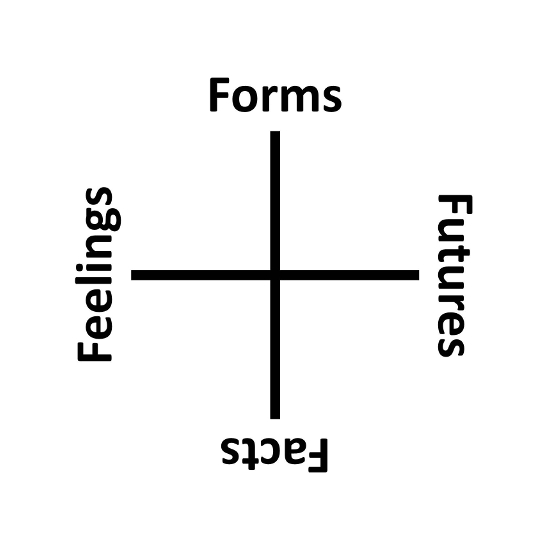
The Carnot Cycle

sq_carnotThe Carnot Cycle consists of four steps:

  1. Isothermal Expansion
  2. Adiabatic or Isentropic Expansion
  3. Isothermal Compression
  4. Adiabatic or Isentropic Compression

The cycle is ordinarily plotted on two axes in two different ways: Pressure and Volume, in which case the cycle is a curvy quadrilateral and descending to the right, or Temperature and Entropy, in which case the cycle is a nice rectangle that emphasizes the isothermal and adiabatic (isentropic) aspects of the steps.

References:

https://en.wikipedia.org/wiki/Carnot_cycle

Images of the Carnot Cycle from Google search.

Tip of the hat to:

Stuart Kauffman / Investigations

Also please see the previous posts:

https://equivalentexchange.wordpress.com/2012/01/27/thermodynamics-and-the-four-thermodynamic-potentials/

https://equivalentexchange.wordpress.com/2013/05/24/the-four-laws-of-thermodynamics/

[*9.51]

<>

King – Man + Woman = Queen

sq_king_man_woman_queen

Here is a fascinating article and paper on computational linguistics.

References:

https://www.technologyreview.com/2015/09/17/166211/king-man-woman-queen-the-marvelous-mathematics-of-computational-linguistics/

http://arxiv.org/abs/1509.01692

[*9.46]

<>


Religion and Science

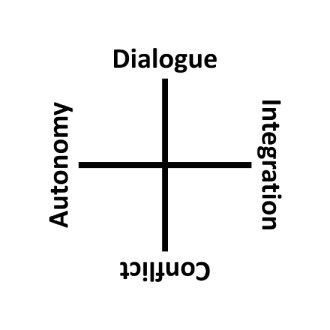
sq_religion_vs_scienceWhat is the relationship between religion and science? Instead of one answer, Templeton Prize winner Ian Barbour presents us with four possibilities: independence (or autonomy), conflict, dialogue, and integration.

These four relationships described by Barbour can be useful to consider, as they describe what may exist between the two entities in the mind of an individual or the social discourse of a culture. For religion and science, what is their stance towards one another? Would you say they are independent of one another like Stephen Jay Gould’s non-overlapping magisteria, or in constant conflict as they appear to be in the media? Or are they in helpful dialogue with one another or even harmoniously integrated with one another? Or are they one thing some times, and then another thing at other times?

It seems that these four relationships are not restricted to just religion and science, as any two distinct institutions could have one or more of these interactions between them. For example there is religion and government, science and business, or public education and certain political organizations, to name just a few. Also, any two different religious institutions or any two different scientific fields could be in any of these relationships. For example there is the Catholic Church and all Protestant Churches, Sunni Islam and Shia Islam, and even Christianity and Buddhism. For science, consider physics and biology, chemistry and sociology, etc.

So why pick on religion and science? Is it because there seems to be so much conflict between them in our own minds? Are they frequently at odds with one another in the public and private spheres? And is that a good thing or a bad thing?

What is religion, anyway? Is it the sum total of all religious institutions and cultural behaviors? Is it the sum total of all religious beliefs held by individuals? Or is it the total of both of those things, plus more? And what is science? Is it the sum total of all scientific facts and literature, or the actual institutional structures and methodologies for all scientific practitioners? Is it the sum total of all scientific knowledge along with all the evidence for all that knowledge that are in the current minds of scientists and even non-scientists?

Without people, all you would have left of religion are the buildings, the texts, and the relics. Without people, all you would have left of science are the buildings, the writings, the instruments, and the facts. Both obviously have very large individual and social components that are sustained through teaching and learning. If post-humans or alien visitors found only the material residue of human religion, they could possibly understand it to some extent with enough anthropological work. If visitors found only the material residue of human science, I think they would be able to follow the chain of reasoning and the body of evidence to support the factual conclusions. Some facts and theories might be incorrect, certainly, but not most. Thus science contains an objective component not found in religion.

The first sentence about each from Wikipedia:

“A religion is an organized collection of beliefs, cultural systems, and world views that relate humanity to an order of existence.”

“Science is a systematic enterprise that builds and organizes knowledge in the form of testable explanations and predictions about the universe”.

The definition of science is pretty clear, but the one for religion is a little vague. I’m not sure what an “order of existence” is supposed to be, and it’s not defined there on Wikipedia. Is it an ordering of things that exist, so humanity is assigned to fit in a certain place in a hierarchy, say between gods and animals, i.e. a “great chain of being”? Is that the same as a “world view”? It seems that a world view could contain an order of existence, but not necessarily the other way around. So one could have a world view without an order of existence.

Only you can decide for yourself which relationship exists between religion and science, and unless you have public writings on the matter, no one can investigate and draw their own conclusions of what you think. And anyone can produce a claim for the ultimate stance between religion and science, but of course such claims must be substantiated by reason and evidence. Scholars can produce informed discussions on the matter, to greater or lesser acceptance.

References:

https://en.wikipedia.org/wiki/Ian_Barbour

https://en.wikipedia.org/wiki/Relationship_between_religion_and_science#Perspectives

Science and Religion: Barbour’s 4 models

https://en.wikipedia.org/wiki/Religion

https://en.wikipedia.org/wiki/Science

Also please see the previous post:

https://equivalentexchange.wordpress.com/2011/07/27/the-four-conic-sections/

[*9.42]

<>

 

Pick Your Causation

sq_causationCausation is one of the most important ways in which we conceptualize the world and ourselves. The reasons that objects go through their motions and people perform the acts they do are explained by the causes that lead to these effects. Constitutive materials can also be causes for the effects on things and individuals. Even the form and function of things can be thought of as effects, dependent on the causes that make them come to be. These effects in turn can be causes for subsequent effects, and so on, in a complex chain or network of causation.

Four different “directions” inform discussion about causes and effects, organized by time (Forward and Backward) and space (Upward and Downward). Perhaps space is not the best word: consider size, distance, or even importance. These four directions can also remind one of Aristotle’s Four Causes, where Efficient Causation is Forward, Formal Causation is Downward, Material Causation is Upward, and Formal Causation is Backward.

Forward causation: Temporal causation, where causes happen before their effects. Ordinarily associated with a deterministic view of causation.

Upward causation: Scientific causation, where the smaller or lower cause the effects of the larger or higher. Ordinarily associated with a reductionistic view of causation.

Downward causation: Structural causation, where the larger or higher can cause the effects of the smaller or lower. Typical examples are free will, agency, intention, or volition, where the mind and not just the brain controls the actions of the body.

Backward causation: Reverse temporal causation, where causes are in the future of their effects. This is not quite the same as teleology, although the concepts are closely linked and require further study. Typical examples are purposes, goals, and ends (versus means) (although this is not the usual philosophical meaning of backward causation).

References:

http://plato.stanford.edu/entries/causation-backwards/

https://en.wikipedia.org/wiki/Downward_causation

https://en.wikipedia.org/wiki/Teleology

https://en.wikipedia.org/wiki/Determinism

http://www.nbi.dk/~emmeche/coPubl/2000d.le3DC.v4b.html

Also see these related posts:

https://equivalentexchange.wordpress.com/2010/08/12/aristotles-four-causes/

https://equivalentexchange.wordpress.com/2010/08/11/a-warning/

[*9.40]

<>

The Marriage of Opposites

sq_marriageThe road up and the road down are the same thing.

— Heraclitus

The Marriage of Opposites, or Chemical Wedding, or Coniunctio Oppositorum, is a term from alchemy that means combining two opposite substances, or essences, or even ideas into a unity greater than the sum of its parts. This term has also meaning in Jungian psychology as Jung showed many parallels between the processes of self-understanding and alchemy. For example, the marriage of opposites is symbolized by the union of the Animus and Anima.

Opposites are everywhere in our everyday lives and language. They are also prevalent in our social institutions such as religion, politics, philosophy, and science. There are long lists of opposites of life and language and institutions: spatial, temporal, relative, linguistic, mathematical, social, normative, philosophical, and mythological.

A + A’ = ?

What does it mean to combine two opposites into one? Does it mean that the two things are no longer extant and only the combination remains, or that the thing is its own opposite (e.g. 1 + -1 = 1)? Does it mean that a new, third thing is now created that incorporates both of the originals but they still exist as well, like Hegel’s thesis, anti-thesis, synthesis (e.g. 1 + -1 = 3)? Or does it mean that the originals annihilate each other, and nothing remains (e.g. 1 + -1 = 0)?

Usually the casual causal combination of opposites leads to an averaging of the two. For example if hot and cold liquids are combined, soon you will just get a tepid mixture. This is entropy, where the difference between the hot and the cold material is soon eliminated by the blending of the parts, and in this case actually fueled by the energy of the hot molecules.

The usual meaning of this Chemical Wedding is rather esoteric or mysterious. I propose that what the term “marriage of opposites” really means is quite different. Each “opposite” is an opposing pair itself, so that the marriage is between two pairs instead of two things. Instead of a unity, I suggest that this is the root of multiplicity. Instead of simplicity, there obtains organized complexity. Two pairs of two things yields four things in many ways: 2 + 2 = 2 * 2 = 2 ^ 2 = 4.

Let A and A’ be a pair of opposites, as well as B and B’. Then we can consider a union between those pairs to be:

(A + A’)(B + B’) = AB + AB’ + A’B + A’B’

Our individual genetic material is really a marriage of opposites in that half of it comes from each of our parents. Like Mendel’s peas, the sexual union generates the possibility of four versions of each feature. Similarly, the combination between two pairs of opposites generates a fourfold of possibilities.

How should one arrange such a union on a diagram? In Aristotle’s Square of Opposition, the true opposites are at opposite corners of a square, the “contradictories” (one is true and one is false). There are also “contraries” (cannot both be true), “subcontraries” (cannot both be false) and “subaltern” (only one implies the other) relations between corners. But the square is built from the logic of quantifiers and properties, different from this fourfold.

They can be arranged as the cycle AB + AB’ + A’B’ + A’B: One can naturally consider AB and A’B’ to be opposites, as well as AB’ and A’B. One can start with the two opposite pairs crossed, and this cycle sequence arises simply between them. Also, one nice feature is that only one of A or B needs to be changed to its opposite as we move around the cycle, even as we return to the beginning of the sequence. This is called a “gray code” in terms of binary numerals.sq_marriage2

They can be arranged as the grid AB + AB’+ A’B + A’B’: Here the opposites fall across a diagonal that runs southwest to northeast. This doesn’t have the nice properties of the cycle above, but I have used it for many of my diagrams. Instead of a cyclic symmetry, we have a dynamic symmetry about this diagonal that runs from an imagined origin of separation towards greater mixing and combination. This is the usual binary numerical sequence.

References:

https://en.wikipedia.org/wiki/Unity_of_opposites

https://en.wikipedia.org/wiki/Dialectic

Notes:

Interestingly, while thinking about the next stage in the 2 + 2, 2 * 2, 2 ^ 2, … series, I found that the superexponential or exponential tower operation is called “tetration”. In fact, Tetration( 2, 2) = 4 as well.

https://en.wikipedia.org/wiki/Tetration

Also, consider “Mirage of Opposites”!

[*9.36]

<>

Evolution and Genetics

Here is a fourfold of evolutionary genetic terms to consider.

  • Ontogenic: related to the development or developmental history of an individual organism
  • Phylogenic: related to the development or evolution of a particular group of organisms
  • Genotypic: related to the genetic makeup of an organism or group of organisms with reference to a single trait, set of traits, or an entire complex of traits
  • Phenotypic: related to the observable constitution of an organism (or the appearance of an organism resulting from the interaction of the genotype and the environment)

References:

https://en.wikipedia.org/wiki/Ontogeny

https://en.wikipedia.org/wiki/Phylogenetics

https://en.wikipedia.org/wiki/Genotype

https://en.wikipedia.org/wiki/Phenotype

https://en.wikipedia.org/wiki/Tinbergen%27s_four_questions

Tip of the hat to:

Cesar Hidalgo / Why Information Grows: The Evolution of Order, from Atoms to Economies

[*9.22]

<>

The Book of Nature

sq_four_senses2The purpose of a system is what it does.

— Stafford Beer

The natural world we find ourselves in is of sufficient wonder, beauty, pain, and terror that many insist that some demiurge had to have made it, and fashioned us as well. For centuries before the dawn of science, the notion of the “Book of Nature” was an influential concept of how knowledge about the world was to be found and understood, borrowed from ideas on how to read and interpret religious writings: exegesis or hermeneutics. Nature was a text, writ by its creator.

Back in Medieval times, there were four ‘senses’ of reading and understanding scripture:

  • Anagogia: the higher meaning (Invisible Invisibility*)
  • Allegoria: the deeper meaning (Invisible Visibility)
  • Historia: the literal meaning (Visible Visibility)
  • Tropologia: the moral meaning (Visible Invisibility)

Perhaps the meaning of these senses were more or less literal. Therefore on my diagram I have placed the higher above, the deeper below, the historical in the past, and the moral in the future. Morals inform us what we should do or what our purpose is. A heuretic of systems thinking coined by Stafford Beer is “the purpose of a system is what it does.” And remember the immortal words of Yoda: “Try not. Do or do not. There is no try.”

Fortunately or unfortunately, nature is nothing like a text. All texts are written by people, and are structured by human thought and language. Nature requires other methods for understanding its basis and processes. The so-called scientific method evolved by fits and starts to explore the workings of nature, its components, causes, structures and functions. And it continues to evolve because it is not in itself entirely mechanistic: no precise algorithm that we know of can be specified to turn the crank and do ‘science’. Does that mean it’s unscientific? Not at all.

References and Links:

* The terms Invisible Invisibility, etc. are from:

6. The four senses

The Quadralectics of Marten Kuilman

http://en.wikipedia.org/wiki/Book_of_Nature

http://en.wikipedia.org/wiki/Systems_theory

http://en.wikipedia.org/wiki/The_purpose_of_a_system_is_what_it_does

[*8.48, *8.52]

<>

On the Psychology of Cognition

sq_jardine_relations

Searching for “four primary relations” led me to the work of Rev. Robert Jardine (1840-1924, Canada). His most notable (and perhaps only major) work is “The Elements of the Psychology of Cognition”.

His first fourfold consists of the “four primary relations” of consciousness: difference, resemblance, simultaneity, and succession. Each of these are relations of perception that can be informed and conditioned by other members of these four relations, or at least that is what I think he’s saying. Note that difference and resemblance have to do with information (or space), and simultaneity and succession have to do with time.

His second fourfold consists of the double dual of Internal-External and Quantitative-Qualitative, and are the relations between objects in our thought. Thus these are:

  • Internal Quantitative:
    Relations of figure, size, shape, motion, number, and so on, of the constituent parts or elements of objects, classes or systems. These relations may be any of the four primary relations or any combination of them.
  • Internal Qualitative:
    Relations between the qualities of objects of our knowledge, or classes of objects, these qualities being made known to us by the sensations or ideas which they produce in our minds.
  • External Quantitative:
    Relations of any of the four primary kinds or any combinations of them between the figure, size, shape, motion, duration, number, and so on, of objects, classes or systems which are external to one another.
  • External Qualitative:
    Relations between external objects or systems with reference to qualities made known by sense, moral or aesthetical qualities, characters, habits, conditions and any other characteristics of objects of knowledge which may be appropriately called qualitative.

Quantities he relates to Forms, and Qualities to Sensations.

Some of the material seems interesting, but before running to read, consider the beginning of the review (of the 1st edition) from Nature, by Douglas A. Spalding:

MR. JARDINE has seemingly had some personal reason for writing this treatise; for in the preface he asks the critic to bear in mind “that the book has been written with considerable haste, in order to secure its publication within a certain limited time.” It would have been wiser to ignore the critic: for this unsympathetic personage is only too certain to meet this innocent confidence with the unfeeling remark that perhaps the interests of science would not have suffered had the author taken a little more time over his work.

I could well adopt the last phrase as a tagline for my own blog! The review concludes with:

Another general criticism that must be made is, that there is not a sufficient wealth of concrete illustration, and that, though the writer has “endeavoured to express himself in as clear and simple language as possible,” his words are, nevertheless, often dark and difficult enough. What will readers “beginning their philosophical studies” make of such a sentence as this?—“It must be borne in mind that it is in their character as modes of the non-ego that objectified sensations are localised. The localising is, therefore, not so much an act of consciousness as a precept of consciousness and a form of the non-ego.”

Eh?

References and Links:

Robert Jardine / The Logical Doctrine of the Proposition. The Calcutta Review, Vol 62, No 124 (1876), 307-323.

Rev. Robert Jardine / The Elements of the Psychology of Cognition, MacMillan & Co. (2nd edition 1885)

Review of 1st edition in The Calcutta Review, Vol 60, No 120 (1875), 280-322.

Review of 1st edition from Nature 11, 422-423 (01 April 1875) | doi:10.1038/011422a0

Book available online:

https://archive.org/details/cu31924031232600

[*9.10]

<>

Four Primary Relations

sq_four_ances

I’ve written previously about my fourfold Structure-Function (consisting of Structures, Functions, Actions, and Parts) and its association with four Modal Verbs (Must, Should, May, and Can). This resulted in the combined fourfold of Modal Things.

Here I present the next step: what it is that Structures Must do, what it is that Functions Should do, what it is that Actions May do, and what it is that Parts Can do.

Structures Must Maintain => Maintenance
Functions Should Perform => Performance
Actions May Occur => Occurrence
Parts Can Vary => Variance

The first column lists the four aspects of Structure-Function. They are loosely based on Aristotle’s Four Causes. Structures correspond to the formal cause. Functions correspond to the final cause. Actions correspond to the efficient cause. Parts correspond to the material cause.

The second column lists the Modal Verbs, the “modes” of each aspect. They are similar to deontic logic, two being more or less necessary and two being more or less contingent.

The third column lists the Actional Verbs, what it is that each aspect does in its modal way. One could also say these as mottos: “Structures must be maintained”, “Functions should be performed”, “Actions may have occurred”, and “Parts can be varied”.

The fifth column lists the four primary relations that correspond to each of the four aspects.

These four relations could inform a metaphysics, consisting of relations all the way down, all the way up, all the way back, and all the way forward.

Links:

http://plato.stanford.edu/entries/logic-deontic/

[*7.192, *8.40, *8.136]

<>

The Sackur-Tetrode Equation

sq_sackur_tetrode

The Sackur-Tetrode Equation expresses the entropy of a monatomic classical ideal gas. Including quantum aspects of the system gives this formula a more detailed description than it would have otherwise. Above I’ve tried to represent the four uncertainties that constitute the equation in its information theoretic version: positional, momenta, quantum, and identity.

From Wikipedia:

In addition to using the thermodynamic perspective of entropy the tools of information theory can be used to provide an information perspective of entropy. The physical chemist Arieh Ben-Naim rederived the Sackur–Tetrode equation for entropy in terms of information theory, and in doing so he tied in well known concepts from modern physics. He showed the equation to consist of the sum of four entropies (missing information) due to positional uncertainty, momenta uncertainty, the quantum mechanical uncertainty principle and the indistinguishability of the particles.

http://en.wikipedia.org/wiki/Sackur%E2%80%93Tetrode_equation

http://en.wikipedia.org/wiki/Entropy_%28information_theory%29

[*9.4]

<>

Every Fourth Thing

Daydream Tourist

Because there are way more than seven wonders in the world.

The Digital Ambler

Always Forward Between Heaven and Earth

The Mouse Trap

Psychological Musings

Wrong Every Time

Critiquing anime and everything else

The Chrysalis

"For man has closed himself up, till he sees all things thro' narrow chinks of his cavern" -- William Blake

  Bartosz Milewski's Programming Cafe

Category Theory, Haskell, Concurrency, C++

The Inquisitive Biologist

Reviewing fascinating science books since 2017

Gizmodo

Every Fourth Thing

Simplicity

Derek Wise's blog: Mathematics, Physics, Computing and other fun stuff.

COMPLEMENTARY 4x

integrating 4 binary opposites in life, learning, art, science and architecture

INTEGRATED 4x

integrating 4 binary opposites in life, learning, art, science and architecture

Playful Bookbinding and Paper Works

Chasing the Paper Rabbit

Antinomia Imediata

experiments in a reaction from the left

Digital Minds

A blog about computers, evolution, complexity, cells, intelligence, brains, and minds.

philosophy maps

mind maps, infographics, and expositions

hyde and rugg

neat ideas from unusual places

Visions of Four Notions

Introduction to a Quadralectic Epistomology

Explaining Science

Astronomy, space and space travel for the non scientist

Log24

Every Fourth Thing

Ideas Without End

A Serious Look at Trivial Things

Quadralectic Architecture

A Survey of Tetradic Testimonials in Architecture

Minds and Brains

Musings from a Naturalist

Why Evolution Is True

Why Evolution is True is a blog written by Jerry Coyne, centered on evolution and biology but also dealing with diverse topics like politics, culture, and cats.

Quadriformisratio

Four-fold thinking4you

Multisense Realism

Craig Weinberg's Cosmology of Sense

RABUJOI - An Anime Blog

Purveyors of Fine Anime Reviews and Ratings Since 2010

Intra-Being

Between Subject and Object

The Woodring Monitor

Every Fourth Thing

FORM &amp; FORMALISM

Every Fourth Thing

Log24

Every Fourth Thing

The n-Category Café

Every Fourth Thing

THIS IS NOT A BLOG

Every Fourth Thing

PHILOSOPHY IN A TIME OF ERROR

Sometimes those Sticking their Heads in the Sand are Looking for Something Deep

Networkologies

Online Home of Christopher Vitale, Associate Professor of Media Studies, The Graduate Program in Media Studies, Pratt Institute, Brooklyn, NY.

Hyper tiling

Linking Ideas

DEONTOLOGISTICS

RESEARCHING THE DEMANDS OF THOUGHT

Incognitions

Explorations in the Paradoxes of Meaning

Object-Oriented Philosophy

"The centaur of classical metaphysics shall be mated with the cheetah of actor-network theory."

Objects & Things

objects & things, design, art & technology