The Eightfold Path

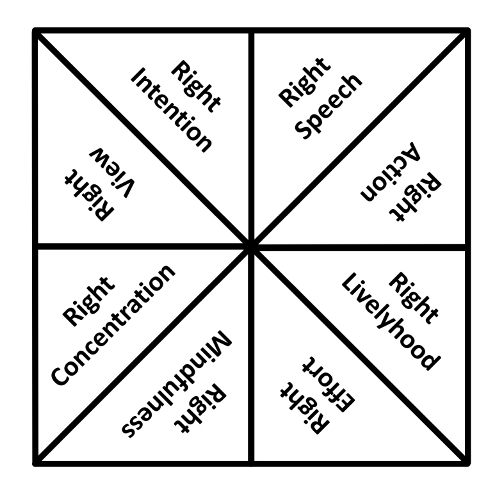
The Noble Eightfold Path of Buddhism (八正道):

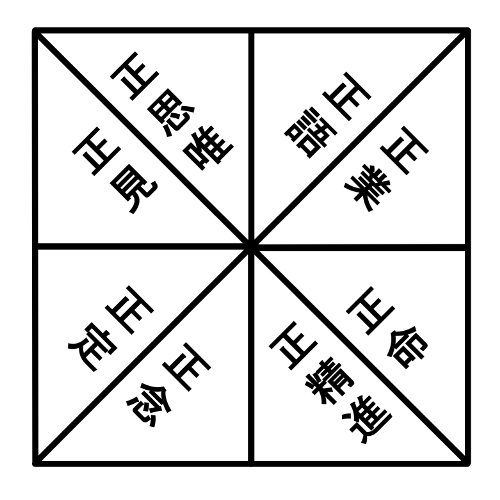
  • Right View (also Understanding) (正見)
  • Right Intention (also Thought) (正思唯)
  • Right Speech (正語)
  • Right Action (正業)
  • Right Livelyhood (正命)
  • Right Effort (正精進)
  • Right Mindfulness (正念)
  • Right Concentration (正定)

I’ve also translated the diagram into Chinese.

Further Reading:

https://en.wikipedia.org/wiki/Noble_Eightfold_Path

The Noble Eightfold Path

https://www.buddha101.com/p_path.htm#The%20Eightfold%20Path

https://www.orientaloutpost.com/shufa.php?q=eightfold

Note:

In the anime “One Piece,” marines often have the characters 正義 on the back of their coats. This means “Seigi,” or Right Morality or Justice. Note that this isn’t part of the Eightfold Path.

https://onepiece.fandom.com/wiki/Justice

[*10.118]

<>

Hannah Arendt: The Human Condition and the Life of the Mind

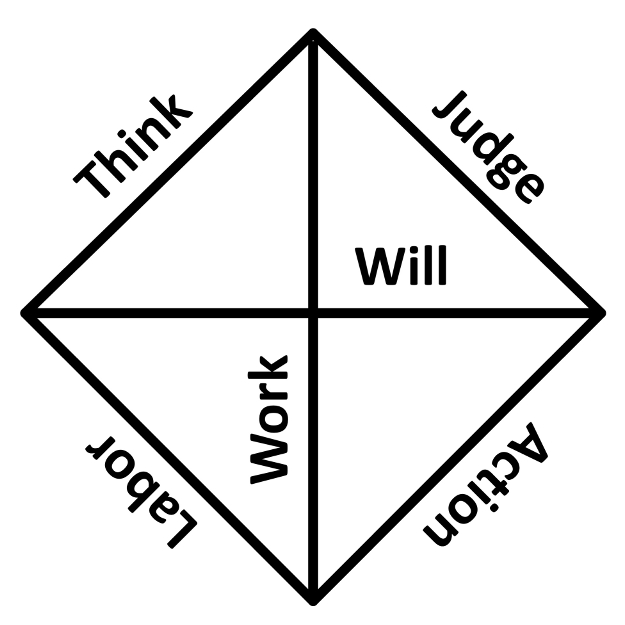
In her book “The Human Condition”, philosopher Hannah Arendt discussed the vita activa, the active life:

  • Labor
  • Work
  • Action

In “The Life of the Mind”, she wished to present the vita contemplativa, the contemplative life:

  • Thinking
  • Willing
  • Judgment

Unfortunately, she died just as started working on Judgment, so that aspect was just outlined with notes.

The differences between the active and the contemplative can also be thought of as the practical versus the theoretical. This pair of triplets is not easy to turn into a troika of duals.Further Reading:

https://en.wikipedia.org/wiki/The_Human_Condition_(book)

https://www.brainpickings.org/2014/09/16/hannah-arendt-the-life-of-the-mind/

https://www.giffordlectures.org/lectures/life-mind

https://plato.stanford.edu/entries/arendt/

https://en.wikipedia.org/wiki/Hannah_Arendt

[*9.98, *10.102]

<>


Six Types of Philosophers

I have mentioned fourfold classifications of philosophers before, most notably the Philosophical Semantics of philosopher Richard McKeon (which is similar to the Archic Matrix of Walter Watson and David Dilworth). These are actually sixteen-fold classifications, since each of four attributes have four types.

Instead, consider this six-fold classification by Justin E. H. Smith:

  • Curiosa – Particularist
  • Sage – Systematist
  • Gadfly – Social Critic, Commentator
  • Ascetic – Disciplinarian
  • Mandarin – Academic, Professional
  • Courtier – Bureaucrat, Institutionalist

In addition, here is another diagram of this same classification scheme.

tr_six_philosophersFurther Reading:

Justin E.H. Smith / The Philosopher: A History in Six Types, Princeton University Press, 2016.

https://ndpr.nd.edu/news/the-philosopher-a-history-in-six-types/

The Philosopher: A History in Six Types

http://www.jehsmith.com/

[*10.96]

<>

Science, Technology, Engineering, and Mathematics

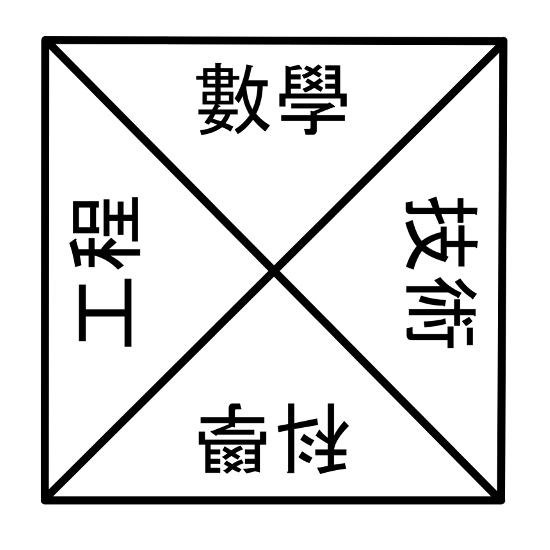
STEM: Science, Technology, Engineering, and Mathematics. We often hear that these areas of education and expertise are critical for the development of our modern society. To attract students to these fields, banners and logos are full of bright colors and crisp graphics. In comparison, above is my rather dull diagram. Not very enticing, is it?

Some are now adding Arts to the four, giving STEAM. I think the Arts are important of course, but fives don’t go with my oeuvre.

In addition, I give you a diagram with Chinese substituted for English (科學 技術 工程 數學).

Further Reading:

https://en.wikipedia.org/wiki/Science,_technology,_engineering,_and_mathematics

https://www.google.com/search?tbm=isch&q=science+technology+engineering+mathematics

[*10.110]

<>

Wan Shou Wu Jiang

While eating out the other day I noticed a melamine plate with an interesting fourfold arrangement of Chinese characters on it. After asking the waitress what they meant and she didn’t know, I decided to figure them out using “the internet”. I first tried to use a photo of one of the characters with Google translate, but that didn’t seem to work. Next I tried several “draw the character” websites like Mobilefish, but those are tricky and require you to draw the strokes of the character in the correct sequence. Finally, with some success I was able to determine that the characters “Wan Shou Wu Jiang” (wàn shòu wú jiāng or 萬壽無疆) mean “infinite long life”, and are on many Chinese tableware, both antique and everyday.

I have to say I think representing fourfolds with such tidy logograms is quite beautiful and I would enjoy seeing my diagrams translated into them.

Further Reading:

Some notes on Wan Shou Wu Jiang (万寿无疆) Porcelains since the Late Qing period

http://gotheborg.com/glossary/wanshouwujiang.shtml

https://www.mobilefish.com/services/chinese_handwriting_recognition/chinese_handwriting_recognition.php

https://www.google.com/search?q=萬壽無疆&tbm=isch

[*10.110]

<>

The Infinity Stones

Sure, why not? Here is a handy-dandy diagram for the six Infinity Stones appearing together soon in the latest Marvel/Disney extravaganza. Confusingly, the colors changed from the original ones to new ones as they appeared in the Marvel Cinematic Universe.

  • Soul: Green, then Orange
  • Time: Orange, then Green
  • Space: Purple, then Blue
  • Mind: Blue, then Yellow
  • Reality: Yellow, then Red
  • Power: Red, then Purple

So ideally, I maybe should have paired (Soul, Time) in the middle as a 2-cycle, and placed (Space, Mind, Reality, Power) as a 4-cycle around the edge.

Further Reading:

https://www.npr.org/sections/monkeysee/2018/04/16/601138466/heres-what-you-need-to-know-about-infinity-stones-before-the-new-avengers-movie

https://en.wikipedia.org/wiki/Infinity_Gems

https://en.wikipedia.org/wiki/Infinity_Stones

Please compare to other fine six-folds in this blog, for example:

https://equivalentexchange.wordpress.com/2017/09/24/the-philosophers-wheel/

https://equivalentexchange.wordpress.com/2017/09/09/simon-magus-and-the-six-roots-of-boundless-power/

[*10.96]

<>


Noether-Pauli-Jung

What happens when the fourfold of Noether’s Theorem is spliced together with the fourfold of Pauli-Jung? Both have Space-Time and Matter-Energy. The former has Conservation and Symmetry, and the latter has Causality and Synchronicity.

I had to remind myself that Conservation means consistency (of matter or energy) through time (and space), and Symmetry means consistency (of form) through space (and time), so in some sense they are dualistic.

Combined, one has the three axes of dual concepts, represented above.

Further Reading:

https://equivalentexchange.wordpress.com/2012/05/04/noethers-theorem/

https://equivalentexchange.wordpress.com/2018/01/23/atom-and-archetype/

[*10.68]

<>

The Six Elements

What happens if one combines the four classical Greek (Western) elements with the five classical Chinese (Eastern) elements? Air is in the former and not the latter. Wood and metal are in the latter and not the former.

I’ve left out the Aether (the Fifth Element) of the West because I follow Empedocles, and I see that the five classical Japanese elements have those four and Void as well. But, I’m just looking at material and tangible elements.

One might consider Wood and Metal to be derivatives of Earth, but let’s consider them to be distinct for this exercise. So, maybe six elements!

Further Reading:

https://en.wikipedia.org/wiki/Wu_Xing

https://en.wikipedia.org/wiki/Classical_element

https://en.wikipedia.org/wiki/Empedocles

[*10.68]

<>

A General Theory of Value, Part 2

What is value?

In his unpublished book “A General Theory of Value”, architect Michael Benedikt argues for a information-theoretic account of value, defining value as follows:

The theory of value offered in this book revolves around three propositions: first, that positive value is attributed to that which preserves or creates more life; second, that “lifefulness” is characterized by a particular quantity and combination of complexity and organization; and third, that in the case of human societies and minds, achieving this optimal quantity and combination of complexity and organization depends on the quality and flow of information among people, and between people and their less-animate environment—plants, animals, buildings, places, things.

It is fascinating that the things that are alive and the products of these lives obtain the highest calculated value of “complexity and organization”.

In order to begin to quantify value, a measurement of the complexity and a measurement of the organization of an entity or system is required. It is worth noting that “not organized” does not mean “complex”, nor does “not complex” mean “organized”. Thus complexity and organization are independent of one another.

Above I have schematized Benedikt’s “Ω Plane”, which consists of two axes, organization and complexity, ranging from disorganized (chaotic) to organized, and simple to complex. “Δ Ω” is simply the measure of the increase in both complexity and organization, and points the way to “value”.

Generously, Benedikt has made his unpublished book available on his web site for all to read.

Further Reading:

Michael Benedikt / A General Theory of Value (unpublished)

https://en.wikipedia.org/wiki/Michael_Benedikt_(urbanist)

http://www.mbenedikt.com/b-o-o-k-s.html

A good resource for reading about information:

http://www.informationphilosopher.com/

Also see Cesar Hidalgo’s excellent “Why Information Grows”.

Cesar Hidalgo / Why Information Grows: The Evolution of Order, from Atoms to Economies

https://paulromer.net/why-information-grows/

[*7.132, *10.86]

<>

A General Theory of Value

What is value?

In “A General Theory of Value”, philosopher Ralph Barton Perry argued for a naturalistic account of values, defining value as “any object of any interest.”

From 1946 to 1948, Perry gave a Gifford Lecture, which later was enlarged to became his book “Realms of Value”. The Gifford Lectures are purportedly about “natural theology”, but many normative subjects have been addressed in them.

Above I have diagrammed Perry’s eight “realms of value”, although I have changed morality to ethics. I have also paired them up to give a fourfold, which doesn’t seem too erroneous.

  • Custom and Art
  • Economics and Science
  • Politics and Law
  • Religion and Ethics

I’m disappointed that Knowledge is missing from his list, but I could eliminate some of his choices and rearrange a bit to make room for it.

Further Reading:

Ralph Barton Perry / A General Theory of Value: its meaning and basic principles construed in terms of interest

Ralph Barton Perry / Realms of Value (Gifford Lectures)

Home

https://en.wikipedia.org/wiki/Ralph_Barton_Perry

http://www.newworldencyclopedia.org/entry/Ralph_Barton_Perry

On this blog: The World Values Survey

Notes:

Another “General Theory of Value” available on the web:

C. L. Sheng / A Utilitarian General Theory Of Value

Click to access cls04-09.pdf

[*3.111, *10.74, *10.75]

<>


Every Fourth Thing

Daydream Tourist

Because there are way more than seven wonders in the world.

The Digital Ambler

Always Forward Between Heaven and Earth

The Mouse Trap

Psychological Musings

Wrong Every Time

Critiquing anime and everything else

The Chrysalis

"For man has closed himself up, till he sees all things thro' narrow chinks of his cavern" -- William Blake

  Bartosz Milewski's Programming Cafe

Category Theory, Haskell, Concurrency, C++

The Inquisitive Biologist

Reviewing fascinating science books since 2017

Gizmodo

Every Fourth Thing

Simplicity

Derek Wise's blog: Mathematics, Physics, Computing and other fun stuff.

COMPLEMENTARY 4x

integrating 4 binary opposites in life, learning, art, science and architecture

INTEGRATED 4x

integrating 4 binary opposites in life, learning, art, science and architecture

Playful Bookbinding and Paper Works

Chasing the Paper Rabbit

Antinomia Imediata

experiments in a reaction from the left

Digital Minds

A blog about computers, evolution, complexity, cells, intelligence, brains, and minds.

philosophy maps

mind maps, infographics, and expositions

hyde and rugg

neat ideas from unusual places

Visions of Four Notions

Introduction to a Quadralectic Epistomology

Explaining Science

Astronomy, space and space travel for the non scientist

Log24

Every Fourth Thing

Ideas Without End

A Serious Look at Trivial Things

Quadralectic Architecture

A Survey of Tetradic Testimonials in Architecture

Minds and Brains

Musings from a Naturalist

Why Evolution Is True

Why Evolution is True is a blog written by Jerry Coyne, centered on evolution and biology but also dealing with diverse topics like politics, culture, and cats.

Quadriformisratio

Four-fold thinking4you

Multisense Realism

Craig Weinberg's Cosmology of Sense

RABUJOI - An Anime Blog

Purveyors of Fine Anime Reviews and Ratings Since 2010

Intra-Being

Between Subject and Object

The Woodring Monitor

Every Fourth Thing

FORM &amp; FORMALISM

Every Fourth Thing

Log24

Every Fourth Thing

The n-Category Café

Every Fourth Thing

THIS IS NOT A BLOG

Every Fourth Thing

PHILOSOPHY IN A TIME OF ERROR

Sometimes those Sticking their Heads in the Sand are Looking for Something Deep

Networkologies

Online Home of Christopher Vitale, Associate Professor of Media Studies, The Graduate Program in Media Studies, Pratt Institute, Brooklyn, NY.

Hyper tiling

Linking Ideas

DEONTOLOGISTICS

RESEARCHING THE DEMANDS OF THOUGHT

Incognitions

Explorations in the Paradoxes of Meaning

Object-Oriented Philosophy

"The centaur of classical metaphysics shall be mated with the cheetah of actor-network theory."

Objects & Things

objects & things, design, art & technology