Category Archives: Science

Education is Not a Product

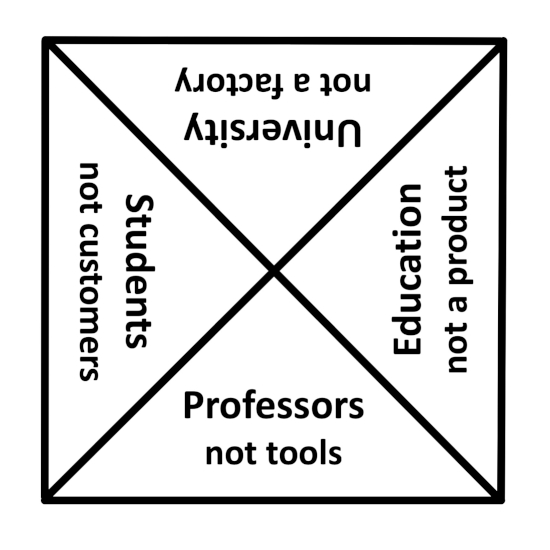
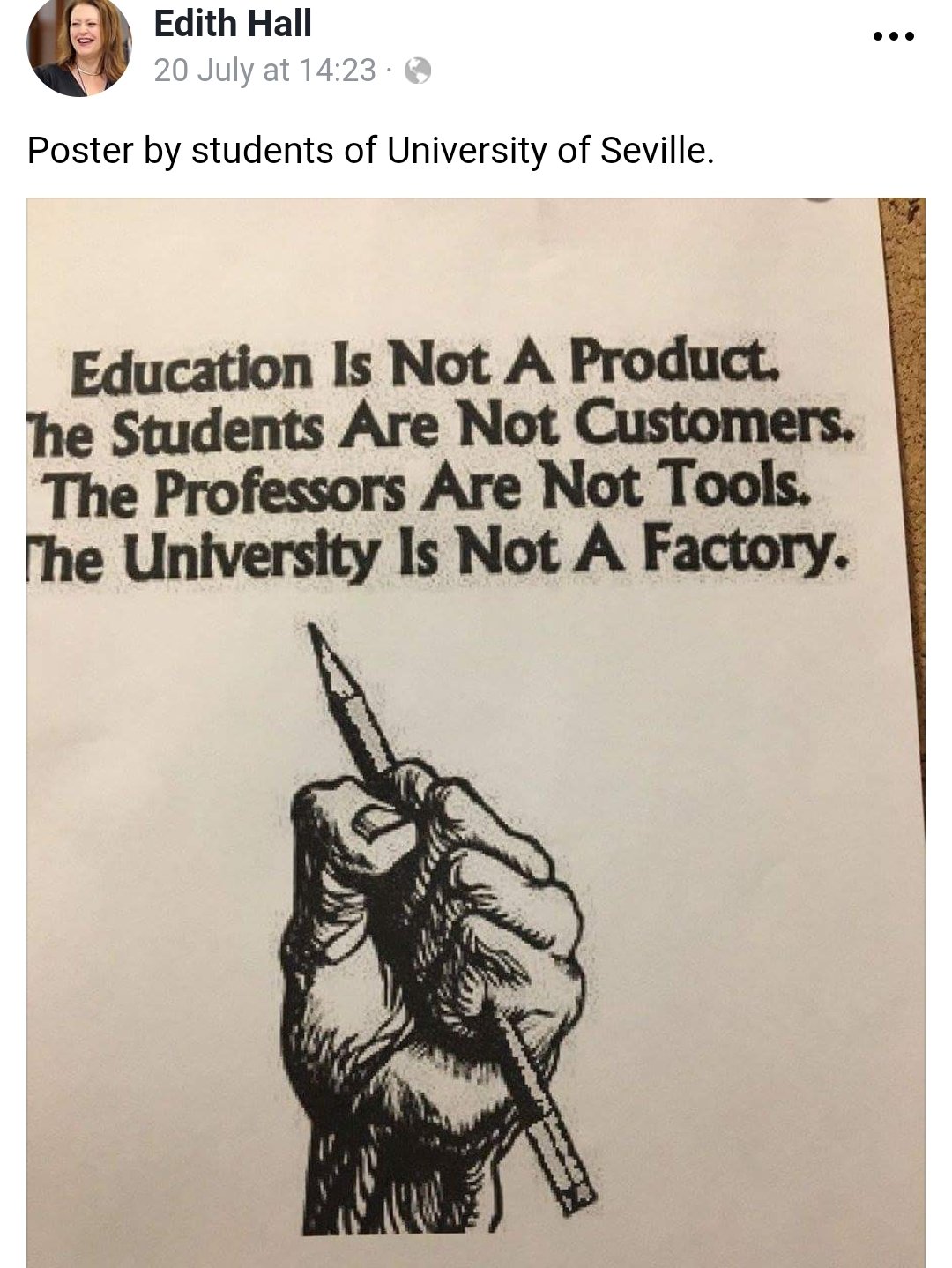
A recent meme popular in education:

  • Education is not a product.
  • Students are not customers.
  • Professors are not tools.
  • The University is not a factory.

I’m not sure who originally came up with this interesting saying.

Examining the anti-analogy, you have “customers buy products made in a factory with tools”. Perhaps a better fourfold would be to change this to “workers use tools to make products in a factory”, so you could say “Students are not workers.” But then you lose the capitalistic “consumer culture” geist.

Or you could say the Professors are (not) factory workers and the Students are (not) the raw material. As a homework assignment, write an essay or develop a mathematical theory comparing this anti-analogy fourfold (or a close derivative thereof) to Aristotle’s Four Causes. Please show your work.

Further Reading:

Note the similarity with some of the elements of the following (which also reminds me for the Four Causes):

J.-Y. Girard’s Transcendental Syntax, V2

[*11.18]

<>

Four New Synthetic Base Pairs Added to DNA

All life on earth uses DNA with four types of base molecules arranged in a “double helix” to encode information as sequences of Adenine-Thymine (A-T) and Cytosine-Guanine (C-G) pairs. Because A pairs only with T and C only pairs with G, DNA can be split into two halves and then each half may be completed so that two double helices with the same information can be obtained. Nature also uses the “genetic code” to translate the information in DNA into specific amino acids via its molecular machinery that assembles proteins in the correct sequence.

Now scientists have doubled the number of base pairs of DNA by adding four synthetic ones to the original four natural ones. Four new base molecules S (a Pseudo-T), B (a Pseudo-B), Z (a Pseudo-C), and P (a Pseudo-G) have been created so that S only pairs with B and Z pairs only with P. Now you have twice as many options as you had before and so this “hachimoji” (eight letter) DNA can have much greater information density. Plus if you re-engineer the molecular machinery to use these new bases you can have a brand new extended genetic code to build all sorts of synthetic proteins.

Further Reading:

https://www.scientificamerican.com/article/four-new-dna-letters-double-lifes-alphabet/

http://science.sciencemag.org/content/363/6429/884

https://gizmodo.com/freaky-eight-letter-dna-could-be-the-stuff-aliens-are-m-1832823430

[*11.46]

<>

Spiral Dynamics

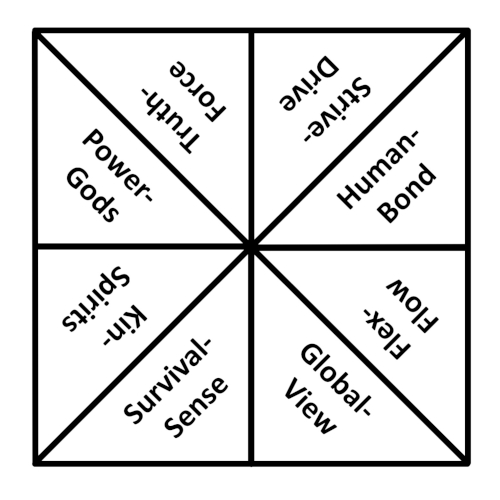
Spiral Dynamics is an intriguing model for the different levels of development and interaction that individuals (and even cultures) may exhibit towards each other and the world. It has interesting parallels to Erikson’s Eight Stages of Psychosocial Development and even Leary’s Eight Brain Circuit Model of Consciousness.

Below is a list of these levels by (Catchy) Name, Social Structure, Motives, and Means of Coping:

  • SurvivalSense, Loose Bands, Survival, Instinctive
  • KinSpirits, Tribes, Magic/Safety, Animistic
  • PowerGods, Empires, Power/Dominance, Egocentric
  • TruthForce, Pyramidal, Order/Morality, Absolutistic
  • StriveDrive, Delegative, Autonomy/Achievement, Multiplistic
  • HumanBond, Egalitarian, Approval/Equality/Community, Relativistic
  • FlexFlow, Interactive, Adaptability/Integration, Systemic
  • GlobalView, Global, Compassion/Harmony, Holistic

And maybe another, further step if we don’t destroy ourselves and the Earth by just being stupid.

Further Reading:

Don Edward Beck, Christopher C. Cowan / Spiral Dynamics: mastering values, leadership and change

Don Edward Beck, et. al. / Spiral Dynamics in Action: humanity’s master code

https://en.wikipedia.org/wiki/Don_Edward_Beck

Fixing our world: Understanding Spiral Dynamics will help us get back on track

Spiral Dynamics Integral: How to Use Grave’s Values Model for Psychological Development

https://en.wikipedia.org/wiki/Integral_theory_(Ken_Wilber)

http://www.awaken.com/2014/04/ken-wilber-summary-of-spiral-dynamics-model/

[*11.41, *11.45]

<>

Erik Erikson’s Eight Stages of Psychosocial Development

Erik Erikson developed an eight stage developmental model of the psyche for the full life of the human individual. Each stage has a key conflict (with both positive and negative sides), its resolution into a “virtue,” and the typical age range for that conflict.

  • Trust vs. Mistrust, “Hope”, Infancy (0-1 years)
  • Autonomy vs. Shame, “Will”, Early Childhood (1-3 years)
  • Initiative vs. Guilt, “Purpose”, Play Age (3-5 years)
  • Industry vs. Inferiority, “Competency” (or “Ability” or “Skill”), Schooling (5-12 years)
  • Ego identity vs. Role confusion, “Fidelity”, Adolescence (12-18 years)
  • Intimacy vs. Isolation, “Love”, Young Adult (18-40 years)
  • Generativity vs. Stagnation, “Care”, Adulthood (40-65 years)
  • Ego integrity vs. Despair, “Wisdom”, Old Age (65-? years)

I would think that these ages would depend significantly on cultural norms.

Further Reading:

https://en.wikipedia.org/wiki/Erikson%27s_stages_of_psychosocial_development

https://courses.lumenlearning.com/teachereducationx92x1/chapter/eriksons-stages-of-psychosocial-development/

Erik Erikson’s Stages of Psychosocial Development

[*11.44]

<>

An Eightfold Metaphysics

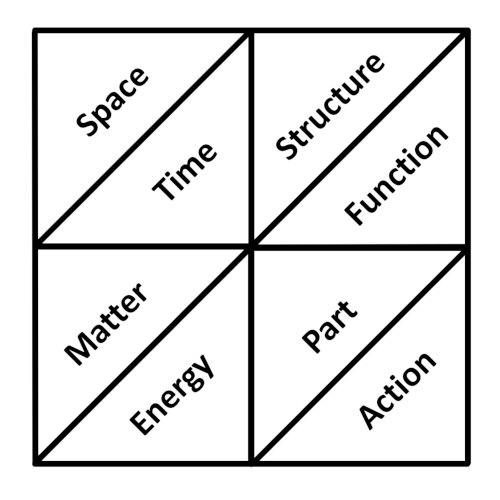
If one juxtaposes the fourfold Space-Time-Matter-Energy with the fourfold Structure-Function-Part-Action, one sees that there are several relations between them. These are simple common-sense relations, not modern-physics types of relations. Below they are listed by Space-type relations and Time-type relations.

Space is required for the extension of Structures.
Matter constitutes Structures.
Parts in an arrangement make up Structures.

Structures extend and are organized in Space.
Matter is located in Space.
Parts occupy Space.

Time allows the expression of Functions.
Energy is required for the operation of Functions.
Actions in a sequence constitute Functions.

Functions have duration and reoccur in Time.
Energy requires and is dependent on Time.
Actions take place within Time.

Several analogies are also evident in this diagram.

  1. Space : Structures :: Time : Functions
  2. Space : Parts :: Time : Actions
  3. Space : Matter :: Time : Energy
  4. Structures : Parts :: Functions : Actions
  5. Structures : Matter :: Functions : Energy
  6. Parts : Matter :: Actions : Energy

Notice that analogies 1.-3. are “contains” relations, and 4.-6. are “part of” relations. One obtains the nesting of entities:

Space > Structures > Parts > Matter
Time > Functions > Actions > Energy

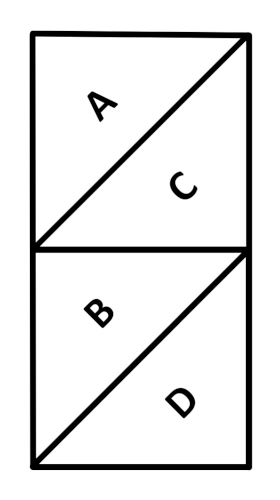
I suppose that any analogy could be shown in a figure like the one on the right (or even written as A / B // C / D) or with the two squares side by side, and that sets of four or six analogies that overlap could be nicely shown as above. If so, I wonder what can be gained by such representations? Probably individually not so much but with overlaps I think it would be interesting.

Further Reading:

The study of parts and wholes relations is called Mereology.

https://en.wikipedia.org/wiki/Mereology

https://plato.stanford.edu/entries/mereology/

[*10.157, *11.26, *11.34]

<>


The Free Energy Principle

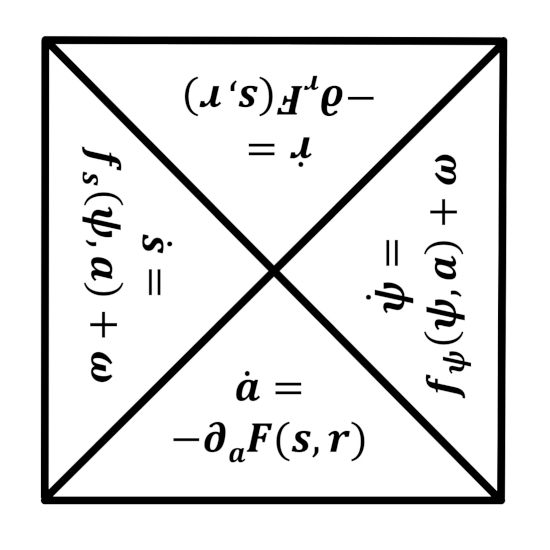
Below is a link to a fascinating article about Karl Friston, whose research on the “free energy principle” (also known as active inference) tries to explain how biological (or even artificial) systems maintain or even increase their organization. Without much explanation, here are some details. The model is a system with four main variables:

  • Sense (s)
  • Action (a)
  • Internal States (r or μ)
  • Hidden States (ψ)

Sense and action divide the internal states of the system from the hidden states external to it. This division is called a “Markov Blanket”. I’ve tried to show the equations between the variables correctly but I’m not too sure if I have them right. They seem to change from paper to paper. F is an expression of the free energy, but I’m not sure what f is at the moment, except for being some sort of “flow”.

Further Reading:

https://www.wired.com/story/karl-friston-free-energy-principle-artificial-intelligence/

https://en.wikipedia.org/wiki/Free_energy_principle

https://en.wikipedia.org/wiki/Markov_blanket

http://rsif.royalsocietypublishing.org/content/15/138/20170792

[*11.6]

<>


The Eight Planets

Now that Pluto has been kicked out of the League of Planets (poor Pluto!), with the eight remainders I can present the above diagram.

The Sun and the Moon, not planets either, are usually thought of as a pair. I’ll add them in by themselves for good measure.

Further Reading:

https://en.wikipedia.org/wiki/Planet

https://en.wikipedia.org/wiki/Planet_symbols

[*10.149]

<>


The Standard Model of Particle Physics

Until a few years ago, the Standard Model of particle physics had sixteen particles verified. Recently, the Higgs Boson was added, so just imagine another triangle hanging off somewhere. Or, alternately, one may combine the Z and W Bosons when adding the Higgs, so a sixteen-fold scheme is maintained.

Also, the Standard Model is much more than a list of these seventeen particles and their attributes. Not shown are a plethora of equations that describe the properties of these entities and their interactions.

I admit that this diagram is not very useful for scientific knowledge, but the reader may contemplate it as they please.

Further Reading:

https://en.wikipedia.org/wiki/Standard_Model

https://home.cern/about/physics/standard-model

https://physics.info/standard/

Also:

Can We Understand the Standard Model?

[*10.148]

<>


The Seasons and the Zodiac

This isn’t a bad little diagram of the four seasons along with the twelve zodiac names and symbols. However, it might be oriented wrong by convention or going clockwise instead of counter-clockwise.  Interestingly, old horoscope charts that show what was in the sky (the positions of the zodiac stars and the eight or nine planets in regards to the twelve “astrological houses”) at the time of a person’s birth were shown using the outside ring of twelve triangles instead of the more familiar circle that is used today. The inner square might be for notes or some nice drawing.

Further Reading:

https://en.wikipedia.org/wiki/Zodiac

https://www.completehoroscope.org/envelope-diagram-horoscope.htm

The Four Seasons

[*10.145]

<>


Ohm’s Law

Unfortunately it has finally come to this: enter the sixteenfolds!

  • Voltage = V = P/I = sqrt(P·R) = I·R
  • Resistance = R = V^2/P = V/I = P/I^2
  • Current = I = V/R = sqrt(P/R) = P/V
  • Power = P = I^2·R = V·I = V^2/R

Further Reading:

https://en.wikipedia.org/wiki/Ohm%27s_law

Ohm’s Law

[*8.4, *8.5, *8.8-8.10, *10.62, *10.112]

<>