Category Archives: Science

The Duality of Time and Information, V2

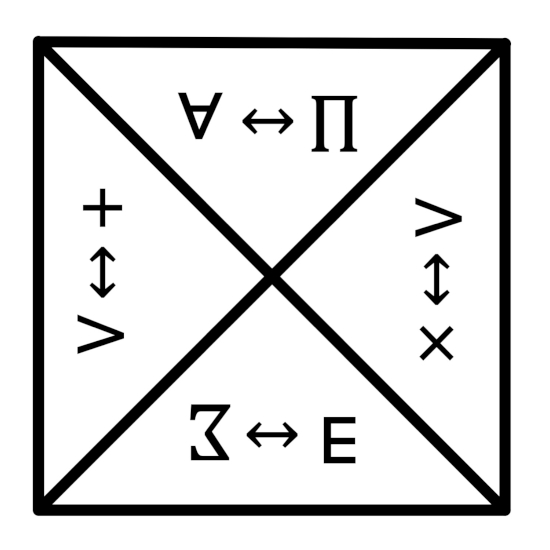
The states of a computing system bear information and change time, while its events bear time and change information.

from The Duality of Time and Information by Vaughan Pratt

The most promising transformational logic seems to us to be Girard’s linear logic.

— from Rational Mechanics and Natural Mathematics by Vaughan Pratt

Here we have three duals: information – time, state – event, and bear – change.

References:

Vaughan Pratt / The Duality of Time and Information http://boole.stanford.edu/pub/dti.pdf

Vaughan Pratt / Time and Information in Sequential and Concurrent Computation http://boole.stanford.edu/pub/tppp.pdf

Vaughan Pratt / Rational Mechanics and Natural Mathematics http://chu.stanford.edu/guide.html#ratmech

[*5.170]

<>

The Space-Time Tetrahedron

In honor of April Fool’s Day, I present the Space-Time Tetrahedron.

The Internet is full of crackpot and nutty websites, and one of the most famous concerns the so-called Time Cube.

Since the ideas expressed on this website are pretty much ignored, it is hoped that it could at least find some recognition as being slightly crackpot or somewhat nutty.

Let’s examine the similarities between Time Cube theory and my theory.

The number four is very important in each. In fact, the Time Cube is a fourfold, although quite a puzzling one.

The notions of space and time are crucial to Time Cube; many of my fourfolds involve some aspect of space and time or spacetime.

How about the differences? I don’t think one can find any common claims between the two theories. At least I hope not!

References:

http://en.wikipedia.org/wiki/Time_Cube

http://knowyourmeme.com/memes/the-time-cube

[*7.150]

<>

Equivalent Exchange

There is an old riddle that asks, what is the value of a human body? It goes on to enumerate the quantities of the various chemicals that constitute an average body, and then price those chemicals to come up with a total material value. This might come as a shock to the one who tried to answer the riddle, because the value is so low.

Of course that analysis ignores the real value of the body because it ignores the spatial arrangement of those chemicals in the various tissues and organs of the body. It ignores the form of the body as an hierarchical arrangement of structured parts. These parts are very valuable for someone needing an organ donation, for example.

This static analysis is lacking as well because it neglects the dynamic actions that a body can perform. Taken as a set of discrete individual acts, this is like considering the individual chemicals that constitute a body. One can enumerate the acts too, as in counting the number of breaths or the number of heart beats over a lifetime.

But we are still not finished, because this enumeration of actions also overlooks the functions that a body can perform, as arrangements of actions in time. These functions are the most important value of a body because they include but are not limited to being alive, thinking, and feeling.

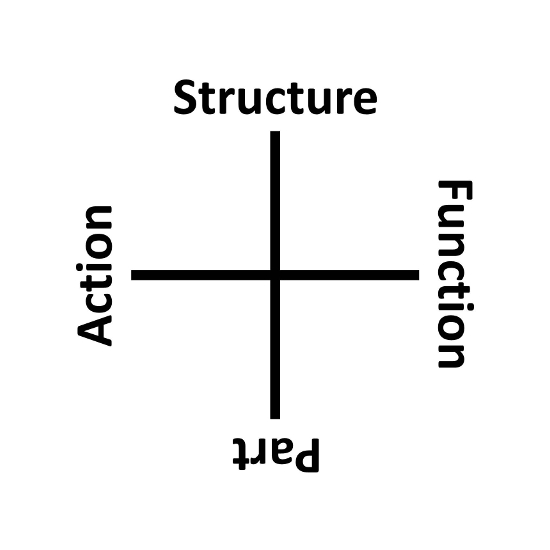
So it seems to me that there is a heirarchy here, that goes from parts to structure to actions to function, with parts being at the lowest level and function being at the highest. Each level of the hierarchy is dependent on the level below, but the nature of a level is fundamentally different from the level below it, as well as the level above it. Please see my previous post Structure-Function.

The term “equivalent exchange” comes from an alchemy-centric anime, where through a process called “human transmutation” it is attempted to recreate a body starting from a pile of the basic chemicals that constitute it. Even with some high-powered magic, the attempt fails due to the fact that much more is required to fashion a body or even a living, breathing person.

Further Reading:

http://chemistry.about.com/b/2011/02/06/how-much-are-the-elements-in-your-body-worth.htm

http://www.datagenetics.com/blog/april12011/index.html

https://briankoberlein.com/post/four-elements/

<>

Schrödinger’s Cat

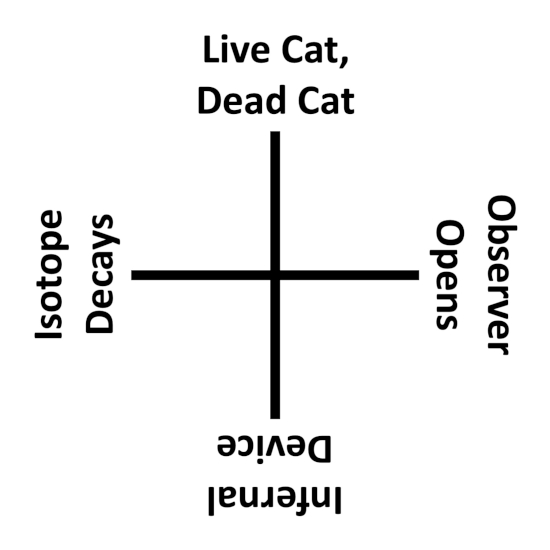
Now let’s look at another thought experiment, that of Schrödinger’s Cat. This thought experiment is supposed to confound the micro and macro worlds of quantum physics and ordinary, human-size physics. A cruel device is built consisting of a closed box which contains a sample of radioactive material, a mechanism to release poison into the box if an atom of the radioactive material decays, a living cat, and a door that must be opened to reveal the condition of the cat to an external observer.

The story of the experiment goes that if the observer waits to open the box until there is a 50% probability that an atom decays, the state of the cat (hidden in the unopened box) to the observer will be both alive and dead. The cat’s so-called wave-function will be a superposition of the wave-function of a live cat and that of a dead cat, which will collapse into one or the other only by the opening of the door and the observation of the actual condition of the cat. This is called the Copenhagen Interpretation.

Some say that the detector of the poison release mechanism will be the true observer in this experiment, and before the external observer opens the door the cat will be definitely alive or dead because of the action of the mechanism. This might be considered the objective collapse theory. Others say that the world splits in two between a world where the cat is alive and one where the cat is dead. This is called a many-worlds interpretation.

There seems to me a similarity between Maxwell’s Demon and Schrödinger’s Cat. The fourfold elements of the experiment are shown above, but now consider these elements in a system in terms of Aristotles’s Four Causes. The material causes are the discreet constituents of the experiment, everything from box to atoms to cat to observer. The efficient cause is the decay or non-decay of a radioactive atom. The final cause is action of the observer in opening the box. The formal cause is the poor cat in its ambiguous state, simultaneously both dead or alive.

It doesn’t make too much common sense to say that the opening of the box and the observing of the cat “causes” the atom to have really decayed or not, and so concretize the past and the cat into a certain way of being, but that is mostly what the Copenhagen Interpretation is saying. Indeed, Linear Logic, which has been described many times on this blog, has been used to describe aspects of quantum physics for decades.

References:

http://en.wikipedia.org/wiki/Schr%C3%B6dinger%27s_Cat

http://en.wikipedia.org/wiki/Copenhagen_interpretation

[*7.138]

<>

Maxwell’s Demon

I am currently reading Tor Norretranders “The User Illusion”, and he opens the book with chapters on information theory and thermodynamics. His description of the thought experiment “Maxwell’s Demon” made me realize that this system has all the ingredients of a fourfold: the two chambers, the demon, the door between the two chambers that the demon operates, and the molecules that the demon allows to or prevents from passing through the door from one chamber to another. The only way between the two chambers is through the door. The molecules are in a gaseous state, with a distribution of velocities, so some are moving faster than others.

The major physical action that the demon can perform is to open or close the door. If the demon did this randomly, it would accomplish nothing, and the system would ultimately evolve the same as one without door or demon. Instead the demon is able to open and close the door so as to allow faster molecules to collect in one chamber and slower molecules to collect in the other. The demon doesn’t touch the molecules, but he is somehow able to tell whether a molecule is fast or slow so he can decide whether to open or close the door.

The purpose of the thought experiment is to suggest that this system could violate the second law of thermodynamics by increasing order. By letting faster molecules move to one chamber, the system would then be able to do work by, for example, powering an engine. Perhaps the temperature differential is also able to power the demon itself. We would then have a perpetual motion machine, one that could give us unlimited energy, as long as there was a surplus of energy after the needs of the demon.

However, the modern analysis of the thought experiment shows that entropy does indeed increase within this system because the demon would eventually have to forget information about the molecules, and his forgetting would increase entropy. The demon would have to be an irreversible process.

References:

http://en.wikipedia.org/wiki/Maxwell%27s_demon

Tor Norretranders / The User Illusion: Cutting Consciousness Down to Size

[*7.130]

<>

The Four Bases of DNA

DNA neither cares nor knows. DNA just is. And we dance to its music.

Richard Dawkins

DNA, the genetic code and biological machinery all life on earth shares, has been in the news lately. It was once thought that much of our DNA was useless junk, but recent research reveals that this portion of our DNA is very important to the operation of epigenesis. This portion of DNA could be called dark bio-matter, or better dark bio-information or even dark bio-code, since it contains switches and instructions that guide each individual organism’s developmental growth through time.

Previously, the parts of DNA thought to be important were those regions that define the proteins that assemble to form our tissues. Mutations in the DNA that specify proteins can lead to disease because the mutated proteins cannot perform the functions that they need to. Of course, mutated proteins can also be improved and increase health. Comparing protein sequences across species shows that we have many commonalities as well as important differences with our animal cousins. What was once considered a “great chain of being” is now thought to be a great tree of life, all shown by DNA.

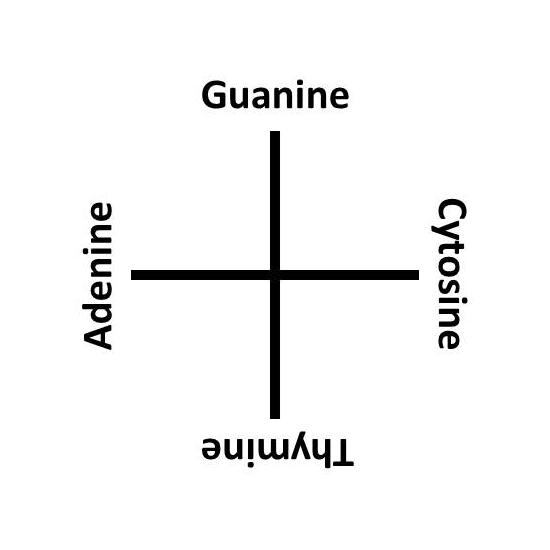
DNA is also a fourfold, and a double dual as well, since for the four bases Adenine (A), Thymine (T), Guanine (G), and Cytosine (C): A pairs with T, and G with C. I am not saying that DNA is analogous to the other fourfolds presented here, but it makes a nice diagram.

Questions:

Why does DNA have four bases and not two, like binary computer code?

Even more of DNA determines our health and variation, the things that make us who we are. Does that constrain us even more, or will this knowledge make us more free?

Further Reading:

http://en.wikipedia.org/wiki/DNA

[*7.112]

<>


Epistemic Virtues of Objectivity

I recently finished reading Lorraine Daston and Peter Galison’s “Objectivity”. In this very interesting book, the authors argue that the notion of scientific objectivity has evolved over time. They have divided the course of this evolution into three main phases: truth-to-nature, mechanical objectivity, and trained judgement. During each phase, the main view of objectivity is dominant, but previous phases are still important to the overall idea of what objectivity means in the scientific community.

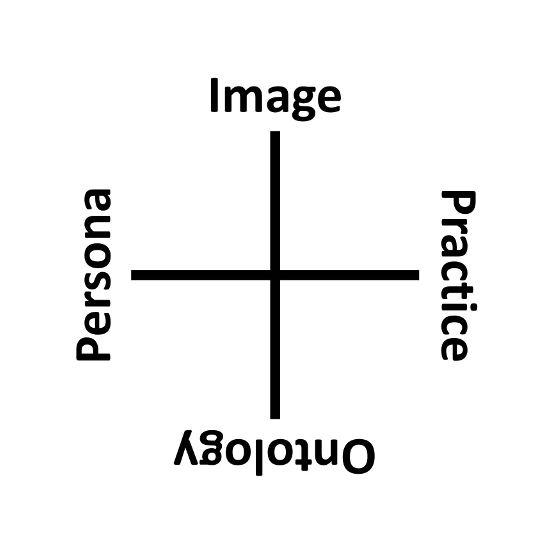
The epistemological virtues of objectivity can be divided into four major aspects: persona, ontology, image, and practice. For each phase of objectivity, each aspect has different qualities. For instance, the scientific persona becomes a sage during the truth-to-nature phase, a worker during the mechanical objectivity phase, and an expert during the trained judgement phase. Similarly, the ontology aspect passed through the qualities of universals-particulars-families, the image aspect passed through reasoned-mechanical-interpreted, and practice  passed through the stages selection and synthesis-automated transfer-pattern recognition.

The evolutionary phases of objectivity, as well as the qualities of the epistemological virtues seen as the four aspects, is beautifully shown by many examples from a collection of scientific atlases. Anyone interested in the history of science as well as the notion of scientific objectivity should enjoy this book.

I thought it was also remarkable that these four aspects of objectivity were very similar to the four aspects of the Archic Matrix of Watson and Dilworth.

Further Reading:

Lorraine Daston and Peter Galison / Objectivity

[*7.106]

<>


The Curry-Howard Correspondence

The Curry-Howard Correspondence reveals a close correspondence between the constituents of Logic and of Programming. Also known as the Formulas as Types and the Proofs as Programs interpretations.

Existential Quantification (∃) of Logic corresponds to the Generalized Disjoint Sum Type (∑) of Programming. Universal Quantification (∀) of Logic corresponds to the Generalized Cartesian Product Type (∏) of Programming. Conjunction (⋀) of Logic corresponds to the Product type (×) of Programming. Disjunction (⋁) of Logic corresponds to the Sum type (+) of Programming.

There are associations between the Curry-Howard Correspondence and the fourfolds of the Square of Opposition, Attraction and Repulsion, and of course Linear Logic.

Further Reading:

http://en.wikipedia.org/wiki/Curry-Howard_correspondence

<>


The Physical Force Carriers

The probable discovery of the Higgs Boson was announced recently. I was initially confused about the difference between the Higgs and the yet to be discovered Graviton. After some reading on the internet, I’m still confused, but they are theorized to be two different particles, since the Graviton is the quantum manifestation of the force of gravity, and the Higgs is the quantum manifestation of the field that gives certain particles mass. Since the Graviton can effect Photons, and the Higgs can’t, they must be different.

You would think that since particles have to have mass to be effected by gravity, they would have to be related. I guess there are some theories out there that do that, but none have been validated. Additionally, the Higgs Boson is part of the Standard Model, and the Graviton isn’t, even though the Higgs doesn’t seem to fit nicely into those 4 x 4 matrices.

The above fourfold is patterned after the Four Fundamental Forces of Physics.

http://en.wikipedia.org/wiki/Quantum_gravity

http://en.wikipedia.org/wiki/Higgs_boson

http://en.wikipedia.org/wiki/Standard_model

<>

Structure-Function

Aristotle’s Four Causes is an important fourfold that seems to be the basis for many of the fourfolds, both original and not, presented in this blog. Two of the causes, efficient and material, are acceptable to modern scientific inquiry because they can be thought of as motion and matter, respectively, but the other two causes, formal and final, are not. Why is that?

The formal cause is problematic because the formal is usually considered to be an abstract concept, a construction of universals that may only exist in the human mind. The final cause is also problematic because it is associated with the concept of telos or purpose. There, too, only human or cognitive agents are allowed to have goals or ends. So for two causes, efficient and material, all things may participate in them, but for the two remaining, formal and final, only agents with minds may.

These problems may be due to the pervasive influence of what the recent philosophical movement of Object Oriented Philosophy calls correlationism: ontology or the existence of things is limited to human knowledge of them, or epistemology. The Four Causes as usually described becomes restricted to the human creation and purpose of things. Heidegger’s Tool Analysis or Fourfold, which also appears to have been derived from the Four Causes, is usually explained in terms of the human use of human made things: bridges, hammers, pitchers. Even scientific knowledge is claimed to be just human knowledge, because only humans participate in the making of this knowledge as well as its usage.

Graham Harman, one of the founders of Speculative Realism of which his Object Oriented Ontology is a result, has transformed Heidegger’s Fourfold so that it operates for all things, and so the correlationism that restricts ontology to human knowledge becomes a relationism that informs the ontology for all things. Instead of this limiting our knowledge even more, it is surprising what can be said about the relations between all things when every thing’s access is as limited as human access. However, this transformation is into the realm of the phenomenological, which is not easily accessible to rational inquiry.

I wish to update the Four Causes, and claim that they can be recast into a completely naturalistic fourfold operating for all things. This new version was inspired by the Four Operators of Linear Logic. Structure and function are commonplace terms in scientific discourse, and I wish to replace formal and final causes with them. It may be argued that what is obtained can no longer be properly called the Four Causes, and that may indeed be correct.

First, let us rename the efficient cause to be action, but not simply a motion that something can perform. I’m not concerned at the moment with whether the action is intentional or random, but it must not be wholly deterministic. Thus there are at least two alternatives to an action. I’m also not determining whether one alternative is better than the other, so there is no normative judgement. An action is such that something could have done something differently in the same situation. This is usually called external choice in Linear Logic (although it makes more sense to me to call it internal choice: please see silly link below).

Second, let us call the material cause part, but not simply a piece of something. Instead of the material or substance that something is composed of, let us first consider the parts that constitute it. However, a part is not merely a piece that can be removed. A part is such that something different could be substituted for it in the same structure, but not by one’s choice. Like an action, I am not concerned whether one of the alternatives is better than the other, but only that the thing is still the thing regardless of the alternative. This is usually called internal choice.

Next, we will relabel the formal cause to be structure, but not simply the structure of the thing under consideration. Ordinarily structure is not a mere list of parts, or a set of parts, or even a sum or integral of parts, but an ordered assembly of parts that shapes a form. Ideally structure is an arrangement of parts in space. However, in this conceptualization, structure will be only an unordered list of parts with duplications allowed.

Last, instead of final cause we will say function, but not simply the function of the thing as determined by humans. Ordinarily function is not a mere list of actions, or a set of actions, or a sum or integral of actions, but an ordered aggregate of actions that enables a functionality. Ideally function is an arrangement of actions in time. However, like structure, function will be only an unordered list of actions with duplications allowed.

As we transform the Four Causes from made things to all things, both natural and human-made, we will later examine how that changes them.

References:

http://en.wikipedia.org/wiki/Speculative_realism

http://en.wikipedia.org/wiki/Object-oriented_ontology

http://en.wikipedia.org/wiki/Graham_Harman

http://wiki.cmukgb.org/index.php/Internal_and_External_Choice

[*6.144, *7.32, *7.97]

<>