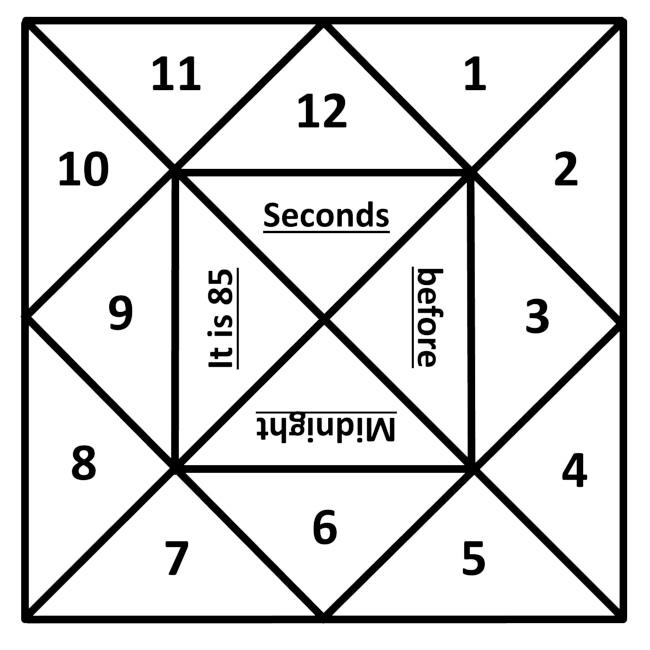
On the Doomsday Clock, it is 85 seconds before midnight!
Tick… tick… tick… tick…
Further reading:
Home page for the Bulletin of the Atomic Scientists:
2026 Doomsday Clock Announcement: Complete Livestream
<>
On the Doomsday Clock, it is 85 seconds before midnight!
Tick… tick… tick… tick…
Further reading:
Home page for the Bulletin of the Atomic Scientists:
2026 Doomsday Clock Announcement: Complete Livestream
<>
The Golden Mean is the desirable middle ground between two extremes of behavior, one of excess and the other of deficiency. It appeared in Greece at least as early as the Delphic maxim “nothing in excess”, which was discussed by Plato. Aristotle analyzed the Golden Mean by saying that the virtues of character can be described as means between having too much and having too little. For example, courage is a virtue in the Aristotelian view, being the mean between recklessness (too much) and cowardice (too little).
The Mean between Excess and Dearth is Virtue!
Further Reading:
https://en.wikipedia.org/wiki/Golden_mean_(philosophy)
https://philosophybreak.com/articles/the-golden-mean-aristotle-guide-to-living-excellently/
https://plato.stanford.edu/entries/aristotle-ethics/
[*14.98]
<>
I generally dislike those type of household decorations with words that encourage positive things to promote in your life or to be thankful for. I’m sure you know the kind that I’m talking about, like motivational or inspirational posters for the home. I guess a good word for such things is schmaltz, or more meanly: “virtue signaling”.
One wonders then why I spend so much time making somewhat similar diagrams for this blog, although I don’t (often) print and pin them up for display. And I can say for the most part that they are not of this nature, but that’s just an excuse. Even so, I kind of like this one, so please forgive.
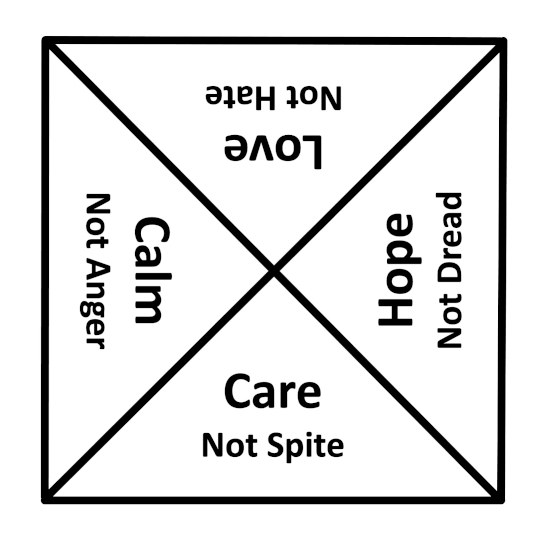
These four attitudes (calm, care, love, and hope) started with their four opposites (anger, spite, hate, and dread) as the key messages I took away from ads from a certain political party a few years ago. Unlike my post Capitalistic Values, which dealt with actual, social objectivities, messages with these four types of negativity were intended to inculcate base subjective emotions.
But the more I looked at them and considered what to say about them, the more I thought that I was adopting these negative attitudes for myself as well. And so I hope that I can choose the positive ones and not their negative counterparts, as things continue forward.
Or perhaps you’d prefer only the positives.
Further Reading:
https://en.wikipedia.org/wiki/Virtue_signalling
https://en.wikipedia.org/wiki/Keep_Calm_and_Carry_On
[*13.76]
<>
I have a foreboding of an America in my children’s or grandchildren’s time — when the United States is a service and information economy; when nearly all the manufacturing industries have slipped away to other countries; when awesome technological powers are in the hands of a very few, and no one representing the public interest can even grasp the issues; when the people have lost the ability to set their own agendas or knowledgeably question those in authority; when, clutching our crystals and nervously consulting our horoscopes, our critical faculties in decline, unable to distinguish between what feels good and what’s true, we slide, almost without noticing, back into superstition and darkness.
— Carl Sagan from The Demon-haunted World
As science is confused with pseudo-science, as real news is conflated with fake, we need much better ways to judge the truth of the information we require to be good citizens. Unfortunately, in this age of nontraditional television networks, kitchen-sink cable, and internet news sources, our information sources can be subverted by entities that wish to bend our mindset to their agenda, rather than giving us measured and reasonable knowledge. When these entities wish to fracture and divide our polity, our social fabric strains and unravels.
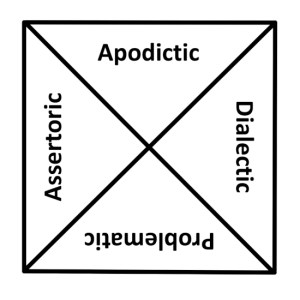
Here are four (or five minus one) distinctions for information or knowledge claims, based upon their type of warrant, or context of truthfulness. Three of them are modalities from Kant’s doctrine of judgments, and I suggest that Dialectic could reasonably be added to them, but I do not know if they form a complete set or not. I would suppose they can be ordered by their level of assurance, from low to high. Another more scientific option might be Probablistic instead of Dialectic, based upon measurements or even theoretical arguments. Certainly there must be something between a bald assertion or the questionable and the certain.
From Wikipedia:
Apodictic propositions contrast with assertoric propositions, which merely assert that something is (or is not) true, and with problematic propositions, which assert only the possibility of something being true. Apodictic judgments are clearly provable or logically certain. For instance, “Two plus two equals four” is apodictic. “Chicago is larger than Omaha” is assertoric. “A corporation could be wealthier than a country” is problematic. In Aristotelian logic, “apodictic” is opposed to “dialectic,” as scientific proof is opposed to philosophical reasoning.
For example, the president’s language (“many say”, “everyone knows”, “we’ll see”) is full of assertoric and problematic claims (to be extremely generous), and perhaps that’s the limit of his ability. I don’t think he could manage part of a measured dialectical argument if pressed, and if he manages an apodictic statement it would be like a clock that tells the time correctly twice a day. To have the head of the executive branch of our government to be so untrustworthy in providing information and knowledge hurts us all, and misleads those that takes his words at face value.
And then there are the news sources that cater to the president and his followers. Perhaps they present some warranted information, but mix plenty of misleading punditry in to tickle the fancy of unquestioning minds. As a result we have citizens who only digest information from sources that appeal to their sensibilities. Some of these news sources disseminate their fabrications via a flood in social media and the internet, because our ability to stifle them is almost nonexistent. And when these news sources originate from foreign countries wanting to influence us for their own purposes, how is it that they are allowed to continue?
In truth, people can be misled on scientific topics like the coronavirus and COVID-19, vaccinations, face masks, climate change or global warming, environmentalism and pollution, pseudoscience, and political topics like mail-in voting, Russian meddling with the 2016 and 2020 elections, conspiracy theories such as QAnon, etc. The lists seem almost endless.
Further Reading:
https://en.wikipedia.org/wiki/Demarcation_problem
https://en.wikipedia.org/wiki/Apodicticity
https://en.wikipedia.org/wiki/Assertoric
https://en.wikipedia.org/wiki/Dialectic
https://plato.stanford.edu/entries/aristotle-logic/
https://plato.stanford.edu/entries/kant-judgment/
https://en.wikipedia.org/wiki/Conspiracy_theory
https://en.wikipedia.org/wiki/List_of_conspiracy_theories
https://en.wikipedia.org/wiki/List_of_political_conspiracies
https://en.wikipedia.org/wiki/Russian_interference_in_the_2016_United_States_elections
https://en.wikipedia.org/wiki/Russian_interference_in_the_2020_United_States_elections
https://en.wikipedia.org/wiki/QAnon
[*11.84]

Nothing is too wonderful to be true if it be consistent with the laws of nature.
— Michael Faraday in his Laboratory Notebook
There are many things to scratch one’s head about in Charles Fourier’s “Theory of the Four Movements,” first published anonymously in 1808. However, his progressive political thought influenced many in France and in the United States. Fourier was a utopian and a socialist, and thought social cooperation and unity were the only ways to overcome the discord and strife he observed in his times. His theory is based on a hierarchy of “movements” within four realms, from low to high: the Material, the Organic, the Animal, and the Social.
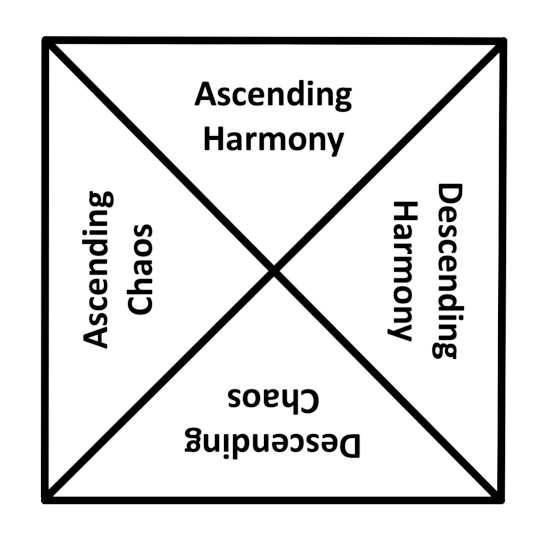
As he elaborated on these movements, Fourier claimed that social history went through four main periods of unhappiness and happiness, ascending from a chaotic period, through two harmonious periods which were each seven times longer, before descending into another chaotic period of length equal to the first. In order to achieve this happiness, he thought that we must envision and engineer a new social order to achieve a common purpose. Nowadays, of course, socialism has a noxious connotation to those of the right-leaning and hyper-capitalist persuasion.
And now, the United States teeters on the brink of choosing four more years of terrible leadership, all to maintain the status-quo of funneling more money into the pockets of the wealthy and more power into the hands of the already dominant.
Further Reading:
Charles Fourier / The Theory of Four Movements
https://libcom.org/library/charles-fourier-theory-four-movements
https://en.wikipedia.org/wiki/Charles_Fourier
https://en.wikipedia.org/wiki/Fourierism
[*9.62, *12.63]
<>
Our representational government is frustrating, to say the least.
We have political leaders at the city, county, state and national levels, and the political affiliations of the levels above you may be quite different from your own leanings. Often it feels like one is not represented at all, and even disenfranchised, because mechanisms are in place to diminish a person’s concerns and voice. I feel sometimes like I’m at the center of a Matryoshka Doll, with different and indifferent political parties around me.
For example, if I’m Blue and in a state that has mostly Red politicians (for my Congressional district, Senators, and Governor), and I reach out to my Congressperson or Senator or Governor with matters of importance to me, I usually feel rather belittled by their quick party-line response. I know that’s how representation works, and I should keep trying to bring my concerns, but still. If I move to a Blue county or state, would I feel better? A little bit, perhaps.
And on a national level, we have a Red president that cares nothing for the concerns of the Blue voters who he mentions with vitriol. And who (even though impeached) has been kept in office by the quick dismissal of the Red Senate. And a presidential election process that gives rural, less-populated states more power to elect a president. And now the Supreme Court that has judged that states with laws that make all electors vote as a group are fine, because sadly it is constitutional.
Part of the problem is the extreme polarization in our country, fed by our fragmented media and news sources. Another part of the problem is the lobbyists and the money, the PACS and Super PACS, exacerbated by even more money. Another part of the problem is the widening income inequality in our country, which just worsens the problems. Another part of the problem is the pervasive racism that still remains in our institutions and politics. But what’s the solution?
And now we have the pandemic.
Further Reading:
https://www.pewresearch.org/topics/political-polarization/
<>
The notions of “Separation of Powers” and “Checks and Balances” are intended to work within our three-branched government to guard against an abuse of power or dereliction of duty by any branch in regard of their responsibilities, by giving oversight abilities to the other two. If instead two branches work in collusion or bad faith to guard against any rectification by the third, then this separation breaks down.
Specifically, the Senate under the current majority is approving federal judges just as fast as possible to alter the political makeup of the Judiciary for decades to come, since they have life-time appointments. You may ask why are so many seats vacant? Because the Senate quelled the approval of the previous president’s nominees, including one to the Supreme Court. Many more examples exist, unfortunately.
This built-in ability of checking and balancing seems that it’s just not working as well as it should. The conservative party as it exists today relentlessly speaks of “broken government” and then goes about to indeed break it, or to “drain the swamp” and fill positions with the swampiest candidates possible. Do we need a fourth branch of government to protect us from this dangerous predicament?
Further Reading:
https://en.wikipedia.org/wiki/Separation_of_powers
https://twitter.com/search?q=%22separation%20of%20powers%22
https://www.google.com/search?q=”separation+of+powers”&tbm=nws
https://www.google.com/search?q=”separation+of+powers”&tbm=isch
[*12.53]
<>
The RSA (Royal Society for the encouragement of Arts, Manufactures and Commerce) has written several articles recently on the ongoing impacts of Covid-19 on society. Their great-sounding motto is that the RSA “believes in a world where everyone is able to participate in creating a better future.” I’ve enjoyed several of their animated videos over time, with signature black and red colors and sped-up hand drawing illustrating a featured talk.
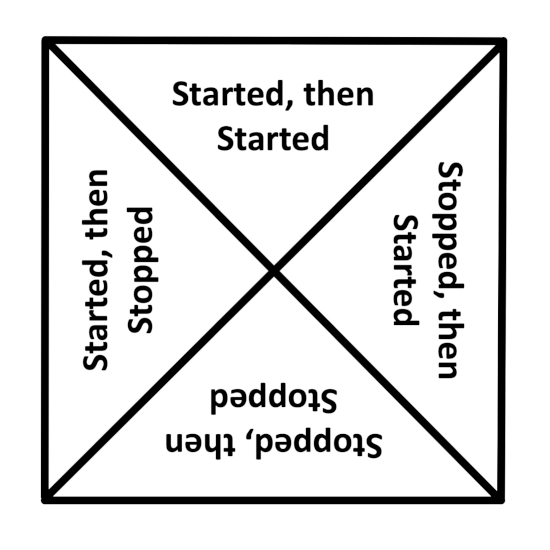
I’ve been meaning to read a few of their recent articles on Covid-19, but hadn’t until I spotted an interesting two-by-two matrix labeled Crisis-Response Measures. Actions or practices that are performed during and after a crisis are divided over four cells as to whether they are stopped or started in those two times. Thus we examine the actions or practices that are:
During Crisis, then Stopped Post-CrisisWhen in the middle of a crisis, one often is so busy that there’s no time to think about what one should be or should not be doing, and to be in that situation is certainly poor planning. Plus we should try to determine what we should plan to be doing in the future, thus giving our planning a normative consideration. Just because we’ve been doing something before the crisis or began something because of it doesn’t mean we should continue.
Indeed, there may be few or even no reasons to go back to the old ways of doing things, and a crisis is a grand opportunity to change the bad and maybe find good new practices and institutions for maintaining them. Of course when good and bad are in great dispute you have a lot of difficulty in coming to a consensus of action. And being in the midst of a crisis is perhaps not the best of times to come to a meeting of the political minds.
Also, these charts don’t describe the actions that are transformations of old actions, only distinguishing them as being new or old. Anything started during the crisis is new (transitory and amplified) and anything stopped during the crisis is old (jettisoned and restarted). However, there are many great ideas in these essays and we certainly need to build bridges to a future that we can look forward to living in.
Further Reading:
https://www.thersa.org/discover/publications-and-articles/rsa-blogs/2020/04/change-covid19-response
<>
Scenario Planning, Analysis, or Thinking is a technique for probing into possible futures when you are anticipating or overwhelmed by tumultuous challenges. One often starts by examining two factors that have both great Importance and Uncertainty and then considering two extremes of each. For their four different mixtures, you can posit causes, how to recover from bad outcomes, what actions would be favorable for all scenarios, etc. In other words, one can develop related stories about these different futures.
In these slides by authors Steven Weber and Arik Ben-Zvi, the two important and uncertain factors are Public Health and Economics, both affected by the Covid-19 pandemic, and for their initial purposes independent of each other. For public health, the disease could kill far more than estimated (a secondary wave) or kill less (vanish like a miracle). For the economic impact, the toll could be sustained (a long term depression) or the recovery could be relatively quick (v-shaped). So the two factors and their extremes are
The four scenarios that are named are basically
and the scenario stories are told with respect to January of 2021 at the next state of the union address. Each of these scenarios are quite detailed and then followed by Insights and Implications for all. Often Scenario Thinking is used for more distant future analysis, but this shows it can be used for a mere nine months as well.
Further Reading:
https://www.linkedin.com/feed/update/urn:li:activity:6663482861041012737/
I don’t take responsibility at all.
There’s going to be a lot of death.
— Donald Trump, 45th President of the USA.
Above is the Eisenhower Matrix, but below detailed for the current president in this pandemic year.
Do First: Deny, diminish, blame. Say the coronavirus is a hoax, that it is under control and cases will go to zero, and that it will vanish with the spring. Blame previous administrations for all mistakes (bad tests that don’t exist, lack of Federal stockpiles), news media that are critical or ask probing questions (nasty, no-talent), and China. Pass on tests offered by WHO. Criticize states and medical professionals for asking for needed ventilators and PPE.
Eliminate: Eliminate pandemic response team created by Obama in 2017. Fire public servants for doing their jobs (Inspector Generals, civil servants, state department individuals). The PREDICT initiative for tracking potentially dangerous viruses was eliminated in September of 2019 when the funds ran out. In addition, eliminate (almost) everyone in the administration that might tell the president that he is wrong or making a bad decision. Just in: eliminate the top oversight IG for the 2 trillion dollar virus relief funds.
Delegate: Delegate critical decisions and coordination to unqualified individuals, such as VP Mike Pence and security-whatever Jared (“the federal stockpile is ours”) Kushner. Say the states need to find their own ventilators and PPE, and then use federal government to intercept their orders. Delegate everything that is difficult or might make this president look bad, so they can take the blame. (“I don’t know them.”)
Do Last: Take credit for doing a “great” job and having “great” ratings (and continuously throughout). Feel good if there are only 100 to 240 thousand American deaths. Expect a grateful nation to re-elect him for a second term. Take a bow (hopefully out)!
Further Reading:
<>
Because there are way more than seven wonders in the world.
Always Forward Between Heaven and Earth
Psychological Musings
Critiquing anime and everything else
"For man has closed himself up, till he sees all things thro' narrow chinks of his cavern" -- William Blake
Category Theory, Haskell, Concurrency, C++
Reviewing fascinating science books since 2017
Every Fourth Thing
Derek Wise's blog: Mathematics, Physics, Computing and other fun stuff.
integrating 4 binary opposites in life, learning, art, science and architecture
Chasing the Paper Rabbit
experiments in a reaction from the left
A blog about computers, evolution, complexity, cells, intelligence, brains, and minds.
mind maps, infographics, and expositions
neat ideas from unusual places
Introduction to a Quadralectic Epistomology
Astronomy, space and space travel for the non scientist
Every Fourth Thing
A Serious Look at Trivial Things
A Survey of Tetradic Testimonials in Architecture
Musings from a Naturalist
Why Evolution is True is a blog written by Jerry Coyne, centered on evolution and biology but also dealing with diverse topics like politics, culture, and cats.
Four-fold thinking4you
Craig Weinberg's Cosmology of Sense
Purveyors of Fine Anime Reviews and Ratings Since 2010
Between Subject and Object
Every Fourth Thing
Every Fourth Thing
Every Fourth Thing
Every Fourth Thing
Every Fourth Thing
Sometimes those Sticking their Heads in the Sand are Looking for Something Deep
Online Home of Christopher Vitale, Associate Professor of Media Studies, The Graduate Program in Media Studies, Pratt Institute, Brooklyn, NY.
Linking Ideas
RESEARCHING THE DEMANDS OF THOUGHT
Explorations in the Paradoxes of Meaning
"The centaur of classical metaphysics shall be mated with the cheetah of actor-network theory."
objects & things, design, art & technology