Category Archives: Philosophy

The Four Types of Knowledge

What types of knowledge are there?

In his Nicomachean Ethics (Book VI), Aristotle famously describes several intellectual virtues. There is Techne, or Art; Episteme, or Knowledge, Phronesis, or Prudence, Sophia, or Wisdom, and Nous, or Intellect. He considered Sophia a combination of Nous and Episteme, but some others think it stands alone. Nous also seems to be more subjective, as well as supplying Phronesis with its aims, but is complicated. So are there three types, or five? I would like there to be four, thank you very much.

In Venharanta and Markopoulos’s paper, Phronesis seems to be the balance or sum of Techne, Episteme, and Sophia. In Carsten Pedersen’s web article, Techne, Episteme, Sophia, and Phronesis form a fourfold, with Nous in the center. Jon Alan Schmidt, a member of Virtuous Engineers, distinguishes between kinds of knowledge (Techne, Episteme, and Phronesis) and forms of human activity associated with them (Poiesis, Theoria, and Praxis). I like this distinction. What is the activity associated with Sophia?

Not knowing any Greek puts me at a disadvantage. Nous is linked to Noesis as a type of knowledge and Noein which seems to be the activity. I will present the following table and see how I like it!

Forms of
Human Activity
Types of
Knowledge
Theoria Episteme Science
Praxis Phronesis Prudence
Poiesis Techne Craft
Noein Sophia Wisdom

Further Reading:

https://en.wikipedia.org/wiki/Nicomachean_Ethics

https://plato.stanford.edu/entries/episteme-techne/

https://en.wikipedia.org/wiki/Nous

https://www.age-of-the-sage.org/nous-noesis-noetic.html

https://www.psychsoma.co.za/learning_in_vivo/2009/09/techne-episteme-poiesis-praxis.html

https://sites.google.com/site/praxisandtechne/Home/architecture/knowledge/episteme

http://ian.umces.edu/blog/2013/08/29/its-all-greek-to-me-the-terms-praxis-and-phronesis-in-environmental-philosophy/

Knowledge for Aristotle & Plato


Kurt von Fritz / ΝΟΥΣ, Noein, and Their Derivatives in Pre-Socratic Philosophy (Excluding Anaxagoras):
Part I. From the Beginnings to Parmenides, Classical Philology, Vol. 40, No. 4 (Oct., 1945), pp. 223-242 https://www.jstor.org/stable/265805

Kurt von Fritz / ΝΟΥΣ, Noein, and Their Derivatives in Pre-Socratic Philosophy (Excluding Anaxagoras):
Part II. The Post-Parmenidean Period, Classical Philology, Vol. 41, No. 1 (Jan., 1946), pp. 12-34
https://www.jstor.org/stable/267530

Vanharanta H., Markopoulos E. / Visualization of the Wisdom Cube Scientific Knowledge Space for Management and Leadership. In: Kantola J., Nazir S. (eds) Advances in Human Factors, Business Management and Leadership. AHFE 2019. Advances in Intelligent Systems and Computing, vol 961. Springer https://doi.org/10.1007
https://link.springer.com/chapter/10.1007/978-3-030-20154-8_2

In Danish (English via Chrome translation):
http://omsigt.dk/hvad-er-praksisfilosofi/

Bent Flyvjerg / Making Social Science Matter: Why Social Inquiry Fails and How it Can Succeed Again
https://www.librarything.com/work/185825/reviews/11378122

Interesting Anime:
https://en.wikipedia.org/wiki/Noein:_To_Your_Other_Self

[*3.34, *11.130]

<>

The Arcane Arts of Ramon Llull : the Dignities

Let us calculate!

— Gottfried Wilhelm Leibniz

Oh, Ramon Llull, where have you been all my life? I’m sure he’s been there all along, death now over seven hundred years in the past, just like always. His legacy seems at first glance to be quite the essence of medieval religion and scholastic philosophy, but still significantly and obscurely different to be enticing to this one. And on further examination, much more.

My schema above has little to do with his grand elaborate figures, except for listing the sixteen attributes he called “dignities”. Llull’s diagrams are full of clock-like wheels within wheels, complicated tableau, and combinatorial patterns. He wished to create a universal model to understand reality, and who wouldn’t want to discover the same? It is said that his methods are akin to an early computer science, and I’m just now starting to understand why.

The magister based the substance of his methods on his Christian faith, although he converted in midlife from Islam. Living in Barcelona, it was probably a good place to make such a change, but felt his calling was to convert others as well, so traveling he went. The methods he developed to convince others of their errors in belief were quite remarkable, as were the volume of his writing.

Like Gottfried Wilhelm Leibniz, who lived four hundred years later and was influenced by him, Llull wished to automate reasoning. But instead of building mechanical devices, Llull built computers from paper and ink, rulers and drawing compasses, scissors and glue. And instead of numbers as the smallest tokens of his computer, he used abstractions (i.e. words) that he felt would be understood by everyone in exactly the same way.

For example, he enumerated these sixteen dignities or aspects of his Christian diety, although sometimes he used the first nine. His constructions allowed one to pose questions and then obtain answers mechanistically that would be convincing to all observers of the correctness of the result. Too bad he was ultimately stoned to death while on his missionary work, although he lived to be eighty two.

Llull’s devices remind me of some of my pitiful charts and diagrams, and make me wonder if I may either adapt some of his techniques to my own use, or be inspired to develop others. I suspect I have locked myself into limitations by my approach, or are these constraints to my advantage? It might be hard to have spinning elements, but I can envision sliding elements like Napier’s Bones, origami-style folding and pleating, and even physical constructions like linkages and abacuses.

Now a martyr within the Franciscan Order, Llull’s feast day is June 30, which I’ve now missed. I hope to remember him to repost or improve on this by next year.

Further Reading:

https://en.wikipedia.org/wiki/Ramon_Llull

https://plato.stanford.edu/entries/llull/

http://trepanatus.blogspot.com/2007/06/ramon-llull.html

https://history-computer.com/Dreamers/Llull.html

https://publicdomainreview.org/2016/11/10/let-us-calculate-leibniz-llull-and-computational-imagination/

http://www.ncregister.com/blog/astagnaro/bl.-raymond-lull-and-the-worlds-first-computer

https://dangerousminds.net/comments/the_13th_century_thinking_machine_of_ramon_llull

The memory wheel

https://www.google.com/search?q=ars+magna+llull&tbm=isch

[*11.118]

<>


Richard McKeon’s Aspects of Knowing, Part 3

Previously on this blog:

Each method can be associated with a discursive process: operational with debate, dialectical with dialogue, logistic with proof, and problematic with inquiry. Each method is also associated with a mode of thought which in turn has two moments and one dependency or assumption: the operational method is debate by discrimination and postulation dependent on chosen theses, the dialectical method is dialogue by assimilation and exemplification dependent on changeless models, the logistic method is proof by construction and decomposition dependent on indivisible constituents, and the problematic method is inquiry by resolution and question dependent on discoverable causes.

For this diagram, the four dependencies or assumptions are in the center, and the associated methods are adjacent to them. Filling out the outer edge are the four pairs of moments. Listed, these facets are:

  • Methods (associated discursive process): Operational (Debate), Dialectical (Dialogue), Logistic (Proof), Problematic (Inquiry)
  • Assumptions: Chosen Theses, Changeless Models, Indivisible Constituents, Discoverable Causes
  • Modes of Thought: discrimination and postulation, assimilation and exemplification, construction and decomposition, resolution and question

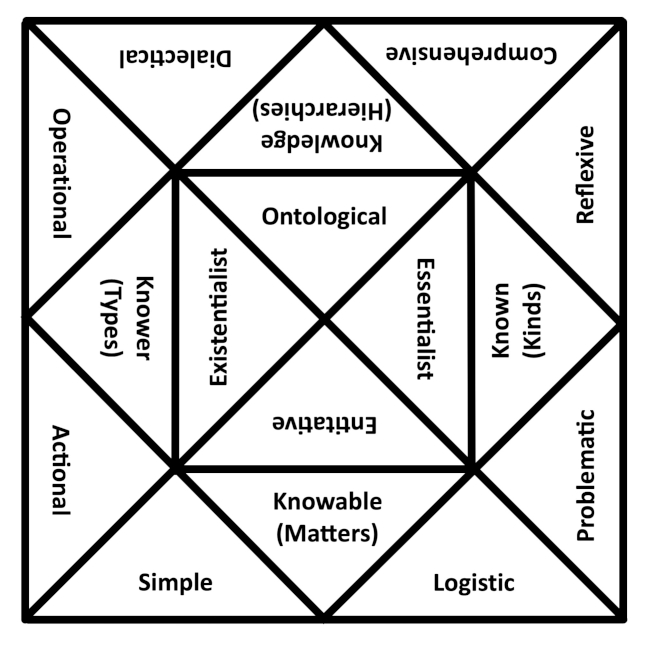
The second diagram comes from a chart in McKeon’s “Philosophic Semantics and Philosophic Inquiry”. Here, the four methods are in the upper left corner (Universal) and lower right corner (Particular), and four principles are in the lower left corner (Meroscopic) and upper right corner (Holoscopic). Four interpretations are in the center (the vertical pair is Ontic, and the horizontal pair is Phenomenal), and four selections are adjacent to them. Listed, these facets are:

  • Methods: Operational, Dialectical, Logistic, Problematic
  • Principles: Simple, Actional, Comprehensive, Reflexive
  • Interpretations: Existentialist, Entitative, Ontological, Essentialist
  • Selections: Knower (Types), Knowable (Matters), Knowledge (Hierarchies), Known (Kinds)

Note that the Archic Matrix of Watson and Dilworth is essentially derived from this, and even has many of the same terms. However and obviously, the sixteen-fold arrangements of the two diagrams are different.

Further Reading:

http://www.richardmckeon.org

Richard McKeon’s Aspects of Knowing

Richard McKeon’s Aspects of Knowing, Part 2, V3

The Archic Matrix

[*5.184, *5.185, *6.20, *11.102, *11.106]

<>


Every Fourth Thing

What do I mean by the subtitle of this blog? If you search on Google for “every fourth thing”, after you see a few references to this blog you see mentions like: being out of something at the druggist, or saying a particular actor is appearing in a random show, or showing extra interest to a comment from a spouse, or things being requested that are forgotten by waiters, or subtexts of statements issuing from celebrities or politicians, or noting that every such organism ever discovered since the beginning of time was in fact a beetle.

So for the most part, a frequency of occurrence, like you have everything of a certain type that exists or can be named or thought about or the facts of the world in a line, and you are counting down and picking out every fourth one of them. For the usual sense of the phrase “every fourth thing”, the three things not picked are ignored because they don’t meet the condition desired, but for the sense I want, they are still “fourths” of things. They are as important as the one picked, either because they implicitly complete the wholeness in some way, or complete some other wholeness.

Or instead of the other three things passed over completing the whole, you have to count out your fourths four times, so you are looking at sixteen things but skipping twelve things to end up with four fourths. Or here is another idea, you have everything (of a certain type) in the world in a bin, and the condition of selection is that it is a fourth by its nature rather than counting it out. This is probably closer to my intention, but the ambiguity between these alternate senses is why I continue to enjoy the subtitle “every fourth thing”.

Once you’ve figured out your selection process, do any four things you select comprise a four-fold, or do only things that go together in a “special way” deserve to be called that? Do you pick with replacement, or once picked do things become unavailable for further selection? You have quite a lot of picking to do, so I would say no to replacement at first consideration; but since I do reuse fourths ad nauseam, replacement must be ok.

And one of the other amusing things that I like about “every fourth thing” is that I can pretty much talk about anything I want to with the minor condition that it has four parts to it (or some multiple of four), or that it’s four things together, or whatever. I used to be far more rigorous and selective, but now I don’t really care so much, and I’ll burden my readers with all sorts of nonsense to while away the time until the sun explodes. There’s really a never ending supply that goes on and on and on (and on).

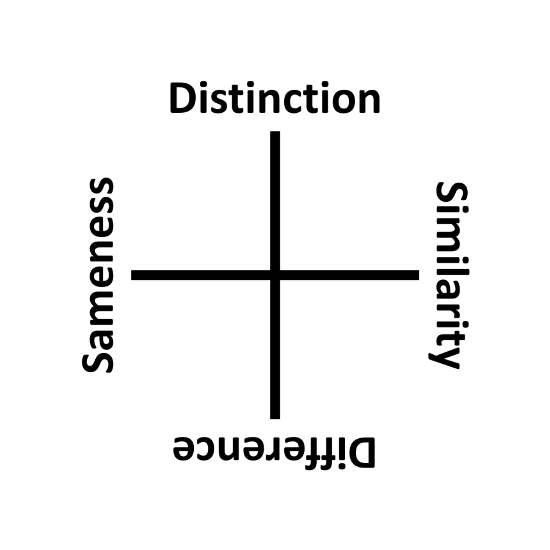
Putting aside those questions for now, since they are evidently more complicated than my initial expectations, for this analysis I am trying to enumerate the different ways that four fourths could combine to form a unity. This list depends heavily on notions of sameness and difference. I have also discussed notions of equivalence before, but I have not returned to those considerations for a while and they may be erroneous or incomplete. But let’s soldier on and at least give it an honest try before we are exhausted by all of our doubts or side issues.
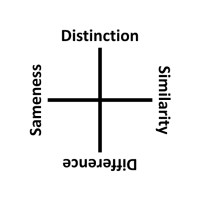
The first way that comes to mind is if each of the fourths is either identically the same thing or merely indistinguishable from each other (via replacement or being indiscernible). I’m not sure at the moment how to differentiate the two concepts so I’ll lump them together for now. Mathematically, we could represent this by the simple sum 1 + 1 + 1 + 1, or maybe the lambda expression λa.4a. For an example we could use the protons in a beryllium atom, a four leaf clover, or the sides of a square.

The second way is if each of the fourths is definitely a different thing. Then you might well ask why they are a unity and I’ll just say because I said so, that’s why! Or if I’m feeling magnanimous, I’ll try to at least give some reasons. Mathematically, we could represent this type of four-fold by a set, e.g. {a, b, c, d}, or by λa λb λc λd.a + b + c + d. As an example, a piano quartet would be nice consisting of piano, violin, viola, and cello. Also, the Four Causes, at first blush.

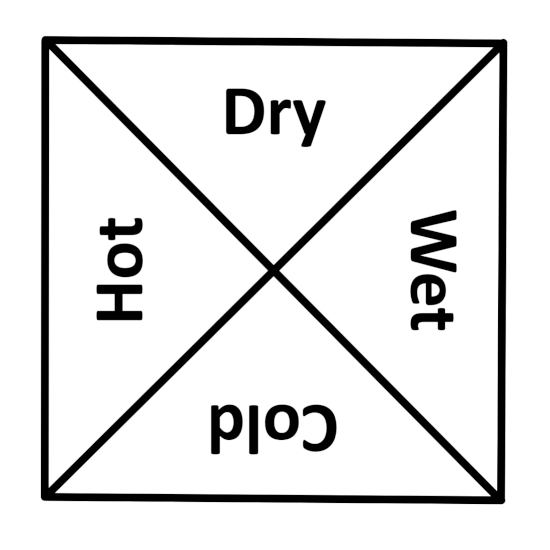
For the third way, we could consider the cross product of two sets, each having two elements, say {A, B} x {C, D}. Again, the linear expression λa λb.2a + 2b is different. And most real world examples have opposite relations like {A, ~A} x {B, ~B} (what I’ve called double duals before), so I’m having difficulty here. Maybe there are really 3 ways here that should be differentiated. Examples: the nucleus of a helium atom, Heidegger’s Four-fold, the Four Qualities, etc.

For the fourth way, let’s consider the fourths to be distinguishable, but there also is an order to them. Mathematically, how about the ordinal 4 = {0, 1, 2, 3} (but not the cardinal!). As an example, consider common time in music (4 4 time), having four quarter notes to a measure. The notes are different because of their order in the sequence, even if they are the same tone. Also the Four Seasons, except that it’s a double dual plus it has a sequence.

Now the fifth way. Mathematically: the Cartesian Plane, R x R, or the Complex Plane, C. Latitude and longitude, or maybe even North, South, East, West are examples. For every ordered pair (x,y) there is (-x, -y), (x, -y), and (-x, y). Or complex x + iy, -x – iy, x – iy, -x + iy.

Sixth. Three and one. Not the song “Three and One” by Thad Jones, even though it’s a great tune. Not the object (or is it the subject) of Trinitarianism, because that’s three IN one, and also the three are different. Ditto for three ingredient recipes. No on the yet to be released 4th Neon Genesis Evangelion movie 3.0 + 1.0, since that’s also three different things as far as I know (the first three movies). Perhaps ammonia (NH3) is an appropriate example with three hydrogens and one nitrogen . But I can’t say I’m very excited about this one, but it may be important due to my selection questions above. Now do the math: λa λb.3a + b.

Seventh. Two and one and one. λa λb λc.2a + b + c. I like this one even less, but at least it lets you see that the lambda expressions can be put into hierarchical order based on partitions of four. Perhaps the nuances of further structure can be teased out by different expressions, such as set theoretical or logical (instead of arithmetical).

Further Reading:

https://en.wikipedia.org/wiki/Axiom_of_choice

https://en.wikipedia.org/wiki/Beryllium

https://en.wikipedia.org/wiki/Piano_quartet

https://en.wikipedia.org/wiki/Time_signature#common_time

https://en.wikipedia.org/wiki/Category:Trinitarianism

[10.156, *10.190, *11.80, *11.81]

<>


The Fourth Way

“The Fourth Way” is the title of a 1957 book by Russian esotericist P. D. Ouspensky that is supposed to be about the self-development methods of the mystic/philosopher/teacher G. I. Gurdjieff. Ouspensky was a student of Gurdjieff for a significant part of his life until there was a parting of the ways. This book was published after Ouspensky died in 1947. A substantial amount of it is constructed in questions and answers, as a teacher might answer their student’s questions.

Ouspensky’s first book in 1909 was about the fourth dimension, which was much in the public consciousness in the first few years after Einstein published his theory of special relativity. His second book was titled “Tertium Organum”, or the third canon of thought, after Aristotle’s first and Francis Bacon’s second. Ouspensky’s third book “A New Model of the Universe” continued in this way, linking science with spirituality, or at least consciousness.

What is a person or what are the aspects of a person? Is a person a machine? A physicalist thinks that a person is their body, and the mind is what the brain does. A dualist thinks that a person has a body as well as a separate mind, but we know that the mind is dependent on the body for operation and it can be diminished by injury, neglect, or abuse. There are other aspects of the person, such as the emotions or “heart”, which are somewhere between the body and the mind.

And if you search on the web, “soul” or “spirit” are often shown in images along side body, mind, and mood, but these terms are imprecise. Sometimes soul is defined as spirit, sometimes spirit as soul. It is difficult to determine what is meant by them, but they are usually of a higher-order nature than the physical or mental or emotional. It is usually what remains the same for a person, the still point of a changing self, regardless if that endures after death.

  • Body
  • Mind
  • Mood (Heart or Emotions)
  • and Spirit?
  • or Soul?
  • or Balance?

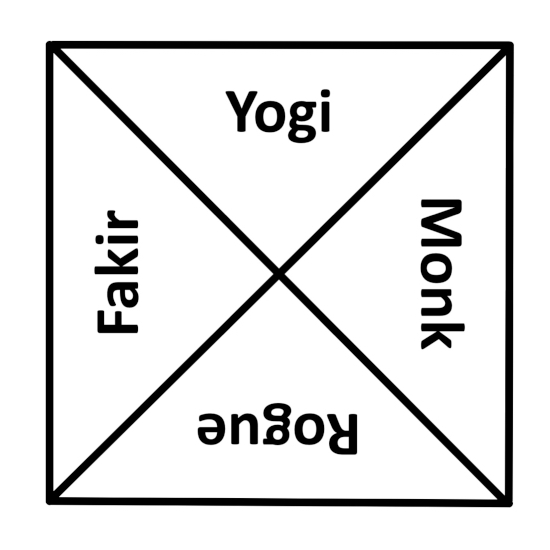
Various schools of spiritual people concentrate on the control and discipline of different aspects of the self: the physical for the Fakir, the mental for the Yogi, and emotions for the Monk. These are the first three historical ways for self-development, but they require separation from the normal social world, and neglect the other aspects of the self. The Fourth Way was said to require no extreme separation, and to develop body, mind, and mood in a balanced way.

Gurdjieff thought that most if not all people were machines because they were “asleep at the wheel” (my metaphor), the wheel being the control of their own consciousness. Similar to the practice of lucid dreaming, these teachings (also called “the work” or “the system”) purported to develop the conscious self into something much more than ordinary awareness. This aware self would have access to all sorts of abilities that remain hidden or dormant in most of us.

The Fourth Way is also said to be the way of the “sly man”, but to be sly is to be crafty, cunning, and tricky. If you are sly you are deceitful or a charlatan, dishonest and evasive, a “rogue”. You take advantage of people, or you game the social system. Are there any truth to these teachings, or were they merely a way that Gurdjieff found to make an easy living? If not, why call it the way of the “sly man”? On the other hand, who doesn’t want to develop their best selves in the most efficient and clever way?

  • Fakir: Physical
  • Yogi: Mental
  • Monk: Emotions
  • Rogue: Balance or ?

I also read that “sly man” is a translation of the French “le ruse”. The idea behind this name is for a person that takes advantage of opportunities in their normal life to development their awareness, rather than just their attitude towards others. And so it’s a posture towards the broader world, not just towards people. If I had a short word to substitute for “rogue” in the above diagram, I might do so, to prevent the negative impression I might be giving. But the term “rogue” is probably less offensive that it used to be, so I’ll keep it for now.

Yet people do love to be deceived. They love to be entertained, and they love a good story with charismatic characters. They also love to hear what they want to hear. Perhaps that’s all these teachings really were and are. And yet, many artists, writers, and thinkers have embraced the ideas of this fourth way. Certainly to enhance one’s consciousness is a positive thing to do, or to eliminate erroneous or harmful thought, or to “know thyself”. Socrates taught that “the unexamined life is not worth living”. Perhaps there is some worth to these teachings after all, but a person may have to determine this for themselves.

Further Reading:

https://en.wikipedia.org/wiki/Fourth_Way

https://en.wikipedia.org/wiki/The_Fourth_Way_(book)

https://en.wikipedia.org/wiki/George_Gurdjieff

https://en.wikipedia.org/wiki/P._D._Ouspensky

Tertium Organum online:

http://www.sacred-texts.com/eso/to/index.htm

https://en.wikipedia.org/wiki/Novum_Organum

https://en.wikipedia.org/wiki/Centers_(Fourth_Way)

https://en.wikipedia.org/wiki/Know_thyself

Some videos to entertain found by searching for “fourth way” and “sly man”:

[*10.168, *11.48]

<>


Noether-Pauli-Jung, V2

What happens when the fourfold of Noether’s Theorem is spliced together with the fourfold of Pauli-Jung? Both have Space-Time and Matter-Energy. The former has Conservation and Symmetry, and the latter has Causality and Synchronicity. And if Space-Time and Matter-Energy are both divided into Space and Time and Matter and Energy, one obtains this eight-fold.

Causality means that some action or cause in time (say a process) of things in space can have an effect (another process, say) on different things in space, and Synchronicity means that different events (say processes) separated in space can have non-causal relationships between them.  Conservation means the consistency of a quantity of matter or energy or matter-energy through time, and Symmetry means the consistency of a measure of a structure or form through space.

I am reminded of my fourfold Four Bindings, consisting of Chains, Grids, Blocks, and Cycles. Causality and Synchronicity are Chains (or non-chains for the latter) Space and Time are Grids (or flexible meshes), Matter and Energy are Blocks (or chunks of stuff), and Symmetry or Conservation are Cycles (of the group-theoretic kind or the equivalence class kind or just loops).

Further Reading:

https://en.wikipedia.org/wiki/Causality

https://en.wikipedia.org/wiki/Synchronicity

https://en.wikipedia.org/wiki/Symmetry

https://equivalentexchange.wordpress.com/2012/05/04/noethers-theorem/

https://equivalentexchange.wordpress.com/2018/01/23/atom-and-archetype/

Four Bindings

This is a reworking of a previous six-fold diagram that I believe is served better as an eight-fold.

Noether-Pauli-Jung

[*10.68, *10.155, *11.55]

<>

An Eightfold Metaphysics

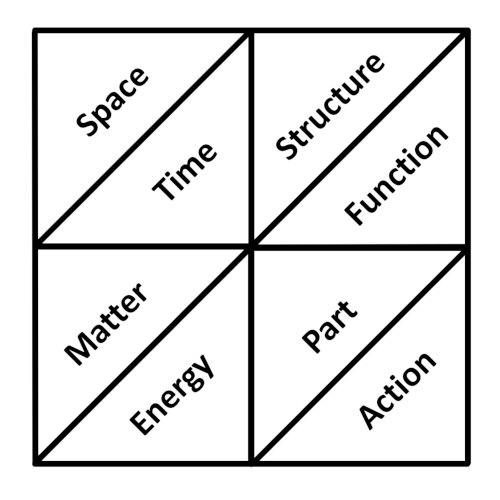
If one juxtaposes the fourfold Space-Time-Matter-Energy with the fourfold Structure-Function-Part-Action, one sees that there are several relations between them. These are simple common-sense relations, not modern-physics types of relations. Below they are listed by Space-type relations and Time-type relations.

Space is required for the extension of Structures.
Matter constitutes Structures.
Parts in an arrangement make up Structures.

Structures extend and are organized in Space.
Matter is located in Space.
Parts occupy Space.

Time allows the expression of Functions.
Energy is required for the operation of Functions.
Actions in a sequence constitute Functions.

Functions have duration and reoccur in Time.
Energy requires and is dependent on Time.
Actions take place within Time.

Several analogies are also evident in this diagram.

  1. Space : Structures :: Time : Functions
  2. Space : Parts :: Time : Actions
  3. Space : Matter :: Time : Energy
  4. Structures : Parts :: Functions : Actions
  5. Structures : Matter :: Functions : Energy
  6. Parts : Matter :: Actions : Energy

Notice that analogies 1.-3. are “contains” relations, and 4.-6. are “part of” relations. One obtains the nesting of entities:

Space > Structures > Parts > Matter
Time > Functions > Actions > Energy

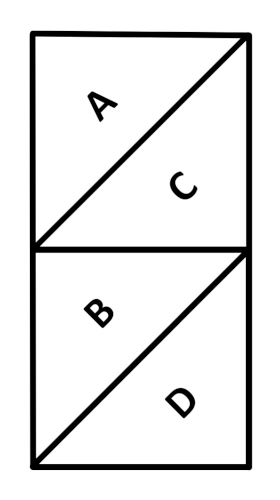
I suppose that any analogy could be shown in a figure like the one on the right (or even written as A / B // C / D) or with the two squares side by side, and that sets of four or six analogies that overlap could be nicely shown as above. If so, I wonder what can be gained by such representations? Probably individually not so much but with overlaps I think it would be interesting.

Further Reading:

The study of parts and wholes relations is called Mereology.

https://en.wikipedia.org/wiki/Mereology

https://plato.stanford.edu/entries/mereology/

[*10.157, *11.26, *11.34]

<>


The Rosetta Stone of Arthur M. Young

In his book “The Geometry of Meaning”, Arthur M. Young developed a system which he called his “Rosetta Stone” because he claimed that it associated mental attributes to some physical measurements, giving a kind of map to mind-body dualism. In the above diagram the expressions and names of these twelve objective values or physical units are shown. Examine the list below to see the twelve subjective values or mental attributes (shown in parentheses) that Young ascribed to them.

I’ve rearranged the sequence of these somewhat because I don’t quite understand the reasons for the organization Young gave them. I’ve also relabeled the units using the more standard derivative notation L’ = dL/dT, L” = d^2 L/ dT^2, etc. His notation is given at the end of each line below in parentheses for comparison (essentially he removes the d’s from the derivatives, writing dL/dT as L/T, which seems confusing to me when then multiplied by L).

Given the measurement Position or Length (L), Moment is Mass (M) times Position giving ML, and Moment of Inertia is Moment (ML) times Position giving ML^2. Velocity (L’), Acceleration (L”), and Control (L”’) have similarly related pairs of values by multiplying each by M and by ML. This gives four sets of similar expressions differing by their common derivative. I should have probably named the 1st set to be 0th, 2nd set to be 1st, 3rd set to be 2nd, and 4th set to be 3rd after the order of the common derivative.

  • Position (Observation): L
  • Moment (Significance): ML
  • Moment of Inertia (Faith): ML^2
  • Velocity (Change): L′ (L/T)
  • Momentum (Transformation): ML′ (ML/T)
  • Action (Impulse): MLL′ (ML^2/T)
  • Acceleration (Spontaneous act): L” (L/T^2)
  • Force (Being): ML” (ML/T^2)
  • Work (Fact): MLL” (ML^2/T^2)
  • Control (Control): L′′′ (L/T^3)
  • Mass Control (Establishment): ML′′′ (ML/T^3)
  • Power (Knowledge): MLL′′′ (ML^2/T^3)

How does Young justify associating, for example, the mental attribute “Faith” with the physical unit “Moment of Inertia”? It seems to have something to do with his original cyclic order of these twelve measurements and the associations he gives them to the Astrological Signs of the Zodiac. This mapping is not shown but can easily be found in the links below.

Further Reading:

Arthur M. Young / The Geometry of Meaning

http://www.arthuryoung.com/

http://mindfire.ca/The%20Geometry%20of%20Meaning/Chapter%20Five%20-%20%20The%20Rosetta%20Stone%20of%20Meaning.htm

http://kairos.laetusinpraesens.org/meaning_1_h_15

The only early entry in my blog without a leading figure (and poor tables as well):

https://equivalentexchange.blog/2011/01/02/arthur-m-young%e2%80%99s-fourfold-theory-of-process/

[*7.78, *7.79, *8.2, *11.38]

<>

The Law of the Instrument

Sometimes I wonder if I overdo this fourfold thing. The law of the instrument says something like “if all you have is a hammer, everything looks like a nail”. Dividing things up into four parts, or bringing four things together into a whole, is the belabored theme of this blog. Fourfolds are my hammer, and what a nice hammer it is!

When my father was in a nursing home, he had a roommate for a period of time that would just draw houses continuously. Not nice architectural renderings either, but houses like a child would, where you can see three sides of it at once (the front and both sides). I might be doing that one day, endlessly drawing fourfold diagrams in endless fourfold permutations.

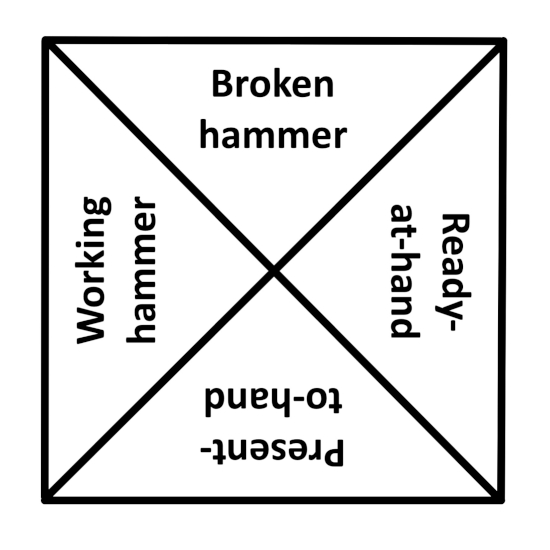
Speaking of hammers, Martin Heidegger also wrote at length about them in regards to equipment or instrumentality. He contrasted a working hammer that was “ready-to-hand” to a broken hammer that was “present-at-hand”. The working hammer recedes into the background of its ready utility, but the broken hammer, being useless, is merely present in pieces.

The notion of science as negative enterprise was raised by Heidegger since scientific investigation only gives you the present-at-hand, and not the smooth extension of ability that is ready-to-hand. I disagree, because how can you fashion a hammer in the first place or repair it if you aren’t full cognizant of its constituents and construction?

I realize that some worthwhile analyses are made by this approach to technology. For example, few are able to construct or repair modern automobiles or smartphones. In a sense, that should make Heidegger happy, since most are using this modern equipment with no clue as to how they work. And if they wear out or break or become obsolete, they are too costly to repair or upgrade and are sent to the scrapheap. But I say this tongue-in-cheek.

Heidegger’s “tool analysis” is the basis for much of his later writings, specifically concerning “das Geviert” (simply meaning square). If tool analysis is itself a tool, what happens when you apply tool analysis towards itself? Does one get an infinite fractal of fourfolds, ascending and descending, approaching and receding?

Further Reading:

https://en.wikipedia.org/wiki/Law_of_the_instrument#Abraham_Maslow

https://en.wiktionary.org/wiki/if_all_you_have_is_a_hammer,_everything_looks_like_a_nail

https://en.wikipedia.org/wiki/Heideggerian_terminology#Present-at-hand

https://en.wikipedia.org/wiki/Heideggerian_terminology#Ready-to-hand

Look at this painting!

https://www.dia.org/art/collection/object/das-geviert-94252

[*10.193]

<>


The Question Concerning Technology

“The Question Concerning Technology” by Martin Heidegger is not an easy read. This short essay is full of unusual terms and phrases. I think part of the reason for this is Heidegger’s style of writing, and part is the capacity of the German language to build compound words easily. Thus in the English translation you have several hyphenated words like “standing-reserve” and “bringing-forth”. Of course, difficult terminology seems to be typical for Heidegger, but there are also many words taken from classical philosophy that have special meanings, which Heidegger was well versed in.

In this essay we first learn that our question is really a questioning and will be a process that “builds a way” to understanding, so initially we are more interested in the journey than the destination. The way that is desired is towards a “free relationship” between an “open” human existence and the “essence of technology” (essence being what a thing is, as if we can know exactly, so finding out is part of our journey). Second, we are told that the essence of technology is not technological, so to try to find what this essence is by using more technology is to be in an “unfree” relationship with it.

Third, our question concerning technology is really asking what technology is. A common and “correct” definition is that it is both a means to an end, and a human activity. The former is the instrumental aspect of technology, and the later is the anthropological aspect. But Heidegger does not think that these two aspects are the complete or “true” ones, and so our questioning leads us to inquire as to the essence of instrumentality. For that, we turn next to consider the general causes of things and their effects, and so on to examine the classical Four Causes of Aristotle.

Readers of this blog will be familiar with the Four Causes, as I have mentioned them frequently. I consider them an important paradigmatic four-fold, and have tried to develop a more modern version of them with my four-fold Structure-Function. However, Heidegger was no friend to modernity, and his treatment of the Four Causes and the remainder of his essay shows that plainly. But let us continue on with our journey before we spoil our quest. As a reminder, here is a quick list of the Four Causes:

  • Efficient Cause – causa efficiens – Logos
  • Material Cause – causa materialis – Hylos
  • Formal Cause – causa formalis – Eidos
  • Final Cause – causa finalis – Telos

By thinking about causes in this way, can we discover the essence of causality? Heidegger explains that what causality is involves the things responsible for the bringing about of other things or what kinds of things a thing is indebted to in order for it to occur. (Others have argued that instead of causes another good name is the four “becauses”, i.e. the reasons for or the explanations of things). Note that Heidegger uses the terms responsibility and indebtedness to give the Four Causes (what I consider to be) a normative aspect.

Heidegger presents to us a silver chalice as an example of how to think about the the Four Causes in relation to Greek thought. Hylos (or hyle) is the material we start with, Eidos is its form or aspect, Telos is responsible for bringing together both (but not as aim or purpose but as bounds or context), and all three are indebted to… Logos? Heidegger now departs from how Aristotle was understood to view the causes named after him, and says so himself, in order to argue that these four ways of responsibility and indebtedness are really what these causes are all about.

To be continued… maybe…

Further Reading:

https://en.wikipedia.org/wiki/The_Question_Concerning_Technology

Click to access question_concerning_technology.pdf

http://www.english.hawaii.edu/criticalink/heidegger/guide1.html

https://en.wikipedia.org/wiki/Heideggerian_terminology

https://en.wikipedia.org/wiki/Four_causes

https://plato.stanford.edu/entries/aristotle-causality/

Roisin Lally / The Ontology of Technology: a Heideggerian Perspective. Ph. D. Thesis June 2016

https://www.academia.edu/30749168/THE_ONTOLOGY_OF_TECHNOLOGY_A_Heideggerian_Perspective

Notes for Further Writing:

Interesting articles on Shintoism and Heidegger:

https://iainews.iai.tv/articles/spirited-away-meets-heidegger-we-killed-the-gods-with-technology-but-the-sacredness-of-life-is-continuous-auid-1104

https://prezi.com/hvul4-ped2z4/shintoism-and-spirited-away/

https://en.wikipedia.org/wiki/Shinto

Interesting article on language and technology (tool-making) arguing that they are related: The structure of language mirrors the methodological structure of tool making:

https://www.theatlantic.com/science/archive/2018/06/toolmaking-language-brain/562385/

A nice symmetric view of the Four Causes as things undergoing changes is shown in:

Boris Henning / The Four Causes, The Journal of Philosophy, Vol.106, No.3 (March 2009), pp. 137-160

[*10.114]

<>