Category Archives: Philosophy

The Square of Epictetus

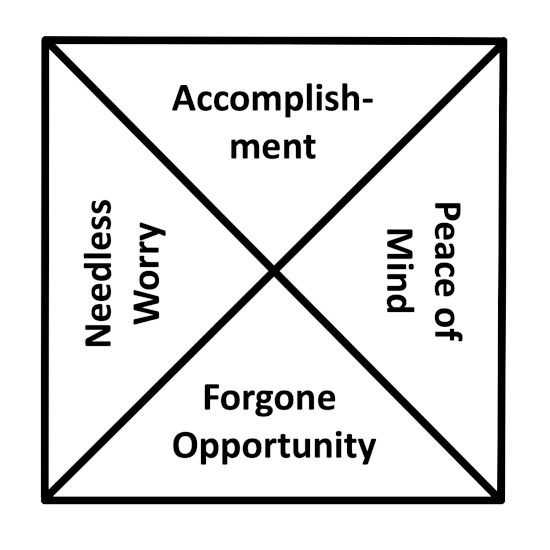
Here is a nice two-by-two matrix by engineer David E. Goldberg derived from the stoic philosophy of Epictetus. For each and every concern, it’s the cross product of one’s Activity (control vs. no control) and State of Mind (concerned vs. not concerned). And so we have the four combinations:

  • Concerned with Control: Accomplishment
  • Unconcerned with Control: Forgone Opportunity
  • Concerned but No Control: Needless Worry
  • Unconcerned and No Control: Peace of Mind

Of course the key is to dwell within the positive Accomplishment and Peace of Mind regions, and not to inhabit the negative ones of Needless Worry and Forgone Opportunity.

Further Reading:

http://entrepreneurialengineer.blogspot.com/2006/11/square-of-epictetus.html

https://www.linkedin.com/pulse/20141007110433-722904-worry-less-accomplish-more/

More Accomplishment, Less Worry: Follow the Epictetus Square

https://plato.stanford.edu/entries/epictetus/

Epictetus

<>


Knowledge as Justified True Belief

Quid est veritas?

— Pontius Pilate

Explanations come to an end somewhere.

— Ludwig Wittgenstein

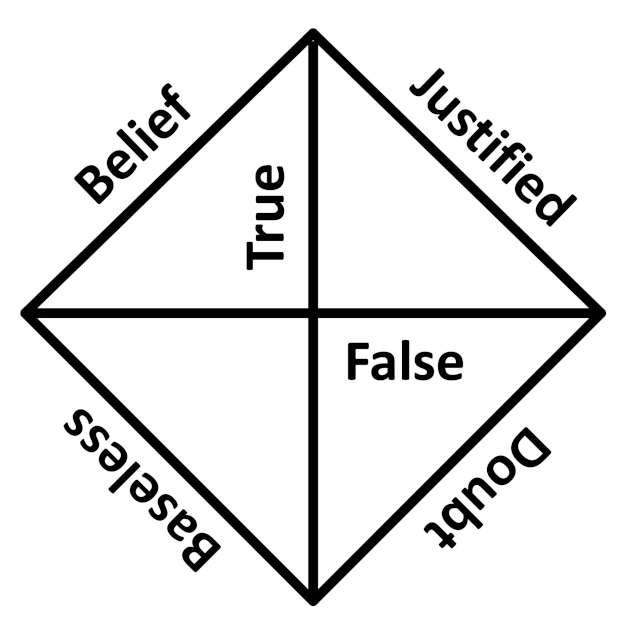
I read that Edmund Gettier died recently, famous for the problem of knowledge named after him. He argued that justified true belief may not really be knowledge, and gave counterexamples for it not being so.

Here I show a diagram for those three conditions (Justified, True, Belief) and their opposites (Baseless, False, Doubt). The Wikipedia page on the Gettier problem states simply that the solution for it is that the justification must be true also, as the belief.

I don’t want to be posing as Pilate, but it does seems that truth is the most difficult and elusive of the three criteria, conditioning as it must the other two. In this age of disinformation, you could do worse than read the articles below.

Further Reading:

https://en.wikipedia.org/wiki/Gettier_problem

https://en.wikipedia.org/wiki/Edmund_Gettier

https://plato.stanford.edu/entries/knowledge-analysis/

https://plato.stanford.edu/entries/epistemology/

https://www.researchgate.net/publication/318135910_Justified_True_Belief_Plato_Gettier_and_Turing

[*10.88]

<>

Four Dimensions of Knowledge

What is the best way to educate, to teach and learn? Ideally, students shouldn’t merely memorize facts and recall them on demand, although retaining well accepted knowledge is important. Certainly, students need mental structures to organize these facts, so that they form associated groups of categories and classification. Additionally, methods are needed for accepting and rejecting facts, and procedures for organizing facts, although facts may often be revisited for truth, or to reorganize them, and so on.

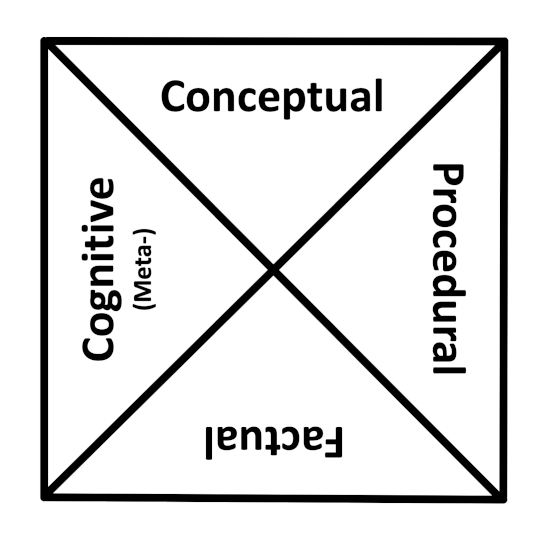
Benjamin Bloom et al. developed a taxonomy for educators of six mental aspects for the acquisition of knowledge, which was revised later into six cognitive actions or processes by L. Anderson, B. S. Krathwohl and others. These six actions form a sort of food pyramid for knowledge, so that lower actions form a broader base for higher ones. Both taxonomies sort a dimensional hierarchy of knowledge operated by these aspects or actions from concrete to abstract: Factual, Conceptual, Procedural, and Metacognitive (the last added when revised).

In the revised taxonomy, “Remember” is the lowest cognitive action, described by “remember facts and basic concepts,” which deals with the Factual and Conceptual. Above it is “Understand,” described by “explain ideas or concepts,” and I imagine an idea can be a fact. Next is a procedural action “Apply: use information in new situations,” and in fact all six actions are procedural by being actions. At the top of the pyramid is “Analyze,” “Evaluate,” and “Create”. The Metacognitive dimension (“thinking about thinking”) is for thinking about these six actions and these four dimensions, as to how they are related and differ.

These taxonomies are well considered and there are many resources to investigate.

Further Reading:

http://edtheory.blogspot.com/2016/03/knowledge-dimensions-factual-conceptual.html

Bloom’s Taxonomy

https://www.celt.iastate.edu/teaching/effective-teaching-practices/revised-blooms-taxonomy/

Bloom’s Taxonomy Revised

https://www.goconqr.com/en/mindmap/12973371/four-types-of-knowledge

Pedagogy of book and chapter organization

Click to access krathwohl.pdf

Anderson, L., Bloom, B. S., Krathwohl, D., & Airasian, P. (2000). Taxonomy for learning, teaching and assessing: A revision of Bloom’s Taxonomy of Educational Objectives (2nd ed.). New York: Allyn & Bacon, Inc.

Anderson, L. W., Krathwohl, D. R., Airasian, P. W., Cruikshank, K. A., Mayer, R. E., Pin- trich, P. R., … & Wittrock, M. C. (2001). A taxonomy for learning, teaching, and assessing: A revision of Bloom’s taxonomy of educational objectives, abridged edition. White Plains, NY: Longman.

https://en.wikipedia.org/wiki/Metacognition

https://en.wikipedia.org/wiki/Concept

https://plato.stanford.edu/entries/concepts/

https://iep.utm.edu/th-th-co/


https://en.wikipedia.org/wiki/Cognition

https://plato.stanford.edu/entries/innateness-cognition/

[*12.84]

<>

Kant’s Tables of Judgments and Categories

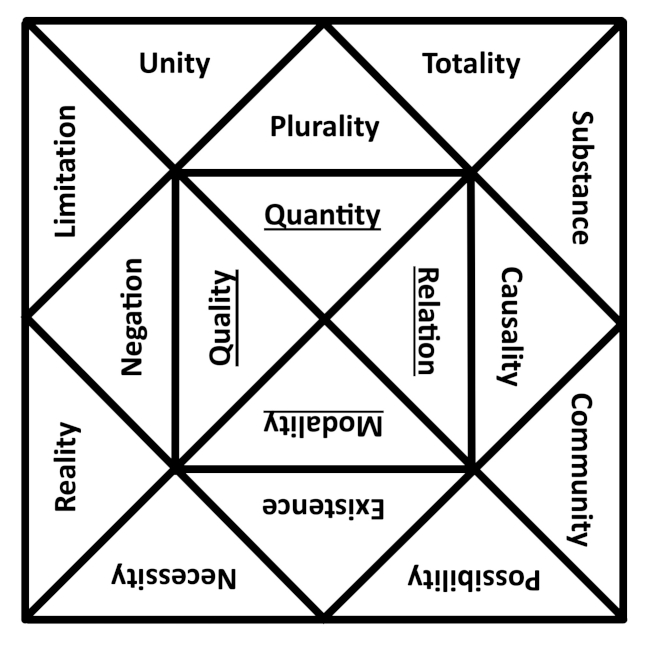
Even though Immanuel Kant’s tables of Judgments and Categories are each made up of four triples, both are divided into the same four headings: Quantity, Quality, Relation, and Modality. And as to the tripartite structure of their divisions, I can’t say I’m convinced of their coherence and completeness, c.f. Lovejoy’s article below.

Judgments

  • Quantity: Universal, Particular, Singular
  • Quality: Affirmative, Negative, Infinite
  • Relation: Categorical, Hypothetical, Disjunctive
  • Modality: Problematic, Assertoric, Apodictic

Categories

  • Quantity: Unity, Plurality, Totality
  • Quality: Reality, Negation, Limitation
  • Relation: Substance, Cause, Community
  • Modality: Possibility, Existence, Necessity

Further Reading:

Immanuel Kant: Logic

Kant, Immanuel

https://plato.stanford.edu/entries/kant-judgment/

https://en.wikipedia.org/wiki/Category_(Kant)

Arthur O. Lovejoy / Kant’s Classification of the Forms of Judgment, The Philosophical Review, Nov. 1907, Vol. 16, No. 6, pp. 588-603

Click to access 2177294.pdf


Some researchers discussing Kant’s judgments that look interesting:

https://siucarbondale.academia.edu/RichardLanigan

https://www.degruyter.com/view/journals/semi/2019/227/article-p273.xml?language=en

http://www.mrc.uidaho.edu/~rwells/

https://webpages.uidaho.edu/rwells/techdocs/Principles%20of%20Mental%20Physics/

[*4.136, *7.114]

<>


Agent, Actor, Critic, and Spectator

To understand all (causally) is to forgive all (normatively). To understand all (normatively) is to forgive nothing, for it is to talk about norms, not people; about mathematics, in which there is no error and no responsibility, and not about mathematicians, who do make mistakes.

— Lewis White Beck

Here is a set of distinctions by philosopher Lewis White Beck that may have some relevance to thinking about human determination and action. Beck was most renowned as a scholar of Kant.

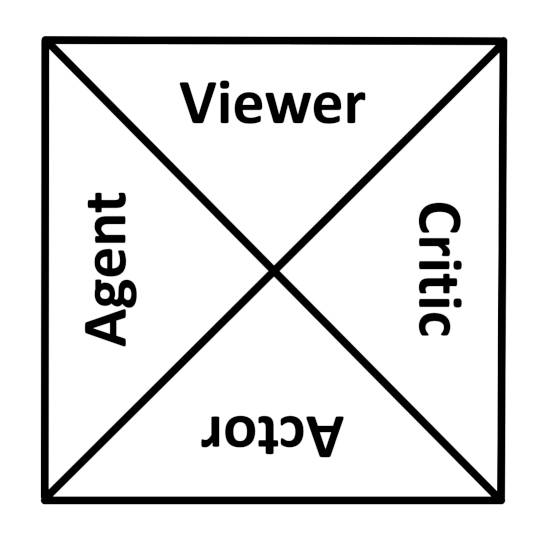
  • Agent: a person X who thinks they are responsible and free in choices and actions (essentially a “free” agent), with motives and reasons
  • Actor: a person X who thinks they are an agent but is judged by a Spectator Y to not be free and instead determined by external causes
  • Spectator (diagrammed as Viewer): a person Y who observes any X and explains their actions exclusively by causal terms, and so judges them to be an Actor
  • Critic: a person Z who is in a position to agree with X that X is indeed an Agent or a Spectator Y that X is instead an Actor

A great deal of language revolves around explaining our behavior and that of others, both for the benefit or detriment to ourselves and others. All of us would usually rather be free and responsible agents than causally determined actors, but certainly we are not entirely free to act no matter how little we are not. Philosophical discussion of human action continues to be commonly cast into terms such as agency, action, intention, and even authenticity.

Beck later returned to these ideas for his Ernst Cassirer lectures, and a book of them was published in 1975. By the title and a short description, it appears that Beck reduced the fourfold to a mere dual, in order to simplify as well as elaborate his ideas (but I cannot say for sure as I have not read it). Still, I like the original fourfold scheme that in my mind bears likenesses to others presented here (for example, Modal Verbs.)

Further Reading:

Lewis White Beck / Agent, Actor, Spectator, and Critic, The Monist , April, 1965, Vol. 49, No. 2, pp. 167-182
http://www.jstor.com/stable/27901588

Lewis White Beck / The Actor and the Spectator: foundations of the theory of human action (1975)

https://en.wikipedia.org/wiki/Lewis_White_Beck

https://en.wikipedia.org/wiki/Agency_(philosophy)

https://plato.stanford.edu/entries/agency/

https://en.wikipedia.org/wiki/Action_(philosophy)

https://plato.stanford.edu/entries/action/

https://en.wikipedia.org/wiki/Intention

https://plato.stanford.edu/entries/intention/

https://en.wikipedia.org/wiki/Authenticity_(philosophy)

https://plato.stanford.edu/entries/authenticity/

[*4.40, *4.108, *7.38, *9.66]

<>

Flowing and Falling

Some philosophers say everything is process. From the cosmic scale of the universe to the submicroscopic scale of atoms, physical forces marshal matters and energies to and fro. In between these at the human scale, biology is ruled by flows of energy from the sun and nutrients from the environment as well as from other living beings. Dynamical forces such as temperature, weather and tides also affect biology and even the cultural processes of higher lifeforms.

At the scale of the solar system, gravity collects gases to ignite stars and form planets. Once stars reach their limits to burn, gravity can collapse them to dense cinders and black holes or even to rebound and spread their atomic matters in novas and supernovas. Even light spread by the stars can be gathered together into gravity wells such as black holes. Stars in turn are gathered into galaxies by the gravity of black holes and even unknown dark matters.

At the scale of atoms and molecules, temperature differentials and water can partition certain types of elementary constituents to form membranes and segregate insides from outsides. If an inside is protected sufficiently, then there is time and the conditions to harbor and perpetuate the delicate structures and processes that form cells. Cells can even gather together and continue as multicellular communities, or only temporarily to fruit and disperse again as simple creatures known as slime molds.

At the individual human or societal scale, there are flows for nutrients and excreta, materials for habitation and the manufacture of tools, distributed energies such as electricity, fossil fuels, and information for learning, work, and civic participation. Even speech and writing can be thought as flows of information. But just as flows of nutrients and materials and energies can prove toxic to biological health or ecologies, so can information.

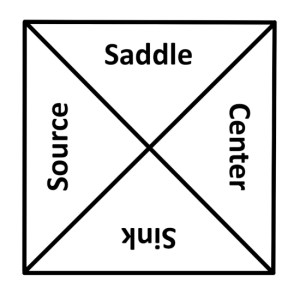
For two-dimensional dynamical systems, certain common elements can be mapped out: sources and sinks, saddles and centers. Sources have flows out from a point or region, and sinks have flows in. Saddles have a roughly stationary center, due to balanced flows in and out at (not necessarily) right angles. Centers are circular vortexes about a stationary point or region. Sources and sinks can spiral, saddles can twist, centers can become eccentric or elliptical.

For example, think about everyday weather forecasts. The atmosphere is relatively thin compared to the earth and so the flows of air can be considered two-dimensional, at least at the ordinary strata of human habitation. There are air pressure highs and lows (sources and sinks), and air temperature cold and warm fronts (usually not saddles though), stationary fronts (centers?), and even circulations (hurricanes are spiraling sinks I guess).

Ordinary, human-sized change has conditioned many of our intuitions and insights about the way the universe works. Heraclitus famously said that all was change, and so he thought fire was the primal element. His predecessor Thales thought that water was instead the basic element, and it is pretty mutable also. Lucretius, inspired by Empedocles, thought none of the four classical elements were foundational, but all were composed of tiny bits that fell and bounced against each other through an endless void.

As earth is in opposition to air, and fire to water, the seasonal changes of temperature and moisture were considered by Hippocrates. Heat gains dominion over cold in Spring and Summer, but cold replaces it in Fall and Winter. Similarly wet and dry quarters cycle through the seasons. These oppositions gave rise to the theory of the four temperaments or humourism. Even to this day these considerations have inspired various theories of personality, like the Myers-Briggs Assessment.

Is everything a struggle of opposites? Empedocles, already mentioned, thought love and strife were the relations that respectively attracted and repelled all matter in their dance and change. Now we know that things fall towards the earth, not for the love of it, but because of the shape of space that the earth’s mass makes. Heat flows into the cold because both even up. Order dissolves into chaos since the latter is more likely, unless fed by other sources of order turning to disorder.

Is everything a flow between opposites? Light spreads out and diminishes into darkness, but gravity gathers matter together. Enough gravity can even gather light and bind it into the darkness of a black hole. A drop of ink spreads out in a glass of water, never to return to that inky state, unless the glass sits and the water evaporates until only a drop remains. Even epidemics and pandemics can be thought to be flows of transmission and contagion. Here, the small becomes the large, and the few the many.

Further Reading:

https://en.wikipedia.org/wiki/Stability_theory

https://en.wikipedia.org/wiki/Four_temperaments

https://en.wikipedia.org/wiki/Process_philosophy

Also note that these four classifications are somewhat analogous to four valued logic: True is Source, False is Sink, None is Center, Both is Saddle.

[*12.52, *12.56]

<>
 

The Four Philosophy Ensemble

A woman came up to me and said
“I’d like to poison your mind
With wrong ideas that appeal to you
Though I am not unkind”
She looked at me, I looked at something
Written across her scalp
And these are the words that it faintly said
As I tried to call for help…

— From Whistling in the Dark, by They Might Be Giants

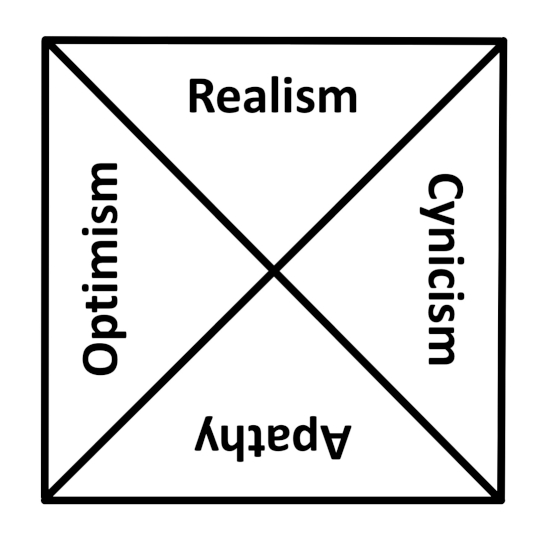
  • The Cynic
  • The Realist
  • The Optimist
  • The Apathetic

Further Reading:

https://tvtropes.org/pmwiki/pmwiki.php/Main/FourPhilosophyEnsemble

The Utopian vs. the Dystopian

https://en.wikipedia.org/wiki/Flood_(They_Might_Be_Giants_album)

https://genius.com/They-might-be-giants-whistling-in-the-dark-lyrics

Notes:

Since these pair up nicely (Realism and Apathy, Optimism and Cynicism), perhaps one could combine them as Optimistic Realism, Optimistic Apathy, Cynical Realism, Cynical Apathy.

<>

Schopenhauer’s Four Laws of Thought

The first three of Arthur Schopenhauer’s Four Laws of Thought are pretty much the same as the classical three laws of thought. Schopenhauer added a fourth law that was basically for his Principle of Sufficient Reason.

  • Identity
  • Non-contradiction
  • Excluded middle
  • Sufficient reason

These Four Laws are often given in two flavors: the first, in fairly concrete terms of subjects and predicates, and the second, more glib in terms of existence and being and such (isness).

  • A subject is equal to the sum of its predicates. Everything that is, exists. (Identity)
  • No predicate can be simultaneously attributed and denied to a subject. Nothing can simultaneously be and not be. (Non-contradiction)
  • Of every two contradictorily opposite predicates one must belong to every subject. Each and every thing either is or is not. (Excluded middle)
  • Truth is the reference of a judgment to something outside it as its sufficient reason or ground. Of everything that is, it can be found why it is. (Sufficient reason)

The phrase ‘it can be found’ sounds like a constructive method rather than a mere existence proof, but the common theological technique that combines both by saying “everything happens for a reason” avers the reason to an ineffable deity. (I bet Schopenhauer would have disliked this view because from what I understand he was an atheist.)

Moving on, I would like to represent these four laws in even more concrete terms of logical expressions. In the following attempt, let a, b be subjects (or objects), and P, Q be predicates (or qualities):

  • ∀a (a ≡ ∀P P(a))
  • ∀a ¬∃P (P(a) ∧ ¬P(a))
  • ∀a ∀P (P(a) ∨ ¬P(a))
  • ∀a ∃b (b → a)

When detailed in this way, these four laws don’t seem very complete, or don’t quite form a unity, as implication and equivalence are each in only one of them. Even though it doesn’t help that criticism, perhaps one can succinctly say:

  • Things can be reduced to (all) their qualities.
  • Qualities are disjoint from their opposites.
  • Qualities and their opposites are sufficient.
  • Things are entailed by some thing (possibly same).

In addition, I quite liked this Goodread review which aligns Aristotle’s Four Causes with Schopenhauer’s Fourfold Root. So then:

  • From Parts : Material Cause : Becoming : Identity
  • For Functions : Final Cause : Knowing : Non-contradiction
  • Into Structures : Formal Cause : Being : Excluded-middle
  • By Actions : Efficient Cause : Acting : Sufficient reason

Further Reading:

https://en.wikipedia.org/wiki/Law_of_thought

https://en.wikipedia.org/wiki/Law_of_identity

https://en.wikipedia.org/wiki/Law_of_excluded_middle

https://en.wikipedia.org/wiki/Law_of_noncontradiction

https://en.wikipedia.org/wiki/Principle_of_sufficient_reason

https://plato.stanford.edu/entries/sufficient-reason/

https://plato.stanford.edu/entries/schopenhauer/

https://en.wikipedia.org/wiki/Quantifier_(logic)

https://en.wikipedia.org/wiki/Universal_quantification

https://en.wikipedia.org/wiki/Existential_quantification

https://www.goodreads.com/review/show/1328220242

Aristotle’s Four Causes

Schopenhauer’s Fourfold Root of the Principle of Sufficient Reason

Things Happen

[*11.196, *11.197]

Notes:

At some point, I need to understand the difference between the law of the excluded middle and the principle of bivalence.

https://en.wikipedia.org/wiki/Principle_of_bivalence

https://philosophy.stackexchange.com/questions/3268/what-is-the-difference-between-law-of-excluded-middle-and-principle-of-bivalence

https://thephilosophyforum.com/discussion/1840/the-principle-of-bivalence-and-the-law-of-the-excluded-middle-please-help-me-understand

<>

Tractatus Logico-Philosophicus

Just the facts, ma’am.

— Detective Joe Friday

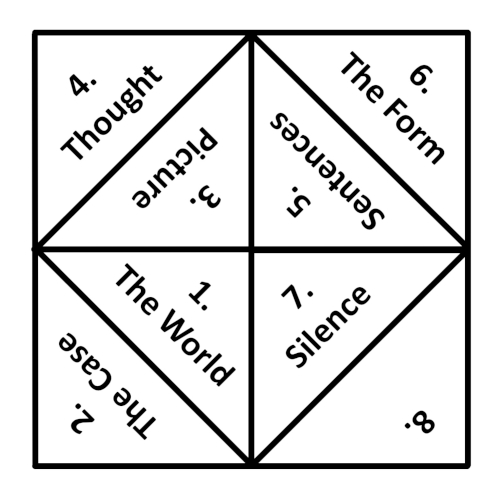
  1. The World (Die Welt): The world is everything that is the case.
  2. The Case (Der Fall): What is the case, the fact, is the existence of atomic facts.
  3. The Picture (Das Bild): The logical picture of the facts is the thought.
  4. Thought (Gedanke): The thought is the significant proposition.
  5. Propositions (Der Satz): Propositions are truth-functions of elementary propositions.
  6. The Form (Die Form): The general form of truth-function is: [p-bar, xi-bar, N(xi-bar)].
  7. Silence (Schweigen): Whereof one cannot speak, thereof one must be silent.
  8. ( ):

The Tractatus has seven propositions, most with sub-propositions and sub-sub-propositions, etc. I have added the eighth, which is the actual silence of all one cannot speak of. Quite a large section, for all its emptiness.

I also thought it would be nice to have an internet version where you could click and expand down through the sub-sentences. There are already many such versions available for your enjoyment.

I can’t decide whether I like the English or the German version better, so here are both.

Further Reading:

https://en.wikipedia.org/wiki/Tractatus_Logico-Philosophicus

http://www.bazzocchi.com/wittgenstein/tractatus/eng/index.htm

http://www.kfs.org/jonathan/witt/ten.html

https://pbellon.github.io/tractatus-tree/#/

http://daxoliver.com/tractatus/

http://people.umass.edu/klement/tlp/

The Tricky Truth about Tractatus Trees (updated)

[*11.170]

<>

Aristotle’s Four Questions of Inquiry

At the beginning of the second book of his “Posterior Analytics”, Aristotle claims that there are four questions for investigating the nature of things and their properties. The answers to these questions hopefully gives us “demonstrable” knowledge about them, or knowledge of a “scientific” nature.

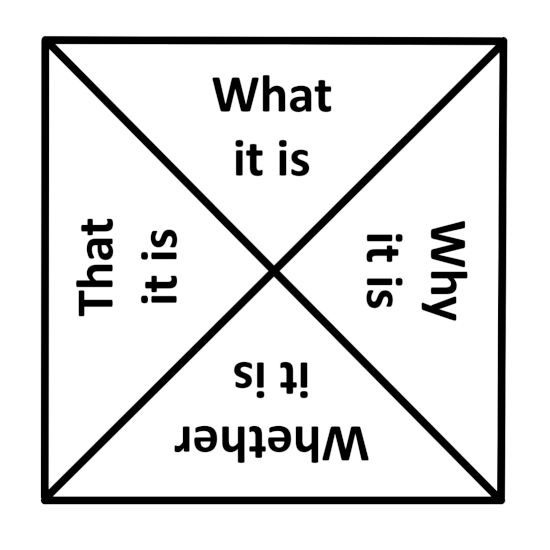
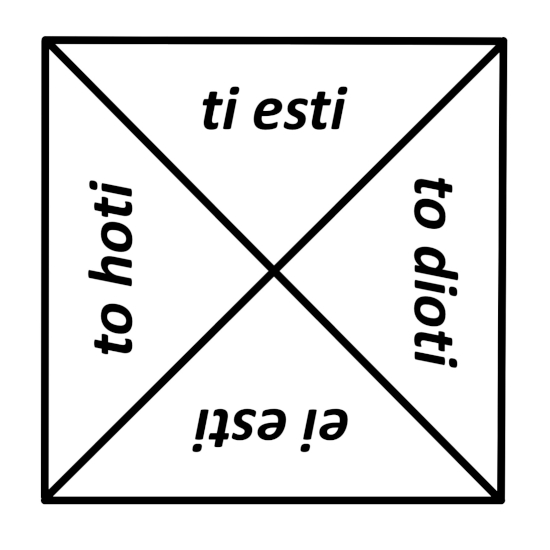
  • That it is (to hoti) : Is it a fact that a thing has a property? (Is this that?) “the question of fact” knowing-that
  • Why it is (to dioti) : Why does a thing have a property? (Why is this that?) “the question of reason or cause” knowing-why
  • Whether it is (ei esti) : Does a thing or property exist? (Does this or that exist?) “the question of if it is or of existence” knowing-if
  • What it is (ti esti) : What is the nature and meaning of a thing or property? (What is this or that?) “the question of what it is or of being or essence” knowing-what

The original terms were innovative in their ancient Greek, and even today cause some confusion in their translation and explanation (at least for this reader, so pardon the multiplicity of phrasings). It seems these questions are more about kinds or universals and not individuals or particulars, so they aren’t really about agents or locations or times (such as who, where, when).

The questions naturally fall into two sets of pairs: the first pair being between a thing and a property (binary), with the first question leading to the second question (knowing the fact comes before knowing the reason for the fact), and the second pair being just about a thing (unary), again with the first question leading to the second question (knowing the existence comes before knowing the essence).

In order to obtain a demonstration that an answer to one of the two questions to hoti or to dioti is correct, Aristotle reasoned that a “middle thing” is needed, a “link” between question and answer. Four types of cause are given, two of which borrowed from his Four Causes (Efficient and Final), and two others (those of definition and of “an antecedent that necessitates a consequent” (does this mean logical entailment or consequence?)).

Robert Sokolowski in the article cited below calls the ei esti and ti esti questions hermeneutic in comparison with the scientific questions to hoti and to dioti, and argues that each pair of questions reciprocally compliment the other, rather than one pair being dependent on the other. That is because the existence and the essence of things being sought after are indeed the “links” being sought after in the how and the why questions.

Obviously these concepts are too deep to be understood at a simplistic level, which is all I have managed so far.

Further Reading:

https://en.wikipedia.org/wiki/Posterior_Analytics

Click to access McK-Hellenistic&RomanFdnsOfAristotleInWest.pdf

Robert Sokolowski / Scientific and Hermeneutic Questions in Aristotle, Philosophy & Rhetoric, Vol. 4, No. 4 (1971), pp. 242-261
https://www.jstor.org/stable/40236788

Patrick Hugh Byrne / Analysis and Science in Aristotle

Keith Bemer / A PHILOSOPHICAL EXAMINATION OF ARISTOTLE’S HISTORIA ANIMALIUM, Thesis 2014, University of Pittsburgh
http://d-scholarship.pitt.edu/22674/

[*11.142, *11.144, *11.146, *11.163]

<>