Category Archives: fourfolds

Every Fourth Thing

What do I mean by the subtitle of this blog? If you search on Google for “every fourth thing”, after you see a few references to this blog you see mentions like: being out of something at the druggist, or saying a particular actor is appearing in a random show, or showing extra interest to a comment from a spouse, or things being requested that are forgotten by waiters, or subtexts of statements issuing from celebrities or politicians, or noting that every such organism ever discovered since the beginning of time was in fact a beetle.

So for the most part, a frequency of occurrence, like you have everything of a certain type that exists or can be named or thought about or the facts of the world in a line, and you are counting down and picking out every fourth one of them. For the usual sense of the phrase “every fourth thing”, the three things not picked are ignored because they don’t meet the condition desired, but for the sense I want, they are still “fourths” of things. They are as important as the one picked, either because they implicitly complete the wholeness in some way, or complete some other wholeness.

Or instead of the other three things passed over completing the whole, you have to count out your fourths four times, so you are looking at sixteen things but skipping twelve things to end up with four fourths. Or here is another idea, you have everything (of a certain type) in the world in a bin, and the condition of selection is that it is a fourth by its nature rather than counting it out. This is probably closer to my intention, but the ambiguity between these alternate senses is why I continue to enjoy the subtitle “every fourth thing”.

Once you’ve figured out your selection process, do any four things you select comprise a four-fold, or do only things that go together in a “special way” deserve to be called that? Do you pick with replacement, or once picked do things become unavailable for further selection? You have quite a lot of picking to do, so I would say no to replacement at first consideration; but since I do reuse fourths ad nauseam, replacement must be ok.

And one of the other amusing things that I like about “every fourth thing” is that I can pretty much talk about anything I want to with the minor condition that it has four parts to it (or some multiple of four), or that it’s four things together, or whatever. I used to be far more rigorous and selective, but now I don’t really care so much, and I’ll burden my readers with all sorts of nonsense to while away the time until the sun explodes. There’s really a never ending supply that goes on and on and on (and on).

Putting aside those questions for now, since they are evidently more complicated than my initial expectations, for this analysis I am trying to enumerate the different ways that four fourths could combine to form a unity. This list depends heavily on notions of sameness and difference. I have also discussed notions of equivalence before, but I have not returned to those considerations for a while and they may be erroneous or incomplete. But let’s soldier on and at least give it an honest try before we are exhausted by all of our doubts or side issues.
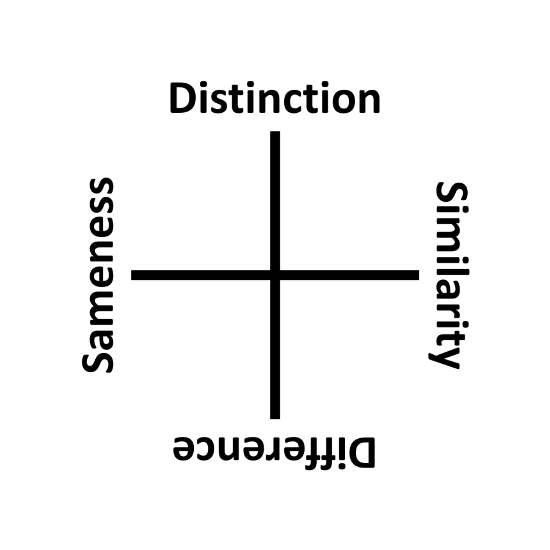
The first way that comes to mind is if each of the fourths is either identically the same thing or merely indistinguishable from each other (via replacement or being indiscernible). I’m not sure at the moment how to differentiate the two concepts so I’ll lump them together for now. Mathematically, we could represent this by the simple sum 1 + 1 + 1 + 1, or maybe the lambda expression λa.4a. For an example we could use the protons in a beryllium atom, a four leaf clover, or the sides of a square.

The second way is if each of the fourths is definitely a different thing. Then you might well ask why they are a unity and I’ll just say because I said so, that’s why! Or if I’m feeling magnanimous, I’ll try to at least give some reasons. Mathematically, we could represent this type of four-fold by a set, e.g. {a, b, c, d}, or by λa λb λc λd.a + b + c + d. As an example, a piano quartet would be nice consisting of piano, violin, viola, and cello. Also, the Four Causes, at first blush.

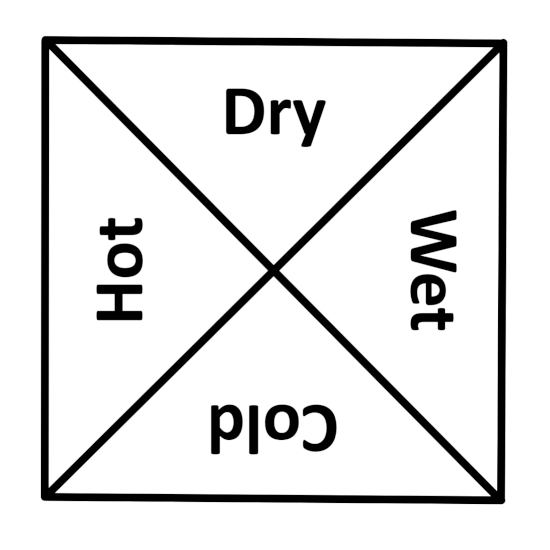
For the third way, we could consider the cross product of two sets, each having two elements, say {A, B} x {C, D}. Again, the linear expression λa λb.2a + 2b is different. And most real world examples have opposite relations like {A, ~A} x {B, ~B} (what I’ve called double duals before), so I’m having difficulty here. Maybe there are really 3 ways here that should be differentiated. Examples: the nucleus of a helium atom, Heidegger’s Four-fold, the Four Qualities, etc.
For the fourth way, let’s consider the fourths to be distinguishable, but there also is an order to them. Mathematically, how about the ordinal 4 = {0, 1, 2, 3} (but not the cardinal!). As an example, consider common time in music (4 4 time), having four quarter notes to a measure. The notes are different because of their order in the sequence, even if they are the same tone. Also the Four Seasons, except that it’s a double dual plus it has a sequence.

Now the fifth way. Mathematically: the Cartesian Plane, R x R, or the Complex Plane, C. Latitude and longitude, or maybe even North, South, East, West are examples. For every ordered pair (x,y) there is (-x, -y), (x, -y), and (-x, y). Or complex x + iy, -x – iy, x – iy, -x + iy.

Sixth. Three and one. Not the song “Three and One” by Thad Jones, even though it’s a great tune. Not the object (or is it the subject) of Trinitarianism, because that’s three IN one, and also the three are different. Ditto for three ingredient recipes. No on the yet to be released 4th Neon Genesis Evangelion movie 3.0 + 1.0, since that’s also three different things as far as I know (the first three movies). Perhaps ammonia (NH3) is an appropriate example with three hydrogens and one nitrogen . But I can’t say I’m very excited about this one, but it may be important due to my selection questions above. Now do the math: λa λb.3a + b.

Seventh. Two and one and one. λa λb λc.2a + b + c. I like this one even less, but at least it lets you see that the lambda expressions can be put into hierarchical order based on partitions of four. Perhaps the nuances of further structure can be teased out by different expressions, such as set theoretical or logical (instead of arithmetical).

Further Reading:

https://en.wikipedia.org/wiki/Axiom_of_choice

https://en.wikipedia.org/wiki/Beryllium

https://en.wikipedia.org/wiki/Piano_quartet

https://en.wikipedia.org/wiki/Time_signature#common_time

https://en.wikipedia.org/wiki/Category:Trinitarianism

[10.156, *10.190, *11.80, *11.81]

<>


Particle Man

Particle man, particle man
Doing the things a particle can
What’s he like? It’s not important
Particle man

— From “Particle Man”, by They Might Be Giants

…nothing is missing from your understanding of “Particle Man”…

— John Linnell of They Might Be Giants

In the song “Particle Man”, four “men” that are maybe super heroes are discussed:

  • Particle Man: even if something was known about this entity, except for being minute, it would seem to be of no consequence
  • Person Man: whether this individual just has low self esteem or actually deserves their belittled state is indeterminate
  • Triangle Man: hates Particle Man and Person Man for some reason, and bests each one individually in fights; a bully perhaps
  • Universe Man: might be identified with the whole of space-time itself and so may be too large or important for petty conflicts

Further Reading:

https://en.wikipedia.org/wiki/Particle_Man

https://en.wikipedia.org/wiki/They_Might_Be_Giants

https://en.wikipedia.org/wiki/Flood_(They_Might_Be_Giants_album)

[*11. 88]

<>


Neon Genesis Evangelion Reshown

Like an angel with cruel and merciless intent
Go forth, young boy, and you’ll become a legend!

— From A Cruel Angel’s Thesis, lyrics by Neko Oikawa

I’m sure all that are interested have already heard that Netflix is streaming some version of the original Neon Genesis Evangelion anime beginning 6/21/2019. This diagram shows the names of the first four pilot children from the series, ignoring possible later ones and new characters from those problematic Rebuilt movies.

Further Reading:

https://en.wikipedia.org/wiki/Neon_Genesis_Evangelion

https://www.crunchyroll.com/anime-news/2019/03/22-1/neon-genesis-evangelion-anime-makes-its-netflix-debut-on-june-21

‘A Cruel Angel’s Thesis’ took just two hours to write says Evangelion lyricist Neko Oikawa

Excellent reviews of the first few episodes (but spoilers of course!):

http://wrongeverytime.com/tag/neon-genesis-evangelion/

[*11.15]

<>

The Fourth Way

“The Fourth Way” is the title of a 1957 book by Russian esotericist P. D. Ouspensky that is supposed to be about the self-development methods of the mystic/philosopher/teacher G. I. Gurdjieff. Ouspensky was a student of Gurdjieff for a significant part of his life until there was a parting of the ways. This book was published after Ouspensky died in 1947. A substantial amount of it is constructed in questions and answers, as a teacher might answer their student’s questions.

Ouspensky’s first book in 1909 was about the fourth dimension, which was much in the public consciousness in the first few years after Einstein published his theory of special relativity. His second book was titled “Tertium Organum”, or the third canon of thought, after Aristotle’s first and Francis Bacon’s second. Ouspensky’s third book “A New Model of the Universe” continued in this way, linking science with spirituality, or at least consciousness.

What is a person or what are the aspects of a person? Is a person a machine? A physicalist thinks that a person is their body, and the mind is what the brain does. A dualist thinks that a person has a body as well as a separate mind, but we know that the mind is dependent on the body for operation and it can be diminished by injury, neglect, or abuse. There are other aspects of the person, such as the emotions or “heart”, which are somewhere between the body and the mind.

And if you search on the web, “soul” or “spirit” are often shown in images along side body, mind, and mood, but these terms are imprecise. Sometimes soul is defined as spirit, sometimes spirit as soul. It is difficult to determine what is meant by them, but they are usually of a higher-order nature than the physical or mental or emotional. It is usually what remains the same for a person, the still point of a changing self, regardless if that endures after death.

  • Body
  • Mind
  • Mood (Heart or Emotions)
  • and Spirit?
  • or Soul?
  • or Balance?

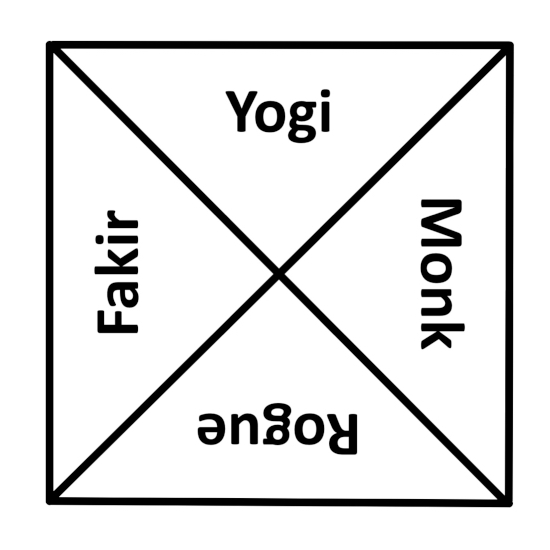
Various schools of spiritual people concentrate on the control and discipline of different aspects of the self: the physical for the Fakir, the mental for the Yogi, and emotions for the Monk. These are the first three historical ways for self-development, but they require separation from the normal social world, and neglect the other aspects of the self. The Fourth Way was said to require no extreme separation, and to develop body, mind, and mood in a balanced way.

Gurdjieff thought that most if not all people were machines because they were “asleep at the wheel” (my metaphor), the wheel being the control of their own consciousness. Similar to the practice of lucid dreaming, these teachings (also called “the work” or “the system”) purported to develop the conscious self into something much more than ordinary awareness. This aware self would have access to all sorts of abilities that remain hidden or dormant in most of us.

The Fourth Way is also said to be the way of the “sly man”, but to be sly is to be crafty, cunning, and tricky. If you are sly you are deceitful or a charlatan, dishonest and evasive, a “rogue”. You take advantage of people, or you game the social system. Are there any truth to these teachings, or were they merely a way that Gurdjieff found to make an easy living? If not, why call it the way of the “sly man”? On the other hand, who doesn’t want to develop their best selves in the most efficient and clever way?

  • Fakir: Physical
  • Yogi: Mental
  • Monk: Emotions
  • Rogue: Balance or ?

I also read that “sly man” is a translation of the French “le ruse”. The idea behind this name is for a person that takes advantage of opportunities in their normal life to development their awareness, rather than just their attitude towards others. And so it’s a posture towards the broader world, not just towards people. If I had a short word to substitute for “rogue” in the above diagram, I might do so, to prevent the negative impression I might be giving. But the term “rogue” is probably less offensive that it used to be, so I’ll keep it for now.

Yet people do love to be deceived. They love to be entertained, and they love a good story with charismatic characters. They also love to hear what they want to hear. Perhaps that’s all these teachings really were and are. And yet, many artists, writers, and thinkers have embraced the ideas of this fourth way. Certainly to enhance one’s consciousness is a positive thing to do, or to eliminate erroneous or harmful thought, or to “know thyself”. Socrates taught that “the unexamined life is not worth living”. Perhaps there is some worth to these teachings after all, but a person may have to determine this for themselves.

Further Reading:

https://en.wikipedia.org/wiki/Fourth_Way

https://en.wikipedia.org/wiki/The_Fourth_Way_(book)

https://en.wikipedia.org/wiki/George_Gurdjieff

https://en.wikipedia.org/wiki/P._D._Ouspensky

Tertium Organum online:

http://www.sacred-texts.com/eso/to/index.htm

https://en.wikipedia.org/wiki/Novum_Organum

https://en.wikipedia.org/wiki/Centers_(Fourth_Way)

https://en.wikipedia.org/wiki/Know_thyself

Some videos to entertain found by searching for “fourth way” and “sly man”:

[*10.168, *11.48]

<>


Recipe for Mathematics

Guided only by their feelings for symmetry, simplicity, and generality, and an indefinable sense of the fitness of things, creative mathematicians now, as in the past, are inspired by the art of mathematics rather than by any prospect of ultimate usefullness.

— E. T. Bell

A smile fell on the grass.
Irretrievable!

And how will your night dances
Lose themselves. In mathematics?

— Sylvia Plath, from The Night Dances

Further Reading:

https://en.wikipedia.org/wiki/Eric_Temple_Bell

https://hellopoetry.com/poem/710/the-night-dances/

https://poetrywithmathematics.blogspot.com/

[*11.14]

<>


Degen’s Eight-square Identity

Here is another identity but this time corresponding to an eight-fold: the Eight-square identity of Ferdinand Degen found about 1818. You know the drill: it states that a product of two numbers that are each the sum of eight squares is itself the sum of eight squares!

(a12 + a22 + a32 + a42 + a52 + a62 + a72 + a82)(b12 + b22 + b32 + b42 + b52 + b62 + b72 + b82) =

…The sum of the expressions in the eight triangles written in the diagram above. (Please consult the Wikipedia entry below for the textual formulas, as it’s too hard to write in HTML.)

Note that the expressions above have an interesting symmetry, aside from the one on the upper left. Indeed, Euler’s Four-square Identity has a similar simpler symmetry. There is also a connection with Octonions if you are interested in digging for it. If you are anticipating that there is such a formula for sums of sixteen squares, there is, but not a bilinear one, and it is much more complicated!

Further Reading:

https://en.wikipedia.org/wiki/Degen%27s_eight-square_identity

https://en.wikipedia.org/wiki/Pfister%27s_sixteen-square_identity

[*11.64]

<>


Euler’s Four-square Identity

Here’s a nice little math identity that mathematician Leonard Euler wrote down in a letter dated 1748. It states that the product of two numbers that are sums of four squares is itself the sum of four squares.

(a12+a22+a32+a42)(b12+b22+b32+b42) =

(a1b1-a2b2-a3b3-a4b4)2 + (a1b2+a2b1+a3b4-a4b3)2 + (a1b3+a3b1+a4b2-a2b4)2 + (a1b4+a4b1+a2b3-a3b2)2

It can be proved with elementary algebra or even by quaternions!

Further Reading:

https://en.wikipedia.org/wiki/Euler%27s_four-square_identity

[*11.62]

<>

Seven Sermons to the Dead, V2

We must, therefore, distinguish the qualities of the pleroma. The qualities are pairs of opposites, such as—

The Effective and the Ineffective.
Fullness and Emptiness.
Living and Dead.
Difference and Sameness.
Light and Darkness.
The Hot and the Cold.
Force and Matter.
Time and Space.
Good and Evil.
Beauty and Ugliness.
The One and the Many. etc.

— Carl Jung, from Seven Sermons to the Dead

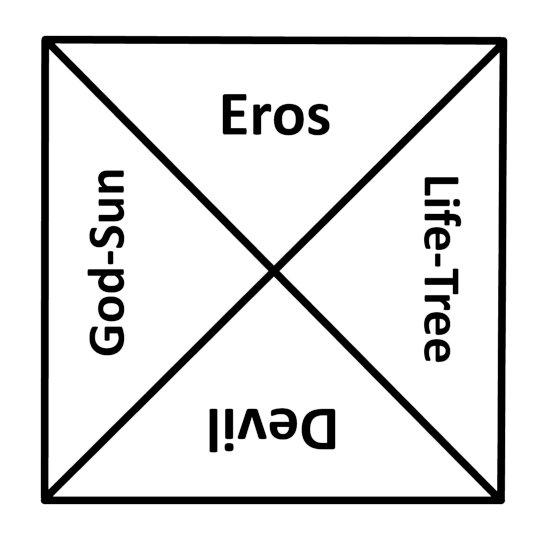
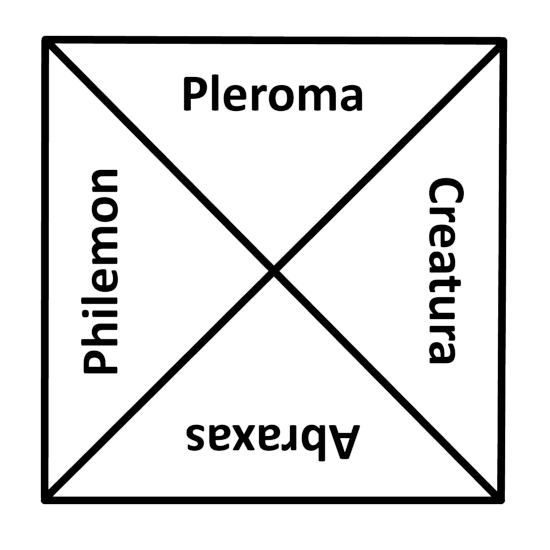
I previously mentioned two fourfolds which are perhaps better combined as an eightfold. These concepts or entities are from Carl Jung’s “Seven Sermons to the Dead”.

To the left are the “principal gods”, who are said to be in one-to-one correspondence with the “world’s measurements”. What then are these measurements? Are they the coordinates of relativistic Space-Time or something else?

  • The God-Sun: The beginning
  • Eros: Binding of two together, outspreading and brightening
  • The Tree of Life: Filling space with bodily forms
  • The Devil: The Void, opening all that is closed, dissolving all formed bodies, and destroyer of everything

And to the right we have:

  • The Pleroma: The spiritual universe as the abode of gods and of the totality of the divine powers and emanations.
  • The Creatura: The living world, subject to perceptual difference, distinction, and information
  • Abraxas: The supreme power of being transcending all divinities and demons and uniting all opposites into one
  • Philemon: Jung’s spiritual guide and the narrator, also said to be Simon Magus or Basilides

Further Reading:

http://gnosis.org/library/7Sermons.htm

https://en.wikipedia.org/wiki/Seven_Sermons_to_the_Dead

https://jungiangenealogy.weebly.com/seven-sermons.html

https://en.wikipedia.org/wiki/Tree_of_life

https://en.wikipedia.org/wiki/Pleroma

https://en.wikipedia.org/wiki/Abraxas

Who is Philemon?

Seven Sermons to the Dead

Seven Sermons to the Dead, Part 2

[*10.76, *11.49]

<>


Four Forms Make a Universe, Part 2

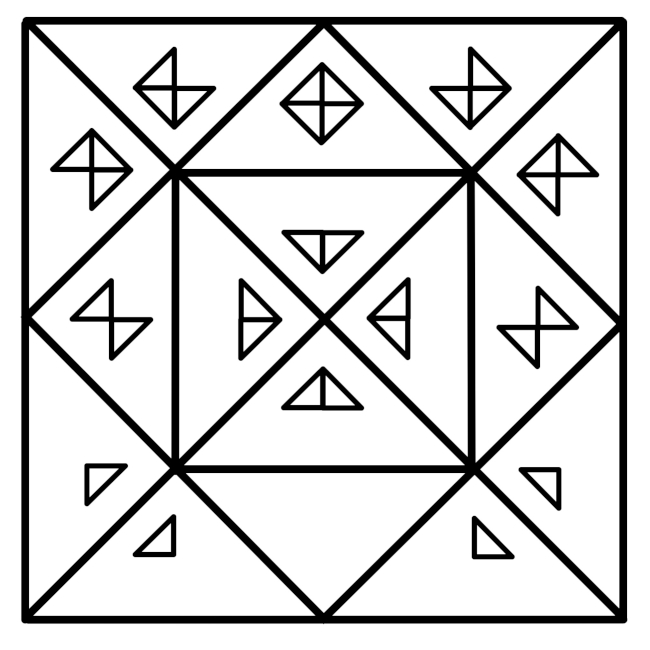
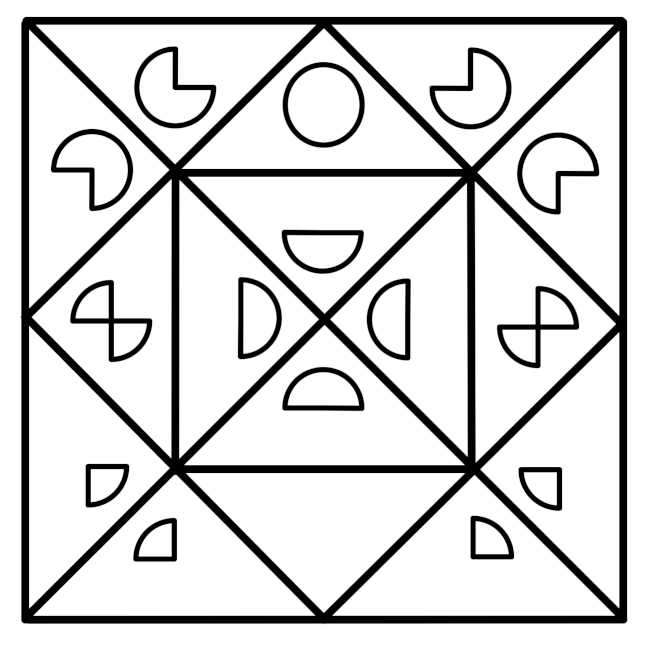
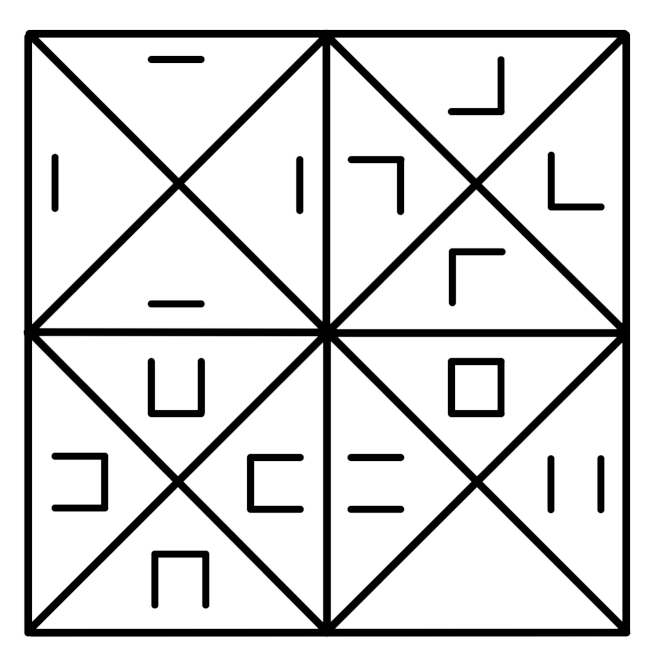
This is a continuation of my last entry. Above is a different representation of the LICO alphabet, with the letters turned 45 degrees counter-clockwise, and rearranged into a symmetric pattern. The letters seem to arise more naturally in this orientation, but then Schmeikal rotates them into his normal schema.

And to the right is a diagram of the logical expressions that correspond to the letters above.

After making these new diagrams, I became inspired and made a few other figures to share with you.

These two versions, with triangles instead of line segments, and also with borders between adjacent triangles removed:


And these two versions, with quarter circles, and also with edges between adjacent quarter circles removed:


Further Reading:

Four Forms Make a Universe

[* 11.50, *11.58]

<>


Four Forms Make a Universe

How could I not love a paper with this title? I’ve struggled with it for a bit, and I’ve only managed a couple of diagrams relating the author’s LICO (Linear Iconic) alphabet made up of 16 letters. However, I see that there are a few other papers by Schmeikal available on ResearchGate that look easier to understand. But also however, the first one says to read the “Four Forms” paper first!

At any rate, I present a sixteen-fold of the LICO alphabet, and another of the binary Boolean operators that are in a one-to-one mapping with LICO. There is much to understand from these papers, including much syncretism between various mathematical sixteen-folds, so please forgive me if I don’t explain it all with immediate ease. However, I believe it is well worth the effort to understand.

(Please note that the characters of the LICO alphabet are oriented so that the bottoms of the letters are downward, but the Boolean operators are oriented so that the bottoms of the equations are towards the right angles of the triangles.)

The title comes from the result that four elements of LICO can reproduce the other twelve via linear combinations. These four forms are 1) Boolean True (A or ~A), 2) A, 3) B, and 4) A=B. These are within the interior right-hand triangles in the LICO diagram. Of course, it is well known from Computer Science that the NAND operator (~A or ~B) can also generate all other fifteen operators, but this is by multiple nested operations instead of simple Boolean arithmetic. There are several other “universal” binary gates that can do this as well.

Two other representations that have four elements that can generate the other twelve via linear combinations come from CL(3,1), the Minkowski algebra. These representations are called “Idempotents” and  “Colorspace vectors”. Because of this algebra’s association with space and time in relativity, Schmeikal claims that LICO has ramifications in many far-ranging conceptualizations.

Further Reading:

Bernd Schmeikal / Four Forms Make a Universe, in Advances in Applied Clifford Algebras (2015), Springer Basel (DOI 10.1007/s00006-015-0551-z)

https://link.springer.com/article/10.1007/s00006-015-0551-z

At http://www.researchgate.net:

Bernd Schmeikal / Free Linear Iconic Calculus – AlgLog Part 1: Adjunction, Disconfirmation and Multiplication Tables

Bernd Schmeikal / LICO a Reflexive Domain in Space-time (AlgLog Part 3)

https://en.wikipedia.org/wiki/Spacetime_algebra

https://www.allaboutcircuits.com/technical-articles/universal-logic-gates/

[*9.145, *11.50]

<>