Category Archives: fourfolds

Four Sociological Traditions

A blurb found on the web for this 1994 book:

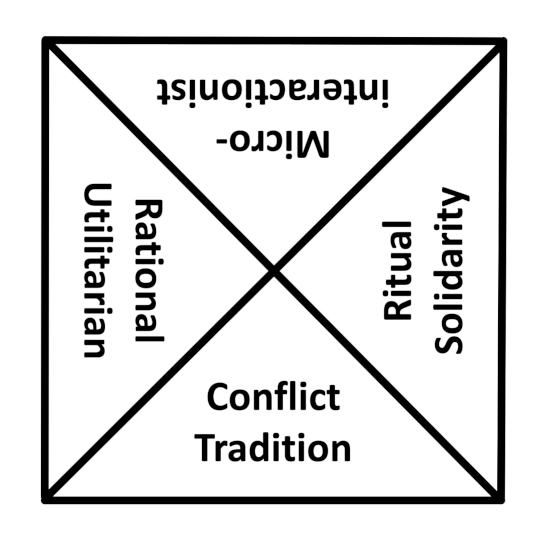
The updated version of Collins’s critically-acclaimed Three Sociological Traditions, this text presents a concise intellectual history of sociology organized around the development of four classic schools of thought: the conflict tradition of Marx and Weber, the ritual solidarity of Durkheim,the microinteractionist tradition of Mead, Blumer, and Garfinkel, and–new to this edition–the utilitarian/rational choice tradition. Collins, one of the liveliest and most exciting writers in sociology today, traces the intellectual highlights of these four main schools from classical theories to current developments, introducing the roots of sociology and indicating the areas where progress has been made in our understanding, the areas where controversy still exists, and the direction in which sociology is headed.

Further Reading:

Randall Collins / Four Sociological Traditions

https://en.wikipedia.org/wiki/Randall_Collins

The Four Requisites of Randall Collins

[*4.6, *11.110]

Continue reading Four Sociological Traditions →

Category Theory

I’ve been interested in Category Theory for a substantial number of years, but have never dedicated the time necessary to learn it properly. But it seems to me that these are great days (salad days?) for learning at least the rudiments of the subject. There are now wealths of copious materials available on-line for free for one’s self-study and enrichment, as well as new and classic treatises on Categories and their theory.

Category Theory has been called “abstract nonsense”, but while it is very abstract, it is hardly nonsense. Like set theory, it can be used to study the foundations of mathematics. Like algebra, it can be used to study generalized structure and relationships in math. Like the assortment of tools that is computer science, it can be used to study the essence of logic and computation. And like calculus, it can be used for all sorts of applied and scientific purposes.

Like all good math, Category Theory (CT) generalizes concepts that lie at the heart of many branches of mathematics. These concepts allow the mathematician to see similarities between these different branches, and carry them over into others as well. You might think “maths” is all one thing, and it is, roughly, but like science, it has evolved into a myriad of subjects and specialities. Ontologically (or perhaps even categorically), CT is listed as a topic under algebra, and it in turn has its own distinct branches.

And like all good math, CT benefits from a judicious choice of definitions and properties, that balance generality with precision to great expressive advantage. This balance between abstraction and concreteness gives it the power and utility that it has enjoyed for the better part of seventy-five years. This makes CT rather a new-comer to mathematics, but please don’t mistake youth for lack of expertise.

If I wanted to represent CT emblematically, I might suggest the diagram above. At root, a category merely consists of a collection of objects and the pairwise morphisms (or arrows) between them. But additionally, the arrows must also obey a small set of conditions, so the objects usually have a similar nature. This nature can be quite abstract though, and one of the most familiar “concrete” categories is that of sets and the functions between them.

If arrows are the mappings between objects, then “functors” are mappings between categories, that once again have to obey some rules to maintain structure. So you can think analogically that arrows are to objects as functors are to categories and you wouldn’t be too wrong. Next, you can imagine generalizing to a higher level that there are mappings between functors, and “natural transformations” are indeed defined to be so.

There are many types of entities and characters that inhabit the theory that serve to propel the plot threads along. Some turn out more important than others, but most are essential to the overarching tale. Mathematics as storytelling? What an interesting and novel concept!

Further Reading:

https://www.math3ma.com/blog/what-is-category-theory-anyway

http://rs.io/why-category-theory-matters/

https://inference-review.com/article/categories-from-zero-to-infinity

https://en.wikipedia.org/wiki/Lists_of_mathematics_topics

https://en.wikipedia.org/wiki/Outline_of_category_theory

https://en.wikipedia.org/wiki/Category_(mathematics)

https://en.wikipedia.org/wiki/Category_theory

https://plato.stanford.edu/entries/category-theory/

https://ncatlab.org/nlab/show/category+theory

https://bartoszmilewski.com/

https://www.youtube.com/user/DrBartosz/videos

Rina Zazkis, Peter Liljedahl / Teaching Mathematics as Storytelling

Why Is Category Theory a Trending Topic?

Also, these courses on applied and computational category theory:

https://ocw.mit.edu/courses/mathematics/18-s097-applied-category-theory-january-iap-2019/

http://brendanfong.com/programmingcats.html

[*6.180, *11.104]

<>

The Four Loves

The Four Loves of C. S. Lewis:

  • Storge: affection or empathy
  • Philia: friendship
  • Eros: romantic love
  • Agape: charity or unconditional love

Further Reading:

https://en.wikipedia.org/wiki/The_Four_Loves

[*11.78]

<>


The Mouse’s Tale

No apologies to Lewis Carroll.

Further Reading:

https://en.wikipedia.org/wiki/The_Mouse%27s_Tale

[* 11.100]

<>


The Tangram

Further Reading:

https://en.wikipedia.org/wiki/Tangram

A Game of Fourfolds, Part 5

Tangrams: Decomposition and Diagonals

[*11.100]

<>

The Chromatic Scale of Music

All art constantly aspires towards the condition of music.

— Walter Pater

I really don’t know much about music theory, but I know I like this chromatic “circle” with solmization center.

Also, if you count out seven triangles clockwise around the rim starting from C you get G, D, A, E, B, F#, etc., which is the Circle of Fifths for chords. (But you get that with any chromatic circle.)

And I imagine if you go counter-clockwise you get the Circle of Fourths, which is important for Jazz chords!

Further Reading:

https://en.wikipedia.org/wiki/Chromatic_scale

https://www.skytopia.com/project/scale.html

https://en.wikipedia.org/wiki/Circle_of_fifths

http://mentalfloss.com/article/53280/why-are-notes-tonal-scale-called-do-re-mi

https://en.wikipedia.org/wiki/Solmization

https://publicdomainreview.org/2019/05/16/music-of-the-squares-david-ramsay-hay-and-the-reinvention-of-pythagorean-aesthetics/

The Circle of Fifths

[*11.68, *11.69]

<>

Combogenesis: a constructive, emergent cosmos

I just finished reading Tyler Volk’s “Quarks to Culture: how we came to be”. In this book Volk outlines an interesting model for what he calls combo-genesis, a “great chain of being” leading from basic physical law up through the highest organizational structures that we know of, human societies. He traces a path through human knowledge: physics, chemistry, biology, zoology, sociology, etc., and I am reminded of E. O. Wilson’s “Consilience: the unity of knowledge” that argued for some of the same things.

But Volk’s work has some good new ideas. He details twelve hierarchical levels, where each level is constructed on a “lower” previous level, and the new “higher” level has new things and different abilities than its predecessor. These levels range from the level of fundamental quanta (the quarks of the title), to geo-political states (the culture of the title).

  • QUA: fundamental quanta
  • PRO: nucleons, which are protons and neutrons
  • NCL: atomic nuclei
  • ATM: atoms
  • MOL: molecules
  • PCL: prokaryotic cells
  • ECL: eukaryotic cells
  • ANI: multicellular organisms, including animals
  • ASG: animal social groups
  • HUM: human tribal meta-groups
  • AGR: agro-villages
  • STA: geo-political states

These levels are within three dynamical realms, the first realm being of physical laws and then those realms of biological and cultural evolution. Each of these realms has a base level that has a capability for great constructive and emergent potential via an “Alpha-kit”. An alpha-kit has two facets, an element set and a cornucopia set, that operate like an alphabet and the myriad combinations that that alphabet can produce.

Dynamical realms:

  • Realm of physical laws: QUA -> MOL
  • Realm of biological evolution PCL -> ASG
  • Realm of cultural evolution HUM -> STA

Base levels and their Alpha-kits:

  • QUA, means for chemistry and molecules (atomic)
  • PCL, mechanisms for biology and its evolution (genetic)
  • HUM, faculty for culture and its evolution (linguistic)

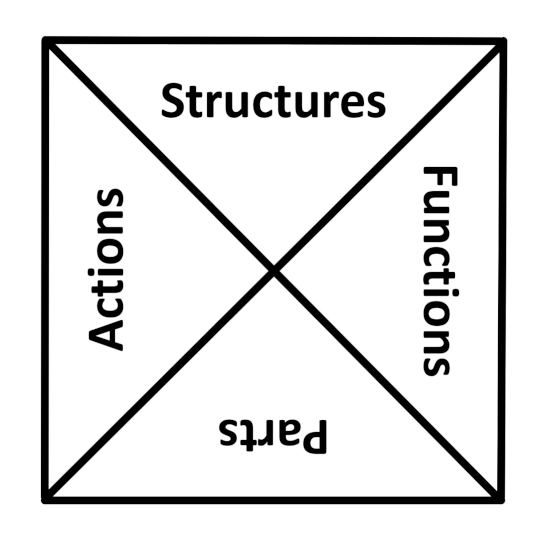
As Volk’s model has each higher level based on or constructed from the previous lower one, I make the following suggestion utilizing my four-fold Structure-Function. The structures of each lower level serve as the parts of the next higher level, and the functions of each lower level serve as the actions of the next higher level. In this way a chain of actions and parts, structures and functions are built giving different entities and capabilities to different operational domains.

In the diagram shown, the sets of structures (S) and functions (F) of level i are used for the sets of parts (P) and actions (A) of level i+1, so S(i)=>P(i+1) and F(i)=>A(i+1). Not all structural information or functional abilities are necessarily accessible in the higher level of parts and actions, similar to the information and method hiding in object-oriented programming, and so reducing overall complexity. And as I have argued before, parts are combined to create the structures and actions are combined to create the functions of each level, so P(i+1)=>S(i+1) and A(i+1)=>F(i+1). In this way we have a bottom-up combo-genesis leading from quarks to culture.

Are we now entering another dynamical realm, perhaps based on some technological or computational alpha-kit? But, unfortunately we have to ask, will it take us forwards or backwards?

Further Reading:

Tyler Volk / Quarks to Culture: how we came to be

https://en.wikipedia.org/wiki/Tyler_Volk

https://blogs.scientificamerican.com/cross-check/how-quarks-turned-into-cultures/

http://www.integralworld.net/smith56.html

http://www.integralworld.net/visser114.html

https://inquisitivebiologist.wordpress.com/2019/03/06/book-review-quarks-to-culture-how-we-came-to-be/

Tyler Volk and Robert Wright discuss:

mol-2017-09-28-wright-volk

Edward O. Wilson / Consilience: the unity of knowledge

https://en.wikipedia.org/wiki/Consilience_(book)

https://en.wikipedia.org/wiki/Consilience

[*11.98, *11.99]

<>


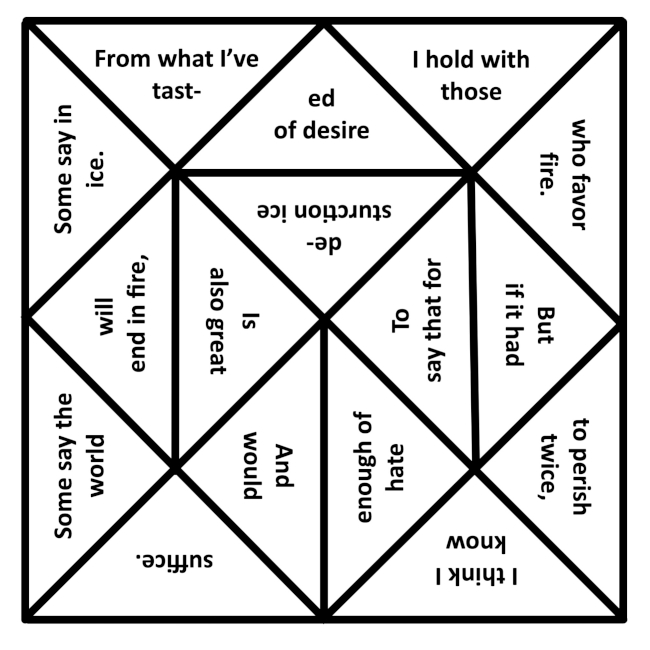
Fire and Ice

Apologies to Robert Frost.

Further Reading:

https://www.poetryfoundation.org/poems/44263/fire-and-ice

https://en.wikipedia.org/wiki/Fire_and_Ice_(poem)

[*8.128, *11.96]

<>


You Are What

Identity, simplified? Pop psychology? Truth by Google search suggestion? Go to http://www.google.com and type in “you are what you”.

Further Reading:

https://www.blog.google/products/search/how-google-autocomplete-works-search/

https://en.wikipedia.org/wiki/You_Are_What_You

[*11.82]

<>

The Hero’s Journey

Professor of Literature Joseph Campbell [1] popularized the monomyth of the “hero’s journey” [2], a recurring template for the plot arc or cycle of many heroic characters found in mythologies and even popular modern stories. From his most famous book, “The Hero with a Thousand Faces”:

A hero ventures forth from the world of common day into a region of supernatural wonder: fabulous forces are there encountered and a decisive victory is won: the hero comes back from this mysterious adventure with the power to bestow boons on his fellow man. [3]

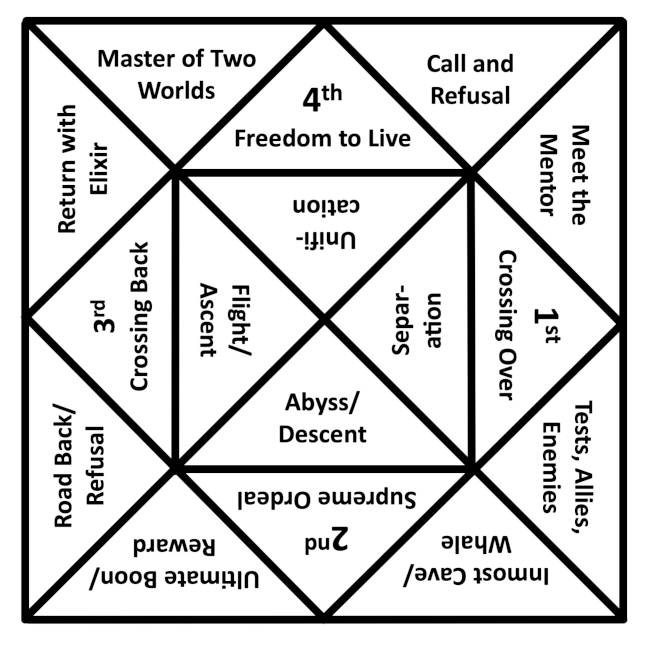
Quite a few diagrams are available showing the generic journey of the hero or heroine; some are more complete than others, and the one I present here is no exception. Campbell’s schema is said to have seventeen basic parts to it, but not all elements need to be present in any specific narrative. I list four basic “acts” (separation, descent, ascent, unification) and twelve basic events, including four thresholds: 1st) crossing into the special world, 2nd) surmounting the supreme ordeal, 3rd) returning to the normal world, and 4th) journey’s end and / or beginning.

  • Call and Refusal
  • ——–< Separation >
  • Meet the Mentor
  • Crossing Over (1st Threshold)
  • Tests, Allies, Enemies
  • ——–< Into the Abyss / Descent >
  • Inmost Cave / Whale Belly
  • Supreme Ordeal (2nd Threshold)
  • Ultimate Boon / Reward
  • ——–< Magic Flight / Ascent >
  • Road Back / Refusal
  • Crossing Back (3rd Threshold)
  • Return with Elixir / Resurrection
  • ——–< Unification >
  • Master of Two Worlds
  • Freedom to Live (or Die) (4th Threshold)

Any hero’s journey must be transformational, and so has associations with alchemical change. It must be of such difficulty that it utterly changes the nature and the mindset of the traveler. Even though many supporting characters may influence, help, and even hinder our hero, it is ultimately about their journey, their sacrifice, and their reward. But what the hero brings back with them is also key to the story, because it is for the benefit of others as well as for themselves.

An interesting dissertation by Richard Warm that I ran across recently proposes that leaders, like heroes, need ordeals and trials in order to bring back the inspiration and wisdom to motivate others. From the abstract:

This dissertation will explore leadership as a mytho-poetic transformational journey toward self-knowledge, authenticity, and ultimately wisdom; the power to make meaning and give something back to the world in which we live; and the necessity of transformation. I view leadership as a transformative process and a transformational responsibility. As leaders we must undergo our own transformation in order to lead change on a larger scale. The dissertation will be both philosophical and theoretical, exploring how the threads of the hero’s journey, transformation, wisdom, and leadership intertwine. …[4]

These ordeals may also be of an intellectual or moral kind, and not just feats of strength or stamina, although those are important too. Warm also has a company [5] for coaching you on your leadership, life, and legacy.

One of my favorite books that I think of when the hero’s journey comes to mind is “Figures of Earth: a comedy of appearances” by James Branch Cabell. It is a bit of a spoof on fantasy tropes, well before its time. However, I’m not quite sure what the “magic elixir” is that the hero returns with except for his story: that life is what you make of it, or what it appears to be to others, or what you can convince yourself that it is, or that it is what it is and must be sufficient to you in the end.

References:

[1] https://en.wikipedia.org/wiki/Joseph_Campbell

[2] https://en.wikipedia.org/wiki/Hero%27s_journey

[3] Joseph Campbell / The Hero with a Thousand Faces

[4] https://aura.antioch.edu/etds/113/

[5] https://mythoscoaching.com/

Further Reading:

https://tvtropes.org/pmwiki/pmwiki.php/Main/TheHerosJourney

http://www.movieoutline.com/articles/the-hero-journey-mythic-structure-of-joseph-campbell-monomyth.html

https://en.wikipedia.org/wiki/Figures_of_Earth

“There are one or two things that I do not fancy the looks of in this torture-chamber.”

[*6.38, *6.133, *6.149, *9.200, *11.70]

<>