The more of these moments memory can contract into one, the firmer is the hold which it gives to us on matter : so that the memory of a living being appears indeed to measure, above all, its powers of action upon things, and to be only the intellectual reverberation of this power. Let us start, then, from this energy, as from the true principle : let us suppose that the body is a centre of action, and only a centre of action. We must see what consequences thence result for perception, for memory, and for the relations between body and mind.
Perception is master of space in the exact measure in which action is master of time.
Walter Bowman Russell was an American polymath, artist, author, and philosopher who made copious contributions and claims to various fields, including spirituality, art, and metaphysics. While his work encompasses a broad range of ideas, here are four major themes that capture the essence of his philosophy:
Universal Law and Natural Order: One of Russell’s central ideas is the existence of an underlying universal law and natural order that governs all aspects of the universe. He believed that this law operates in perfect harmony, and by understanding and aligning ourselves with it, we can achieve balance and fulfillment in our lives.
Unity and Interconnectedness: Russell emphasized the interconnectedness of all things in the universe. He saw everything as part of a grand, unified whole, where all elements are interdependent and interconnected. According to his philosophy, recognizing this interconnectedness enables us to grasp the fundamental unity of all existence.
Harmonic Vibrations and Rhythmic Balance: Russell believed that the universe is fundamentally vibrational in nature, with everything composed of waves and rhythms. He emphasized the importance of achieving harmony and balance within ourselves and in our interactions with the world around us. By attuning ourselves to the harmonies and rhythms of the universe, we can lead more fulfilling and purposeful lives.
The Power of Mind and Consciousness: Russell regarded the power of the human mind and consciousness as fundamental forces in shaping our reality. He believed that our thoughts and beliefs have the ability to create and influence the world we experience. According to his philosophy, by harnessing the power of our minds and cultivating a positive and constructive consciousness, we can achieve personal and collective transformation.
These four themes offer a glimpse into the multifaceted philosophy of Russell, often presented with his signature illustrations. However, it’s worth noting that Russell’s ideas encompass a vast array of subjects, including a non-standard physics and a spiritual cosmology, all interconnected through his unique perspective and understanding of the universe. Indeed, he was perhaps the first to endorse “new age” thought.
(Thanks, ChatGPT! I didn’t have the strength to read enough to write a quick summary. You were far less skeptical than I would have been, so I made a few small edits.)
“The Fourth Way” is the title of a 1957 book by Russian esotericist P. D. Ouspensky that is supposed to be about the self-development methods of the mystic/philosopher/teacher G. I. Gurdjieff. Ouspensky was a student of Gurdjieff for a significant part of his life until there was a parting of the ways. This book was published after Ouspensky died in 1947. A substantial amount of it is constructed in questions and answers, as a teacher might answer their student’s questions.
Ouspensky’s first book in 1909 was about the fourth dimension, which was much in the public consciousness in the first few years after Einstein published his theory of special relativity. His second book was titled “Tertium Organum”, or the third canon of thought, after Aristotle’s first and Francis Bacon’s second. Ouspensky’s third book “A New Model of the Universe” continued in this way, linking science with spirituality, or at least consciousness.
What is a person or what are the aspects of a person? Is a person a machine? A physicalist thinks that a person is their body, and the mind is what the brain does. A dualist thinks that a person has a body as well as a separate mind, but we know that the mind is dependent on the body for operation and it can be diminished by injury, neglect, or abuse. There are other aspects of the person, such as the emotions or “heart”, which are somewhere between the body and the mind.
And if you search on the web, “soul” or “spirit” are often shown in images along side body, mind, and mood, but these terms are imprecise. Sometimes soul is defined as spirit, sometimes spirit as soul. It is difficult to determine what is meant by them, but they are usually of a higher-order nature than the physical or mental or emotional. It is usually what remains the same for a person, the still point of a changing self, regardless if that endures after death.
Body
Mind
Mood (Heart or Emotions)
and Spirit?
or Soul?
or Balance?
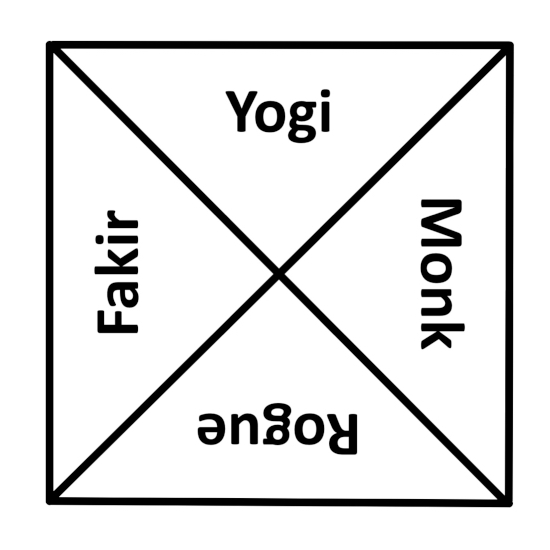
Various schools of spiritual people concentrate on the control and discipline of different aspects of the self: the physical for the Fakir, the mental for the Yogi, and emotions for the Monk. These are the first three historical ways for self-development, but they require separation from the normal social world, and neglect the other aspects of the self. The Fourth Way was said to require no extreme separation, and to develop body, mind, and mood in a balanced way.
Gurdjieff thought that most if not all people were machines because they were “asleep at the wheel” (my metaphor), the wheel being the control of their own consciousness. Similar to the practice of lucid dreaming, these teachings (also called “the work” or “the system”) purported to develop the conscious self into something much more than ordinary awareness. This aware self would have access to all sorts of abilities that remain hidden or dormant in most of us.
The Fourth Way is also said to be the way of the “sly man”, but to be sly is to be crafty, cunning, and tricky. If you are sly you are deceitful or a charlatan, dishonest and evasive, a “rogue”. You take advantage of people, or you game the social system. Are there any truth to these teachings, or were they merely a way that Gurdjieff found to make an easy living? If not, why call it the way of the “sly man”? On the other hand, who doesn’t want to develop their best selves in the most efficient and clever way?
Fakir: Physical
Yogi: Mental
Monk: Emotions
Rogue: Balance or ?
I also read that “sly man” is a translation of the French “le ruse”. The idea behind this name is for a person that takes advantage of opportunities in their normal life to development their awareness, rather than just their attitude towards others. And so it’s a posture towards the broader world, not just towards people. If I had a short word to substitute for “rogue” in the above diagram, I might do so, to prevent the negative impression I might be giving. But the term “rogue” is probably less offensive that it used to be, so I’ll keep it for now.
Yet people do love to be deceived. They love to be entertained, and they love a good story with charismatic characters. They also love to hear what they want to hear. Perhaps that’s all these teachings really were and are. And yet, many artists, writers, and thinkers have embraced the ideas of this fourth way. Certainly to enhance one’s consciousness is a positive thing to do, or to eliminate erroneous or harmful thought, or to “know thyself”. Socrates taught that “the unexamined life is not worth living”. Perhaps there is some worth to these teachings after all, but a person may have to determine this for themselves.
Timothy Leary’s dead… No, no-no, he’s outside, looking in…
— The Moody Blues
Timothy Leary came up with this scheme of eight circuits of consciousness and Robert Anton Wilson expanded and renamed most of them. It’s basically a “great-chain” of evolutionary brain circuitry, leading from lower to higher states of consciousness.
I’ve labeled my diagram with RAW’s names, but below I also list Leary’s names in parentheses.
Conscious Capitalism is a philosophy of business and also a corporation that tries to promote better social practices than ordinary (predatory) capitalism. Or perhaps it is mainly intended to make you (either as consumer or producer) think that capitalism can be kinder and gentler.
Conscious Capitalism consists of four principles:
Conscious Leadership
Higher Purpose
Conscious Culture
Stakeholder integration
John Mackey one of the authors for a book about Conscious Capitalism, and is well-known as being a co-founder of Whole Foods, the grocery store chain that Amazon bought in 2017. Mackey has been in the news over the years as being against the Affordable Care Act, anti-union, and even skeptical about human-caused climate change. I’m not sure how he stands on these issues now.
From the Conscious Capitalist Credo on their web site:
“We believe that business is good because it creates value, it is ethical because it is based on voluntary exchange, it is noble because it can elevate our existence and it is heroic because it lifts people out of poverty and creates prosperity. Free enterprise capitalism is the most powerful system for social cooperation and human progress ever conceived. It is one of the most compelling ideas we humans have ever had. But we can aspire to even more.”
So it is basically capitalism with a conscious. Don’t get me wrong, if their corporation can make a difference in the way that capitalism is usually practiced then I’m all for it. But it is likely too little, too late.
Is analogy or metaphor the root of thinking? Some thinkers think so. But what exactly is analogy?
Looking at various lists of analogies of the A:B::C:D motif, I have distilled them into four groups: Relational, Hierarchical, Linguistical, and Mathematical. Are there analogies that don’t fit this scheme?
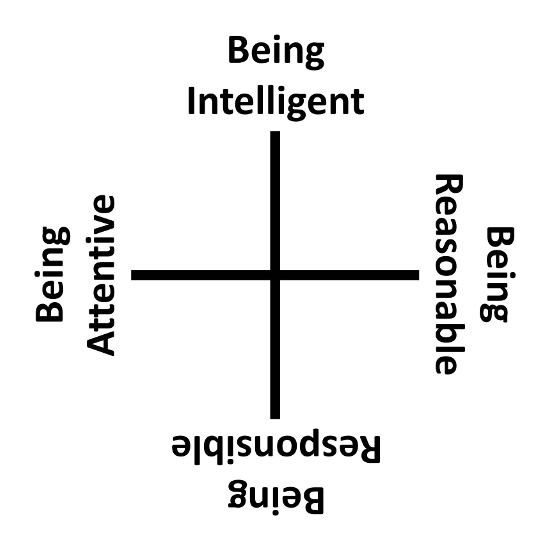
Jesuit and theologian Bernard Lonergan had a worthy goal: to generalize the successful methods of science to all facets of human inquiry. Most particularly, he sought to consider not only exterior data from sensation but interior data from consciousness. He presented four epistemological precepts of ‘being’ that transcended cultural norms, to inform all domains of human knowing and knowledge:
Being Attentive in Experience
Being Intelligent in Understanding
Being Reasonable in Judgment
Being Responsible in Deciding
In addition, his Generalized Empirical Method (GEM) had four facets, and four methodological questions:
Cognitional What do I do when I know?
Epistemological Why is doing that knowing?
Metaphysical What do I know when I do it?
Methodological What therefore should we do?
These are certainly worthy precepts, domains, facets, and questions. How well have his techniques worked? At one time, Lonergan was said to be considered by many to be one of the finest thinkers of the 20th century.
The summary of the article on Lonergan at the IEP states:
A generalized empirical method in ethics clarifies the subject’s operations regarding values. The effort relies on a personal appropriation of what occurs when making value judgments, on a discovery of innate moral norms, and on a grasp of the meaning of moral objectivity. These innate methods of moral consciousness are expressed in explanatory categories, to be used both for conceptualizing for oneself what occurs regarding value judgments and for expressing to others the actual grounds for one’s value positions.
GEM is based on a gamble that the odds of genuine moral development are best when the players lay these intellectual, moral and affective cards on the table. Concretely, this implies a duty to acknowledge the historicity of one’s moral views as well as a readiness to admit oversights in one’s self-knowledge. Moreover, given the proliferation of moral issues that affect confronting cultures with different histories today, it also implies a duty to meet the stranger in a place where this openness can occur.
Lonergan’s imperatives are also somewhat similar to Kolb’s Learning Cycle and the Scientific Method. In both of those fourfolds, observation (sensation) occurs both before (but also cyclically after) experimentation (action). Could this be because these are methods for inquiry as opposed to one of making? Some think there is no distinction, that discovery is always socially constructed anyway, but I disagree.
Why Evolution is True is a blog written by Jerry Coyne, centered on evolution and biology but also dealing with diverse topics like politics, culture, and cats.