All posts by Martin K. Jones

Human Limitations

 Everything existing in the universe is the fruit of chance and necessity.

Democritus

What are humans limited by? We are limited by time and by space.

We are limited in time because we are mortal beings, bound to the past by our birth and to the future by our death, delimiting the short interval of our lifetimes.

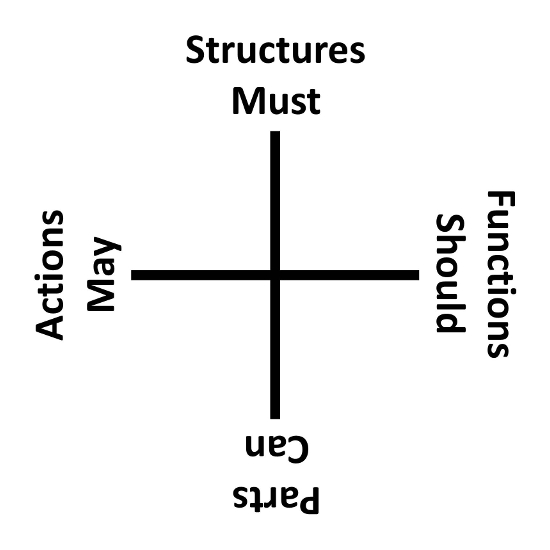
We are limited in space because we are finite beings. At each point of time we are constrained by what we are and what we might become. We are bound both by our actuality and our possibility. Our nature defines our actuality and our nurture sets our possibility.

Certainly, we can transcend our limitations, but this just means they weren’t really the true limits after all. We can’t say for certain what our real limits are, so that’s a good thing.

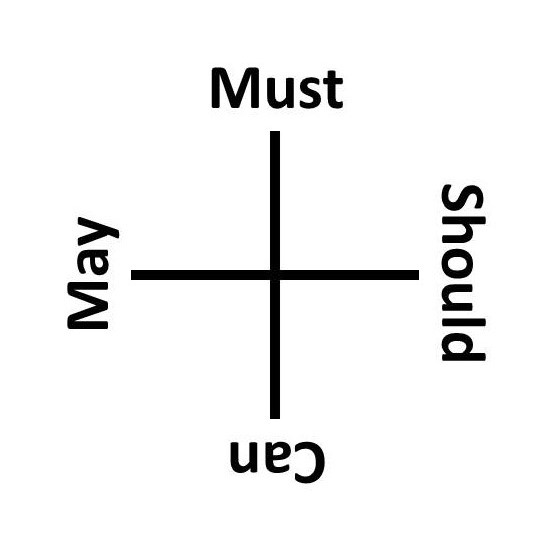
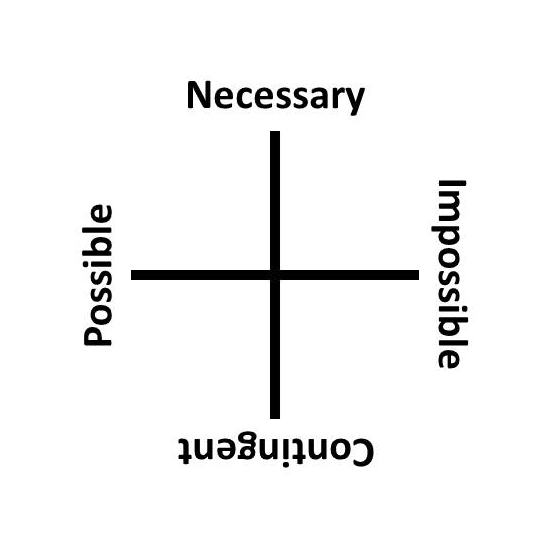
This fourfold also reminds me of the following modal square of opposition. At birth, much is possible. At death, all becomes impossible. Nurture is contingent and Nature is necessary.

References:

http://plato.stanford.edu/entries/logic-deontic/

http://en.wikipedia.org/wiki/Chance_and_Necessity

[*7.174]

<>


E. F. Schumacher’s Four Fields of Knowledge

This fourfold is created from the product of two duals: Self & World, and Inner Experience & Outer Appearance.

  • The Inner Experience of Self is Experience.
  • The Outer Appearance of Self is Behavior.
  • The Inner Experience of World is Communication.
  • The Outer Appearance of World is Science.

The first fourfold is very similar to Hjelmslev’s Net, where Content is Inner Experience, Expression is Outer Appearance, Substance is unitary “Self”, and Form is multiplicity “World”.

It is also almost identical to Ken Wilbur’s AQAL as presented here.

References:

E. F. Schumacher / A Guide for the Perplexed

http://en.wikipedia.org/wiki/A_Guide_for_the_Perplexed

http://www.integralworld.net/edwards2.html

[*7.88, *7.174, *7.176]

<>


Light and Dark: Matter and Energy

What are dark matter and dark energy? We do not know; we just know of them by their effects.

Dark matter is thought to be present in halos around galaxies since the estimated amount of matter is too small to keep the galaxies rotating at their measured rate. Dark energy is thought to be present in the empty spaces between galaxies pushing them apart because the velocities separating them are actually increasing instead of slowing down. Nobody knows what dark matter and dark energy really are, but new theories are often being suggested. Perhaps one of these theories will be tested soon and we will have a better idea of what these mysterious materials and forces are.

Could it be that dark matter and dark energy are linked by an equation, like normal “light” matter and “light” energy? For ordinary matter and energy, which are really two aspects of the same thing, it is Einstein’s famous equation: E= m*c^2. But since we have no idea what the dark stuff is, we can only conjecture.

Why should we care what these things are that are so difficult to characterize? In any scientific investigation, if we have gaps and inconsistencies in our knowledge and our theories it just bothers us to no end. We’re just not happy until we figure out the puzzle. In this case, the universe is almost completely made up of these dark parts, so it seems pretty important.

Unfortunately in my diagram the horizontal axis is light energy-dark energy, which is separating, and the vertical axis is dark matter-light matter, which is combining. In many of my fourfolds the horizontal axis is combining or conjunctive and the vertical axis is separating or disjunctive. Is the energy-matter dual more important than the conjunctive-disjunctive dual? Perhaps this fourfold doesn’t really fit but I like it anyway.

Further Reading:

http://en.wikipedia.org/wiki/Dark_matter

http://en.wikipedia.org/wiki/Dark_energy

http://science.nasa.gov/astrophysics/focus-areas/what-is-dark-energy/

Eric Chaisson / Epic of Evolution

<>


Things, Thoughts, Words, and Actions

Here are some additional fourfolds from philosopher Richard McKeon.

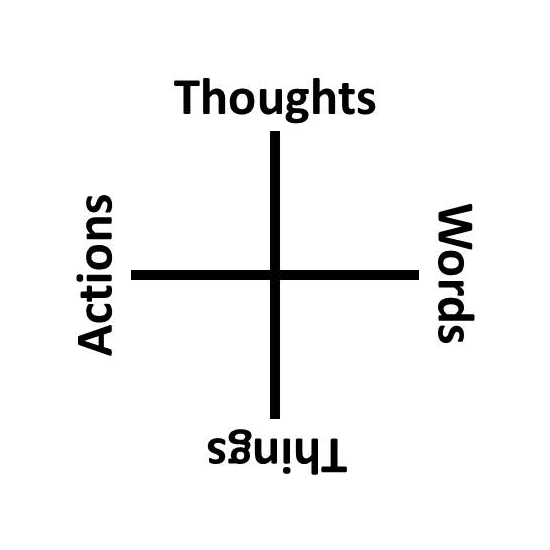
McKeon wrote much on the subject of rhetoric. A favorite fourfold of concepts was that of Things, Thoughts, Words, and Actions. He called these “commonplaces of inquiry” or “places of invention and memory”. Two rhetorical devices he used were amplification and schematization. Amplification can extend the scope of, for example, words to the other three, similar to the principle of indifference. “Objectivity is the inclusive principle of indifference by which it is recognized that being is grasped only in what we think, and say, and do about it.” [1] Schematization was used to identify and distiguish, for example, commonplaces. Thus I think amplification is a conjunctive device, and schematization is a disjunctive device.

Another fourfold of subjects by McKeon was Topics, Themes, Theses, and Hypotheses. McKeon wrote, “Speculation concerning discourse must avoid the fixities of categories, doctrines, methods, and assumptions which discourse assumes in any one form of philosophy or inquiry, if it is to include all the forms which discourse takes in philosophy and in inquiry, action, and production. This is possible because the variety of categories or elements is approached in discourse by way of common topics or ‘commonplaces’; the variety of facts or statements of what is the case by way of common hypotheses; the variety of arts or methods of treating problems by way of common themes; and the variety of assumptions or principles by way of common theses.” [2]

Are both these fourfolds aligned correctly with the previous Knowable, Knowledge, Known, and Knower? McKeon’s use of terms in his rhetoric was very fluid, perhaps to prevent systemization or to promote pluralism. However, his main reference to fourfolds was Aristotle’s four scientific questions, or Four Causes, which we can use to try to understand his fourfolds.

References:

Theresa Enos (ed.) / Encyclopedia of Rhetoric and Composition: Communication from Ancient Times to the Information Age

[1] Richard McKeon / Selected Writings of Richard McKeon: Volume One: Philosophy, Science, and Culture

[2] Richard McKeon / Selected Writings of Richard McKeon, Volume Two: Culture, Education, and the Arts

Click to access McKNotes-Semantics&Inquiry_Intro.pdf

H. L. Ulman / Things, Thoughts, Words, and Actions: the problem of language in late Eighteenth-Century British rhetorical theory

[*5.197, *6.140, *7.162, *7.165]

<>
 

The Four Laws of Thermodynamics

0th Law: Heat doesn’t flow between objects of the same temperature.

1st Law: Heat cannot be created or destroyed.

2nd Law: Entropy increases by the flow of heat in a closed system not in equilibrium.

3rd Law: Entropy approaches a constant minimum in a system as temperature approaches absolute zero.

Further Reading:

http://www.physicsforidiots.com/thermodynamics.html

http://en.wikipedia.org/wiki/Laws_of_thermodynamics

Peter Atkins / Four Laws That Drive the Universe

[*3.169, *7.164]

<>


The Stone Gamut

Our thesis is that the category Set is the ultimate abstraction of body, and that Set^op, equivalent to the category of complete atomic Boolean algebras (i.e. power sets), which we shall advocate thinking of as antisets, is dually the ultimate abstraction of mind.

— From Chu Spaces: automata with quantum aspects by Vaughan Pratt

Reflecting an era of reduced expectations for the superiority of humans, we have implemented causal interaction not with the pineal gland but with machinery freely available to all classical entities, whether newt, pet rock, electron, or theorem (but not quantum mechanical wavefunction, which is sibling to if not an actual instance of our machinery).

— From Rational Mechanics and Natural Mathematics by Vaughan Pratt

http://en.wikipedia.org/wiki/Boolean_algebra

http://en.wikipedia.org/wiki/Distributive_lattice

http://en.wikipedia.org/wiki/Vector_space

http://en.wikipedia.org/wiki/Partially_ordered_set

http://en.wikipedia.org/wiki/Set_%28mathematics%29

References:

Click to access ph94.pdf

Click to access ratmech.pdf

http://chu.stanford.edu/

http://en.wikipedia.org/wiki/Chu_space

Vaughan Pratt / The Stone Gamut: a coordinatization of mathematics

https://ieeexplore.ieee.org/document/523278

[*7.140]

<>

The Archic Philosophers

In a word, the Sophist begins from man, the Democritean from matter, the Platonist from form, and the Aristotelian from functioning.

— From The Architectonics of Meaning, by Walter Watson

Inspired by philosopher Richard McKeon, I believe that philosophy as a whole is encompassed by four main philosophical stances, exemplified by four ancient philosophers: the Sophists (as a group), Democritus, Plato, and Aristotle. Their four systems of thought lay out principal philosophical directions, much like the compass directions east, south, north, and west lay out a complete set of primary directions.

Of course the compass directions can be subdivided into north-east, or south-south-west, and so on, and similarly each of these philosophical systems can be divided into four parts. This division into a four-by-four matrix is called the Archic Matrix and was written about at length in the separate but complementary works of Walter Watson and David Dilworth.

Watson and Dilworth described the four main philosophical directions to be perspective, reality, method, and principle: perspective for the Sophists, reality for Democritus, method for Plato, and principle for Aristotle. I have written about these philosophical perspectives previously in several ways.

Thus philosophy as a practice goes around and around and revisits the same ideas over and over. Perhaps McKeon thought his philosophical system followed in the footsteps of Aristotle, and probably Watson and Dilworth had a similar view.

Likewise, I believe that my fourfold of Structure-Function represents these four philosophical directions in the following way: Action(s) for the Sophists, Part(s) for Democritus, Structure for Plato, and Function for Aristotle.

[*6.108]
<>


The Duality of Time and Information, V2

The states of a computing system bear information and change time, while its events bear time and change information.

from The Duality of Time and Information by Vaughan Pratt

The most promising transformational logic seems to us to be Girard’s linear logic.

— from Rational Mechanics and Natural Mathematics by Vaughan Pratt

Here we have three duals: information – time, state – event, and bear – change.

References:

Vaughan Pratt / The Duality of Time and Information http://boole.stanford.edu/pub/dti.pdf

Vaughan Pratt / Time and Information in Sequential and Concurrent Computation http://boole.stanford.edu/pub/tppp.pdf

Vaughan Pratt / Rational Mechanics and Natural Mathematics http://chu.stanford.edu/guide.html#ratmech

[*5.170]

<>

Wheel of Fortuna

O Fortune, like the moon you are changable,
ever waxing and waning, hateful life,
first oppresses and then soothes as fancy takes it;
poverty and power it melts them like ice.

— From Carmina Burana

References:

http://en.wikipedia.org/wiki/Carmina_Burana

http://en.wikipedia.org/wiki/Carmina_Burana_%28Orff%29

http://en.wikipedia.org/wiki/Rota_Fortunae

http://quadriformisratio.wordpress.com/2013/07/01/the-rule-of-four/

[*7.156]

<>

Falls the Shadow

Between the idea
And the reality
Between the motion
And the act
Falls the Shadow

— From “The Hollow Men” by T. S. Eliot

References:

http://en.wikipedia.org/wiki/The_Hollow_Men

https://allpoetry.com/the-hollow-men

[*7.158]

<>