All posts by Martin K. Jones

Childhood’s End

sq_childhoods_end“No utopia can ever give satisfaction to everyone, all the time. As their material conditions improve, men raise their sights and become discontented with power and possessions that once would have seemed beyond their wildest dreams. And even when the external world has granted all it can, there still remain the searchings of the mind and the longings of the heart.”

― Arthur C. Clarke, Childhood’s End

References:

https://www.goodreads.com/work/quotes/209414-childhood-s-end

[*9.86]

<>

The Four Idols of Francis Bacon

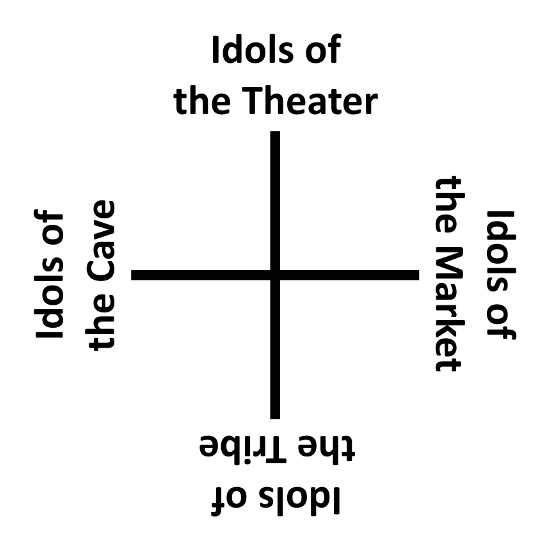
sq_four_idols2As a counterpoint to my previous post (and perhaps most of my previous posts) I present the following from Francis Bacon’s Novum Organum:

Idols of the Tribe
Errors in the mind of the group
Beliefs because most people have them

Idols of the Cave
Errors in the mind of the individual
Beliefs due to limited experience

Idols of the Marketplace
Errors in the use of words
Beliefs due to misuse of words

Idols of the Theater
Errors in false learning
Beliefs colored by religion and personal philosophy

References:

http://www.sirbacon.org/links/4idols.htm

http://www.iep.utm.edu/bacon/#SH2j

http://plato.stanford.edu/entries/francis-bacon/#Ido

[*9.84]

<>

The Four Transcendental Imperatives of Bernard Lonergan

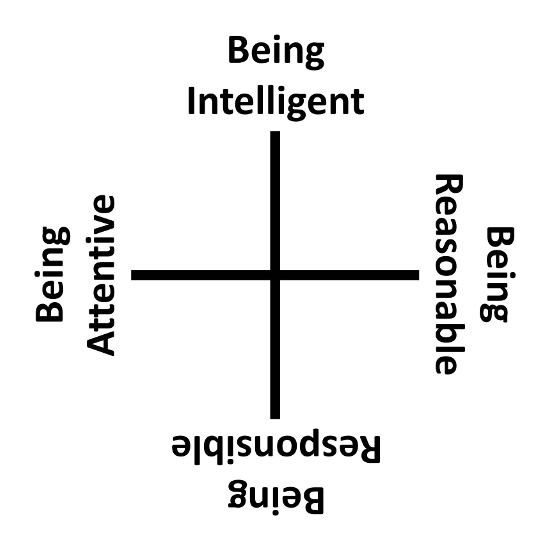
sq_lonerganJesuit and theologian Bernard Lonergan had a worthy goal: to generalize the successful methods of science to all facets of human inquiry. Most particularly, he sought to consider not only exterior data from sensation but interior data from consciousness. He presented four epistemological precepts of ‘being’ that transcended cultural norms, to inform all domains of human knowing and knowledge:

Being Attentive
in Experience

Being Intelligent
in Understanding

Being Reasonable
in Judgment

Being Responsible
in Deciding

In addition, his Generalized Empirical Method (GEM) had four facets, and four methodological questions:

Cognitional
What do I do when I know?

Epistemological
Why is doing that knowing?

Metaphysical
What do I know when I do it?

Methodological
What therefore should we do?

These are certainly worthy precepts, domains, facets, and questions. How well have his techniques worked? At one time, Lonergan was said to be considered by many to be one of the finest thinkers of the 20th century.

The summary of the article on Lonergan at the IEP states:

A generalized empirical method in ethics clarifies the subject’s operations regarding values. The effort relies on a personal appropriation of what occurs when making value judgments, on a discovery of innate moral norms, and on a grasp of the meaning of moral objectivity. These innate methods of moral consciousness are expressed in explanatory categories, to be used both for conceptualizing for oneself what occurs regarding value judgments and for expressing to others the actual grounds for one’s value positions.

GEM is based on a gamble that the odds of genuine moral development are best when the players lay these intellectual, moral and affective cards on the table. Concretely, this implies a duty to acknowledge the historicity of one’s moral views as well as a readiness to admit oversights in one’s self-knowledge. Moreover, given the proliferation of moral issues that affect confronting cultures with different histories today, it also implies a duty to meet the stranger in a place where this openness can occur.

Lonergan’s imperatives are also somewhat similar to Kolb’s Learning Cycle and the Scientific Method. In both of those fourfolds, observation (sensation) occurs both before (but also cyclically after) experimentation (action). Could this be because these are methods for inquiry as opposed to one of making? Some think there is no distinction, that discovery is always socially constructed anyway, but I disagree.

References:

https://en.wikipedia.org/wiki/Bernard_Lonergan

Lonergan, Bernard

http://tipphilosophy.weebly.com/heaps-essay.html

http://www.metanexus.net/essay/learning-be-reflections-bernard-lonergans-transcendental-philosophy-education-towards-integral

https://en.wikipedia.org/wiki/Being

http://www.bernardlonergan.com/

Notes:

A good discussion and comparison of learning and inquiry at the Tetrast:

http://tetrast2.blogspot.com/2013/04/methods-of-learning.html

Books:

Bernard Lonergan / Insight: A Study of Human Understanding

Bernard Lonergen / Method in Theology

[*3.122, *3.124, *9.70, *9.72]

<>


Four Transformations of Chu Spaces

sq_four_transformationsCan mathematics help us reformulate Cartesian Dualism? I have previously tried to diagram some of computer scientist Vaughan Pratt’s notions, such as a Duality of Time and Information and the Stone Gamut. Another recent attempt is the diagram above of four transformations that issue out of his analysis of Chu Spaces. Pratt’s conceptualization of these generalized topological spaces led him to propose a mathematization of mind and body dualism.

The duality of time and information was actually an interplay of several dualities, such as the aforementioned time and information, plus states and events, and changing and bearing (or dynamic and static). The philosophical mathematization in his paper “Rational Mechanics and Natural Mathematics” leads to additional but somewhat different dualities, shown in the following table:

Mind Body
Mental Physical
States Events
Anti-functions Functions
Anti-sets Sets
Operational Denotational
Infers Impresses
Logical Causal
Against time With time
Menu Object
Contingent Necessary

Pratt reveals two transformations that are “mental”: delete and copy, and two that are “physical”: adjoin and identify.

These four transformations are functions and their converses which:

  • Identify when the function is not injective.
  • Adjoin when the function is not surjective.
  • Copy when the converse is not injective.
  • Delete when the converse is not surjective.

Ordinarily we think of mind and body as being radically different in kind, but perhaps they are the same but merely viewed from a different perspective or direction. Recall what Heraclitus says, “the road up and the road down are the same thing”.

References:

https://en.wikipedia.org/wiki/Dualism_%28philosophy_of_mind%29

Click to access ratmech.pdf

http://chu.stanford.edu/

http://en.wikipedia.org/wiki/Chu_space

[*6.74, *6.75, *9.76]

<>

The Day the Earth Stood Still

sq_day_the_earth_stood_still3“I am leaving soon, and you will forgive me if I speak bluntly. The universe grows smaller every day, and the threat of aggression by any group, anywhere, can no longer be tolerated. There must be security for all, or no one is secure. Now, this does not mean giving up any freedom, except the freedom to act irresponsibly. Your ancestors knew this when they made laws to govern themselves and hired policemen to enforce them. We, of the other planets, have long accepted this principle. We have an organization for the mutual protection of all planets and for the complete elimination of aggression. The test of any such higher authority is, of course, the police force that supports it. For our policemen, we created a race of robots. Their function is to patrol the planets in spaceships like this one and preserve the peace. In matters of aggression, we have given them absolute power over us. This power cannot be revoked. At the first sign of violence, they act automatically against the aggressor. The penalty for provoking their action is too terrible to risk. The result is, we live in peace, without arms or armies, secure in the knowledge that we are free from aggression and war. Free to pursue more… profitable enterprises. Now, we do not pretend to have achieved perfection, but we do have a system, and it works. I came here to give you these facts. It is no concern of ours how you run your own planet, but if you threaten to extend your violence, this Earth of yours will be reduced to a burned-out cinder. Your choice is simple: join us and live in peace, or pursue your present course and face obliteration. We shall be waiting for your answer. The decision rests with you.”

— Klaatu’s closing words

“Gort! Klaatu barada nikto!”

— Helen Benson

I, for one, welcome our new X overlords!

References:

http://www.imdb.com/title/tt0043456/quotes

https://en.wikipedia.org/wiki/The_Day_the_Earth_Stood_Still

https://en.wikipedia.org/wiki/Farewell_to_the_Master

[*9.78]

<>

The Four Requisites of Randall Collins

sq_four_requisites2“Everything in the human world has four aspects” states sociologist Randall Collins, and I couldn’t agree more. For his view of sociology, these four aspects are the Social, the Political, the Cultural, and the Economic.

These four requisites are adapted from Talcott Parsons, who was Collins’ undergraduate teacher. Parsons’ four requisites were named differently, and together they are known as the “AGIL” model. “A” stood for Adaptation, “G” for Goal-attainment, “I” for Integration, and “L” for Latency. It was also called the Structural-Functional model of society. Besides the change in names, Collins also says that the functionalism inherent in Parsons’ model has been downplayed in his because a biological, functional approach cannot model conflict, which is pervasive in human interaction.

Collins wrote a book on the historical “sociology” of philosophies, “The Sociology of Philosophies”. This book was the reason I first noted Collins, but I haven’t studied the book in any detail to note if any fourness falls out of the analysis. This kind of historical and organizational model of philosophy seems to be popular, and several others have attempted to compile something similar.

Collins also wrote “Four Sociological Traditions”, a history of sociology organized around the development of four classic schools of thought: the conflict tradition of Marx and Weber, the ritual solidarity of Durkheim, the microinteractionist tradition of Mead, Blumer, and Garfinkel, and the utilitarian/rational choice tradition. This book was the second reason I noted Collins, but not having read the book, I wasn’t sure how to interpret these four schools as a four-fold.

References:

http://sociological-eye.blogspot.com/2015/07/four-requisites-for-success-or-failure.html

https://en.wikipedia.org/wiki/Randall_Collins

https://en.wikipedia.org/wiki/Talcott_Parsons

Books by Randall Collins:

Four Sociological Traditions

The Sociology of Philosophies : a global theory of intellectual change

Philosophical Family Trees:

http://www.philosophyforlife.org/the-kevin-bacon-history-of-philosophy/

http://kevinscharp.com/Kevin%20Scharp%20-%20%20Diagrams.htm

http://www.designandanalytics.com/visualizing-the-history-of-philosophy-as-a-social-network-the-problem-with-hegel

[*3.79, *4.6, *4.7, *9.7, *9.68, *9.71]

<>


The Four Cardinal Virtues

sq_four_virtuesI shall begin with the assumption that a perfect state is one that is rightly ordered, and is therefore wise, brave, temperate and just.

— Plato, from The Republic

From Wikipedia:

The Cardinal virtues are a quartet set of virtues recognized in the writings of Classical Antiquity and, along with the theological virtues, also in Christian tradition. They are comprised of the following qualities:

    • Prudence: also described as wisdom, the ability to judge between actions with regard to appropriate actions at a given time.
    • Justice: also considered as fairness, the most extensive and most important virtue.
    • Restraint: also known as temperance, the practice of self-control, abstention, and moderation tempering the appetition.
    • Courage: also named fortitude, forbearance, strength, endurance, and the ability to confront fear, uncertainty, and intimidation.

References:

https://en.wikipedia.org/wiki/Cardinal_virtues

Images of Four Cardinal Virtues

Also see:

https://equivalentexchange.wordpress.com/2015/01/25/off-to-see-the-wizard/

[*7.146]

<>


The Johari Window

sq_johari_window

As I considered my last post, I wondered if the intersecting centers of all my diagrams represented a “blind spot”, a fifth thing that I have been consistently overlooking. Searching on Google for the topic (besides finding the new television show of the same name), I stumbled on the Johari Window.

The Johari Window is a simple four-fold table that considers what an individual knows and doesn’t know about herself, versus what everyone else knows or doesn’t know.

So, the quadrants are as follows:

Hidden self: Known by self but unknown by others (also called facade)

Public self: Known by self and known by others (also called open or free area, or arena)

Blind self: Unknown by self but known by others (also called blind spot)

Unknown self: Unknown by self and others (unknown but perhaps knowable, also unconscious)

The idea is that the public self can enlarge, and include things from all three of the other selves, and so diminish them. Because having more openness in our selves, as well as less hiddenness, blind-spotness, and unknownness, is a good thing.

And I’m glad the blind spot is really just one of the four things of the Johari Window, so I haven’t left anything out!

References:

https://en.wikipedia.org/wiki/Johari_window

Images for Johari Window

Notes:

Also remember “The Blind Spot: lectures on logic” by Jean-Yves Girard.

[*9.58]

<>

The Brain with David Eagleman

sq_whowhatSpeaking of brains, “The Brain with David Eagleman” by neuroscientist and author David Eagleman is currently showing on PBS. The first episode “What is reality?” was pretty good, showing reasons why what we think of as an objective reality is really just a temporally delayed and conceptually constructed neurological fabrication.

The six episodes are titled:

  1. What is reality?
  2. What makes me?
  3. Who is in control?
  4. How do I decide?
  5. Why do I need you?
  6. Who will we be?

I wonder if the answers to these questions will pretty much be “the brain, the brain, the brain…”. Check your local listings and tune in to find out!

Books:

David Eagleman / The Brain: the story of you

David Eagleman / Incognito: the secret lives of the brain

David Eagleman / Sum: forty tales from the afterlife

David Eagleman / Why the Net Matters: six easy ways to avert the collapse of civilization

References:

Home

https://en.wikipedia.org/wiki/David_Eagleman

[*9.56, *9.57]

<>

The Whole Brain Model of Ned Herrmann

sq_herrmann_brain

Are four different kinds of thinking performed in four distinct areas of the brain?

  • Facts: logical, analytical, fact based, quantitative (left cerebral)
  • Forms: sequential, organized, detailed, planned (left limbic)
  • Feelings: interpersonal, feeling based, kinesthetic, emotional (right limbic)
  • Futures: holistic, intuitive, integrating, synthesizing (right cerebral)

I’ve arranged the quadrants differently than usual. Some might want to see the diagram rotated 180 degrees, so that Facts are at the top. However, there are several reasons that I prefer this arrangement, with organized at top, synthesizing at right, kinesthetic at left, and quantitative at bottom. Part of my confusion is that I ordinarily want to place both Facts and Forms at top, and Feelings and Futures at right.

References:

Ned Herrmann / The Creative Brain

Ned Herrmann / The Whole Brain Business Book

https://en.wikipedia.org/wiki/Herrmann_Brain_Dominance_Instrument

https://www.thinkherrmann.com/

Facts, Form, Feelings and Future in Museum Guiding

Notes:

Images of Whole Brain Herrmann.

The images above remind one of the “Simon Says” toy! Blue, red, green, and yellow are often used in company logos. Three are pigment primary colors, and three are light primary colors. Do colors help one distinguish the quadrants?

Also see the following post, “A Story for Everyone”:

https://equivalentexchange.wordpress.com/2011/06/09/a-story-for-everyone/sq_whowhat

(Where my Who, How, Why, and What are arranged appropriately as Feelings, Forms, Futures, and Facts.)

[*6.120, *6.121, *8.92, *8.139]

<>