All posts by Martin K. Jones

The Eight Auspicious Symbols

Pause only for a moment to contemplate Ashtamangala, or the Eight Auspicious Symbols of Buddhism:

  • The Endless Knot
  • The Treasure Vase
  • The Lotus Flower
  • Two Golden Fish
  • The Fancy Parasol
  • The Conch Shell
  • The Victory Banner
  • The Dharma Wheel

Further Reading:

https://en.wikipedia.org/wiki/Ashtamangala

http://www.buddhanet.net/e-learning/history/b8symbol.htm

https://www.nwrafting.com/international/whitewater-rafters-guide-8-auspicious-symbols-buddhism

[*12.14]

<>

The Book of the New Sun

Gene Wolfe’s “Book of the New Sun” tetralogy is said to be rife with alchemical symbolism. I have not read it yet, although it has been on my to-read stack for years. Nonetheless, here is a diagram for you, partly because it’s an easy post, but also for me, so that I can add interesting links as I might find them.

  • The Shadow of the Torturer
  • The Claw of the Conciliator
  • The Sword of the Lictor
  • The Citadel of the Autarch

Of course, there are a few other tetralogies that exist, although they are not as common as trilogies. One already mentioned on this blog is the Aeygpt Tetralogy by John Crowley.

Further Reading:

https://en.wikipedia.org/wiki/The_Book_of_the_New_Sun

https://en.wikipedia.org/wiki/Tetralogy

An Analysis Of The Alchemical Tradition Behind BOOK OF THE NEW SUN, Part I: Urth, Ushas, And Unus Mundus

An Analysis Of The Alchemical Tradition Behind BOOK OF THE NEW SUN, Part II: The Solve et Coagula of Terminus Est

An Analysis Of The Alchemical Tradition Behind BOOK OF THE NEW SUN, Part III: The Piteous Gate and A Dark Albedo

An Analysis of the Alchemical Tradition Behind BOOK OF THE NEW SUN, Part IV: Hethor, Typhon and the Temptation of Severian

An Analysis of the Alchemical Tradition Behind BOOK OF THE NEW SUN, Part V: The Aestivation Hypothesis and the Hierodules

An Analysis of the Alchemical Tradition Behind BOOK OF THE NEW SUN, Part VI: Tzadkiel and the Mystery of Yesod

<>

Four Valued Logic

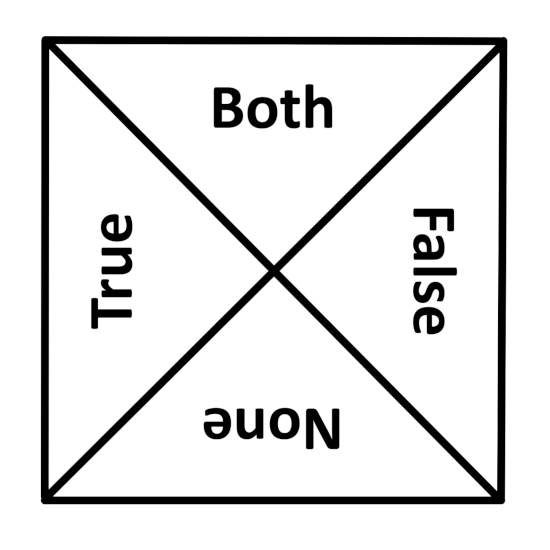
Logic is not as absolute as we would like it to be. For example, linear logic breaks down normal logic into a realm of substructurality. There seems to be several ways to consider expanding classical two-valued logic to four values.

Let this post be a placeholder for considering expansion of classical two-valued logic to four values. For example, one might have:

  • True
  • False
  • Both
  • None

Further Reading:

https://en.wikipedia.org/wiki/Four-valued_logic

J. Michael Dunn / Two, Three, Four, Infinity: The Path to the Four-Valued Logic and Beyond
https://link.springer.com/chapter/10.1007/978-3-030-31136-0_6

Katalin Bimbo & J. Michael Dunn / Four-valued Logic
https://projecteuclid.org/euclid.ndjfl/1063372199

J. Ulisses Ferreira / A Four-Valued Logic
https://doi.org/10.5121%2Fcsit.2017.71206

[*12.6]

<>

Schopenhauer’s Four Laws of Thought

The first three of Arthur Schopenhauer’s Four Laws of Thought are pretty much the same as the classical three laws of thought. Schopenhauer added a fourth law that was basically for his Principle of Sufficient Reason.

  • Identity
  • Non-contradiction
  • Excluded middle
  • Sufficient reason

These Four Laws are often given in two flavors: the first, in fairly concrete terms of subjects and predicates, and the second, more glib in terms of existence and being and such (isness).

  • A subject is equal to the sum of its predicates. Everything that is, exists. (Identity)
  • No predicate can be simultaneously attributed and denied to a subject. Nothing can simultaneously be and not be. (Non-contradiction)
  • Of every two contradictorily opposite predicates one must belong to every subject. Each and every thing either is or is not. (Excluded middle)
  • Truth is the reference of a judgment to something outside it as its sufficient reason or ground. Of everything that is, it can be found why it is. (Sufficient reason)

The phrase ‘it can be found’ sounds like a constructive method rather than a mere existence proof, but the common theological technique that combines both by saying “everything happens for a reason” avers the reason to an ineffable deity. (I bet Schopenhauer would have disliked this view because from what I understand he was an atheist.)

Moving on, I would like to represent these four laws in even more concrete terms of logical expressions. In the following attempt, let a, b be subjects (or objects), and P, Q be predicates (or qualities):

  • ∀a (a ≡ ∀P P(a))
  • ∀a ¬∃P (P(a) ∧ ¬P(a))
  • ∀a ∀P (P(a) ∨ ¬P(a))
  • ∀a ∃b (b → a)

When detailed in this way, these four laws don’t seem very complete, or don’t quite form a unity, as implication and equivalence are each in only one of them. Even though it doesn’t help that criticism, perhaps one can succinctly say:

  • Things can be reduced to (all) their qualities.
  • Qualities are disjoint from their opposites.
  • Qualities and their opposites are sufficient.
  • Things are entailed by some thing (possibly same).

In addition, I quite liked this Goodread review which aligns Aristotle’s Four Causes with Schopenhauer’s Fourfold Root. So then:

  • From Parts : Material Cause : Becoming : Identity
  • For Functions : Final Cause : Knowing : Non-contradiction
  • Into Structures : Formal Cause : Being : Excluded-middle
  • By Actions : Efficient Cause : Acting : Sufficient reason

Further Reading:

https://en.wikipedia.org/wiki/Law_of_thought

https://en.wikipedia.org/wiki/Law_of_identity

https://en.wikipedia.org/wiki/Law_of_excluded_middle

https://en.wikipedia.org/wiki/Law_of_noncontradiction

https://en.wikipedia.org/wiki/Principle_of_sufficient_reason

https://plato.stanford.edu/entries/sufficient-reason/

https://plato.stanford.edu/entries/schopenhauer/

https://en.wikipedia.org/wiki/Quantifier_(logic)

https://en.wikipedia.org/wiki/Universal_quantification

https://en.wikipedia.org/wiki/Existential_quantification

https://www.goodreads.com/review/show/1328220242

Aristotle’s Four Causes

Schopenhauer’s Fourfold Root of the Principle of Sufficient Reason

Things Happen

[*11.196, *11.197]

Notes:

At some point, I need to understand the difference between the law of the excluded middle and the principle of bivalence.

https://en.wikipedia.org/wiki/Principle_of_bivalence

https://philosophy.stackexchange.com/questions/3268/what-is-the-difference-between-law-of-excluded-middle-and-principle-of-bivalence

https://thephilosophyforum.com/discussion/1840/the-principle-of-bivalence-and-the-law-of-the-excluded-middle-please-help-me-understand

<>

Carl Jung’s Alchemical Tetrameria

Jung’s diagram of his alchemical tetrameria is supposed to represent the evolving self, and suggests movement, succession, and change and yet stillness, consistency, and renewal. His own diagram is quite different from mine, but I do think that mine has some merit.

What are those elements A, B, C, D, and a, b, c, d, and the subscripts 1, 2, 3, 4, indicating the modification of them? I’m not quite sure that it matters, except that for the relationships between the two, and the relationships between the four squares, and the relationships between the four parts of the four squares.

In Jung’s diagram, A equals a cycle of a, b, c, and d, and likewise B a cycle of a1, b1, c1, and d1, etc., and so we can instead say A is a cycle of Aa, Ab, Ac, and Ad, and likewise B is a cycle of Ba, Bb, Bc, and Bd, etc. In that sense my diagram denotes much the same as Jung’s.

Nevertheless, I’m going to have to cycle through some more thoughts about why one should spend too much time contemplating this diagram.

Further Reading:

https://elements.spiritalchemy.com/t3-Ch3.html

http://finitegeometry.org/sc/ph/imago.html

http://www.log24.com/philo/Jung/Aion14.html

Murray Stein / Jung’s Map of the Soul: an introduction

Leslie Stein / Becoming Whole: Jung’s equation for realizing God

Carl Jung / Aion

[*12.10, *12.11]

<>

The Growth-Share Matrix

This blog obviously needs more cute animals, right? So to symbolize the Growth-Share matrix of product marketing I give you the diagram above.

  • Dogs or Pets: low market share, slow growing industry
  • Cash Cows: high market share, slow growing industry
  • Stars: high market share, fast growing industry
  • Question Marks: low market share, fast growing industry

Please refer to the article below for more explanation.

Further Reading:

https://en.wikipedia.org/wiki/Growth%E2%80%93share_matrix

[*11.194]

<>


The Prospect Theory of Kahneman and Tversky

Like it or not, we are all betting individuals. But what interactions are there between the perceived and actual probabilities of things happening and the choices made for or against them? The likelihood of their occurrence, coupled with the size of the gains or losses from anticipating and acting on them, show that people are not entirely the rational agents that we think they are.

Instead of armchair introspection, careful experimental methods were used to give us these (not so) unexpected results. What is demonstrated is that deciding individuals make asymmetric choices based on their poor understanding of relative likelihoods. All sorts of biases and poor thinking on our part contribute to non-rational evaluations of how we end up choosing between alternatives.

The findings are that the near certainty of events happening is undervalued in our estimation, and the merely possible is overvalued. So those things very likely to occur have a diminished weight in our minds, and those things unlikely but possible have an increased weight. These are called the certainty effect and the possibility effect, respectively.

  • Likely Gain (Fear)
  • Likely Loss (Hope)
  • Maybe Gain (Hope)
  • Maybe Loss (Fear)

This asymmetry in valuation leads fearful individuals to accept early settlements and buy too much insurance, or hopeful individuals to buy lottery tickets and play the casino more often then they should if choosing optimally. What factors contribute to this behavior? Emotions, beliefs, and biases, probably all play a role in these perceived payoffs between dread and excitement.

In some “Dirty Harry” movie, the lead character essentially asks “do you feel lucky, punk?”, to goad another into taking a risk. In the movie “War Games”, the supercomputer more or less temptingly asks, “would you like to play a game?”, to encourage the playing of unwinnable matches. Watch out for those that know how to play the odds of hope and fear to manipulate our prospects and decisions.

Further Reading:

https://theoryofself.com/the-four-fold-pattern-decisions-under-risk-e4e634eefc61

https://en.wikipedia.org/wiki/Prospect_theory

View at Medium.com

Daniel Kahneman / Thinking Fast and Slow

[*11.180]

<>

Combogenesis and Alphakits

Let us calculate!

— Gottfried Leibnitz

I admit it, I’m rather a Utopian.

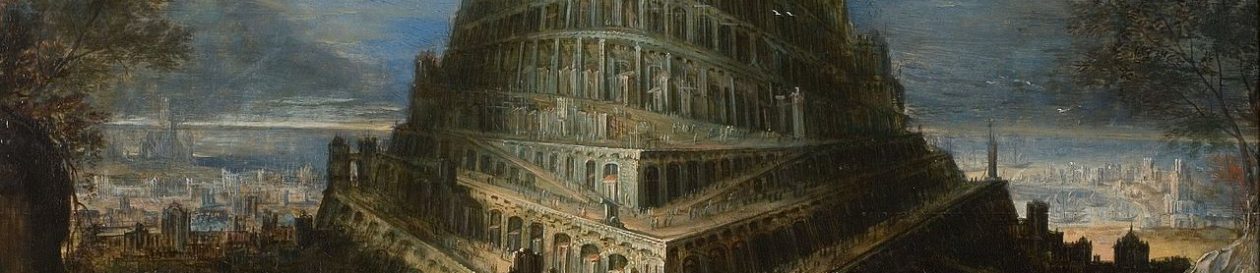
Perhaps I’ve been thinking all this time that it should be possible to find a reduced set of words, symbols, or even concepts that could serve as a basic core of human expression and being, some kind of fundamental proto-language that might cut across all cultures and yet connect all individuals. Something to undo the “Tower of Babel” and be able to heal all misunderstandings, resolve all disagreements, and find everyone’s common ground. I see now I have fallen down the “perfect language” rabbit-hole.

Of course, along with our imperfect languages we also have to deal with our imperfect thoughts and our imperfect feelings. Not only do we want to hide what we’re really thinking and feeling from others, we want to hide it from ourselves. Is it because we don’t want others to know the weakness and darkness within us, or we don’t want to face those parts of our own identities? Perhaps that is the main problem with language, the ease with which we can lie to both ourselves and others, and our eagerness to accept these lies.

Psychology is supposed to help us understand ourselves better. But before that, there were the Tarot decks, Ouija boards, and the I Chings that were supposed to illuminate our thoughts and actions, and help us perceive, however dimly, a little clearer into the past and future. I’m sure I’m not alone in thinking that such devices merely bring concepts to the forefront of the conscious mind and allow one to engage in creative and playful thinking. Maybe they tie into the “unconscious”, whatever that really means, and if not, then what is the source of their utility?

In the same vein, there are other instruments purported to aid in the effort to know thyself, such as Astrology and Myers-Briggs. Astrology has also been used for divination and that is its popular and sad ubiquity, that is “your daily horoscope”. Myers-Briggs is popular in the business world to help the managers manage and to resolve conflicts, and takes itself more seriously. In my foolishness, even though I didn’t believe that there was a perfect language lost in antiquity, perhaps I thought I could invent one anew like Ramon Llull or Gottfried Leibnitz!

Does language reveal reality or does it mask it? Can it blend and synthesize different realities or can it shape and create the very reality we inhabit? I’ve been mulling over the idea of what the next combogenetic alphakit might be, after chemical-molecular, biological-genetic, and symbolic-linguistic. Could it be something hyper-linguistic or hyper-cognitive, to serve as a perfect language, melding syntax, semantics, pragmatics? Or could it be something completely different, a blending of mathematics and philosophy?

Or even a new type of computer science? Such studies are still in their infacy, so one hopes for future breakthroughs and grand theories of logical systems and (e)valuations. Could a machine that creates reality from mere thought be the perfect language we seek, one that performatively produces no ambiguity by changing the abstract into the concrete, the inner into the outer? The Krell machine in the movie Forbidden Planet was one such hypothetical device, and showed the folly of a scheme that granted god-like powers to mere mortals.

Possibly better is a system that starts from grounding axioms that are so simple and fundamental that all must agree with their basis, utilizes logics that are so straightforward and rational that all must agree with their validity, demonstrates proofs that are so rigorous that all must agree with their worth, all enabled by overarching schemas that allow the truth of all things to vigorously and irrefutably shine. Even then, humankind might be too weak to suffer the onslaught against its fragile and flawed cogitations.

But O, what a wonderful world it might be.

Further Reading:

Umberto Eco / The Search for the Perfect Language

The Arcane Arts of Ramon Llull : the Dignities

Combogenesis: a constructive, emergent cosmos

The Myers-Briggs Type Indicator

The Twelve Houses of the Zodiac

The Tempest and Forbidden Planet

The 64 Hexagrams of the I Ching

https://en.wikipedia.org/wiki/Hedgehog%27s_dilemma

[*11.132]

<>

The Devolution of Trust

The Prisoner’s Dilemma is a simple game designed to show how the success or failure of cooperation between individuals can be contingent on various factors, primarily some sort of reward. Shown above is a representative payoff matrix between two players; each square shows the two choices and the two winnings for each. Each player cooperates (A or B) or cheats (A’ or B’) with the other player, so for example if A and B’ obtains (A cooperates but B cheats) then A loses 1 and B wins 3.

Each player knows all the values of the payoff matrix so it is said they have perfect information, except they don’t know what their opponent will do. If they are rational and believe their opponent to be as well, the wisest thing to do is for both to cooperate to maximize their winnings, knowing that their opponent knows that they could also cheat. If the game is played only once, however, that is clearly not the case.

If the game is iterated, things change. If each player remembers what their opponent did previously, and it is considered to be informative for what they might do next, then the player could use it to condition their decision to cooperate or cheat. Different algorithms or personalities can be considered for the players, with more or less thinking about what to do and more or less willingness to cooperate, and it is interesting to try different strategies, all the while seeing what adjustments of the payoff matrix might do to the results.

This Evolution of Trust site is a very nice lesson in some of the complications that can result for such algorithms and adjustments. On the whole, this site indicates that rationality and consideration for others can thrive, if conditions are right. In the traditional Prisoner’s Dilemma, the reward values in the payoff matrix are usually considered to be jail sentence time (so less is better), or for the site mentioned above where I’ve taken the representative matrix, monetary value (so more is better).

One thing of note in these examples is that each player doesn’t distinguish their opponent by anything other than their posteriori plays, because these players are supposed to be all part of the same group or society. But what if there is an a priori distinction that conditions their decision? So, if your opponent is a known Y, and you are a X, then you might want to raise your social credit with your other Xs by punishing a Y, even if it punishes you or even other Xs in the long run.

For example if you are a member of gang X, you wouldn’t want to cheat against another X. But cheating against a member of gang Y might raise your in-group social capital and be as important as the value of the reward. Or you might want to punish your opponent in group Y by not granting them any benefits even at the cost of your own benefit. Such distinctions are not usually part and parcel of the Prisoner’s Dilemma game, but they would add an interesting and realistic dimension to the game.

And thus lend insight into the woes of our modern political scene and culturally diverse society.

Further Reading:

https://ncase.me/trust/

https://en.wikipedia.org/wiki/Prisoner%27s_dilemma

https://en.wikipedia.org/wiki/The_Sneetches_and_Other_Stories

The Prisoner’s Dilemma

https://en.wikipedia.org/wiki/Devolution_(biology)

[*11.24, *11.172]

<>

Tractatus Logico-Philosophicus

Just the facts, ma’am.

— Detective Joe Friday

  1. The World (Die Welt): The world is everything that is the case.
  2. The Case (Der Fall): What is the case, the fact, is the existence of atomic facts.
  3. The Picture (Das Bild): The logical picture of the facts is the thought.
  4. Thought (Gedanke): The thought is the significant proposition.
  5. Propositions (Der Satz): Propositions are truth-functions of elementary propositions.
  6. The Form (Die Form): The general form of truth-function is: [p-bar, xi-bar, N(xi-bar)].
  7. Silence (Schweigen): Whereof one cannot speak, thereof one must be silent.
  8. ( ):

The Tractatus has seven propositions, most with sub-propositions and sub-sub-propositions, etc. I have added the eighth, which is the actual silence of all one cannot speak of. Quite a large section, for all its emptiness.

I also thought it would be nice to have an internet version where you could click and expand down through the sub-sentences. There are already many such versions available for your enjoyment.

I can’t decide whether I like the English or the German version better, so here are both.

Further Reading:

https://en.wikipedia.org/wiki/Tractatus_Logico-Philosophicus

http://www.bazzocchi.com/wittgenstein/tractatus/eng/index.htm

http://www.kfs.org/jonathan/witt/ten.html

https://pbellon.github.io/tractatus-tree/#/

http://daxoliver.com/tractatus/

http://people.umass.edu/klement/tlp/

The Tricky Truth about Tractatus Trees (updated)

[*11.170]

<>