
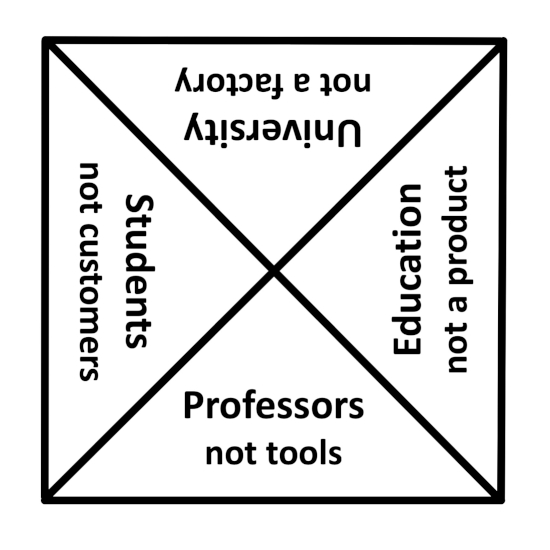
 A recent meme popular in education:
- Education is not a product.
- Students are not customers.
- Professors are not tools.
- The University is not a factory.
I’m not sure who originally came up with this interesting saying.
Examining the anti-analogy, you have “customers buy products made in a factory with tools”. Perhaps a better fourfold would be to change this to “workers use tools to make products in a factory”, so you could say “Students are not workers.” But then you lose the capitalistic “consumer culture” geist.
Or you could say the Professors are (not) factory workers and the Students are (not) the raw material. As a homework assignment, write an essay or develop a mathematical theory comparing this anti-analogy fourfold (or a close derivative thereof) to Aristotle’s Four Causes. Please show your work.
Further Reading:
Note the similarity with some of the elements of the following (which also reminds me for the Four Causes):
[*11.18]
<>
 Equivalent Exchange
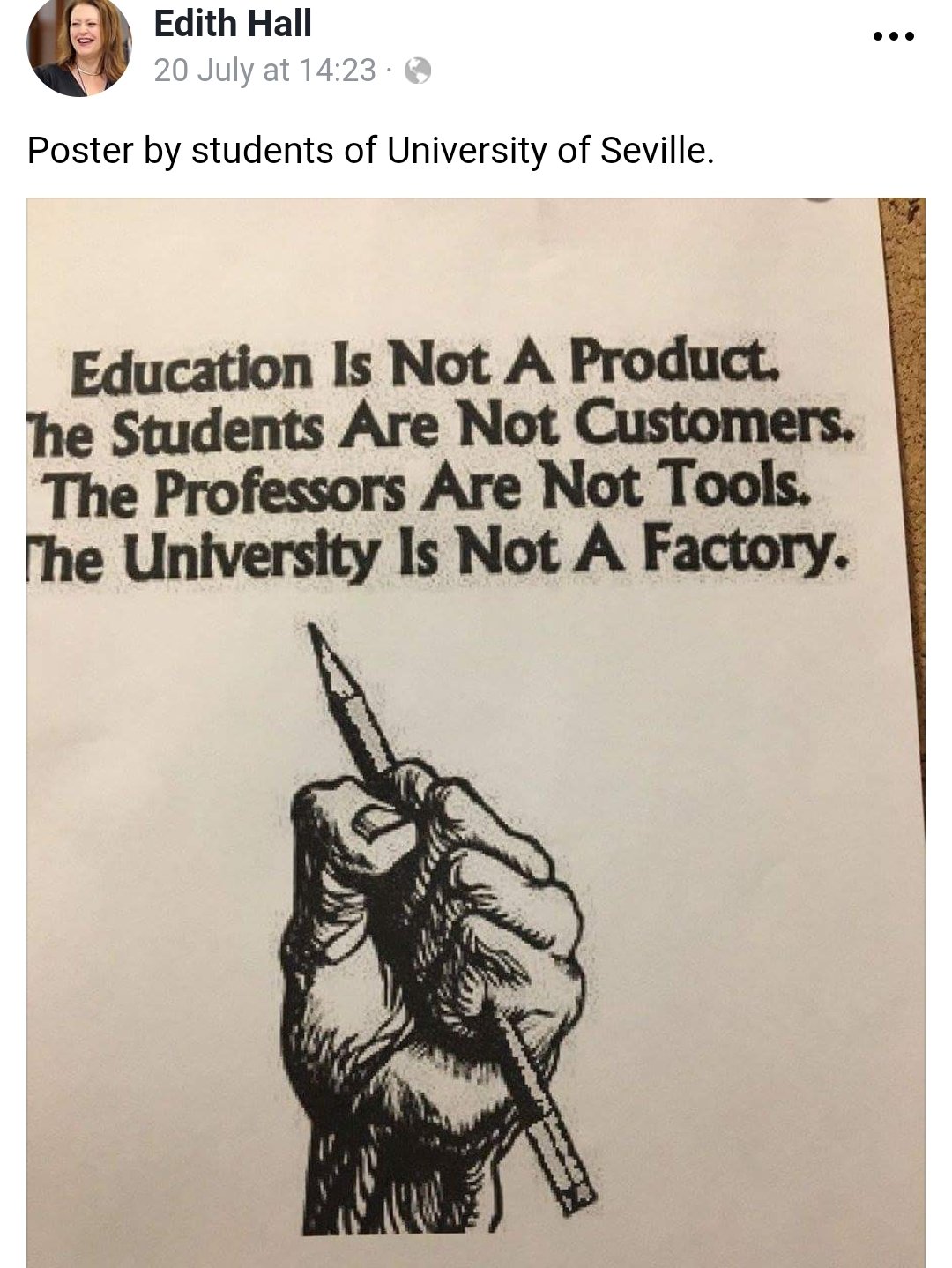
### Education is Not a Product: A Reflection on the True Purpose of Learning (by ChatGPT)
In the contemporary landscape, where market-driven ideologies often permeate various aspects of life, the education system is not immune. Increasingly, educational institutions are being pressured to operate like businesses, with a focus on efficiency, output, and customer satisfaction. This shift in perspective has led to the commodification of education, where it is treated as a product, students as customers, professors as tools, and universities as factories. However, this approach is fundamentally flawed and undermines the true essence of education.
### Education is Not a Product
Education is often misconceived as a product that can be packaged, sold, and consumed. This view is reductive and fails to capture the profound and transformative nature of learning. Education is not something that can be bought or sold; it is a lifelong process of personal and intellectual growth. It is an experience that challenges individuals to think critically, question assumptions, and develop a deeper understanding of themselves and the world around them.
Treating education as a product implies that it can be measured, standardized, and delivered in a uniform manner. This perspective ignores the fact that education is deeply personal and varies from individual to individual. Each student brings unique experiences, perspectives, and aspirations to their educational journey. The value of education lies not in the acquisition of a degree or certificate but in the development of the mind and the ability to engage with complex ideas.
### Students are Not Customers
The notion of students as customers is a byproduct of the commodification of education. In a consumer-driven society, the customer is always right, and businesses are expected to cater to their desires. However, this mindset is detrimental when applied to education. Students are not passive consumers of a product; they are active participants in the learning process. Education is not about delivering a service to satisfy customer demands but about challenging students to engage with new ideas and develop their own understanding.
When students are treated as customers, there is a danger that the focus shifts from learning to satisfying student demands. This can lead to a lowering of academic standards, as institutions may feel pressured to prioritize student satisfaction over academic rigor. Education should be about pushing students to think critically, question their assumptions, and develop a deeper understanding of the world. This process is often uncomfortable and challenging, but it is essential for true learning.
### Professors are Not Tools
Professors play a crucial role in the educational process, but they are not mere tools for delivering content. They are educators, mentors, and scholars who bring a wealth of knowledge and experience to the classroom. Their role is not to simply impart information but to inspire and guide students on their intellectual journey. Professors encourage students to think critically, engage in meaningful dialogue, and explore new ideas.
Viewing professors as tools reduces their role to that of a service provider, whose primary function is to deliver a product to the customer. This perspective undermines the value of the intellectual and emotional labor that professors invest in their students. Professors are not machines that can be programmed to deliver a standard product; they are individuals who bring their own unique perspectives and expertise to the educational process.
### The University is Not a Factory
The metaphor of the university as a factory is a reflection of the industrialization of education. In this model, universities are seen as institutions that produce graduates who are ready to enter the workforce. This perspective reduces education to a process of producing standardized outputs, where the focus is on efficiency and productivity rather than intellectual growth and personal development.
However, a university is not a factory, and education is not about producing standardized products. Universities are spaces for intellectual exploration, where students are encouraged to question, challenge, and expand their understanding of the world. The value of a university education lies not in the production of graduates but in the cultivation of critical thinking, creativity, and a lifelong love of learning.
### Conclusion
The commodification of education, where it is treated as a product, students as customers, professors as tools, and universities as factories, is a dangerous trend that undermines the true purpose of education. Education is not about the acquisition of a product but about the development of the mind and the cultivation of intellectual and personal growth. It is a process that requires active participation, critical thinking, and a willingness to engage with complex ideas.
To preserve the true essence of education, we must resist the pressure to commodify it and instead focus on creating learning environments that inspire and challenge students. Education is not a product to be consumed but a journey of discovery that has the power to transform individuals and society as a whole.
LikeLike