The Four Treasures of Ireland

In honor of St. Patrick’s Day, I present the Four Treasures of Ireland: the Spear, the Sword, the Cauldron, and the Stone.

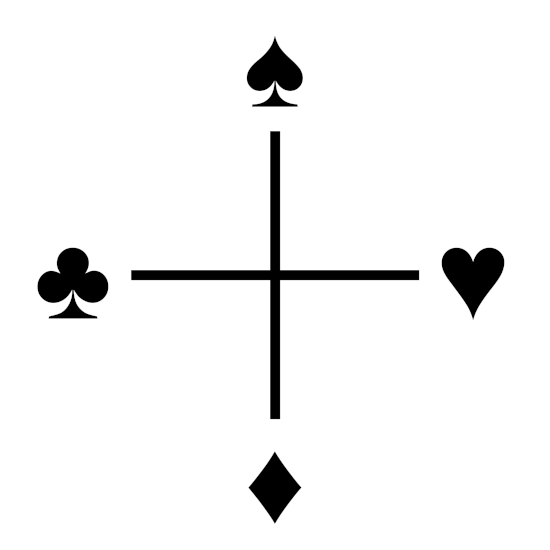
The suits of Tarot Cards and Playing Cards are very similar to the Four Treasures. For Tarot, they are Wands, Swords, Cups, and Pentagrams. For Playing Cards, there are many variations, but the most common today are Clubs, Spades, Hearts, and Diamonds.

Treasures and suits are also tied to the four elements.

References:

http://en.wikipedia.org/wiki/Four_Treasures_of_the_Tuatha_D%C3%A9_Danann

http://en.wikipedia.org/wiki/Minor_Arcana

http://en.wikipedia.org/wiki/Suit_%28cards%29

http://en.wikipedia.org/wiki/Elidor

[*7.2, *7.54, *7.55]

<>

Kent Palmer’s Levels of Being

Another fourfold that transitions from simplicity to complexity. Similar to the Cynefin Framework and Bright to Dark.

References:

http://www.goertzel.org/books/wild/chap4fold.html

http://archonic.net/Lx01a14.pdf

[*7.76]

<>


My Dear Aunt Sally

When I took first year algebra in school, I learned the rule “My Dear Aunt Sally” as a mnemonic for the order of applying binary operations in algebraic expressions. “My Dear” meant to perform multiplication and division first. “Aunt Sally” meant to perform addition and subtraction next and last. Most of us have learned some variation of this rule. I see that it has now been enlarged to “Please Excuse My Dear Aunt Sally” to include parentheses and exponentiation, and to perform these two first before the original and now last four.

Why remark about this simplistic and even obsolete rule? Note the similarity between this fourfold of binary arithmetic operators and the four binary linear logic operators. In each there are two operators for increasing: addition and multiplication in arithmetic, and the disjunctive operators plus and par in linear logic. In each there are two operators for decreasing: subtraction and division in arithmetic, versus the conjunctive operators with and tensor in linear logic. In each there are two rules for attraction and two rules for repulsion.

In addition, the double duality of the four arithmetic operators is revealed, as in arithmetic addition and subtraction are duals, and multiplication and division are duals. In linear logic, with and plus are duals, and tensor and par are duals. Can arithmetic be simulated by linear logic, or vice versa? Is linear logic equivalently exchangable with arithmetic? I don’t think so but perhaps some expert can tell us.

References:

http://en.wikipedia.org/wiki/Order_of_operations

[*7.94]

<>

Equivalent Exchange

There is an old riddle that asks, what is the value of a human body? It goes on to enumerate the quantities of the various chemicals that constitute an average body, and then price those chemicals to come up with a total material value. This might come as a shock to the one who tried to answer the riddle, because the value is so low.

Of course that analysis ignores the real value of the body because it ignores the spatial arrangement of those chemicals in the various tissues and organs of the body. It ignores the form of the body as an hierarchical arrangement of structured parts. These parts are very valuable for someone needing an organ donation, for example.

This static analysis is lacking as well because it neglects the dynamic actions that a body can perform. Taken as a set of discrete individual acts, this is like considering the individual chemicals that constitute a body. One can enumerate the acts too, as in counting the number of breaths or the number of heart beats over a lifetime.

But we are still not finished, because this enumeration of actions also overlooks the functions that a body can perform, as arrangements of actions in time. These functions are the most important value of a body because they include but are not limited to being alive, thinking, and feeling.

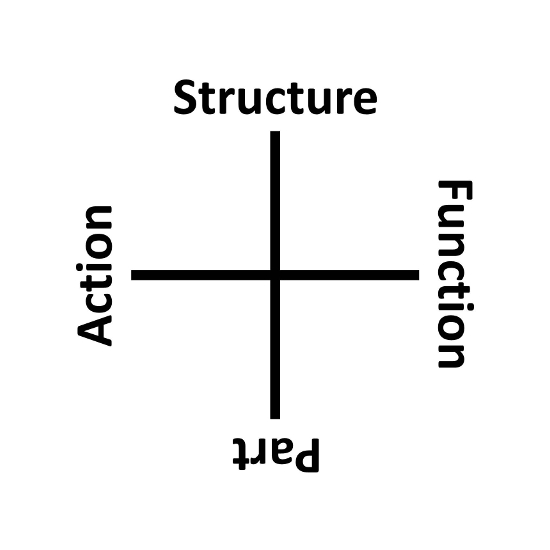
So it seems to me that there is a heirarchy here, that goes from parts to structure to actions to function, with parts being at the lowest level and function being at the highest. Each level of the hierarchy is dependent on the level below, but the nature of a level is fundamentally different from the level below it, as well as the level above it. Please see my previous post Structure-Function.

The term “equivalent exchange” comes from an alchemy-centric anime, where through a process called “human transmutation” it is attempted to recreate a body starting from a pile of the basic chemicals that constitute it. Even with some high-powered magic, the attempt fails due to the fact that much more is required to fashion a body or even a living, breathing person.

Further Reading:

http://chemistry.about.com/b/2011/02/06/how-much-are-the-elements-in-your-body-worth.htm

http://www.datagenetics.com/blog/april12011/index.html

https://briankoberlein.com/post/four-elements/

<>

Essay on Man

All nature is but art, unknown to thee;
All chance, direction, which thou canst not see,
All discord, harmony not understood,
All partial evil, universal good…

 — From An Essay on Man by Alexander Pope

I was struck by the four divisions that the poet makes in the world, and how it echoes many other of the fourfolds shown here. Ignoring whether you think the former or the latter extreme of each division is correct, consider the aspect of the world that each division ranges over. Between nature and art lies the material and the parts of the world, either naturally occurring or fashioned by some intention. Between chance and direction lies the individual actions and occurrences of the world, either merely haphazard or towards something. Between discord and harmony lies structures of those materials and parts, and between evil and good lies functional arrangements of those acts and occurrences.

References:

http://en.wikipedia.org/wiki/An_Essay_on_Man

[*7.98]

<>

Schrödinger’s Cat

Now let’s look at another thought experiment, that of Schrödinger’s Cat. This thought experiment is supposed to confound the micro and macro worlds of quantum physics and ordinary, human-size physics. A cruel device is built consisting of a closed box which contains a sample of radioactive material, a mechanism to release poison into the box if an atom of the radioactive material decays, a living cat, and a door that must be opened to reveal the condition of the cat to an external observer.

The story of the experiment goes that if the observer waits to open the box until there is a 50% probability that an atom decays, the state of the cat (hidden in the unopened box) to the observer will be both alive and dead. The cat’s so-called wave-function will be a superposition of the wave-function of a live cat and that of a dead cat, which will collapse into one or the other only by the opening of the door and the observation of the actual condition of the cat. This is called the Copenhagen Interpretation.

Some say that the detector of the poison release mechanism will be the true observer in this experiment, and before the external observer opens the door the cat will be definitely alive or dead because of the action of the mechanism. This might be considered the objective collapse theory. Others say that the world splits in two between a world where the cat is alive and one where the cat is dead. This is called a many-worlds interpretation.

There seems to me a similarity between Maxwell’s Demon and Schrödinger’s Cat. The fourfold elements of the experiment are shown above, but now consider these elements in a system in terms of Aristotles’s Four Causes. The material causes are the discreet constituents of the experiment, everything from box to atoms to cat to observer. The efficient cause is the decay or non-decay of a radioactive atom. The final cause is action of the observer in opening the box. The formal cause is the poor cat in its ambiguous state, simultaneously both dead or alive.

It doesn’t make too much common sense to say that the opening of the box and the observing of the cat “causes” the atom to have really decayed or not, and so concretize the past and the cat into a certain way of being, but that is mostly what the Copenhagen Interpretation is saying. Indeed, Linear Logic, which has been described many times on this blog, has been used to describe aspects of quantum physics for decades.

References:

http://en.wikipedia.org/wiki/Schr%C3%B6dinger%27s_Cat

http://en.wikipedia.org/wiki/Copenhagen_interpretation

[*7.138]

<>

Maxwell’s Demon

I am currently reading Tor Norretranders “The User Illusion”, and he opens the book with chapters on information theory and thermodynamics. His description of the thought experiment “Maxwell’s Demon” made me realize that this system has all the ingredients of a fourfold: the two chambers, the demon, the door between the two chambers that the demon operates, and the molecules that the demon allows to or prevents from passing through the door from one chamber to another. The only way between the two chambers is through the door. The molecules are in a gaseous state, with a distribution of velocities, so some are moving faster than others.

The major physical action that the demon can perform is to open or close the door. If the demon did this randomly, it would accomplish nothing, and the system would ultimately evolve the same as one without door or demon. Instead the demon is able to open and close the door so as to allow faster molecules to collect in one chamber and slower molecules to collect in the other. The demon doesn’t touch the molecules, but he is somehow able to tell whether a molecule is fast or slow so he can decide whether to open or close the door.

The purpose of the thought experiment is to suggest that this system could violate the second law of thermodynamics by increasing order. By letting faster molecules move to one chamber, the system would then be able to do work by, for example, powering an engine. Perhaps the temperature differential is also able to power the demon itself. We would then have a perpetual motion machine, one that could give us unlimited energy, as long as there was a surplus of energy after the needs of the demon.

However, the modern analysis of the thought experiment shows that entropy does indeed increase within this system because the demon would eventually have to forget information about the molecules, and his forgetting would increase entropy. The demon would have to be an irreversible process.

References:

http://en.wikipedia.org/wiki/Maxwell%27s_demon

Tor Norretranders / The User Illusion: Cutting Consciousness Down to Size

[*7.130]

<>

Fourfolds and Double Duals, Part 2

In addition to the symbolic fourfold presented in the previous entry Fourfolds and Double Duals, which includes the alchemical symbols for the four elements, here is another generic representation. This fourfold reminds me of the fourfolds Bright-Light-Dim-Dark shown in the early entry with the Four Elements, as well as the newer fourfold of The One and the Many.

If one considers the outer ring and the inner circle to be “outer-as-inner”, then this fourfold is related to the One and the Many by letting One be white and Many be black.

Additionally, the symbols can be seen to map to the fourfold Bright-Light-Dim-Dark by noting that White-as-White is Bright, White-as-Black is Light, Black-as-White is Dim, and Black-as-Black is Dark.

For fun, this figure can be tweaked to reveal a deconstructed yin yang. It reminds me of John Dee’s Hieroglyphic Monad. Or someone holding a Vulcan Lirpa from Star Trek’s Amok Time.

References:

http://en.wikipedia.org/wiki/Monas_Hieroglyphica

Notes:

Amusingly, I’m starting to think of the lower figure as a crossed fork and spoon: a fork to separate and a spoon to combine. Note the handles of the utensils (the circles) appear to be switched, but that is just the way it is.

Also: a c & t’s mouth and c t’s eye; a d g’s nose and d g’s eye. These are the binary operators of Linear Logic!

<>

Fourfolds and Double Duals

For every aspect of the world that someone has thought to analyze into its components, it probably has been suggested to divide it into four parts. I suggest that many of the things that have a fourfold form, are a fourfold in the same way. Not in the trivial cardinal sense, but in a deeper structural sense. They are a combination of two dualities, a double dual if you will, such that one dual operates as interior and exterior, or true and false, a duality of opposites, and another (dual) dual operates as one and many, or unity and multiplicity, or discreteness and continuity, a duality of numeracy.

I have been gathering fourfolds for a time, and have written about some more than others. Some have been around a long time, and others I’ve been inspired to fashion. I have tried to orient them all in the same way to accentuate their common deep structure. For example, everything in the left position in the diagrams have a commonality across fourfolds, as does everything in the lower, upper, and right positions. The four ancient symbols shown in the diagram above represent the four elements of alchemy: fire, earth, air, and water.

Because of these relations between the fourths and the halves of these fourfolds, I have choosen the name “Equivalent Exchange”. In addition, the fourfolds themselves might be “equivalently exchangable” with each other because of their common deep structure. For many reasons, I believe that the best exemplar for these fourfolds is the recent logical system known as Linear Logic, which has two combining binary operators and two dividing binary operators.

Others before me have reached similar hypotheses about fourfolds in general, and I am grateful for their scholarship. I hope others will follow, and I’m sure they will present their findings more eloquently and convincingly than I have.

References:

http://en.wikipedia.org/wiki/4_%28number%29

http://www.samuel-beckett.net/Penelope/four_symbolism.html

http://www.unterzuber.com/4our.html

<>

McLuhan’s Tetrad of Media Effects

References:

http://en.wikipedia.org/wiki/Tetrad_of_media_effects

http://earth-wizard.livejournal.com/56638.html

[*6.4, *7.122]

<>


Every Fourth Thing

Daydream Tourist

Because there are way more than seven wonders in the world.

The Digital Ambler

Always Forward Between Heaven and Earth

The Mouse Trap

Psychological Musings

Wrong Every Time

Critiquing anime and everything else

The Chrysalis

"For man has closed himself up, till he sees all things thro' narrow chinks of his cavern" -- William Blake

  Bartosz Milewski's Programming Cafe

Category Theory, Haskell, Concurrency, C++

The Inquisitive Biologist

Reviewing fascinating science books since 2017

Gizmodo

Every Fourth Thing

Simplicity

Derek Wise's blog: Mathematics, Physics, Computing and other fun stuff.

COMPLEMENTARY 4x

integrating 4 binary opposites in life, learning, art, science and architecture

INTEGRATED 4x

integrating 4 binary opposites in life, learning, art, science and architecture

Playful Bookbinding and Paper Works

Chasing the Paper Rabbit

Antinomia Imediata

experiments in a reaction from the left

Digital Minds

A blog about computers, evolution, complexity, cells, intelligence, brains, and minds.

philosophy maps

mind maps, infographics, and expositions

hyde and rugg

neat ideas from unusual places

Visions of Four Notions

Introduction to a Quadralectic Epistomology

Explaining Science

Astronomy, space and space travel for the non scientist

Log24

Every Fourth Thing

Ideas Without End

A Serious Look at Trivial Things

Quadralectic Architecture

A Survey of Tetradic Testimonials in Architecture

Minds and Brains

Musings from a Naturalist

Why Evolution Is True

Why Evolution is True is a blog written by Jerry Coyne, centered on evolution and biology but also dealing with diverse topics like politics, culture, and cats.

Quadriformisratio

Four-fold thinking4you

Multisense Realism

Craig Weinberg's Cosmology of Sense

RABUJOI - An Anime Blog

Purveyors of Fine Anime Reviews and Ratings Since 2010

Intra-Being

Between Subject and Object

The Woodring Monitor

Every Fourth Thing

FORM &amp; FORMALISM

Every Fourth Thing

Log24

Every Fourth Thing

The n-Category Café

Every Fourth Thing

THIS IS NOT A BLOG

Every Fourth Thing

PHILOSOPHY IN A TIME OF ERROR

Sometimes those Sticking their Heads in the Sand are Looking for Something Deep

Networkologies

Online Home of Christopher Vitale, Associate Professor of Media Studies, The Graduate Program in Media Studies, Pratt Institute, Brooklyn, NY.

Hyper tiling

Linking Ideas

DEONTOLOGISTICS

RESEARCHING THE DEMANDS OF THOUGHT

Incognitions

Explorations in the Paradoxes of Meaning

Object-Oriented Philosophy

"The centaur of classical metaphysics shall be mated with the cheetah of actor-network theory."

Objects & Things

objects & things, design, art & technology