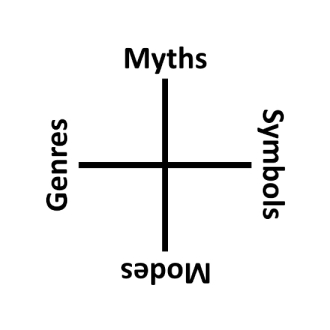
Four Dimensional Space-time

sq_4d_spacetime

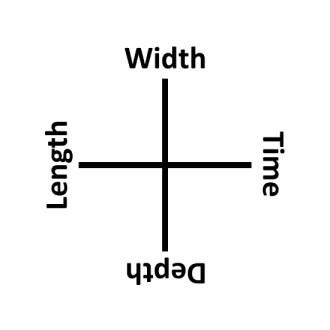
Here’s a simple fourfold I’ve been ignoring just because it’s so trivial, but that triviality can be deceiving. Space-time as formulated in special relativity has four dimensions: three of space and one of time. Our everyday experience shows us the three dimensions of space: length, width (or breadth), and depth (or height), but time is a different kind of thing because we cannot see or move forward and backward through time with our eyes or body, like we can along the axes of space.

Personally, only our memory and imagination can let us range through time. Of course, after the invention of language and more recent technologies, the spoken word, writings, photographs, audio recordings, and videos can also be used. But it’s not the same as shifting one’s gaze along the length of something or moving one’s body across a width.

So, we can move semi-freely through the three spatial dimensions but our movement in time seems to be fixed into a relentless forward motion that we have no control over. And because gravity pulls us down onto the surface of the world, one of the spatial dimensions (depth or height) is more limiting than the other two.

sq_ll2Thus another interesting comparison to this fourfold is to that of linear logic. One observation is that length and width can be considered reversible but depth and time can be considered somewhat irreversible. That’s not true of course, but because of gravity it is easier to descend than to ascend, and it’s far easier to move into the future than into the past. But we can see into the distant past, just not our own, as we turn our telescopes to the heavens.

Space without time could have four or even higher dimensions, but we have no empirical evidence that it is so. Mathematically, however, we can easily construct multidimensional spaces. One representation of four dimensional space is by using quaternions, which have four dimensions to the complex numbers’ two. Tuples of real numbers or even vector spaces can also be used. However, the geometry of space-time is not Euclidean; it is described by the Minkowski metric.

Novels about characters living in different numbers of spatial dimensions are an interesting way to learn and think about them. The very first was Flatland by Edwin Abbott Abbott, about a being limited to two dimensions that learns about a third outside his experience when a three dimensional being comes to visit. Just recently I’ve finished reading Spaceland by Rudy Rucker, about an ordinary human person limited to the three dimensions of space that learns about the fourth dimension by similar reasons.

Links:

http://en.wikipedia.org/wiki/Special_relativity

http://en.wikipedia.org/wiki/Minkowski_space

http://en.wikipedia.org/wiki/Four-dimensional_space

http://en.wikipedia.org/wiki/Flatland

http://en.wikipedia.org/wiki/Flatland_%282007_film%29

http://en.wikipedia.org/wiki/Spaceland_%28novel%29

[*8.72]

<>
Maxwell’s Equations

sq_maxwell_eq2

Actually, just the left hand side of the equations, because it looks better that way. The right hand sides are just a click away.

E and B are the electric and magnetic fields, respectively. is the “del” operator.

The divergences ∇ · E and ∇ · B are the “fields emanating from the sources.”

The curls ∇ x E and ∇ x B are the “circulation of the fields.”

Further Reading:

http://en.wikipedia.org/wiki/Maxwell%27s_equations

<>

All Watched Over

sq_all_watchedI like to think
(it has to be!)
of a cybernetic ecology
where we are free of our labors
and joined back to nature,
returned to our mammal
brothers and sisters,
and all watched over
by machines of loving grace.

— Richard Brautigan from All Watched Over by Machines of Loving Grace

References:

http://en.wikipedia.org/wiki/All_Watched_Over_by_Machines_of_Loving_Grace

http://en.wikipedia.org/wiki/All_Watched_Over_by_Machines_of_Loving_Grace_(TV_series)

[*6.150, *8.70]

<>

There is Nothing Wrong

sq_outer_limits

There is nothing wrong with your television set. Do not attempt to adjust the picture. We are controlling transmission. If we wish to make it louder, we will bring up the volume. If we wish to make it softer, we will tune it to a whisper. We will control the horizontal. We will control the vertical. We can roll the image, make it flutter. We can change the focus to a soft blur or sharpen it to crystal clarity. For the next hour, sit quietly and we will control all that you see and hear. We repeat: there is nothing wrong with your television set. You are about to participate in a great adventure. You are about to experience the awe and mystery which reaches from the inner mind to – The Outer Limits.

— The Control Voice from The Outer Limits

Links:

http://en.wikipedia.org/wiki/The_Outer_Limits_%281963_TV_series%29

http://tvtropes.org/pmwiki/pmwiki.php/Series/TheOuterLimits

[*8.70]

<>

A Game of Four-folds, Part 2

elements_tetraflexagon_s1elements_tetraflexagon_s2

One way to have all six arrangements of the quadrants for each four-fold card is to make a tetraflexagon for each card. Above are the two sides of a sheet that should be printed out by flipping it on the short edge, so that the upper right corner of the bottom image will end up behind the upper left corner of the top image. Then fold the tetraflexagon by the simple instructions found at the link below. Then you will have all six arrangements of the four-fold for the Four Elements! There are actually seven states for the tetraflexagon, six of which have a valid arrangement on just one side of it, and one that doesn’t have a valid arrangement on either side. Seems like a lot of work, though.

How to Fold a Hexa-tetraflexagon

[*8.59]

<>


A Game of Four-folds

sq_MESTsq_structure_function

One thing those that love four-folds (quadraphiles?) like to do is compare and contrast them. A solitaire card game based on four-folds might be fun for some individuals obsessed by tetrads and such. But how would it work?

If two four-fold cards are chosen at random, then insight into their relationship might be obtained. For example: Structure-Function and Matter-Energy-Space-Time (MEST). The simple observation is that each quadrant of Structure-Function requires a corresponding quadrant of MEST. Actions require Energy. Parts require Matter. Structures require Space. Functions require Time. Energy is necessary for Actions, etc.

One problem is that not everyone agrees how the quadrants of two different four-folds can correspond, or be “lined up”. In general, the only things that are available to explain the reasoning for the arrangement are analogical thinking and argumentation, so it is at least half subjective. This isn’t science, after all.

Note that the different poles of each four-fold can be ordered in six different ways. If we have a square four-fold of A B C D, we can always place A at the Left or West position. Then the remaining 3 letters can be arranged in six different ways.

A B C D
A C D B
A D B C
A B D C
A C B D
A D C B

If one just has a fixed card for each four-fold, then the other five permutations are not available. You could have six versions of each card, but I think that would be a poor solution, since you are only picking one of them at any time.

To acheive flexibility in arrangement, each card could be divided into its quadrants, for example by right triangles. But then you’d have triangular cards. Plus the fact that you couldn’t combine them well on a web page.

Or you could have the four-folds turned to be X’s, and then the quadrants could be squares. That’s somewhat appealing, since this blog is titled “Equivalent eXchange”, after all. For example:

sqx_MEST

sqx_MEST_energysqx_MEST_spacesqx_MEST_timesqx_MEST_matter

However, if you are picking two cards at random, then the four quadrants won’t be together as a group.

Notes:

Is Mahjong called “Game of Four Winds” or is it just a name of a computer version of it? From what I can tell, the players are named after the four winds (i.e. cardinal directions). But there are also four flowers and four seasons.

[*8.56]

<>

The Quadralectics of Marten Kuilman

sq_quadralectics Marten Kuilman has written extensively on four-folds and what he calls quadralectics, division-thinking, or four-fold thinking.

Publishing in the Netherlands, his books aren’t available on Amazon. Graciously, he has made several of his works available on the internet via his blogs Quadralectics and Quadriformisratio. Quadriformisratio presents Four – A Rediscovery of the ‘Tetragonus Mundus’, a treatise of four-folds through history, and Quadralectics is his two volume work on Quadralectic Architecture.

Not only does Kuilman expound at length on various four-folds throughout the ages and how they affected the intellectual and artistic developments of the time, his work unifies many of them into his four aspects of visibility: invisible invisibility, invisible visibility, visible visibility, and visible invisibility. Above, I’ve arranged these four aspects by my positions for the four elements. Unfortunately, they aren’t in the same sequence as Kuilman’s quadrants.

Because Kuilman emphasizes a recurring association of  his four-fold of visibility with communication, it is also reminiscent of Hjelmslev’s Net. Then, invisibility could be understood as content, and visibility as expression.

Interestingly, my four-fold of Bright-to-Dark (here or here) is most relatable to this four-fold of visibility, but in the reverse sense that the invisible invisibility is bright, and the visible visibility is dark. One could quickly reconcile this opposition by considering the empty circle as most invisible, and the full circle as most visible.

Another interesting result of Kuilman’s investigations is to derive his four-fold of Unity, Muun (Multi-unity), Part, and Whole, which I believe has important associations with my four-fold Structure-Function.

References:

Marten Kuilman / Four – A Rediscovery of the ‘Tetragonus Mundus’

Marten Kuilman / QUADRALECTIC ARCHITECTURE – A Panoramic Review

http://quadriformisratio.wordpress.com/

http://quadralectics.wordpress.com/

http://quadralectics.wordpress.com/7-the-quadralectic-theory/

[*8.48, *8.52, *8.53, *8.54, *8.55]

<>

Notions of Equivalence

sq_equivalencesRecently I have been wondering what different notions of equivalence are possible. Thinking about one of my favorite fourfolds — Structure-Function — with help from the fourfold of The One and the Many, I have (naturally) come up with four notions: Identities, Isomorphisms, Confluences, and Indiscernibles.

Identities: One as One. In mathematics, an identity is an equivalence between two (or more) things that are really just the same thing. One can say there is an equivalence relation between the things and they are part of the same equivalence class. In equations, each thing can be substituted for the other thing because they are really just the same thing! In my consideration, Actions have these kind of identities, and so it is a reasonable term to use for Actions in the Structure-Function fourfold.

Isomorphisms: One as Many. In mathematics, an isomorphism is an equivalence between two (or more) things that have the same (mathematical) structure. Another way to consider this is to say that there is a paradigm or model that is representative of all the things that have this same structure. Thus it is a good term to use for Structures in the Structure-Function fourfold.

Confluences: Many as One. In logic, computer science (rewriting theory), and mathematics, a confluence is an equivalence between two (or more) things that can each be transformed into the same, maybe different, thing. Confluences can be used for this notion of equivalence because if one says that two rivers are confluent, then that means that they both flow into another larger river. Thus I think it is a valuable term to use for Functions in the Structure-Function fourfold.

Indiscernibles: Many as Many. In philosophy and perhaps physics, an indiscernible is an equivalence between two (or more) things where one cannot tell the difference between them. Thus it is a useful term to use for Parts in the Structure-Function fourfold. Another term to consider using is Substitutivities. Thus I do not believe I agree with the principle of the Identity of Indiscernibles since I think that would collapse my two notions of Identities and Indiscernibles into one. For instance, atoms of gold may be indiscernible from one another but that doesn’t mean they are the same atom.

To Do:

A recent foundational project for mathematics starts with the following:

Univalence Axiom: (A = B) ~ (A ~ B): Identity is equivalent to equivalence.

At this time I do not understand the implications of this axiom and how it might impact my four notions of equivalence.

Notes:

Perhaps Extensionalities would  be a better choice than Confluences.

References:

http://en.wikipedia.org/wiki/Identity_%28mathematics%29

http://en.wikipedia.org/wiki/Isomorphism

http://en.wikipedia.org/wiki/Confluence_%28abstract_rewriting%29

http://en.wikipedia.org/wiki/Indiscernibles

The HoTT Book: Homotopy Type Theory: Univalent Foundations of Mathematics

http://homotopytypetheory.org/book/

http://en.wikipedia.org/wiki/Univalence_axiom

http://plato.stanford.edu/entries/identity-indiscernible/

http://en.wikipedia.org/wiki/Extensionality

[*8.17, *8.40]

<>

Metropolis

sq_metropolis_agents“The Mediator between the head and hands must be the heart!”

— Fritz Lang’s Metropolis

A couple of years ago I watched The Complete Metropolis, the recently restored version of the 1927 silent film. The message that flashes before the viewer at the beginning and at the end of the film is “The Mediator between the head and hands must be the heart!”

I can’t remember if I’ve seen some previous version of Metropolis or not. I’m sure I’ve seen many of the scenes but I hadn’t seen all of them. I cannot speak for previous versions of the film, but this one was enjoyable and I’m glad I watched it.

Somewhat like the film Agora mentioned previously that showed the gulf between science and religion, this film details a fictional conflict between a technocratic ruling class and a subjugated working class. There is some religious imagery throughout and the epic battle between Freder and Rotwang even takes place on the rooftops of a cathedral.

Interestingly, the three elements of the epigram above correspond to three of the elements of Carl Jung’s Psychological Types: sq_jungHead with Cognition, Heart with Emotion, Hands with Sensation. What about the missing aspect, Intuition? I’ve placed Maria at that point because her meeting with Freder really initiates the plot of the film.

Actually I should have placed Grot, a worker foreman, at the Hands position instead of Rotwang. However, I think Rotwang is a more interesting character. Comparing these characters to those in The Tempest and Forbidden Planet, Rotwang is more like Prospero’s Caliban, or Morbius’s Id monster.

As evidence of his evil nature, Rotwang creates a robotic version of Maria and uses her to incite the workers to confusion and violence. Note that the spirit Ariel and Robby the Robot are also placed at Jung’s Intuition position.

Several of the images from the banner on this blog are from the movie, and are of the central tower and office of Fredersen. It is called “The New Tower of Babel” since it was inspired by Bruegel’s painting of the Tower of Babel.

Notes:

For the “4 H Club”, the four H’s are Health, Head, Hands, and Heart. Probably deserves its own post!

Links:

http://en.wikipedia.org/wiki/Metropolis_%281927_film%29

http://en.wikipedia.org/wiki/Tower_of_Babel

http://en.wikipedia.org/wiki/4-H

[*7.152]

<>

Graham Harman’s Quadruple Object, V2

The world is made up of a basic set of polarities – four of them, it turns out. They cannot be derived from a single radical root, but neither do they exist as incorruptible elements untransmutable into one another in the manner of the Empedoclean air, earth, fire and water.

— From Prince of Networks by Graham Harman

sq_harman

Objects exist as autonous units, but they also exist in conjunction with their qualities, accidents, relations, and moments without being reducible to these. To show how these terms can convert into one another is the alchemical mission of the object-oriented thinker.

— From Prince of Networks by Graham Harman

sq_harman2

I have made an attempt at orienting Graham Harman’s fourfold of real object, sensual object, real qualities, and sensual qualities with respect to the other fourfolds presented here. The fourfold object emerges from Harman’s analysis of Heidegger’s das Geviert.

References:

Graham Harman / Guerrilla Metaphysics: phenomenology and the carpentry of things

Graham Harman / Prince of Networks: Bruno Latour and metaphysics

Graham Harman / The Quadruple Object

[*6.46, *6.48, *6.62, *7.40, *7.132, *7.133]

<>

Every Fourth Thing

Daydream Tourist

Because there are way more than seven wonders in the world.

The Digital Ambler

Always Forward Between Heaven and Earth

The Mouse Trap

Psychological Musings

Wrong Every Time

Critiquing anime and everything else

The Chrysalis

"For man has closed himself up, till he sees all things thro' narrow chinks of his cavern" -- William Blake

  Bartosz Milewski's Programming Cafe

Category Theory, Haskell, Concurrency, C++

The Inquisitive Biologist

Reviewing fascinating science books since 2017

Gizmodo

Every Fourth Thing

Simplicity

Derek Wise's blog: Mathematics, Physics, Computing and other fun stuff.

COMPLEMENTARY 4x

integrating 4 binary opposites in life, learning, art, science and architecture

INTEGRATED 4x

integrating 4 binary opposites in life, learning, art, science and architecture

Playful Bookbinding and Paper Works

Chasing the Paper Rabbit

Antinomia Imediata

experiments in a reaction from the left

Digital Minds

A blog about computers, evolution, complexity, cells, intelligence, brains, and minds.

philosophy maps

mind maps, infographics, and expositions

hyde and rugg

neat ideas from unusual places

Visions of Four Notions

Introduction to a Quadralectic Epistomology

Explaining Science

Astronomy, space and space travel for the non scientist

Log24

Every Fourth Thing

Ideas Without End

A Serious Look at Trivial Things

Quadralectic Architecture

A Survey of Tetradic Testimonials in Architecture

Minds and Brains

Musings from a Naturalist

Why Evolution Is True

Why Evolution is True is a blog written by Jerry Coyne, centered on evolution and biology but also dealing with diverse topics like politics, culture, and cats.

Quadriformisratio

Four-fold thinking4you

Multisense Realism

Craig Weinberg's Cosmology of Sense

RABUJOI - An Anime Blog

Purveyors of Fine Anime Reviews and Ratings Since 2010

Intra-Being

Between Subject and Object

The Woodring Monitor

Every Fourth Thing

FORM &amp; FORMALISM

Every Fourth Thing

Log24

Every Fourth Thing

The n-Category Café

Every Fourth Thing

THIS IS NOT A BLOG

Every Fourth Thing

PHILOSOPHY IN A TIME OF ERROR

Sometimes those Sticking their Heads in the Sand are Looking for Something Deep

Networkologies

Online Home of Christopher Vitale, Associate Professor of Media Studies, The Graduate Program in Media Studies, Pratt Institute, Brooklyn, NY.

Hyper tiling

Linking Ideas

DEONTOLOGISTICS

RESEARCHING THE DEMANDS OF THOUGHT

Incognitions

Explorations in the Paradoxes of Meaning

Object-Oriented Philosophy

"The centaur of classical metaphysics shall be mated with the cheetah of actor-network theory."

Objects & Things

objects & things, design, art & technology