The Paradoxes of Zeno

sq_zeno_paradoxes5“Suppose,” said Zeno, “that Achilles and a tortoise are planning to race”.

Such is the beginning of a famous thought experiment by an ancient philosopher. Since athletic Achilles was much faster than the slow tortoise, he let the tortoise start first. But alas, he could never catch up to it, since every time Achilles made it to where the tortoise had been, the tortoise had moved just a little further ahead. Of course Achilles was faster so he had to pass the tortoise quickly unless it had started near the finish line. So, paradox!

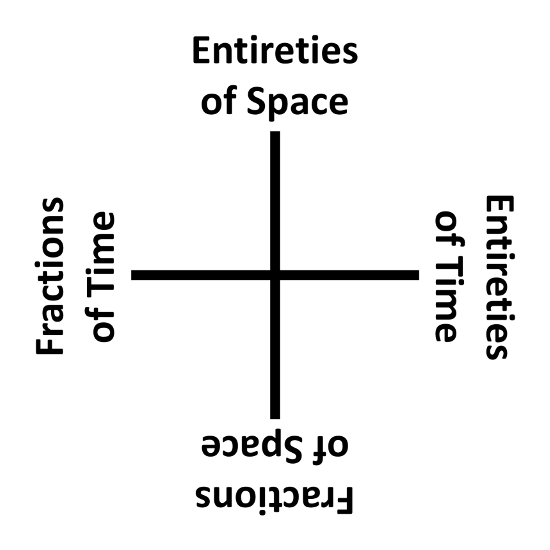
Most of the paradoxes of Zeno were about fractions and entireties of time and space. Can an infinite series of fractions of space add up to a finite entirety of space in a finite entirety of time? Some might say that integral calculus solves these basically mathematical problems, yet others think they point to metaphysical issues as regards to the discreteness and the continuity of time and space.

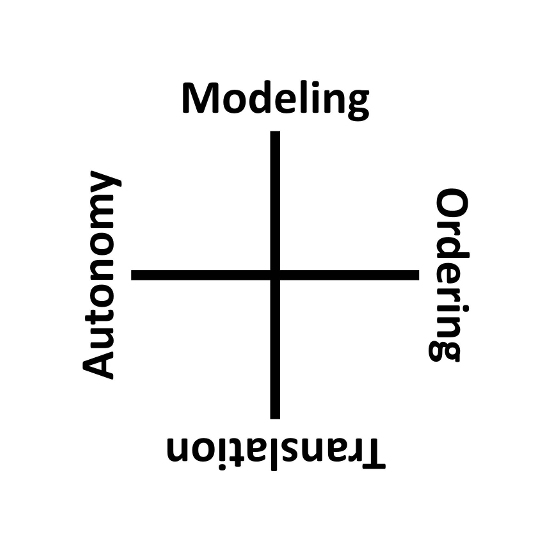
This fourfold reminds me of my previous fourfold Spacetime which dealt with succession (as parts of time), location (as parts of space), extension (as wholes of space), and duration (as wholes of time). It must have been in the back of my mind.

References:

https://en.wikipedia.org/wiki/Zeno%27s_paradoxes

https://equivalentexchange.wordpress.com/2011/09/23/spacetime/

[*9.122]

<>

Invention and Discovery

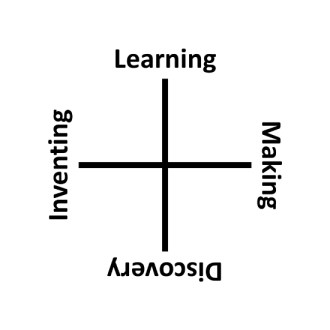
sq_learning2What are the differences between invention and discovery? Ever since my post Propositions as Types I’ve been trying to determine what they are. Some say that mathematics and logic are completely human inventions and they have no correspondence to the natural world. Others say that mathematics already exists in some “Platonic” realm just waiting for our discovery. Similar to convergent evolution, the parallel invention or discovery of similar notions in mathematics lends credence to the idea that there is something “out there” just waiting for us to find it, although one could also argue that it’s merely the cultural climate along with some innate functioning of the brain. For example there is the parallel development of calculus by Newton and Leibniz. The notion of effective computability in the “Propositions as Types” paradigm also has several concurrent developments.

Modern science is based on mathematics so as one goes so goes the other. Physicist Eugene Wigner wrote a famous article on the “Unreasonable effectiveness of mathematics in the natural sciences” which has inspired a host of similarly titled articles about the “unreasonable effectiveness” of one thing for another. But the key point is that we really don’t understand the origins of mathematical thinking, or why it is so useful in helping us understand the natural world. Its value and utility seems, in fact, unreasonable.

But let’s return to the differences between invention and discovery. If something is invented, it means that it is new, freshly created. If something is discovered, it means that it already exists and it’s just waiting for us to find it. Thus the difference is between the natural and artificial, or between what exists and what didn’t exist before humans created it. Some believe the natural world itself is socially constructed, so in some sense it didn’t exist before humans saw it, or will disappear when humans stop perceiving it. This is about is arrogant as believing that the world didn’t exist before a person was born or after they die; a solipsistic view if ever there was one.

Once something is discovered, one can learn about it. Once something is invented, one can make it. Thus learning and making are tied to discovering and inventing, respectively. Inventing and discovering are required for making and learning. Of course one can also learn about an invention or how something is made, or one can learn facts about a discovery.

This fourfold of inventing, discovering, learning, and making is also related to other fourfolds. The Four Hats of Creativity seem to utilize each of these special actions for each livelihood: inventing (or creating) for the artist, discovery for the scientist, and making for the engineer (but less well learning for the designer). In addition, the Psychological Types of Jung appear to emphasize a type for each special action: intuition for invention, sensation for discovering, and cognition for learning (but less clear emotion for making).

Please compare this with a related analysis on the methods of active learning at the Tetrast (link below), where the key faculties are struggle for invention, practice for discovery, value for making, and discipline for learning.

References:

https://en.wikipedia.org/wiki/Convergent_evolution

https://math.dartmouth.edu/~matc/MathDrama/reading/Wigner.html

http://tetrast2.blogspot.com/2013/04/methods-of-learning.html

[*9.86]

<>
 

Four Bindings

sq_four_bindings

Nothing in the world stands by itself. Every object is a link in an endless chain and is thus connected with all the other links. And this chain of the universe has never been broken; it unites all objects and processes in a single whole and thus has a universal character. We cannot move so much as our little finger without “disturbing” the whole universe. The life of the universe, its history lies in an infinite web of connections.

— A. Spirkin, from Dialectical Materialism

How is the universe bound up with itself, and we and everything else, as denizens of it? How are we connected to each other, and with all the other things in the universe? And how is all that stuff related to itself, and with all the other stuff that it shares space and time with?

In a previous post I mentioned chains, grids, cycles, and blocks, and associated them with the Four Causes and my fourfold Structure-Function. As I thought more about what those terms meant, I decided that they were bindings.

At first I tried to enumerate how four things could be arranged in exactly four ways. I didn’t get very far with that, but I ended up with this fourfold. It’s a gift.

References:

When I looked up “universal connections”, the first thing I saw was the following link:

https://www.marxists.org/reference/archive/spirkin/works/dialectical-materialism/ch02-s05.html

Alexander Spirkin / Dialectical Materialism

https://www.marxists.org/reference/archive/spirkin/works/dialectical-materialism/index.html

Sylvia Plath / Love Letter

http://allpoetry.com/Love-Letter

[*9.27, *9.102]

<>

Categories of Experience

sq_categoriesThe philosophy of Charles S. Peirce is chock-full of triples, but especially present are his three universal categories of experience. Threes aren’t really my specialty, but while reading a chapter of Richard Bernstein’s book on the “pragmatic turn”, I was reminded of Peirce’s relational ontology: Firstness, Secondness, and Thirdness. Wondering how these could be extended to a Fourthness, I immediately found a fair amount of work on the subject.

Of course, Peirce argued that such a Fourthness was redundant, unnecessary to the structure of his systematic philosophy. He used various reasons for his conclusions, including mathematical, logical, and semiological. There is also a wealth of subsequent work by later researchers on defending this claim, but what is interesting is that others have investigated extending his three into a four.

So, what might be Fourthness? Some of the aspects of fourfolds collected here have commonalities with some of the attributes of Firstness, Secondness, and Thirdness. For Firstness: feeling, quality, possibility; For Secondness: will, fact, existence; For Thirdness: knowledge, law, representation. I really don’t have anything to add at the present time and I have merely gathered these notions together for my future consideration.

References:

http://en.wikipedia.org/wiki/Categories_%28Peirce%29

http://en.wikipedia.org/wiki/Hypostatic_abstraction

http://www.paulburgess.org/triadic.html

http://tetrast.blogspot.com/2006/09/compare-to-aristotle-aquinas-peirce.html

Carl G. Vaught / Semiotics and the Problem of Analogy: a critique of Peirce’s theory of categories. Trans. of the Charles S. Peirce Society, Vol. 22, No. 3 (1986) 311-326

http://www.jstor.org/stable/40320143

Carl R. Hausman / Fourthness: Carl Vaught on Peirce’s categories. Trans. of the Charles S. Peirce Society, Vol. 24, No. 2 (1988) 265-278

http://www.jstor.org/stable/40320211

Donald W. Mertz / Peirce: logic, categories, and triads. Trans. of the Charles S. Peirce Society, Vol. 15, No. 2 (1979) 158-175

Richard J. Bernstein / The Pragmatic Turn. Polity (2010)

Also:

Ben Goertzel / The Hidden Pattern: a patternist philosophy of mind

[*9.108, *9.109, *9.112]

<>

Propositions as Types

sq_propositions_as_types3For almost 100 years, there have been linkages forged between certain notions of logic and of computation. As more associations have been discovered, the bonds between the two have grown stronger and richer.

  • Propositions in logic can be considered equivalent to types in programming languages.
  • Proofs of propositions in logic can be considered equivalent to programs of given type in computation.
  • The simplification of proofs of propositions in logic can be considered equivalent to the evaluation of programs of types in computation.

The separate work of various logicians and computer scientists (and their precursors) can be paired:

  • Gerhard Gertzen’s work on proofs in intuitionistic natural deduction and Alonzo Church’s work on the simply typed lambda calculus.
  • J. Roger Hindley and Robin Milner’s work on type systems for combinatory logic and programming languages, respectively.
  • J. Y. Girard and John Reynold’s work on the second order lambda calculus and parametric polymorphic programs, respectively.
  • Haskell Curry’s and W. A. Howard’s work on the overall correspondence between these notions of proofs as programs or positions as types.

Logic and computation are the sequential chains of efficient causation and actions. Propositions and types are the abstract grids of formal causation and structures. Proofs and programs are the normative cycles of final causation and functions. Simplification and evaluation are the reductive solids of material causation and parts.

References:

Philip Wadler / Propositions as Types, in Communications of the ACM, Vol. 58 No. 12 (Dec 2015) Pages 75-85.

http://cacm.acm.org/magazines/2015/12/194626-propositions-as-types/fulltext

Preprint at

Click to access propositions-as-types.pdf

Also see:

http://www.drdobbs.com/old-ideas-form-the-basis-of-advancements/184404384

https://en.wikipedia.org/wiki/Hindley%E2%80%93Milner_type_system

https://en.wikipedia.org/wiki/System_F

https://en.wikipedia.org/wiki/Curry%E2%80%93Howard_correspondence

[*9.92-9.94]

<>


Means and Ends

sq_means_and_ends2

An interesting fourfold I saw while browsing through “The Power of the 2×2 Matrix” that I mentioned previously was the Means and Ends matrix of Russell Ackoff, known as a pioneer in the fields of systems and management sciences.

Composed of the relationships between two purposeful agents, where the means and the ends of each are separately considered to be compatible or incompatible.

  • Conflict: Incompatible means, incompatible ends
  • Competition: Incompatible means, compatible ends
  • Coalition: Compatible means, incompatible ends
  • Cooperation: Compatible means, compatible ends

Ackoff is also known for the “Hierarchy of Understanding” of Data, Information, Knowledge, and Wisdom, which probably begs for its own entry.

References:

https://en.wikipedia.org/wiki/Russell_L._Ackoff

Russell Ackoff and Fred Emery / On Purposeful Systems: an interdisciplinary analysis of individual and social behavior as a system of purposeful events

Jamshid Gharajedaghi / Systems Thinking: managing chaos and complexity: a platform for designing business architecture

Images of Data Information Knowledge Wisdom

[*9.88, *9.89]

<>

The Four Hats of Creativity

sq_four_hats

These four livelihoods: artist, designer, scientist, and engineer, make a nice fourfold. They are called the “four hats of creativity” by Rich Gold. They are also called the “four winds of making” by computer scientist Richard P. Gabriel.

Some say the artist and scientist are “inward” looking, and the designer and engineer are “outward” looking. Some say the artist and the designer “move minds”, and the scientist and engineer “move matter”. One can observe that the artist sorts the important from the boring, the scientist separates the true from the false, the designer discerns the cool from the uncool, and the engineer divides the good from the bad.

References:

Rich Gold / The Plenitude: creativity, innovation, and making stuff

https://www.dreamsongs.com/

https://www.linkedin.com/pulse/20130727173842-1391-the-creativity-compass

Images of Artist Scientist Designer Engineer.

[*9.20]

<>

A Solstice Message

sq_jung_quote

“As far as we can discern, the sole purpose of human existence is to kindle a light of meaning in the darkness of mere being.”

— Carl Jung, from Memories, Dreams, Reflections

[*9.80]

<>

The Four Cultures Model of Fons Trompenaars

sq_trompenaarHere is a model of cultural differences, with two major axes:

Egalitarian (Decentralized) vs. Hierarchical (Centralized)
Person (Informal) vs. Task (Formal)

Leading to the following types (and orientations):

  • Incubator (Fulfilment) [Egalitarian/Person]
  • Family (Power) [Hierarchical/Person]
  • Guided Missile (Project) [Egalitarian/Task]
  • Eiffel Tower (Role) [Hierarchical/Task]

Trompenaars’ research later expanded these into seven cultural differences (universalism vs. particularism, individualism vs. communitarianism, neutral vs. emotional, specific vs. diffuse, achievement vs. ascription, sequential vs. synchronic, and internal vs. external control)! I’m not clear on how the four map into the seven.

Another model of cultural dimensions was developed by Geert Hofstede, who first found four dimensions (power distance index, individualism vs. collectivism, uncertainty avoidance index, and masculinity vs. femininity), and later increased these to six (adding long-term vs. short-term, and indulgence vs. restraint). Again, I’m unsure what the differences are between Trompenaars’ and Hofstede’s models.

Trompenaars’ model of four cultures is somewhat similar to another fourfold I found in the article “How to Build Scenarios”. It consists of two axes: individual vs. community and fragmentation vs. coherence.

  • Ectopia [Community/Fragmented]
  • I Will [Individual/Fragmented]
  • Consumerland [Individual/Coherent]
  • New Civics [Community/Coherent]

This fourfold is also mentioned in the book “The Power of the 2×2 Matrix”, which looks quite interesting. I think it is generally geared towards business decision applications, but has a compendium of various 2×2 matrices that appear to be broadly useful.

Also, the ChangingMinds.org website looks like it has a wealth of models and introductory information about them (and not only those with four aspects).

References:

http://changingminds.org/explanations/culture/trompenaars_four_cultures.htm

https://en.wikipedia.org/wiki/Fons_Trompenaars

http://en.wikipedia.org/wiki/Trompenaars’_model_of_national_culture_differences

http://en.wikipedia.org/wiki/Hofstede’s_cultural_dimensions_theory

Books / Articles:

Fons Trompenaars, Peter Woolliams / Business Across Cultures

Lawrence Wilkinson / How to Build Scenarios (in Wired Scenarios 1.01)

Alex Lowy, Phil Hood / The Power of the 2×2 Matrix: using 2×2 thinking to solve business problems and make better decisions

[*4.130, *9.64, *9.82]

<>

Childhood’s End

sq_childhoods_end“No utopia can ever give satisfaction to everyone, all the time. As their material conditions improve, men raise their sights and become discontented with power and possessions that once would have seemed beyond their wildest dreams. And even when the external world has granted all it can, there still remain the searchings of the mind and the longings of the heart.”

― Arthur C. Clarke, Childhood’s End

References:

https://www.goodreads.com/work/quotes/209414-childhood-s-end

[*9.86]

<>

Every Fourth Thing

Daydream Tourist

Because there are way more than seven wonders in the world.

The Digital Ambler

Always Forward Between Heaven and Earth

The Mouse Trap

Psychological Musings

Wrong Every Time

Critiquing anime and everything else

The Chrysalis

"For man has closed himself up, till he sees all things thro' narrow chinks of his cavern" -- William Blake

  Bartosz Milewski's Programming Cafe

Category Theory, Haskell, Concurrency, C++

The Inquisitive Biologist

Reviewing fascinating science books since 2017

Gizmodo

Every Fourth Thing

Simplicity

Derek Wise's blog: Mathematics, Physics, Computing and other fun stuff.

COMPLEMENTARY 4x

integrating 4 binary opposites in life, learning, art, science and architecture

INTEGRATED 4x

integrating 4 binary opposites in life, learning, art, science and architecture

Playful Bookbinding and Paper Works

Chasing the Paper Rabbit

Antinomia Imediata

experiments in a reaction from the left

Digital Minds

A blog about computers, evolution, complexity, cells, intelligence, brains, and minds.

philosophy maps

mind maps, infographics, and expositions

hyde and rugg

neat ideas from unusual places

Visions of Four Notions

Introduction to a Quadralectic Epistomology

Explaining Science

Astronomy, space and space travel for the non scientist

Log24

Every Fourth Thing

Ideas Without End

A Serious Look at Trivial Things

Quadralectic Architecture

A Survey of Tetradic Testimonials in Architecture

Minds and Brains

Musings from a Naturalist

Why Evolution Is True

Why Evolution is True is a blog written by Jerry Coyne, centered on evolution and biology but also dealing with diverse topics like politics, culture, and cats.

Quadriformisratio

Four-fold thinking4you

Multisense Realism

Craig Weinberg's Cosmology of Sense

RABUJOI - An Anime Blog

Purveyors of Fine Anime Reviews and Ratings Since 2010

Intra-Being

Between Subject and Object

The Woodring Monitor

Every Fourth Thing

FORM &amp; FORMALISM

Every Fourth Thing

Log24

Every Fourth Thing

The n-Category Café

Every Fourth Thing

THIS IS NOT A BLOG

Every Fourth Thing

PHILOSOPHY IN A TIME OF ERROR

Sometimes those Sticking their Heads in the Sand are Looking for Something Deep

Networkologies

Online Home of Christopher Vitale, Associate Professor of Media Studies, The Graduate Program in Media Studies, Pratt Institute, Brooklyn, NY.

Hyper tiling

Linking Ideas

DEONTOLOGISTICS

RESEARCHING THE DEMANDS OF THOUGHT

Incognitions

Explorations in the Paradoxes of Meaning

Object-Oriented Philosophy

"The centaur of classical metaphysics shall be mated with the cheetah of actor-network theory."

Objects & Things

objects & things, design, art & technology