Analogical Thinking

sq_analogicalIs analogy or metaphor the root of thinking? Some thinkers think so. But what exactly is analogy?

Looking at various lists of analogies of the A:B::C:D motif, I have distilled them into four groups: Relational, Hierarchical, Linguistical, and Mathematical. Are there analogies that don’t fit this scheme?

Relational

Object / characteristic
Order, sequence
Transformation
Agent / object, action
Function, purpose
Cause / effect
Source / product

Hierarchical

Classification, category, type, membership
Whole / part
General / specific

Linguistical

Meaning, definition
Synonym, antonym
Contrast, degree, intensity
Word parts
Expressions

Mathematical

Equivalence
Multiples
Negation
Patterns, geometries
Number
Size, magnitude
Direction, vectors
Spacial, temporal
Ratio, proportion

References:

https://en.wikipedia.org/wiki/Analogy

http://www.nyjournalofbooks.com/book-review/surfaces-and-essences-analogy-fuel-and-fire-thinking

View at Medium.com

Currently Reading:

George Lakoff, Mark Johnson / Metaphors We Live By

To Read:

Douglas Hofstadter, Emmanuel Sander / Surfaces and Essences: analogy as the fuel and fire of thinking, Basic Books (2013)

Noah Roderick / The Being of Analogy, Open Humanities Press (2016)

https://en.wikipedia.org/wiki/Functor

[*9.140, *9.141, *9.178]

<>

Pass It On!

sq_pass_it_on3Is humankind selfish by nature or altruistic? Are people competitive or cooperative? Tribal or cosmopolitan? The short answer to all these questions is yes. We are both of those things, and often at the same time.

In this new age of nationalism and protectionism, we are diminished by our choices made from fear and small mindedness. Almost all the knowledge we have is from the choices, both good and bad, made by our forebearers, and those they have met and helped and been helped by along the way. Certainly our individual hard work does us credit, but most of the credit goes to what is automatically given to us at birth.

This includes but is not limited to: our language and our culture; our knowledge and science; our heritage and cultural relationships; our technology and skills; our education and institutions. All this and more, generated by our ancestor’s struggle to survive and flourish, as well as for the survival and flourishing of their progeny and their society.

As we think the horizons of our future recede we squabble over our claims and our distrust. I think we are made better more by our sharing of knowledge than our hoarding. Of course the things shared must have value; they cannot be lies or false or fake. Let us extend our concerns to all of humankind and to the earth we share.

  • If someone can create something, then others can make it.
  • If someone can find or discover something, then others can know, see, or grasp it.
  • If someone can teach something, then others can learn it.
  • If someone can demonstrate or show something, then others can use, do, or apply it.

Pass it on!

Also See:

Invention and Discovery

https://equivalentexchange.wordpress.com/2016/04/15/invention-and-discovery/

[*9.87]

<>

The Anatomy of Technology

sq_technology

Does technology have a fundamental structure? Does it have a unifying code? I am of the mind that technology is the totality of all tools devised by humankind. If so, what constitutes a tool? Again, I believe in a very broad definition, and think language and culture are also tools and thus technology.

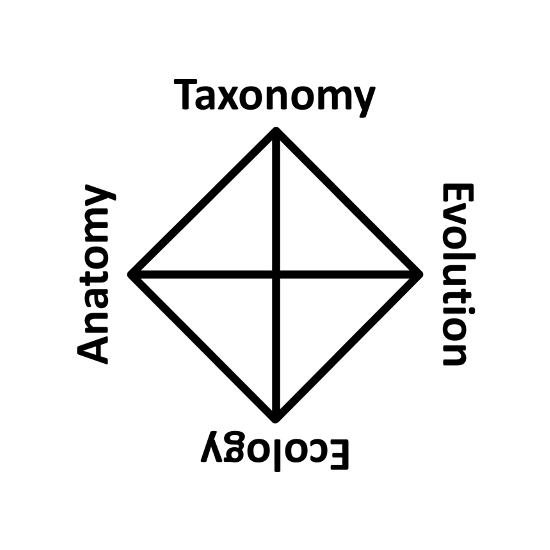
Van Wyk proposes that technology is “created competence.” This competence performs actions (processing, storing, transporting) on stuff (matter, energy, information). sq_technology_frameworksThis begins the first framework of a technology, its anatomy. Along with anatomy, three other frameworks of a technology to consider are its taxonomy, evolution, and ecology.

In my diagram above, I have added a fourth action: that of creation. After all, technology is created competence. One might say technology cannot create, but is itself created. It is true that matter and energy cannot be created, but their shape and flow can be designed. Also, it seems that information can be created, and not just processed.

Further, I propose another addition to the stuff that technology acts upon: technology itself. Technology is often a mix of matter, energy, and information, and so technology can operate on technology and recursively act on and also improve itself. So perhaps both information and technology can at least be thought of as created.

So, in order to broaden the scope of the anatomy of technology, I propose changing the anatomical grid from 3 x 3 to 4 x 4. Then we have as actions

  • Creating & Designing
  • Storing & Accessing
  • Moving & Dispersing
  • Changing & Processing

Of course, the 3 x 3 anatomical grid is a well researched tool, and the changes I propose may not be justified or useful.

References:

Rias J. van Wyk / Technology: a fundamental structure? Knowledge, Technology, and Policy. 9/2002 Vol 15, Issue 3 (14-35)

Download at https://www.researchgate.net/publication/225385908_Technology_A_fundamental_structure

http://www.technoscan.com/

To read:

Rias J. van Wyk / Technology – a unifying code: a simple and coherent view of technology (2004)

Frederick Christoffel Lochner / The functionality grid as paradigm for management of technology

PDF at http://scholar.sun.ac.za/handle/10019.1/17994

Notes:

Van Wyk’s technological analysis is called Strategic Technology Analysis (STA).

In N. Katherine Hayles’ “My Mother Was a Computer”, three modalities of information are making, storing, and transmitting. Interesting that processing is not listed as a modality.

My Mother Was a Computer: Digital Subjects and Literary Texts – N. Katherine Hayles

[*1.37, *3.32, *8.30, *9.2, *9.154, *9.176, *9.177]

<>


Political Fourfolds

sq_politicalToday I present an example of a political fourfold. Frequently they have two factors: first, between the personal and the economic, and second, between liberty and security, or freedom and control. The quadrants that result can have different labels, but the one above is essentially the Nolan Chart, consisting of Authoritarian, Conservatism, Libertarian, and Liberalism.

  • Libertarian (personal freedom, economic freedom)
  • Authoritarian (personal control, economic control)
  • Conservatism (personal control, economic freedom)
  • Liberalism (personal freedom, economic control)

But you can read this anytime! This is an important day in United States politics so I urge everyone that can to please get out and vote!

References:

https://en.wikipedia.org/wiki/Nolan_Chart

Images of “Political Quadrants”:

https://www.google.com/search?q=political+quadrants&biw=1609&bih=888&tbm=isch&tbo=u&source=univ&sa=X&ved=0ahUKEwjBo7upp5nQAhXHwVQKHZXuB28QsAQIGg#imgrc=_

Notes:

Well that went poorly.

Another political or ideological fourfold is Anarchism, Radicalism, Conservatism, and Liberalism. This appears in Hayden White’s “Metahistory” but I’m unsure of its previous history.

[*3.172, *7.31, *9.172]

<>

A Game of Fourfolds, Part 4

sq_game4

Many of the fourfolds presented here are roughly a combination of two dualities, a double dual if you will. Their diagrams could be considered as a crossed pair of rectangular cards, with each card showing a single pair of opposites. If one creates cards for every unique and important dual, new juxtapositions not thought of previously may be revealed by random and spontaneous association.

Of course many fourfolds cannot be reduced to the simple sum of their parts, or even the sum of their pairs. All four concepts often ramify themselves and each other due to binary, tertiary, and quaternary relations. Then the fourfold is greater than its individual constituents.

For example, the Four Elements are more than the opposite pairs of Air and Earth, Fire and Water. In Hjelmslev’s Net, Substance and Form combines with a superficially similar Content and Expression. However, above is an example of what I am striving for when Space and Time is combined with Matter and Energy.

Below is a list of dualities that might be used to create a useful set of cards. Some duals will come from fourfolds mentioned here but others will be new. Dualities or dichotomies are usually included in lists of opposites or antonyms, although they are usually more philosophical in nature.

Fourfolds that cannot be readily divided into two duals may by presented by square cards, perhaps called “trumps” or “major arcana” (or perhaps even “arcana quadra”). If cards are picked randomly but placed by choice, the rules of such actions must next be determined.

List of Duals (alphabetic):

Above, Below
Absence, Presence
Absolute, Relative
Abstract, Concrete
Active, Passive
Actual, Potential (Actual, Possible)
Addition, Subtraction
After, Before
All, None
Analytic, Synthetic
Answer, Question
And, Or
A Posteriori, A Priori
Artificial, Natural
Asymmetric, Symmetric
Atom, Void
Beautiful, Horrible
Begin, End (Start, Stop)
Being, Becoming
Belief (Faith), Doubt
Big, Little
Birth, Death
Black, White
Body, Mind
Bondage, Freedom
Bounded, Infinite
Cause, Effect
Chaos, Order (Discord, Harmony)
Child, Parent
Clean, Dirty
Combine, Separate
Complex, Simple
Content, Expression
Contingent, Necessary
Continuous, Discrete
Create, Destroy
Crooked, Straight
Dark, Light
Dawn, Dusk
Day, Night
Dead, Live
Decrease, Increase
Demand, Supply
Difference, Sameness (Distinction, Similarity)
Disease, Health (Sick, Well)
Division, Multiplication
Down, Up
Dynamic, Static
Electrical, Magnetic
Emotion, Reason (Irrational, Rational)
Empirical, Rational
Empty, Full
Enemy, Friend
Energy, Matter
Ends, Means
Even, Odd
Evil, Good
False, True
Far, Near
Fast, Slow
Female, Male
Fool, Sage
Forget, Remember
Found, Lost (Find, Lose)
Form, Substance
Future, Past
Gather, Scatter
Give, Take
Global, Local
Greater, Lesser
Guest, Host
Happiness, Sadness
Hate, Love
Hero, Villain
Hidden, Revealed (Invisible, Visible)
Higher, Lower
Holoscopic, Meroscopic
Illogic, Reason
Illusion, Reality
Immanent, Transcendent
Inside, Outside (Internal, External)
Left, Right
Listen, Speak
Long, Short
Many, One
Me, You (Them, Us)
Mix, Sort
Moon, Sun
Nature, Culture
Nature, Nurture
Negative, Positive
New, Old
Object, Subject (Objective, Subjective)
Ontic, Phenomenal
Other, Self
Part, Whole
Particle, Wave
Particular, Universal
Peace, War
Permanent, Temporary
Play, Work
Practice, Theory
Quality, Quantity
Reap, Sow
Religion, Science
Read, Write
Right, Wrong
Rough, Smooth
Private, Public (Personal, Social)
Profane, Sacred (Secular, Spiritual)
Pull, Push
Space, Time
Strong, Weak
Vice, Virtue

List of Trumps:

Air, Earth, Fire, Water
Cold, Hot, Dry, Wet
East, West, North, South
Fall, Winter, Spring, Summer
Dawn, Day, Dusk, Night

References:

http://www.mastersofuniverse.net/list-of-dualities

Vocabulary list by Opposites (or Antonyms)

http://www.enchantedlearning.com/wordlist/opposites.shtml

http://www.englisch-hilfen.de/en/words/opposites1.htm

http://www.michigan-proficiency-exams.com/antonym-list.html

[*9.34, *9.37]

<>
 

Distinctions with and without Differences

sq_distinction2It is often asked, why is there something rather than nothing?

Instead why not ask, why is there a rich diversity of things, rather than a dull sameness? And even though the closer and the further one looks the diversity is almost without limit, one also sees the world divided into natural kinds that partition it into a differentiated but interrelated mixture.

Several ancient philosophers thought that the entire world was an indivisible whole, a solid “being”. Others thought that you can’t even step into the same river twice, thus a fluid “becoming”. The real world seems to be somewhere in-between these two poles, moving continuously back and forth to now generate difference and newness, and then returning to sameness and oldness, and next continuing on to newness again.

Why drives these generative processes? One could say evolution, but evolution merely means “change over time”. And it would need to be an evolution at all levels of the cosmos, from the physical constituents of matter to the psychological constructs of culture. What do these disparate systems have in common?

Perhaps the commonality lies in the relations between small and large ensembles of chunks of space and time. In theories of statistical thermodynamics, the associations between micro states and macro states as well as micro events and macros events may drive entropy.

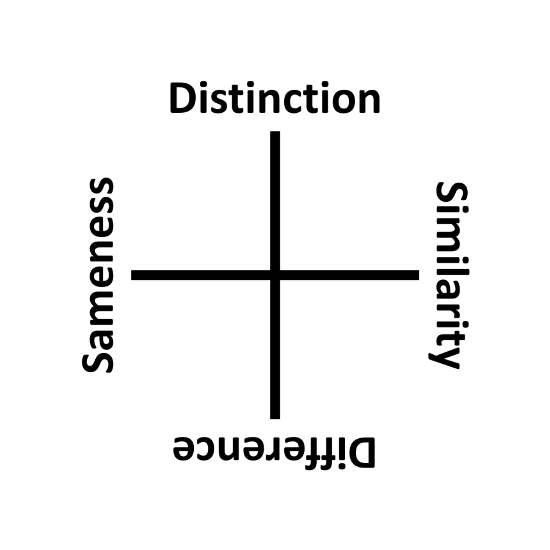
Here I present a schema that divides the continuum between one and many into four: Sameness, Similarity, Distinction, and Difference.
A member of the “being” camp might say these aren’t really different, whereas one from the “becoming” camp could say there really isn’t any sameness to begin with. Here I’ve chosen neither camp but struggled to bridge the gap between them.

References:

https://en.wikipedia.org/wiki/Being

https://en.wikipedia.org/wiki/Becoming_(philosophy)

https://en.wikipedia.org/wiki/Distinction_without_a_difference

Also see:

Statistical Thermodynamics

One and Many

[*9.110]

<>

Statistical Thermodynamics

sq_statisticalWhat drives the arrow of time? How does macroscopic irreversibility arise from microscopic reversibility? What makes entropy increase for closed systems, but decrease in certain open systems?

From the viewpoint of statistical thermodynamics, one can model the evolution of any discrete system by its possible macro states and micro states.

Those macro states having more possible micro states will be more likely to occur, and the macro states having less micro states will be less likely.

Similarly, those macro events caused by more possible micro events will be more likely to obtain, and the macro events caused by less micro events will be less likely.

Therefore, the probabilities of how the past effects the future are determined by the arrangements of the parts making up the micro states and macro states, and similarly the chains of causes constituting the relations between the micro events and macro events.

Apparently time is a progression of events unfolding from the more ordered to the less ordered. However, we know that local order can increase while global order decreases, even if we are unclear as to why. Information and organization can grow; nature and biological evolution are proof of it.

So there is an arrow of time, yet one might think that time is more like a river. (Heraclitus said you could not step into the same river twice.) There is a main flow of the current that carries most everything downstream to disorganization and increasing entropy, but there are eddies here and there that actually increase information and organization.

What enables this to happen? Some say thermodynamic gradients. Some say quantum entanglement. Some say gravity. Some say by the expansion of the universe. Some say dark matter or dark energy. Some say sorting processes.

Can we think of time as being “reversed” in these eddies where information and organization increase locally? No, but it’s an interesting (unscientific) thought.

References and Further Reading:

http://www.informationphilosopher.com/problems/arrow_of_time/

https://en.wikipedia.org/wiki/Arrow_of_time

https://en.wikipedia.org/wiki/Statistical_mechanics

https://en.wikipedia.org/wiki/Entropy

https://en.wikipedia.org/wiki/Introduction_to_entropy

https://en.wikipedia.org/wiki/Entropy_(arrow_of_time)

https://en.wikipedia.org/wiki/Entropy_(statistical_thermodynamics)

https://en.wikipedia.org/wiki/Entropy_(classical_thermodynamics)

https://en.wikipedia.org/wiki/Entropy_(order_and_disorder)

https://en.wikipedia.org/wiki/Entropy_(information_theory)

https://en.wikipedia.org/wiki/Sorting

Italo Scardovi / Time and Chance: a statistical hendiadys

https://rivista-statistica.unibo.it/article/viewFile/75/71

[*7.136, *8.43]

<>

Laws of Form

sq_laws_of_formGeorge Spencer-Brown, author of Laws of Form, recently passed away.

I’ve tried to appreciate this work in the past, but couldn’t really get started. I recently ran across the following four terms associated with the work,

  • Compensation
    -> (())
  • Cancellation
    (()) ->
  • Condensation
    ()() -> ()
  • Confirmation
    () -> ()()

Compensation and Cancellation are both considered Order, and Condensation and Confirmation are both considered Number. Number and Order are distinguished by Distinction, and the pairs of the two distinctions are distinguished by Direction.

I understand Laws of Form starts with “Draw a distinction.” Perhaps I would say “Draw a distinction, then draw a distinction of that distinction.”

References:

http://www.telegraph.co.uk/obituaries/2016/09/13/george-spencer-brown-polymath-who-wrote-the-landmark-maths-book/

https://en.wikipedia.org/wiki/G._Spencer-Brown

https://en.wikipedia.org/wiki/Laws_of_Form

https://en.wikipedia.org/wiki/Distinction_(philosophy)

For further reading:

An Esoteric Guide to Spencer Brown’s Laws of Form #4

Distinction: On Deconstruction

https://www.xenodochy.org/formal/fs_aritx.html

The ‘Form’ of Complexity:

Notes:

Compensation (+2) (Pairs of parentheses)
Cancellation (-2) (Involutory?)
Condensation (-1) (Idempotence)
Confirmation (+1)

[*9.158]

<>


T. S. Eliot: Four Quartets

sq_four_quartets5At the still point of the turning world. Neither flesh nor fleshless;
Neither from nor towards; at the still point, there the dance is,
But neither arrest nor movement.

— From Burnt Norton by T. S. Eliot

Time is a child playing dice.

Heraclitus

See:

http://www.davidgorman.com/4Quartets/

https://en.wikipedia.org/wiki/Four_Quartets

2. The Four Quartets

[*9.148]

<>

The Four New Elements

sq_new_elementsFour new elements have been named! They are Nihonium (Nh 113), Moscovium (Mc 115), Tennessine (Ts 117), and Oganesson (Og 118).

References:

IUPAC is naming the four new elements nihonium, moscovium, tennessine, and oganesson

Also see:

https://equivalentexchange.wordpress.com/2010/07/21/the-four-elements-of-empedocles/

[*9.136]

<>

Every Fourth Thing

Daydream Tourist

Because there are way more than seven wonders in the world.

The Digital Ambler

Always Forward Between Heaven and Earth

The Mouse Trap

Psychological Musings

Wrong Every Time

Critiquing anime and everything else

The Chrysalis

"For man has closed himself up, till he sees all things thro' narrow chinks of his cavern" -- William Blake

  Bartosz Milewski's Programming Cafe

Category Theory, Haskell, Concurrency, C++

The Inquisitive Biologist

Reviewing fascinating science books since 2017

Gizmodo

Every Fourth Thing

Simplicity

Derek Wise's blog: Mathematics, Physics, Computing and other fun stuff.

COMPLEMENTARY 4x

integrating 4 binary opposites in life, learning, art, science and architecture

INTEGRATED 4x

integrating 4 binary opposites in life, learning, art, science and architecture

Playful Bookbinding and Paper Works

Chasing the Paper Rabbit

Antinomia Imediata

experiments in a reaction from the left

Digital Minds

A blog about computers, evolution, complexity, cells, intelligence, brains, and minds.

philosophy maps

mind maps, infographics, and expositions

hyde and rugg

neat ideas from unusual places

Visions of Four Notions

Introduction to a Quadralectic Epistomology

Explaining Science

Astronomy, space and space travel for the non scientist

Log24

Every Fourth Thing

Ideas Without End

A Serious Look at Trivial Things

Quadralectic Architecture

A Survey of Tetradic Testimonials in Architecture

Minds and Brains

Musings from a Naturalist

Why Evolution Is True

Why Evolution is True is a blog written by Jerry Coyne, centered on evolution and biology but also dealing with diverse topics like politics, culture, and cats.

Quadriformisratio

Four-fold thinking4you

Multisense Realism

Craig Weinberg's Cosmology of Sense

RABUJOI - An Anime Blog

Purveyors of Fine Anime Reviews and Ratings Since 2010

Intra-Being

Between Subject and Object

The Woodring Monitor

Every Fourth Thing

FORM &amp; FORMALISM

Every Fourth Thing

Log24

Every Fourth Thing

The n-Category Café

Every Fourth Thing

THIS IS NOT A BLOG

Every Fourth Thing

PHILOSOPHY IN A TIME OF ERROR

Sometimes those Sticking their Heads in the Sand are Looking for Something Deep

Networkologies

Online Home of Christopher Vitale, Associate Professor of Media Studies, The Graduate Program in Media Studies, Pratt Institute, Brooklyn, NY.

Hyper tiling

Linking Ideas

DEONTOLOGISTICS

RESEARCHING THE DEMANDS OF THOUGHT

Incognitions

Explorations in the Paradoxes of Meaning

Object-Oriented Philosophy

"The centaur of classical metaphysics shall be mated with the cheetah of actor-network theory."

Objects & Things

objects & things, design, art & technology