The Duality of Time and Information, V3

The states of a computing system bear information and change time, while its events bear time and change information.

— from The Duality of Time and Information by Vaughan Pratt

The most promising transformational logic seems to us to be Girard’s linear logic.

— from Rational Mechanics and Natural Mathematics by Vaughan Pratt

Here we have three duals:

  • Information – Time
  • States – Events
  • Bear – Change

Further Reading:

Vaughan Pratt / The Duality of Time and Information http://boole.stanford.edu/pub/dti.pdf

Vaughan Pratt / Time and Information in Sequential and Concurrent Computation http://boole.stanford.edu/pub/tppp.pdf

Vaughan Pratt / Rational Mechanics and Natural Mathematics http://chu.stanford.edu/guide.html#ratmech

[*5.170]

<>

The Philosopher’s Wheel

Eric A. Meece’s web site philosopherswheel.com has been in existence for a while, and it claims there is a forthcoming book called “The Philosopher’s Wheel”. This seems like an interesting project and it’s a shame that the book is still “in process”.

Meece has certainly been working on these ideas for a few years. Starting with a Master’s thesis in 1979, and a presentation in 2001, he also has a collection of articles available to the reader that are related to his theme.

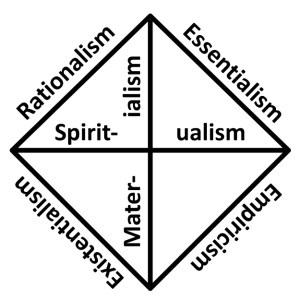
The philosopher’s wheel is essentially composed of three polarities:

  • Materialism vs. Spiritualism
  • Rationalism vs. Empiricism
  • Essentialism vs. Existentialism

Two polarities are related to Jung’s Psychological Types:

  • Rationalism (Thinking)
  • Empiricism (Sensing)
  • Existentialism (Feeling)
  • Essentialism (Intuiting)

I’ve tried to represent these dualities a little differently than Meece. Note in the above diagram that Materialism mediates Rationalism and Empiricism, and Spiritualism mediates Essentialism and Existentialism, similar to the wheel representation.

At right is an attempt at eliminating the “isms”. Perhaps I should have read some more of his writings before making these efforts.

Further Reading:

http://philosopherswheel.com/

http://philosopherswheel.com/philosophycircle.htm

Notes:

The more I think about it, the more I like to compare this with

https://equivalentexchange.wordpress.com/2017/09/09/simon-magus-and-the-six-roots-of-boundless-power/

Images of the Philosopher’s Wheel:

https://www.google.com/search?q=philosopher%27s+wheel&tbm=isch

<>
 

Cassini

“Thanks, and farewell, faithful explorer.”

— Cassini program manager Earl Maize

Today, Cassini’s impetus succumbed to Saturn’s gravity.

Further Reading:

https://www.google.com/amp/amp.usatoday.com/story/667937001/

<>

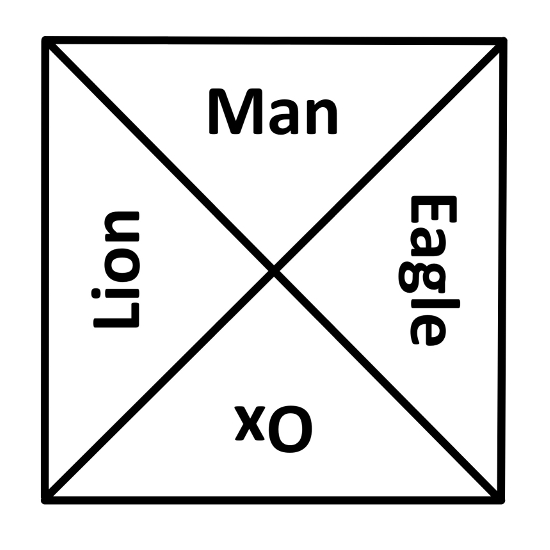
Behold, the Tetramorph

I’ve felt a fondness for the Tetramorph for a long time. Four beings considered simultaneously: a man, an ox, a lion, an eagle.

They are the Babylonian symbols of the four fixed signs of the zodiac: ox or bull for Taurus (and earth), lion for Leo (and fire), eagle for Scorpio (and water), man for Aquarius (and air).

They can be thought of as representing the ancient four elements: earth, fire, water, and air.

They are mentioned in the Judeo-Christian Bible in the books of Ezekiel and Revelation. They have also been paired with the four evangelists and their books: Matthew, Mark, Luke, and John (although the pairing is not fixed).

They are shown on the Tarot card for the “Wheel of Fortune” in the Rider-Waite deck, and the card for the “World” in the Tarot of Marseilles.

Why these four creatures, and not others?

Further Reading:

https://en.wikipedia.org/wiki/Tetramorph

The Tetramorph; The Sumerian Origins of a Christian Symbol

Sacred Symbols: The Four Evangelists (Tetramorph)

Under The Sign Of Tetramorph

https://en.wikipedia.org/wiki/Astrology_and_the_classical_elements#Elements_of_the_zodiac

44. The Tetramorph and more

[*8.38, *8.96]

<>

Simon Magus and the Six Roots of Boundless Power

As we had a taste of Christian Eschatology last time we now nibble on Christian Gnosticism. Simon was mentioned in the bible and in apocryphal works was purported to be a sorcerer of some renown. He developed a philosophically idealistic system wherein six roots of mental aspects issue from a fundamental principle of “Fire”:

  • Mind (Heaven)
  • Voice (Sun)
  • Reason (Air)
  • Reflection (Water)
  • Name (Moon)
  • Thought (Earth)

These six roots form three pairs:

  • Mind [Nous] – Thought [Epinoia]
  • Voice [Phone] – Name [Onoma]
  • Reason [Logismos] – Reflection [Enthumesis]

Above is a representation of these six roots forming their three pairs or syzygies. Most of Simon’s teachings have been either been lost or perhaps even degraded from their original meaning. Do I waste both my time as well as yours to perpetuate this esoteric nonsense? Or is there some merit in it, if only for idle amusement?

Further Reading:

https://en.wikipedia.org/wiki/Simon_Magus

https://en.wikipedia.org/wiki/Simonians

https://hermetic.com/sabazius/simon

http://gnosis.org/library/grs-mead/grsm_simon_magus.htm

http://www.katinkahesselink.net/his/Simon-Magnus.html

http://www.sacred-texts.com/gno/fff/fff21.htm

G. R. S. (George Robert Stow) Mead / Simon Magus: His Philosophy and Teachings

Notes:

Sometimes Mind is called Reason, and then Reason is called Judgment.

Greek philosopher Heraclitus also thought that fire was the fundamental element.

http://www.heraclitusfragments.com/categories/fire.html

Simon was thought to have written the book “The Four Quarters of the World”, now lost to us. Perhaps it was in the Library of Alexandria?

Compare the six roots to de Bono’s six thinking hats.

[*9.222, *9.223]

<>

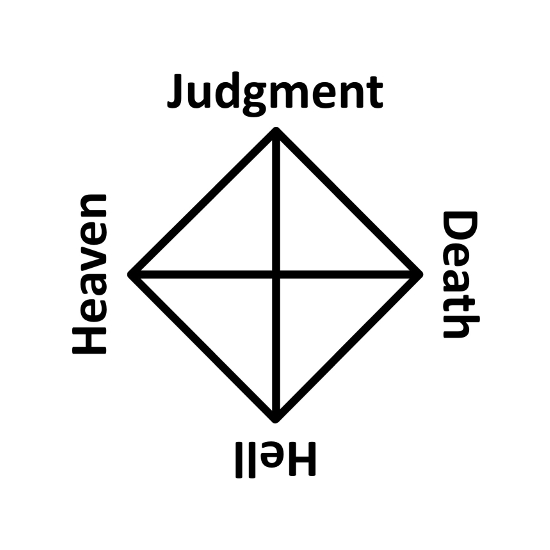
The Four Last Things

Over the years, there has been much religious consideration of the four last things in Christian Eschatology. They are

  • Death
  • Judgment
  • Heaven
  • Hell

Many books have been written and many paintings have been painted. In my project to present every fourth thing, I imagine I’ll come to them eventually, but why wait until then? Or maybe I’m thinking of the “Last Four Things”.

Actually, I’d much rather play the video game on my Mac, because it looks like a lot more fun. Plus it uses classical music for a background soundtrack and images from Hieronymus Bosch’s paintings, such as the Garden of Earthly Delights. When will the Mac version be available? Anyone?

Further Reading:

https://en.wikipedia.org/wiki/Four_last_things

https://en.wikipedia.org/wiki/Christian_eschatology

https://en.wikipedia.org/wiki/Four_Last_Things_(video_game)

http://joemcrichardson.com/fourlastthings/presskit.html

Robert Southwell / A Four-fold Meditation of the Four Last Things

News:

FLT is finally out on Android and iOS! There is much rejoicing!

http://steamcommunity.com/games/503400/announcements/detail/1669015871902809029

[*10.32]

<>

I Dare You!

In 1931, William H. Danforth published the book “I Dare You! Four fold development: stand tall, think tall, smile tall, and live tall.” Perhaps he is better remembered as the founder of the Ralston Purina Company, maker of many fine products and particularly of Chex Cereals. Indeed, Danforth saw life as a type of checkerboard, such that four key components (or “squares”) – the mental, the physical, the social, and the religious – needed to be in balance in order to achieve fulfillment and success in life.

His book was the expression of his personal philosophy of “Four-square” personal development, and was a early example of the “self-help” style of book that has become so popular. Success! Fulfillment! So much can become yours if you take chances and work hard. If only life was that simple! His four aspects of personal development are

  • Physical: Stand Tall!
  • Mental: Think Tall!
  • Social: Smile Tall!
  • Spiritual: Live Tall!

Further Reading:

https://en.wikipedia.org/wiki/William_H._Danforth

William H. Danforth / I Dare You! Only $1 in Kindle format from Amazon! Worth every penny! Don’t delay, buy today!

[*10.31]

<>

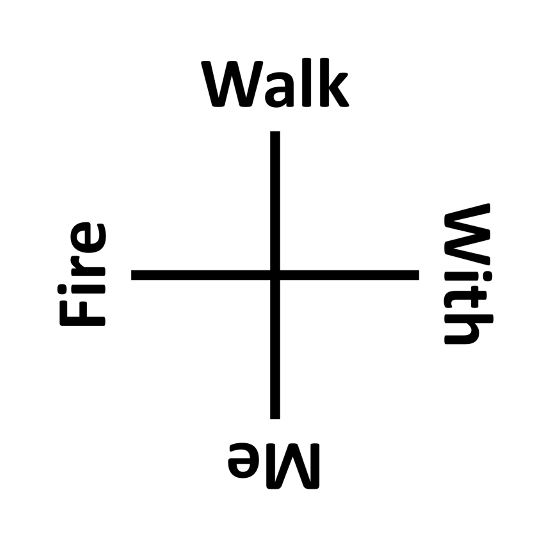
Twin Peaks

Through the darkness of future’s past,
The magician longs to see.
One chants out between two worlds…
“Fire… walk with me.”

— Mike from Twin Peaks

<>

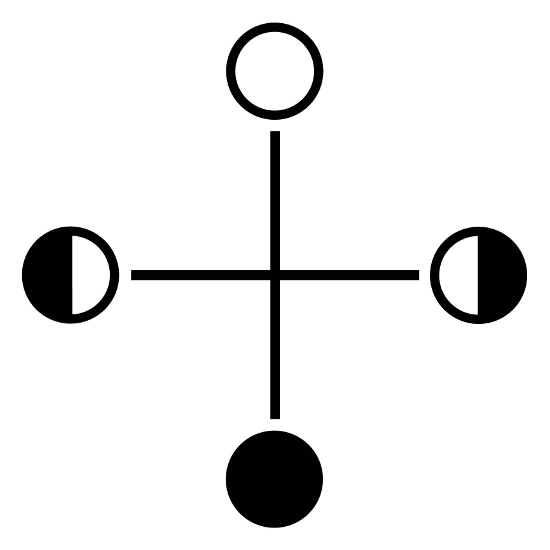
A Solar Eclipse

Further Reading:

https://eclipse2017.nasa.gov/science

https://en.wikipedia.org/wiki/Solar_eclipse_of_August_21,_2017

<>

Four Philosophies, V2

Thinking some more on Popper’s Three Worlds, here is a set of philosophical disciplines that seem to resonate with the themes of this blog.

  • Phenomenology: the philosophical study or theory of phenomena as distinct from that of the nature of being
  • Epistemology: the theory of knowledge, especially with regard to its methods, validity, and scope
  • Ontology: the branch of metaphysics dealing with the nature of being
  • Axiology: the philosophical study of the nature of value and valuation, and of the kinds of things that are valuable

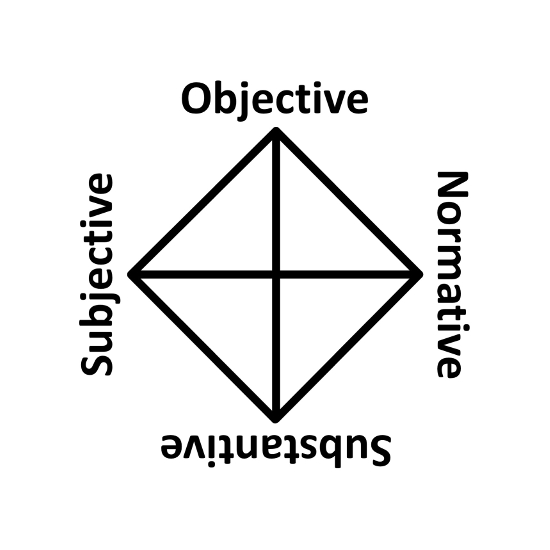
I believe that one could also make a case for associations with phenomenology to the subjective, epistemology to the objective, ontology to the substantive, and axiology to the normative.

Further reading:

https://www.quora.com/What-does-ontology-epistemology-and-axiology-mean

http://cognitive-edge.com/blog/phenomenology-epistemology-ontology/

(Note that the author of the article above, David Snowden, is the creator of the Cynefin Framework.)

https://en.wikipedia.org/wiki/Phenomenology_(philosophy)

https://plato.stanford.edu/entries/phenomenology/

Phenomenology

https://en.wikipedia.org/wiki/Epistemology

https://plato.stanford.edu/entries/epistemology/

Epistemology

https://en.wikipedia.org/wiki/Ontology

https://plato.stanford.edu/entries/logic-ontology/

https://en.wikipedia.org/wiki/Axiology

https://plato.stanford.edu/entries/value-theory/

https://equivalentexchange.wordpress.com/2015/05/14/four-philosophies/

[*10.20]

<=>

Every Fourth Thing

Daydream Tourist

Because there are way more than seven wonders in the world.

The Digital Ambler

Always Forward Between Heaven and Earth

The Mouse Trap

Psychological Musings

Wrong Every Time

Critiquing anime and everything else

The Chrysalis

"For man has closed himself up, till he sees all things thro' narrow chinks of his cavern" -- William Blake

  Bartosz Milewski's Programming Cafe

Category Theory, Haskell, Concurrency, C++

The Inquisitive Biologist

Reviewing fascinating science books since 2017

Gizmodo

Every Fourth Thing

Simplicity

Derek Wise's blog: Mathematics, Physics, Computing and other fun stuff.

COMPLEMENTARY 4x

integrating 4 binary opposites in life, learning, art, science and architecture

INTEGRATED 4x

integrating 4 binary opposites in life, learning, art, science and architecture

Playful Bookbinding and Paper Works

Chasing the Paper Rabbit

Antinomia Imediata

experiments in a reaction from the left

Digital Minds

A blog about computers, evolution, complexity, cells, intelligence, brains, and minds.

philosophy maps

mind maps, infographics, and expositions

hyde and rugg

neat ideas from unusual places

Visions of Four Notions

Introduction to a Quadralectic Epistomology

Explaining Science

Astronomy, space and space travel for the non scientist

Log24

Every Fourth Thing

Ideas Without End

A Serious Look at Trivial Things

Quadralectic Architecture

A Survey of Tetradic Testimonials in Architecture

Minds and Brains

Musings from a Naturalist

Why Evolution Is True

Why Evolution is True is a blog written by Jerry Coyne, centered on evolution and biology but also dealing with diverse topics like politics, culture, and cats.

Quadriformisratio

Four-fold thinking4you

Multisense Realism

Craig Weinberg's Cosmology of Sense

RABUJOI - An Anime Blog

Purveyors of Fine Anime Reviews and Ratings Since 2010

Intra-Being

Between Subject and Object

The Woodring Monitor

Every Fourth Thing

FORM &amp; FORMALISM

Every Fourth Thing

Log24

Every Fourth Thing

The n-Category Café

Every Fourth Thing

THIS IS NOT A BLOG

Every Fourth Thing

PHILOSOPHY IN A TIME OF ERROR

Sometimes those Sticking their Heads in the Sand are Looking for Something Deep

Networkologies

Online Home of Christopher Vitale, Associate Professor of Media Studies, The Graduate Program in Media Studies, Pratt Institute, Brooklyn, NY.

Hyper tiling

Linking Ideas

DEONTOLOGISTICS

RESEARCHING THE DEMANDS OF THOUGHT

Incognitions

Explorations in the Paradoxes of Meaning

Object-Oriented Philosophy

"The centaur of classical metaphysics shall be mated with the cheetah of actor-network theory."

Objects & Things

objects & things, design, art & technology