Octonions

Octonions are the fourth, the last, and the greatest of the so-called normed division algebras based on the Real numbers. When I first learned about the Octonions way back when, I didn’t like them because they weren’t associative like the Quaternions, the Complex numbers, and the Reals. But now I’m fine with that, and they may be important for new theories of physics!

Octonions have the general form:

a0e0 + a1e1 + a2e2 + a3e3 + a4e4 + a5e5 + a6e6 + a7e7

Where the coefficients ai are Real and the bases ei have (something like) the following relations:

e0 = 1 (and -1 = e12 = e22 = …)

e1 = I = e2e3 = e7e6 = e4e5

e2 = J = e5e7 = e3e1 = e4e6

e3 = IJ = e1e2 = e6e5 = e4e7

e4 = K = e5e1 = e6e2 = e7e3

e5 = IK = e7e2 = e1e4 = e3e6

e6 = JK =e5e3 = e1e7 = e2e4

e7 = IJK = e6e1 = e3e4 = e2e5

In addition, if any of the products like e2e3 = e1 are reversed you get the negative, so e3e2 = -e1.

Non-associativity is demonstrated by going through the list of triples:

(e1e2)e3 = e32 = -1

e1(e2e3) = e12 = -1

(e1e2)e4 = e3e4 = e7

e1(e2e4) = e1e6 = -e7

(e1e2)e5 = e3e5 = -e6

e1(e2e5) = e1e7 = e6

so it is hit or miss I guess. Also note that e7 = (IJ)K = -I(JK). And for all (eiej)ek and ei(ejek), if they are not equal, is one equal to the negative of the other? And do I have to multiply them all out to find out?

Further Reading:

https://en.wikipedia.org/wiki/Octonion

http://math.ucr.edu/home/baez/octonions/

https://www.quantamagazine.org/the-octonion-math-that-could-underpin-physics-20180720/

http://mathworld.wolfram.com/Octonion.html

https://ncatlab.org/nlab/show/normed+division+algebra

[*11.33]

<>

Quaternions

The Quaternions are a number system that enlarges the Complex numbers, just as the Complex numbers enlarge the Real numbers. In fact, Quaternions can be thought as special pairs of Complex numbers, just as Complex numbers can be thought as special pairs of Real numbers.

Quaternions can be used for all sorts of wonderful things, such as rotations in 3D space, instead of using matrices. Above is a pitiful diagram (although better than my last one) of the Quaternion units 1, i, j, and k used in the typical representation a + b i + c j + d k. Please read about them in the links below and be amazed!

Further Reading:

https://en.wikipedia.org/wiki/Quaternion

https://en.wikipedia.org/wiki/Quaternions_and_spatial_rotation

http://mathworld.wolfram.com/Quaternion.html

http://www.euclideanspace.com/maths/algebra/realNormedAlgebra/quaternions/

https://www.quantamagazine.org/the-strange-numbers-that-birthed-modern-algebra-20180906/

[*10.160]

<>


Spiral Dynamics

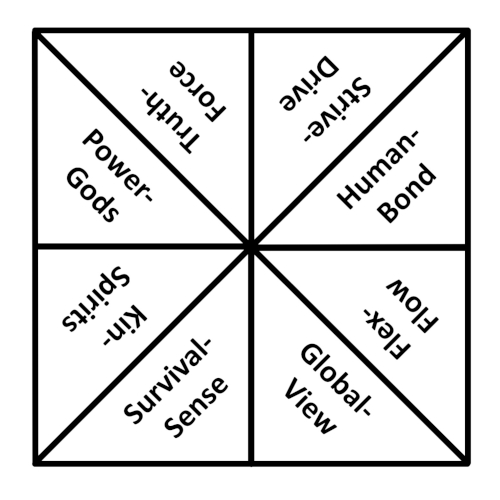
Spiral Dynamics is an intriguing model for the different levels of development and interaction that individuals (and even cultures) may exhibit towards each other and the world. It has interesting parallels to Erikson’s Eight Stages of Psychosocial Development and even Leary’s Eight Brain Circuit Model of Consciousness.

Below is a list of these levels by (Catchy) Name, Social Structure, Motives, and Means of Coping:

  • SurvivalSense, Loose Bands, Survival, Instinctive
  • KinSpirits, Tribes, Magic/Safety, Animistic
  • PowerGods, Empires, Power/Dominance, Egocentric
  • TruthForce, Pyramidal, Order/Morality, Absolutistic
  • StriveDrive, Delegative, Autonomy/Achievement, Multiplistic
  • HumanBond, Egalitarian, Approval/Equality/Community, Relativistic
  • FlexFlow, Interactive, Adaptability/Integration, Systemic
  • GlobalView, Global, Compassion/Harmony, Holistic

And maybe another, further step if we don’t destroy ourselves and the Earth by just being stupid.

Further Reading:

Don Edward Beck, Christopher C. Cowan / Spiral Dynamics: mastering values, leadership and change

Don Edward Beck, et. al. / Spiral Dynamics in Action: humanity’s master code

https://en.wikipedia.org/wiki/Don_Edward_Beck

Fixing our world: Understanding Spiral Dynamics will help us get back on track

Spiral Dynamics Integral: How to Use Grave’s Values Model for Psychological Development

https://en.wikipedia.org/wiki/Integral_theory_(Ken_Wilber)

http://www.awaken.com/2014/04/ken-wilber-summary-of-spiral-dynamics-model/

[*11.41, *11.45]

<>

Howard Gardner’s Theory of Multiple Intelligences

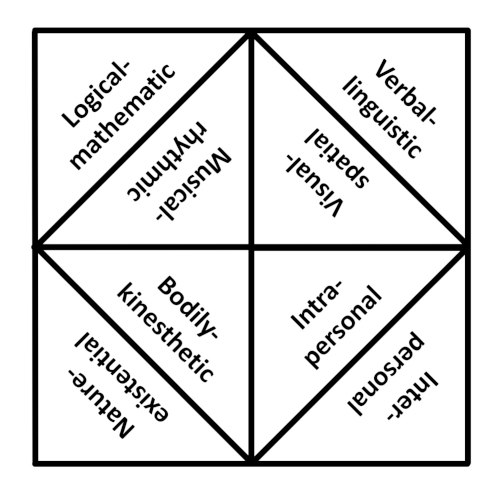
Next we examine (oh so superficially!) Howard Gardner’s Theory of Eight(-ish) Multiple Intelligences. To wit (ha-ha):

  • Intra-personal
  • Interpersonal
  • Bodily-kinesthetic
  • Nature-existential
  • Visual-spatial
  • Verbal-linguistic
  • Musical-rhythmic
  • Logical-mathematical

Further Reading:

https://en.wikipedia.org/wiki/Theory_of_multiple_intelligences

https://www.tecweb.org/styles/gardner.html

Multiple Intelligences

Howard Gardner / Frames of Mind: The Theory of Multiple Intelligences (1983)

Howard Gardner / Multiple Intelligences: The Theory in Practice (1993)

Howard Gardner / Multiple Intelligences: New Horizons in Theory and Practice (2006)

[*11.41]

<>

Erik Erikson’s Eight Stages of Psychosocial Development

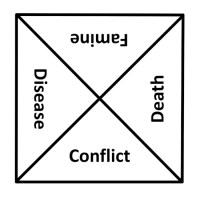
Erik Erikson developed an eight stage developmental model of the psyche for the full life of the human individual. Each stage has a key conflict (with both positive and negative sides), its resolution into a “virtue,” and the typical age range for that conflict.

  • Trust vs. Mistrust, “Hope”, Infancy (0-1 years)
  • Autonomy vs. Shame, “Will”, Early Childhood (1-3 years)
  • Initiative vs. Guilt, “Purpose”, Play Age (3-5 years)
  • Industry vs. Inferiority, “Competency” (or “Ability” or “Skill”), Schooling (5-12 years)
  • Ego identity vs. Role confusion, “Fidelity”, Adolescence (12-18 years)
  • Intimacy vs. Isolation, “Love”, Young Adult (18-40 years)
  • Generativity vs. Stagnation, “Care”, Adulthood (40-65 years)
  • Ego integrity vs. Despair, “Wisdom”, Old Age (65-? years)

I would think that these ages would depend significantly on cultural norms.

Further Reading:

https://en.wikipedia.org/wiki/Erikson%27s_stages_of_psychosocial_development

https://courses.lumenlearning.com/teachereducationx92x1/chapter/eriksons-stages-of-psychosocial-development/

Erik Erikson’s Stages of Psychosocial Development

[*11.44]

<>

The Eight Circuit Model of Consciousness

Timothy Leary’s dead…
No, no-no, he’s outside, looking in…

— The Moody Blues

Timothy Leary came up with this scheme of eight circuits of consciousness and Robert Anton Wilson expanded and renamed most of them. It’s basically a “great-chain” of evolutionary brain circuitry, leading from lower to higher states of consciousness.

labeled my diagram with RAW’s names, but below I also list Leary’s names in parentheses.

  • Oral Bio-survival (Vegetative-invertebrate)
  • Anal Territorial (Emotional-locomotion)
  • Semantic Time-binding (Laryngeal-manual Symbolic)
  • Socio-sexual (Socio-sexual Domestication)
  • Neurosomatic (Neurosomatic)
  • Metaprogramming (Neuro-electric)
  • Morphogenetic (Neurogenetic)
  • Non-local Quantum (Neuro-atomic Metaphysiological)

Pretty wild stuff!

Further Reading:

https://en.wikipedia.org/wiki/Eight-circuit_model_of_consciousness

http://www.phinnweb.org/neuro/8-circuit/

https://en.wikipedia.org/wiki/Timothy_Leary

https://en.wikipedia.org/wiki/Robert_Anton_Wilson

[*11.42]

<>

John Beebe’s Eight Function Model

After my last post about an ad-hoc eightfold metaphysics, I spent a few minutes trying to create an eightfold psychology. Feeling insufficient to the task, I quickly put this aside and instead wondered if there was any prior work for this, and lo and behold, I found a wealth of such things. Eight seems to be a popular number for the enumeration of the psyche and related subjects.

I’ve already mentioned Robert Plutchik’s Emotions and Mihaly Csikszentmihalyi’s Flow, which are both sort of psychological dissections. If you’re into Jung and related psychologies, Jungian analyst John Beebe developed his eight-function model of personality types that blends Jungian concepts together into an interesting system. The eight types are split into two sets of four: for every type in the first “positive” set (ego-syntonic) there is a corresponding type in a “shadow” set (ego-dystonic). Each set of four has a superior, an auxiliary, a tertiary, and an inferior function.

  • Hero/Heroine (superior function)
  • Father/Mother (auxiliary function) (or good parent)
  • Puer/Puella (tertiary function) (or eternal child)
  • Anima/Animus (inferior function)
  • Opposing persona (shadow of superior) (villain?)
  • Senex/Witch (shadow of auxiliary) (or critical parent)
  • Trickster (shadow of tertiary) (added deceiver for balance)
  • Demon/Daimon (shadow of inferior) (daemon?)

In my diagram, I’ve shown each function paired with its shadow function. And of course being Jungian, the terminology is full of gender distinctions, which could fairly easily be eliminated. There are also lots of arcane associations to MBTI and such, so this will take more than a quick look. Please just wait here, and I’ll be back with an update soon (or not)!

Further Reading:

The John Beebe 8 function model

Eight-Function Model

http://www.erictb.info/archetypes.html

https://www.careerplanner.com/8CognitiveFunctions/Cognitive-Functions-Simply-Explained.cfm

https://en.wikipedia.org/wiki/John_Beebe

Also see my posts:

Carl Jung’s Psychological Types

The Myers-Briggs Type Indicator

[*11.41, *11.43]

<>

An Eightfold Metaphysics

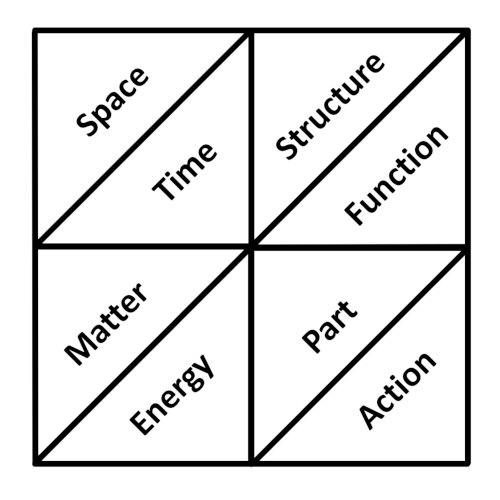
If one juxtaposes the fourfold Space-Time-Matter-Energy with the fourfold Structure-Function-Part-Action, one sees that there are several relations between them. These are simple common-sense relations, not modern-physics types of relations. Below they are listed by Space-type relations and Time-type relations.

Space is required for the extension of Structures.
Matter constitutes Structures.
Parts in an arrangement make up Structures.

Structures extend and are organized in Space.
Matter is located in Space.
Parts occupy Space.

Time allows the expression of Functions.
Energy is required for the operation of Functions.
Actions in a sequence constitute Functions.

Functions have duration and reoccur in Time.
Energy requires and is dependent on Time.
Actions take place within Time.

Several analogies are also evident in this diagram.

  1. Space : Structures :: Time : Functions
  2. Space : Parts :: Time : Actions
  3. Space : Matter :: Time : Energy
  4. Structures : Parts :: Functions : Actions
  5. Structures : Matter :: Functions : Energy
  6. Parts : Matter :: Actions : Energy

Notice that analogies 1.-3. are “contains” relations, and 4.-6. are “part of” relations. One obtains the nesting of entities:

Space > Structures > Parts > Matter
Time > Functions > Actions > Energy

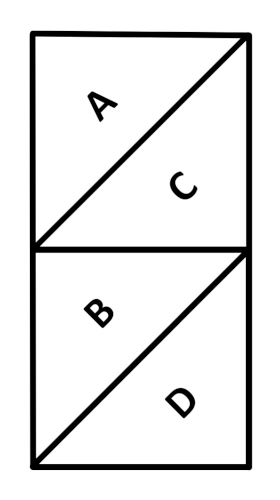
I suppose that any analogy could be shown in a figure like the one on the right (or even written as A / B // C / D) or with the two squares side by side, and that sets of four or six analogies that overlap could be nicely shown as above. If so, I wonder what can be gained by such representations? Probably individually not so much but with overlaps I think it would be interesting.

Further Reading:

The study of parts and wholes relations is called Mereology.

https://en.wikipedia.org/wiki/Mereology

https://plato.stanford.edu/entries/mereology/

[*10.157, *11.26, *11.34]

<>


The Rosetta Stone of Arthur M. Young

In his book “The Geometry of Meaning”, Arthur M. Young developed a system which he called his “Rosetta Stone” because he claimed that it associated mental attributes to some physical measurements, giving a kind of map to mind-body dualism. In the above diagram the expressions and names of these twelve objective values or physical units are shown. Examine the list below to see the twelve subjective values or mental attributes (shown in parentheses) that Young ascribed to them.

I’ve rearranged the sequence of these somewhat because I don’t quite understand the reasons for the organization Young gave them. I’ve also relabeled the units using the more standard derivative notation L’ = dL/dT, L” = d^2 L/ dT^2, etc. His notation is given at the end of each line below in parentheses for comparison (essentially he removes the d’s from the derivatives, writing dL/dT as L/T, which seems confusing to me when then multiplied by L).

Given the measurement Position or Length (L), Moment is Mass (M) times Position giving ML, and Moment of Inertia is Moment (ML) times Position giving ML^2. Velocity (L’), Acceleration (L”), and Control (L”’) have similarly related pairs of values by multiplying each by M and by ML. This gives four sets of similar expressions differing by their common derivative. I should have probably named the 1st set to be 0th, 2nd set to be 1st, 3rd set to be 2nd, and 4th set to be 3rd after the order of the common derivative.

  • Position (Observation): L
  • Moment (Significance): ML
  • Moment of Inertia (Faith): ML^2
  • Velocity (Change): L′ (L/T)
  • Momentum (Transformation): ML′ (ML/T)
  • Action (Impulse): MLL′ (ML^2/T)
  • Acceleration (Spontaneous act): L” (L/T^2)
  • Force (Being): ML” (ML/T^2)
  • Work (Fact): MLL” (ML^2/T^2)
  • Control (Control): L′′′ (L/T^3)
  • Mass Control (Establishment): ML′′′ (ML/T^3)
  • Power (Knowledge): MLL′′′ (ML^2/T^3)

How does Young justify associating, for example, the mental attribute “Faith” with the physical unit “Moment of Inertia”? It seems to have something to do with his original cyclic order of these twelve measurements and the associations he gives them to the Astrological Signs of the Zodiac. This mapping is not shown but can easily be found in the links below.

Further Reading:

Arthur M. Young / The Geometry of Meaning

http://www.arthuryoung.com/

http://mindfire.ca/The%20Geometry%20of%20Meaning/Chapter%20Five%20-%20%20The%20Rosetta%20Stone%20of%20Meaning.htm

http://kairos.laetusinpraesens.org/meaning_1_h_15

The only early entry in my blog without a leading figure (and poor tables as well):

https://equivalentexchange.blog/2011/01/02/arthur-m-young%e2%80%99s-fourfold-theory-of-process/

[*7.78, *7.79, *8.2, *11.38]

<>

The Rigor-Relevance Framework

The Rigor-Relevance Framework is a fourfold developed by the International Center for Leadership in Education (www.leadered.com). It is an instrument to aid in planning and evaluation for teachers and their students. It is composed of

  • Acquisition: Low rigor and low relevance
  • Application: Low rigor and high relevance
  • Assimilation: High rigor and low relevance
  • Adaptation: High rigor and high relevance

Rigor (from low to high) is said to be based on the six levels of Bloom’s Taxonomy of Thinking (knowledge, comprehension, application, analysis, synthesis, evaluation; or revised as remember, understand, apply, analyze, evaluate, create).

Relevance (from low to high) is said to be based on Daggett’s Application Model (knowledge in one discipline, apply in discipline, apply across disciplines, apply to real-world predictable situations, apply to real-world predictable situations).

There seems to be quite a bit of information associated with this center so I’ll need to look at it some more!

Further Reading:

http://leadered.com/our-philosophy/rigor-relevance-framework.php

https://www.kaganonline.com/free_articles/dr_spencer_kagan/367/Kagan-Connections-The-Rigor-Relevance-Framework

Bloom’s Taxonomy

Compare to other learning cycles (I thought I had more than one…)

Kolb’s Learning Cycle

Also I’d like to compare this with Whitehead’s Criteria of Metaphysical Theories

Whitehead’s Criteria for Metaphysical Theories

[*11.30]

<>


Every Fourth Thing

Daydream Tourist

Because there are way more than seven wonders in the world.

The Digital Ambler

Always Forward Between Heaven and Earth

The Mouse Trap

Psychological Musings

Wrong Every Time

Critiquing anime and everything else

The Chrysalis

"For man has closed himself up, till he sees all things thro' narrow chinks of his cavern" -- William Blake

  Bartosz Milewski's Programming Cafe

Category Theory, Haskell, Concurrency, C++

The Inquisitive Biologist

Reviewing fascinating science books since 2017

Gizmodo

Every Fourth Thing

Simplicity

Derek Wise's blog: Mathematics, Physics, Computing and other fun stuff.

COMPLEMENTARY 4x

integrating 4 binary opposites in life, learning, art, science and architecture

INTEGRATED 4x

integrating 4 binary opposites in life, learning, art, science and architecture

Playful Bookbinding and Paper Works

Chasing the Paper Rabbit

Antinomia Imediata

experiments in a reaction from the left

Digital Minds

A blog about computers, evolution, complexity, cells, intelligence, brains, and minds.

philosophy maps

mind maps, infographics, and expositions

hyde and rugg

neat ideas from unusual places

Visions of Four Notions

Introduction to a Quadralectic Epistomology

Explaining Science

Astronomy, space and space travel for the non scientist

Log24

Every Fourth Thing

Ideas Without End

A Serious Look at Trivial Things

Quadralectic Architecture

A Survey of Tetradic Testimonials in Architecture

Minds and Brains

Musings from a Naturalist

Why Evolution Is True

Why Evolution is True is a blog written by Jerry Coyne, centered on evolution and biology but also dealing with diverse topics like politics, culture, and cats.

Quadriformisratio

Four-fold thinking4you

Multisense Realism

Craig Weinberg's Cosmology of Sense

RABUJOI - An Anime Blog

Purveyors of Fine Anime Reviews and Ratings Since 2010

Intra-Being

Between Subject and Object

The Woodring Monitor

Every Fourth Thing

FORM &amp; FORMALISM

Every Fourth Thing

Log24

Every Fourth Thing

The n-Category Café

Every Fourth Thing

THIS IS NOT A BLOG

Every Fourth Thing

PHILOSOPHY IN A TIME OF ERROR

Sometimes those Sticking their Heads in the Sand are Looking for Something Deep

Networkologies

Online Home of Christopher Vitale, Associate Professor of Media Studies, The Graduate Program in Media Studies, Pratt Institute, Brooklyn, NY.

Hyper tiling

Linking Ideas

DEONTOLOGISTICS

RESEARCHING THE DEMANDS OF THOUGHT

Incognitions

Explorations in the Paradoxes of Meaning

Object-Oriented Philosophy

"The centaur of classical metaphysics shall be mated with the cheetah of actor-network theory."

Objects & Things

objects & things, design, art & technology