Category Archives: Science

The Four Requisites of Randall Collins

sq_four_requisites2“Everything in the human world has four aspects” states sociologist Randall Collins, and I couldn’t agree more. For his view of sociology, these four aspects are the Social, the Political, the Cultural, and the Economic.

These four requisites are adapted from Talcott Parsons, who was Collins’ undergraduate teacher. Parsons’ four requisites were named differently, and together they are known as the “AGIL” model. “A” stood for Adaptation, “G” for Goal-attainment, “I” for Integration, and “L” for Latency. It was also called the Structural-Functional model of society. Besides the change in names, Collins also says that the functionalism inherent in Parsons’ model has been downplayed in his because a biological, functional approach cannot model conflict, which is pervasive in human interaction.

Collins wrote a book on the historical “sociology” of philosophies, “The Sociology of Philosophies”. This book was the reason I first noted Collins, but I haven’t studied the book in any detail to note if any fourness falls out of the analysis. This kind of historical and organizational model of philosophy seems to be popular, and several others have attempted to compile something similar.

Collins also wrote “Four Sociological Traditions”, a history of sociology organized around the development of four classic schools of thought: the conflict tradition of Marx and Weber, the ritual solidarity of Durkheim, the microinteractionist tradition of Mead, Blumer, and Garfinkel, and the utilitarian/rational choice tradition. This book was the second reason I noted Collins, but not having read the book, I wasn’t sure how to interpret these four schools as a four-fold.

References:

http://sociological-eye.blogspot.com/2015/07/four-requisites-for-success-or-failure.html

https://en.wikipedia.org/wiki/Randall_Collins

https://en.wikipedia.org/wiki/Talcott_Parsons

Books by Randall Collins:

Four Sociological Traditions

The Sociology of Philosophies : a global theory of intellectual change

Philosophical Family Trees:

http://www.philosophyforlife.org/the-kevin-bacon-history-of-philosophy/

http://kevinscharp.com/Kevin%20Scharp%20-%20%20Diagrams.htm

http://www.designandanalytics.com/visualizing-the-history-of-philosophy-as-a-social-network-the-problem-with-hegel

[*3.79, *4.6, *4.7, *9.7, *9.68, *9.71]

<>


The Brain with David Eagleman

sq_whowhatSpeaking of brains, “The Brain with David Eagleman” by neuroscientist and author David Eagleman is currently showing on PBS. The first episode “What is reality?” was pretty good, showing reasons why what we think of as an objective reality is really just a temporally delayed and conceptually constructed neurological fabrication.

The six episodes are titled:

  1. What is reality?
  2. What makes me?
  3. Who is in control?
  4. How do I decide?
  5. Why do I need you?
  6. Who will we be?

I wonder if the answers to these questions will pretty much be “the brain, the brain, the brain…”. Check your local listings and tune in to find out!

Books:

David Eagleman / The Brain: the story of you

David Eagleman / Incognito: the secret lives of the brain

David Eagleman / Sum: forty tales from the afterlife

David Eagleman / Why the Net Matters: six easy ways to avert the collapse of civilization

References:

Home

https://en.wikipedia.org/wiki/David_Eagleman

[*9.56, *9.57]

<>

The Carnot Cycle

sq_carnotThe Carnot Cycle consists of four steps:

  1. Isothermal Expansion
  2. Adiabatic or Isentropic Expansion
  3. Isothermal Compression
  4. Adiabatic or Isentropic Compression

The cycle is ordinarily plotted on two axes in two different ways: Pressure and Volume, in which case the cycle is a curvy quadrilateral and descending to the right, or Temperature and Entropy, in which case the cycle is a nice rectangle that emphasizes the isothermal and adiabatic (isentropic) aspects of the steps.

References:

https://en.wikipedia.org/wiki/Carnot_cycle

Images of the Carnot Cycle from Google search.

Tip of the hat to:

Stuart Kauffman / Investigations

Also please see the previous posts:

https://equivalentexchange.wordpress.com/2012/01/27/thermodynamics-and-the-four-thermodynamic-potentials/

https://equivalentexchange.wordpress.com/2013/05/24/the-four-laws-of-thermodynamics/

[*9.51]

<>

Religion and Science

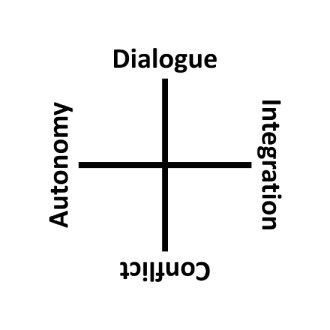
sq_religion_vs_scienceWhat is the relationship between religion and science? Instead of one answer, Templeton Prize winner Ian Barbour presents us with four possibilities: independence (or autonomy), conflict, dialogue, and integration.

These four relationships described by Barbour can be useful to consider, as they describe what may exist between the two entities in the mind of an individual or the social discourse of a culture. For religion and science, what is their stance towards one another? Would you say they are independent of one another like Stephen Jay Gould’s non-overlapping magisteria, or in constant conflict as they appear to be in the media? Or are they in helpful dialogue with one another or even harmoniously integrated with one another? Or are they one thing some times, and then another thing at other times?

It seems that these four relationships are not restricted to just religion and science, as any two distinct institutions could have one or more of these interactions between them. For example there is religion and government, science and business, or public education and certain political organizations, to name just a few. Also, any two different religious institutions or any two different scientific fields could be in any of these relationships. For example there is the Catholic Church and all Protestant Churches, Sunni Islam and Shia Islam, and even Christianity and Buddhism. For science, consider physics and biology, chemistry and sociology, etc.

So why pick on religion and science? Is it because there seems to be so much conflict between them in our own minds? Are they frequently at odds with one another in the public and private spheres? And is that a good thing or a bad thing?

What is religion, anyway? Is it the sum total of all religious institutions and cultural behaviors? Is it the sum total of all religious beliefs held by individuals? Or is it the total of both of those things, plus more? And what is science? Is it the sum total of all scientific facts and literature, or the actual institutional structures and methodologies for all scientific practitioners? Is it the sum total of all scientific knowledge along with all the evidence for all that knowledge that are in the current minds of scientists and even non-scientists?

Without people, all you would have left of religion are the buildings, the texts, and the relics. Without people, all you would have left of science are the buildings, the writings, the instruments, and the facts. Both obviously have very large individual and social components that are sustained through teaching and learning. If post-humans or alien visitors found only the material residue of human religion, they could possibly understand it to some extent with enough anthropological work. If visitors found only the material residue of human science, I think they would be able to follow the chain of reasoning and the body of evidence to support the factual conclusions. Some facts and theories might be incorrect, certainly, but not most. Thus science contains an objective component not found in religion.

The first sentence about each from Wikipedia:

“A religion is an organized collection of beliefs, cultural systems, and world views that relate humanity to an order of existence.”

“Science is a systematic enterprise that builds and organizes knowledge in the form of testable explanations and predictions about the universe”.

The definition of science is pretty clear, but the one for religion is a little vague. I’m not sure what an “order of existence” is supposed to be, and it’s not defined there on Wikipedia. Is it an ordering of things that exist, so humanity is assigned to fit in a certain place in a hierarchy, say between gods and animals, i.e. a “great chain of being”? Is that the same as a “world view”? It seems that a world view could contain an order of existence, but not necessarily the other way around. So one could have a world view without an order of existence.

Only you can decide for yourself which relationship exists between religion and science, and unless you have public writings on the matter, no one can investigate and draw their own conclusions of what you think. And anyone can produce a claim for the ultimate stance between religion and science, but of course such claims must be substantiated by reason and evidence. Scholars can produce informed discussions on the matter, to greater or lesser acceptance.

References:

https://en.wikipedia.org/wiki/Ian_Barbour

https://en.wikipedia.org/wiki/Relationship_between_religion_and_science#Perspectives

Science and Religion: Barbour’s 4 models

https://en.wikipedia.org/wiki/Religion

https://en.wikipedia.org/wiki/Science

Also please see the previous post:

https://equivalentexchange.wordpress.com/2011/07/27/the-four-conic-sections/

[*9.42]

<>

 

Evolution and Genetics

Here is a fourfold of evolutionary genetic terms to consider.

  • Ontogenic: related to the development or developmental history of an individual organism
  • Phylogenic: related to the development or evolution of a particular group of organisms
  • Genotypic: related to the genetic makeup of an organism or group of organisms with reference to a single trait, set of traits, or an entire complex of traits
  • Phenotypic: related to the observable constitution of an organism (or the appearance of an organism resulting from the interaction of the genotype and the environment)

References:

https://en.wikipedia.org/wiki/Ontogeny

https://en.wikipedia.org/wiki/Phylogenetics

https://en.wikipedia.org/wiki/Genotype

https://en.wikipedia.org/wiki/Phenotype

https://en.wikipedia.org/wiki/Tinbergen%27s_four_questions

Tip of the hat to:

Cesar Hidalgo / Why Information Grows: The Evolution of Order, from Atoms to Economies

[*9.22]

<>

The Book of Nature

sq_four_senses2The purpose of a system is what it does.

— Stafford Beer

The natural world we find ourselves in is of sufficient wonder, beauty, pain, and terror that many insist that some demiurge had to have made it, and fashioned us as well. For centuries before the dawn of science, the notion of the “Book of Nature” was an influential concept of how knowledge about the world was to be found and understood, borrowed from ideas on how to read and interpret religious writings: exegesis or hermeneutics. Nature was a text, writ by its creator.

Back in Medieval times, there were four ‘senses’ of reading and understanding scripture:

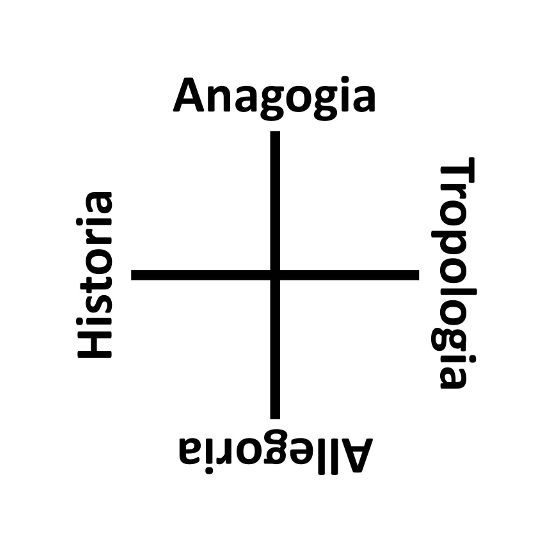
  • Anagogia: the higher meaning (Invisible Invisibility*)
  • Allegoria: the deeper meaning (Invisible Visibility)
  • Historia: the literal meaning (Visible Visibility)
  • Tropologia: the moral meaning (Visible Invisibility)

Perhaps the meaning of these senses were more or less literal. Therefore on my diagram I have placed the higher above, the deeper below, the historical in the past, and the moral in the future. Morals inform us what we should do or what our purpose is. A heuretic of systems thinking coined by Stafford Beer is “the purpose of a system is what it does.” And remember the immortal words of Yoda: “Try not. Do or do not. There is no try.”

Fortunately or unfortunately, nature is nothing like a text. All texts are written by people, and are structured by human thought and language. Nature requires other methods for understanding its basis and processes. The so-called scientific method evolved by fits and starts to explore the workings of nature, its components, causes, structures and functions. And it continues to evolve because it is not in itself entirely mechanistic: no precise algorithm that we know of can be specified to turn the crank and do ‘science’. Does that mean it’s unscientific? Not at all.

References and Links:

* The terms Invisible Invisibility, etc. are from:

6. The four senses

The Quadralectics of Marten Kuilman

http://en.wikipedia.org/wiki/Book_of_Nature

http://en.wikipedia.org/wiki/Systems_theory

http://en.wikipedia.org/wiki/The_purpose_of_a_system_is_what_it_does

[*8.48, *8.52]

<>

The Sackur-Tetrode Equation

sq_sackur_tetrode

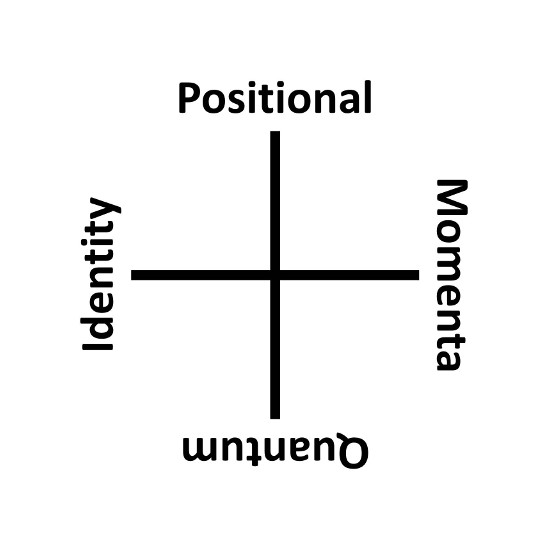
The Sackur-Tetrode Equation expresses the entropy of a monatomic classical ideal gas. Including quantum aspects of the system gives this formula a more detailed description than it would have otherwise. Above I’ve tried to represent the four uncertainties that constitute the equation in its information theoretic version: positional, momenta, quantum, and identity.

From Wikipedia:

In addition to using the thermodynamic perspective of entropy the tools of information theory can be used to provide an information perspective of entropy. The physical chemist Arieh Ben-Naim rederived the Sackur–Tetrode equation for entropy in terms of information theory, and in doing so he tied in well known concepts from modern physics. He showed the equation to consist of the sum of four entropies (missing information) due to positional uncertainty, momenta uncertainty, the quantum mechanical uncertainty principle and the indistinguishability of the particles.

http://en.wikipedia.org/wiki/Sackur%E2%80%93Tetrode_equation

http://en.wikipedia.org/wiki/Entropy_%28information_theory%29

[*9.4]

<>

Wave-Particle Duality

sq_wave_particle_dualityIs the fundamental nature of light and matter more like a wave or is it more like a particle? After hundreds of years of scientific research the answer is … Yes! Light and matter have aspects of both: sometimes one and sometimes the other. Kind of like that duck-rabbit illusion where the drawing flips back and forth between a duck or a rabbit.

Now that we have the irreconcilable duality of wave and particle, can we add to the confusion and enlarge it into a four-fold? Two additional aspects (from physics) come to mind: motions, as in the motions of particles, and fields, as in electric and magnetic fields.

We immediately can see this four-fold as a play of dimensions: (idealized) particles have 0 dimensions, motions have 1 (along a path), waves have 2 (or more), fields have 3 (or more).

sq_lucretiusWe can also see this four-fold in a weak analogy with the Four Elements: particles for earth, waves for water, motions for fire, and fields for air (or space). Also compare to the four-fold for Lucretius!

Should fields above be replaced with wave-functions? I guess a wave-function is a kind of field of probabilities of existence over space and time, so perhaps it makes no difference!

Links:

http://en.wikipedia.org/wiki/Wave%E2%80%93particle_duality

http://en.wikipedia.org/wiki/Field_%28physics%29

http://en.wikipedia.org/wiki/Rabbit%E2%80%93duck_illusion

http://dl.acm.org/citation.cfm?id=2811288&picked=formats

Charis Anastopoulos / Particle or Wave: The Evolution of the Concept of Matter in Modern Physics

Notes:

I like Forces or Speeds better than Motions. Atoms better than Particles at top?

[*7.152, *8.32]

<>


Grid-group Cultural Theory

sq_grid_group

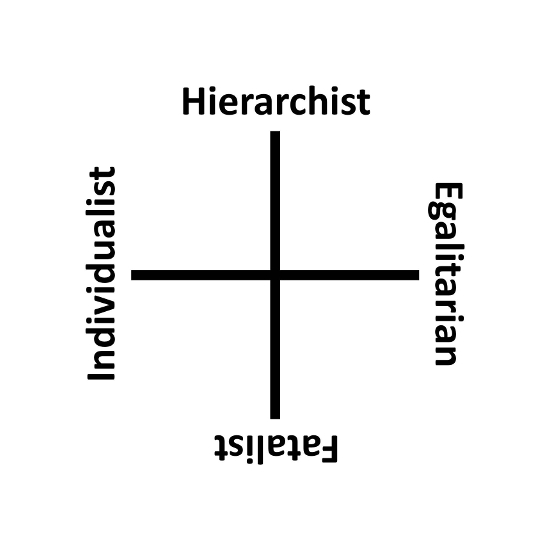
Looking over some old notes, I ran across something about the Grid-Group Cultural Theory. Also known as the Cultural Theory of Risk, it originated from the studies of anthropologist Mary Douglas and political scientist Aaron Wildavsky. Two dimensions of sociality are described, each with a low and high value (or a continuum): grid measures the differentiation between people, and group measures the cohesion or social bonds between people.

Individualist: Low group and low grid
Fatalist: Low group and high grid
Hierarchist: High group and high grid
Egalitarian: High group and low gridsq_archic_philosophers

Notes:

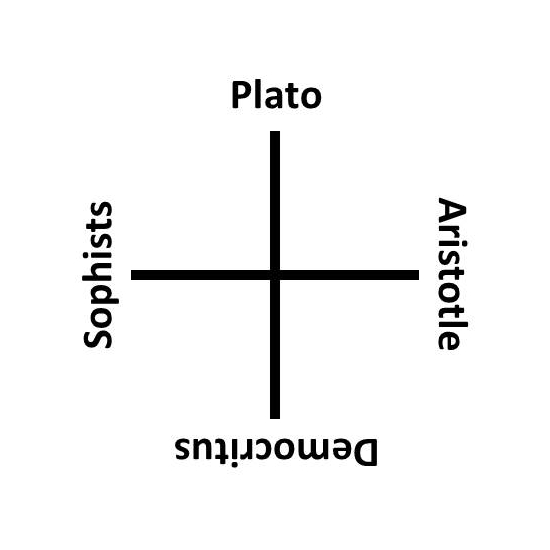
In the representation shown above, this arrangement reminds me significantly of the Archic Philosophers.

Sophists for Individualist
Democritus for Fatalist
Plato for Hierarchist
Aristotle for Egalitarian

Links:

http://en.wikipedia.org/wiki/Cultural_Theory_of_risk

http://changingminds.org/explanations/culture/grid-group_culture.htm

[*4.86, *8.112]

<>


Relative Time

sq_relative_time For what more terrifying revelation can there be than that it is the present moment? That we survive the shock at all is only possible because the past shelters us on one side and the future on another.

— From Orlando, by Virgina Woolf

As we can see on the previous four-folds of space and time, all have a degree of conditioning to the location and orientation of an observer. In other words, there are no absolute frameworks of space or time. That does not mean that they are not useful conventional and conceptual tools.

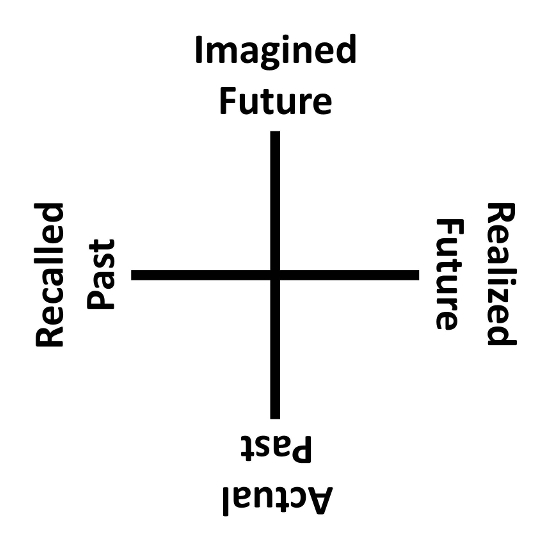
What would a four-fold of Relative Time be like? Because time seems to be linear instead of two dimensional, relative time would be very different than relative directions. What if we contrast our understanding of what happened in time with what actually occurred? What if we compare our thoughts of an imagined future with what becomes realized?

One could contrast an individual’s notions of past and future with a group or society’s notions of past and future. Or one could contrast an individual’s or society’s recalled past and imagined future with the actual past and the realized future. Some might argue that there is no actual past, but only the past we think or recall that it is. Similarly, those or others might argue that there is no realized future, because once the future becomes the present it has already slipped into the past that we can now only recall.

As the future becomes realized, the imagined future is discarded or blended into it to become our recalled past. As we understand more about the real past, our recalled past may be discarded or blended into it to become our new recalled past. Or one can refuse that knowledge and believe whatever suits them.

[*8.99, *9.60]

<>