To teach superstitions as truth is a most terrible thing.
– Hypatia of Alexandria
 In mathematics, the four conic sections are the different shapes that can be formed by the intersection of a three dimensional right double cone and a plane: the circle, the ellipse, the parabola, and the hyperbola. The conics have been studied since the dawn of Greek mathematics. These shapes have interest as pure mathematical constructions, as well as many practical uses in applied mathematics.
Special points (focus or foci, plural) and lines (directrix or directrices, plural) can also be used to generate the conic sections in analytic geometry. A circle or parabola has one focus; the ellipse or hyperbola has two. The circle is a special case of the ellipse, one whose two foci coincide at a unique center, and in a different sense, the parabola can also be considered as a special case of the ellipse, having one of its foci at infinity. All circles can be transformed into each other by uniform scaling, a property shared by all parabolas. Thus the circle can be considered to be a singular shape, as well as the parabola. In contrast, ellipses and hyperbolas have a multitude of shapes and cannot be transformed into others of the same kind by uniform scaling. However, a nonuniform scaling or affine transformation can be used to achieve this goal. In even more abstract projective geometry, one could consider that all the conics are the same.
If the double cone is considered as the so-called light cone in Minkowski Space-time, many interesting concepts in special relativity can be considered. In this simplified model, space has two dimensions and time has one. The light cone divides all of space-time into four parts: the past, the present, the future, and the rest. The observer is located in time and space at the common apex of the two cones. Light travels on the surface of the cones, in straight lines towards and away from the observer. Anything traveling strictly within the space-time of a cone must necessarily be traveling slower than the speed of light. One cone can be thought of as the past: the interior of which contains all space-time that could have been observed by the observer, bounded by the circles of light traveling towards her. The second cone can be thought of as the future: the interior of which contains all space-time that could possibly be observed by the observer, bounded by the circles of other observers observing her light. Everything outside of the light cone cannot be observed or influenced by the observer at that instant, since light from it would have to travel faster than the speed of light in order to be seen or acted on by the observer.
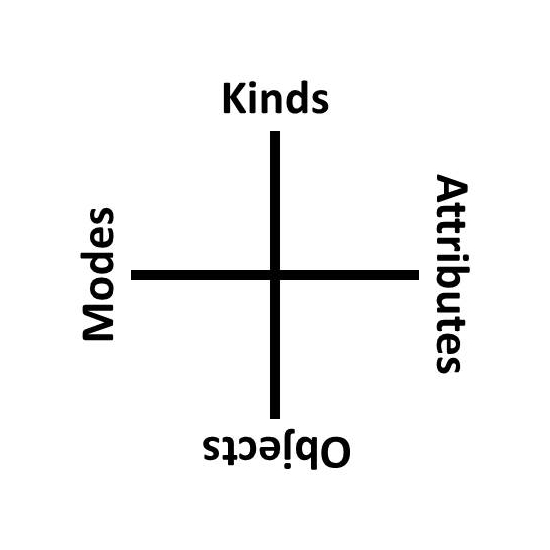
Letting my analogical thinking run rampant, I can think of several associations with other fourfolds presented here. The circle is the shape of perfection, of identity and wholeness. It has one center or focus. In Minkowski Space-time, it is formed by the plane cutting the light cone at a constant time, so that all light arrives at the observer simultaneously from the past. Thus it is the shape of the knower or perspective. The parabola has the shape of gravity, the arc of an object thrown from and falling towards the earth. The shape reminds me of a reality that flies up from the opaque depths of the knowable only to fall away again. Numbers that are perfect squares may have started ancient mathematicians thinking about arithmetic. The ellipse has the shape of cosmology. Once astronomers could consider orbits of planets not to be circles or epicycles, only then science changed from idealism to empiricism. The hyperbola’s asymptotes form the crossed lines of my ever-present double duals, dividing yet unifying, as well as the profile of Minkowski Space-time. In fact, space and time occur over and over in many of the fourfolds I have considered.
Circles and ellipses could be considered the shapes of time, subjectivity, conjunction, and content: closed, finite, and bounded, yet cyclic. Parabolas and hyperbolas could be considered the shapes of space, objectivity, disjunction, and expression: open, infinite, and unbounded, acyclic.
In the recent movie Agora, the main character is Hypatia, the daughter of the last librarian of the great Library of Alexandria. A mathematician, astronomer, and philosopher, only fragments of Hypatia’s writings are available to us today. After the sack of the library, Hypatia is shown in her new study with a beautiful wooden model of the conics that she saved from destruction. For any that love wisdom over superstition, the movie is heartbreaking. As an echo to the loss of the contents of the library, it is offered (without any proof) that she considered the truth of the Heliocentric model of the solar system with the planets moving in elliptical orbits. Her senseless murder meant her insights were destroyed without legacy, falling away into the gravity of the dark unknown. Fortunately, even if she had, Copernicus and Kepler rediscovered these insights well over a thousand years later and brought them to light. The library’s loss will never be recovered.
References:
http://en.wikipedia.org/wiki/Conic_section
http://www.npr.org/blogs/13.7/2011/07/11/137743796/agora-most-intelligent-movie-on-science-and-religion-ever?ft=1&f=114424647
http://babelniche.wordpress.com/2010/09/28/more-on-agora-and-hypatia/
http://www.skepticforum.com/viewtopic.php?f=85&t=14979
[*6.170, *6.172]
<>
 What is space? Is space merely extension? What makes up extension, but a set of locations?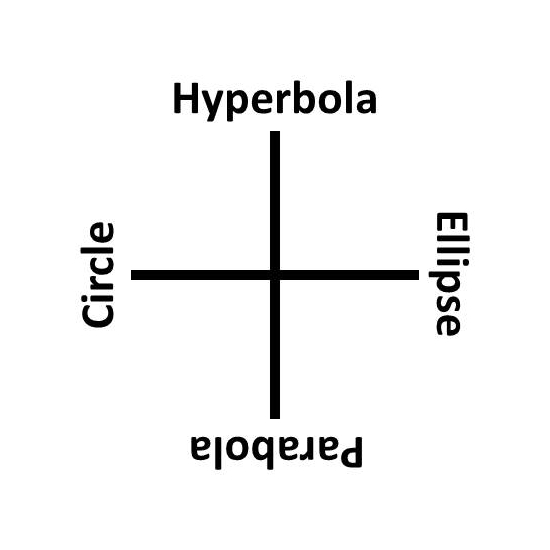



 Equivalent Exchange