Category Archives: Science

Four Dimensional Space-time

sq_4d_spacetime

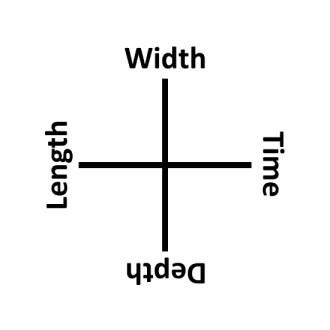
Here’s a simple fourfold I’ve been ignoring just because it’s so trivial, but that triviality can be deceiving. Space-time as formulated in special relativity has four dimensions: three of space and one of time. Our everyday experience shows us the three dimensions of space: length, width (or breadth), and depth (or height), but time is a different kind of thing because we cannot see or move forward and backward through time with our eyes or body, like we can along the axes of space.

Personally, only our memory and imagination can let us range through time. Of course, after the invention of language and more recent technologies, the spoken word, writings, photographs, audio recordings, and videos can also be used. But it’s not the same as shifting one’s gaze along the length of something or moving one’s body across a width.

So, we can move semi-freely through the three spatial dimensions but our movement in time seems to be fixed into a relentless forward motion that we have no control over. And because gravity pulls us down onto the surface of the world, one of the spatial dimensions (depth or height) is more limiting than the other two.

sq_ll2Thus another interesting comparison to this fourfold is to that of linear logic. One observation is that length and width can be considered reversible but depth and time can be considered somewhat irreversible. That’s not true of course, but because of gravity it is easier to descend than to ascend, and it’s far easier to move into the future than into the past. But we can see into the distant past, just not our own, as we turn our telescopes to the heavens.

Space without time could have four or even higher dimensions, but we have no empirical evidence that it is so. Mathematically, however, we can easily construct multidimensional spaces. One representation of four dimensional space is by using quaternions, which have four dimensions to the complex numbers’ two. Tuples of real numbers or even vector spaces can also be used. However, the geometry of space-time is not Euclidean; it is described by the Minkowski metric.

Novels about characters living in different numbers of spatial dimensions are an interesting way to learn and think about them. The very first was Flatland by Edwin Abbott Abbott, about a being limited to two dimensions that learns about a third outside his experience when a three dimensional being comes to visit. Just recently I’ve finished reading Spaceland by Rudy Rucker, about an ordinary human person limited to the three dimensions of space that learns about the fourth dimension by similar reasons.

Links:

http://en.wikipedia.org/wiki/Special_relativity

http://en.wikipedia.org/wiki/Minkowski_space

http://en.wikipedia.org/wiki/Four-dimensional_space

http://en.wikipedia.org/wiki/Flatland

http://en.wikipedia.org/wiki/Flatland_%282007_film%29

http://en.wikipedia.org/wiki/Spaceland_%28novel%29

[*8.72]

<>

Maxwell’s Equations

sq_maxwell_eq2

Actually, just the left hand side of the equations, because it looks better that way. The right hand sides are just a click away.

E and B are the electric and magnetic fields, respectively. is the “del” operator.

The divergences ∇ · E and ∇ · B are the “fields emanating from the sources.”

The curls ∇ x E and ∇ x B are the “circulation of the fields.”

Further Reading:

http://en.wikipedia.org/wiki/Maxwell%27s_equations

<>

Matter, Energy, Space, and Time

sq_MESTThe first little ball is red and green
Oh it’s pretty, yes I know what you mean
I call it Substance, do dio dio do
And what it will do I just don’t know

The next little ball is silver and black
See it chase the first one forward and back
I call it Space, do dio dio do
What it will do I just don’t know

The next little ball is too hot to hold
I have to keep tossing it and I hope it gets cold
I call it Power do dio dio dio
What it will do I just don’t know

The next little ball is orange and blue
I can’t juggle four so I’ll toss it to you
And I call it Time…

— From “The Juggler’s Song” by The Incredible String Band

Here’s a nice little fourfold that I’ve overlooked until now, kind of like a four-leaf clover. If you search for images of matter, energy, space, and time, several websites show a diagram quite similar to this, and some have interesting things to say.

One shows free energy instead of energy in general. Free energy is energy that is able to do work, and that is an important distinction, especially if you are thinking about the Four Causes. Then the four can be considered fundamental resources.

There are some other things to consider from these references. One is that there is the familiar equivalence between matter and energy. Another is the equivalence principle between gravity and acceleration.

Also, there are obvious analogies between this fourfold and the Four Elements and the Four States of Matter. sq_Noether's TheoremI have also used the pairs space-time and matter-energy as two parts of the fourfold Noether’s Theorem, the other two parts being symmetry and conservation. There is also the fourfold Spacetime that has some similarities to this one. And let’s not forget the atomism of On the Nature of Things by Lucretius.

Be sure and watch the upcoming television series Cosmos: a Spacetime Odyssey, hosted by Neil deGrasse Tyson. I’m sure there will be much talk of Matter, Energy, Space, and Time.

Notes:

There is even a term coined for Matter-Energy-Space-Time: MEST. Of course, MEST also stands for Math, Engineering, Science, and Technology! No, sorry, that’s STEM!

Links:

http://abyss.uoregon.edu/~js/ast123/lectures/lec09.html

http://billmoyers.com/2014/01/10/the-new-cosmos-a-spacetime-odyssey/

[*7.90, *8.32]

<>


Relations All the Way Down

There is nothing to be known about anything except an initially large, and forever expandable, web of relations to other things. Everything that can serve as a term of relation can be dissolved into another set of relations, and so on for ever. There are, so to speak, relations all the way down, all the way up, and all the way out in every direction: you never reach something which is not just one more nexus of relations.

— Richard Rorty from Philosophy and Social Hope

sq_ll2

The ancient Greek philosopher Empedocles somehow reasoned that the world was made entirely from four basic elements: fire, earth, water, and air. Science as we know it has disproved this from being the case, but this idea still has a rich symbolic meaning even today that informs our popular culture.

A recent philosophical stance called “ontic structural realism” argues that science suggests that only relations between things are of lasting importance, that is the structural relationships within and between things, not the things themselves that bracket the relations. What we call a quark for instance is just the relations it has with other quarks and the other entities that have relationships with quarks. Perhaps then the world consists of “relations all the way down”, instead of stopping at some point on the lowest level with the things that constitute the world.

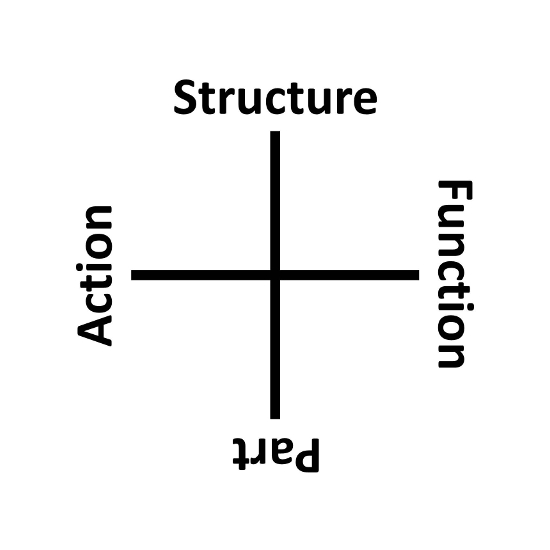
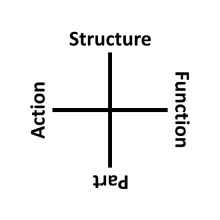
If this is so, what if the world was made completely from four basic relations, instead of four basic things? sq_structure_functionCould they be something like the four binary operators of linear logic? I have likened these four basic operators of Linear Logic to my fourfold Structure-Function, where in addition to Structures, we also have Functions, Actions, and Parts. But these three other relations are also structural, in that only the relation something has to another something makes it structural, functional, actional, or a part of a something.
Book Description for Every Thing Must Go:

Every Thing Must Go argues that the only kind of metaphysics that can contribute to objective knowledge is one based specifically on contemporary science as it really is, and not on philosophers’ a priori intuitions, common sense, or simplifications of science. In addition to showing how recent metaphysics has drifted away from connection with all other serious scholarly inquiry as a result of not heeding this restriction, they demonstrate how to build a metaphysics compatible with current fundamental physics (“ontic structural realism”), which, when combined with their metaphysics of the special sciences (“rainforest realism”), can be used to unify physics with the other sciences without reducing these sciences to physics itself. Taking science metaphysically seriously, Ladyman and Ross argue, means that metaphysicians must abandon the picture of the world as composed of self-subsistent individual objects, and the paradigm of causation as the collision of such objects. Every Thing Must Go also assesses the role of information theory and complex systems theory in attempts to explain the relationship between the special sciences and physics, treading a middle road between the grand synthesis of thermodynamics and information, and eliminativism about information. The consequences of the author’s metaphysical theory for central issues in the philosophy of science are explored, including the implications for the realism vs. empiricism debate, the role of causation in scientific explanations, the nature of causation and laws, the status of abstract and virtual objects, and the objective reality of natural kinds.

Stuff I need to read:

James Ladyman, Don Ross / Every Thing Must Go: Metaphysics Naturalized

http://plato.stanford.edu/entries/structural-realism/

Jason D. Taylor / Relations all the way down? Exploring the relata of Ontic Structural Realism

http://hdl.handle.net/10402/era.27885

Relations All the Way Down

https://ndpr.nd.edu/reviews/every-thing-must-go-metaphysics-naturalized/

<>

 

Knowledge and Its Limits

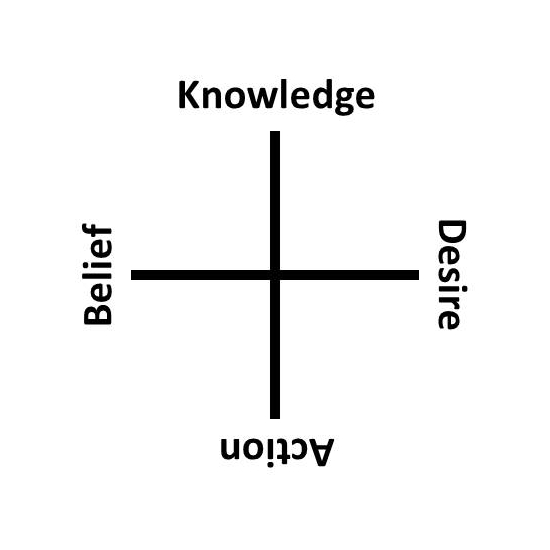
Knowledge and action are the central relations between mind and world. In action, world is adapted to mind. In knowledge, mind is adapted to world. When world is maladapted to mind, there is a residue of desire. When mind is maladapted to world, there is a residue of belief. Desire aspires to action; belief aspires to knowledge. The point of desire is action; the point of belief is knowledge.

— From Knowledge and Its Limits by Timothy Williamson

sq_knowledge_limits

Or with some substitutions:

Theory and practice are the central relations between the mental and the physical. In practice, the physical is shaped to the mental. In theory, the mental is shaped to the physical. When the physical is misshaped to the mental, there is a residue of intention. When the mental is misshaped to the physical, there is a residue of attention. Intention aspires to practice; attention aspires to theory. The point of intention is practice; the point of attention is theory.

sq_knowledge_limits2

Also, note the similarity to The Scientific Method.

Further Reading:

Timothy Williamson / Knowledge and Its Limits

[*6.24, *6.32, *8.22]

<>

Ohm’s Law

Charts for the equations of Ohm’s Law usually consist of the fourfold relation between Voltage (Volts), Current (Amps), Resistance (Ohms), and Power (Watts). For each electrical quantity, there are three equations that represent it in terms of two others, making twelve equations total.

Ohm’s Law is really only between voltage, current, and resistance. Apparently, power is more correctly introduced by the formula for “Joule heating”.

Both voltage and current have been in two fourfolds previously (Four Basic Electrical Components and System Dynamics) but not power and resistance. Well, resistance did make an appearance as a relation between current and voltage.

The twelve equations can be generated by the following identities (where E = voltage, I = current, R = resistance, and P = power):

I*R/E = P/(I*E) = P*R/E^2 = R*I^2/P = 1

http://en.wikipedia.org/wiki/Ohm%27s_law

http://en.wikipedia.org/wiki/Joule%27s_first_law

Google search for images for Ohm’s Law.

[*8.4, *8.5, *8.8, *8.9, *8.10]

<>


States of Matter

The four most familiar states of matter are solid, liquid, gas, and plasma. Other states exist (such as Bose-Einstein condensates), but if I talk about them I couldn’t put them into a nice fourfold.

Note that the sequence of plasma, gas, liquid, and solid is arranged in the order of highest to lowest temperature (usually). Compare this to the classical Four Elements of Empedocles (Fire, Air, Water, and Earth) and to the made-up fourfold of Bright-to-Dark, based on light.

http://en.wikipedia.org/wiki/State_of_matter

http://www.chem4kids.com/files/matter_states.html

http://gizmodo.com/there-are-way-more-than-three-states-of-matter-1182677930

<>


Human Limitations

 Everything existing in the universe is the fruit of chance and necessity.

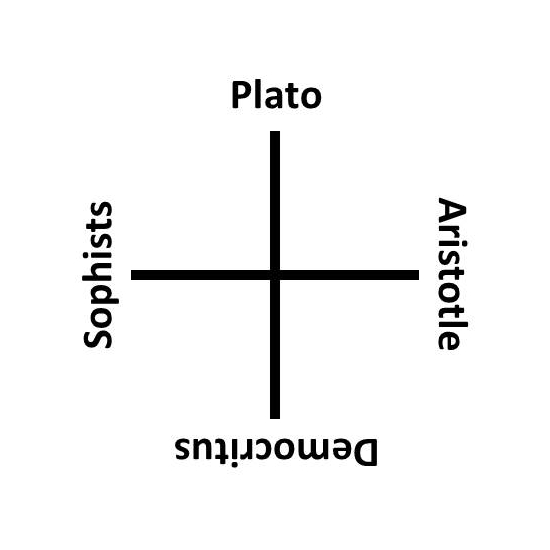
Democritus

What are humans limited by? We are limited by time and by space.

We are limited in time because we are mortal beings, bound to the past by our birth and to the future by our death, delimiting the short interval of our lifetimes.

We are limited in space because we are finite beings. At each point of time we are constrained by what we are and what we might become. We are bound both by our actuality and our possibility. Our nature defines our actuality and our nurture sets our possibility.

Certainly, we can transcend our limitations, but this just means they weren’t really the true limits after all. We can’t say for certain what our real limits are, so that’s a good thing.

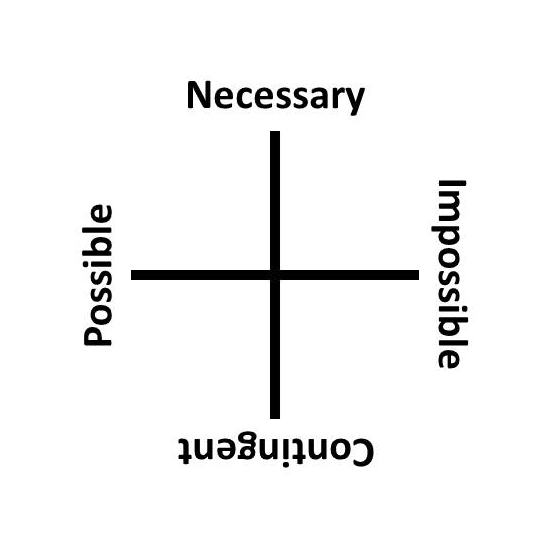
This fourfold also reminds me of the following modal square of opposition. At birth, much is possible. At death, all becomes impossible. Nurture is contingent and Nature is necessary.

References:

http://plato.stanford.edu/entries/logic-deontic/

http://en.wikipedia.org/wiki/Chance_and_Necessity

[*7.174]

<>


Light and Dark: Matter and Energy

What are dark matter and dark energy? We do not know; we just know of them by their effects.

Dark matter is thought to be present in halos around galaxies since the estimated amount of matter is too small to keep the galaxies rotating at their measured rate. Dark energy is thought to be present in the empty spaces between galaxies pushing them apart because the velocities separating them are actually increasing instead of slowing down. Nobody knows what dark matter and dark energy really are, but new theories are often being suggested. Perhaps one of these theories will be tested soon and we will have a better idea of what these mysterious materials and forces are.

Could it be that dark matter and dark energy are linked by an equation, like normal “light” matter and “light” energy? For ordinary matter and energy, which are really two aspects of the same thing, it is Einstein’s famous equation: E= m*c^2. But since we have no idea what the dark stuff is, we can only conjecture.

Why should we care what these things are that are so difficult to characterize? In any scientific investigation, if we have gaps and inconsistencies in our knowledge and our theories it just bothers us to no end. We’re just not happy until we figure out the puzzle. In this case, the universe is almost completely made up of these dark parts, so it seems pretty important.

Unfortunately in my diagram the horizontal axis is light energy-dark energy, which is separating, and the vertical axis is dark matter-light matter, which is combining. In many of my fourfolds the horizontal axis is combining or conjunctive and the vertical axis is separating or disjunctive. Is the energy-matter dual more important than the conjunctive-disjunctive dual? Perhaps this fourfold doesn’t really fit but I like it anyway.

Further Reading:

http://en.wikipedia.org/wiki/Dark_matter

http://en.wikipedia.org/wiki/Dark_energy

http://science.nasa.gov/astrophysics/focus-areas/what-is-dark-energy/

Eric Chaisson / Epic of Evolution

<>


The Four Laws of Thermodynamics

0th Law: Heat doesn’t flow between objects of the same temperature.

1st Law: Heat cannot be created or destroyed.

2nd Law: Entropy increases by the flow of heat in a closed system not in equilibrium.

3rd Law: Entropy approaches a constant minimum in a system as temperature approaches absolute zero.

Further Reading:

http://www.physicsforidiots.com/thermodynamics.html

http://en.wikipedia.org/wiki/Laws_of_thermodynamics

Peter Atkins / Four Laws That Drive the Universe

[*3.169, *7.164]

<>