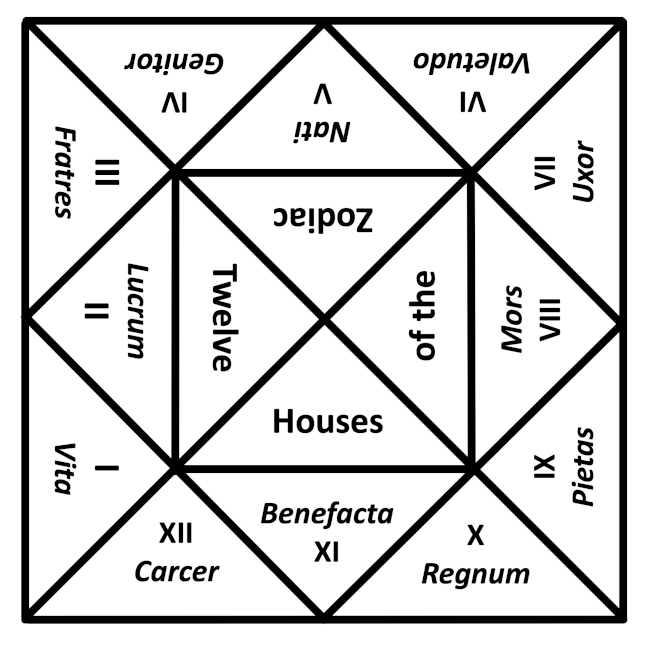
How does one circumscribe the totality of human experience, both for the individual as well as for culture? One of the oldest ways is the twelvefold division of the Houses of the Zodiac, which may have its origins in Babylon. Other similar systems were used in India, China, Europe, etc. In my diagram above I’m using Latin numerals along with the Latin names of the houses.
For Western Astrology, four groups of three houses are divided by the four classical elements and then into triplicities (from Wikipedia):
Fire : Identity (I, V, IX)
Earth : Material (II, VI, X)
Air : Social and intellectual (III, VII, XI)
Water : Soul and Emotional (IV, VIII, XII)
And somewhat similarly for India, the divisions of Vedic Astrology are broken into four Bhavas or “needs” (from Wikipedia):
Dharma : (Duty) The need to find our path and purpose
Artha : (Resources) The need to acquire the necessary resources and abilities to provide for ourselves to fulfill our path and purpose
Kama : (Pleasure) The need for pleasure and enjoyment
Moksha : (Liberation) The need to find liberation and enlightenment from the world
There are more recent and scientific divisions of human universals, such as those by George Murdock, Robin Fox, and Donald Brown, as mentioned by Jungian analyst Anthony Stevens in his book “Archetype Revisited”. These are also grouped into four categories (from Wikipedia):
“The Fourth Way” is the title of a 1957 book by Russian esotericist P. D. Ouspensky that is supposed to be about the self-development methods of the mystic/philosopher/teacher G. I. Gurdjieff. Ouspensky was a student of Gurdjieff for a significant part of his life until there was a parting of the ways. This book was published after Ouspensky died in 1947. A substantial amount of it is constructed in questions and answers, as a teacher might answer their student’s questions.
Ouspensky’s first book in 1909 was about the fourth dimension, which was much in the public consciousness in the first few years after Einstein published his theory of special relativity. His second book was titled “Tertium Organum”, or the third canon of thought, after Aristotle’s first and Francis Bacon’s second. Ouspensky’s third book “A New Model of the Universe” continued in this way, linking science with spirituality, or at least consciousness.
What is a person or what are the aspects of a person? Is a person a machine? A physicalist thinks that a person is their body, and the mind is what the brain does. A dualist thinks that a person has a body as well as a separate mind, but we know that the mind is dependent on the body for operation and it can be diminished by injury, neglect, or abuse. There are other aspects of the person, such as the emotions or “heart”, which are somewhere between the body and the mind.
And if you search on the web, “soul” or “spirit” are often shown in images along side body, mind, and mood, but these terms are imprecise. Sometimes soul is defined as spirit, sometimes spirit as soul. It is difficult to determine what is meant by them, but they are usually of a higher-order nature than the physical or mental or emotional. It is usually what remains the same for a person, the still point of a changing self, regardless if that endures after death.
Body
Mind
Mood (Heart or Emotions)
and Spirit?
or Soul?
or Balance?
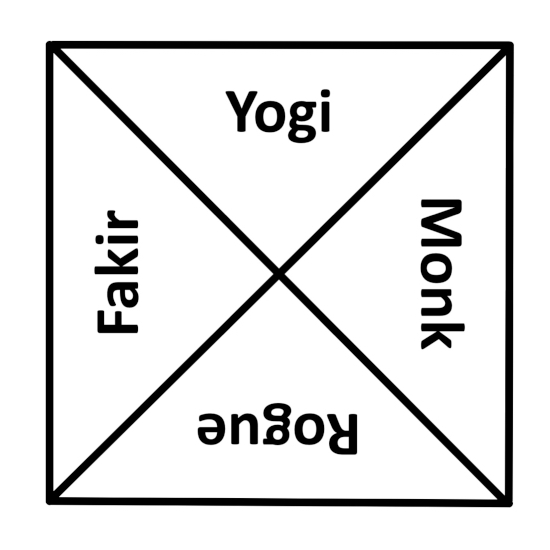
Various schools of spiritual people concentrate on the control and discipline of different aspects of the self: the physical for the Fakir, the mental for the Yogi, and emotions for the Monk. These are the first three historical ways for self-development, but they require separation from the normal social world, and neglect the other aspects of the self. The Fourth Way was said to require no extreme separation, and to develop body, mind, and mood in a balanced way.
Gurdjieff thought that most if not all people were machines because they were “asleep at the wheel” (my metaphor), the wheel being the control of their own consciousness. Similar to the practice of lucid dreaming, these teachings (also called “the work” or “the system”) purported to develop the conscious self into something much more than ordinary awareness. This aware self would have access to all sorts of abilities that remain hidden or dormant in most of us.
The Fourth Way is also said to be the way of the “sly man”, but to be sly is to be crafty, cunning, and tricky. If you are sly you are deceitful or a charlatan, dishonest and evasive, a “rogue”. You take advantage of people, or you game the social system. Are there any truth to these teachings, or were they merely a way that Gurdjieff found to make an easy living? If not, why call it the way of the “sly man”? On the other hand, who doesn’t want to develop their best selves in the most efficient and clever way?
Fakir: Physical
Yogi: Mental
Monk: Emotions
Rogue: Balance or ?
I also read that “sly man” is a translation of the French “le ruse”. The idea behind this name is for a person that takes advantage of opportunities in their normal life to development their awareness, rather than just their attitude towards others. And so it’s a posture towards the broader world, not just towards people. If I had a short word to substitute for “rogue” in the above diagram, I might do so, to prevent the negative impression I might be giving. But the term “rogue” is probably less offensive that it used to be, so I’ll keep it for now.
Yet people do love to be deceived. They love to be entertained, and they love a good story with charismatic characters. They also love to hear what they want to hear. Perhaps that’s all these teachings really were and are. And yet, many artists, writers, and thinkers have embraced the ideas of this fourth way. Certainly to enhance one’s consciousness is a positive thing to do, or to eliminate erroneous or harmful thought, or to “know thyself”. Socrates taught that “the unexamined life is not worth living”. Perhaps there is some worth to these teachings after all, but a person may have to determine this for themselves.
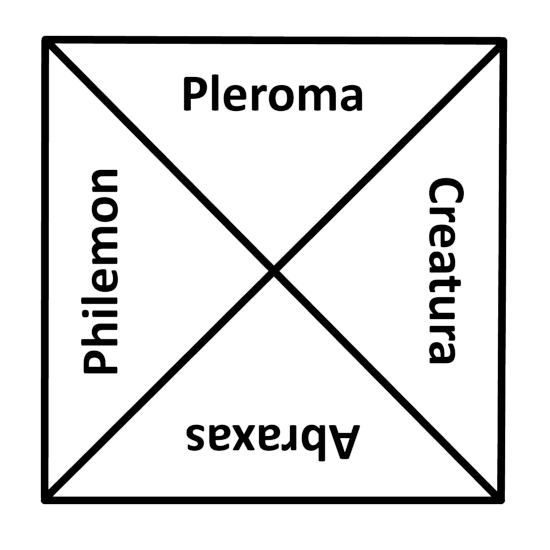
We must, therefore, distinguish the qualities of the pleroma. The qualities are pairs of opposites, such as—
The Effective and the Ineffective. Fullness and Emptiness. Living and Dead. Difference and Sameness. Light and Darkness. The Hot and the Cold. Force and Matter. Time and Space. Good and Evil. Beauty and Ugliness. The One and the Many. etc.
— Carl Jung, from Seven Sermons to the Dead
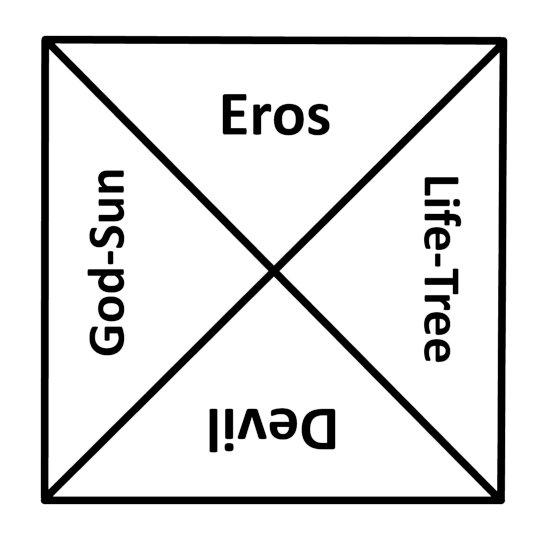
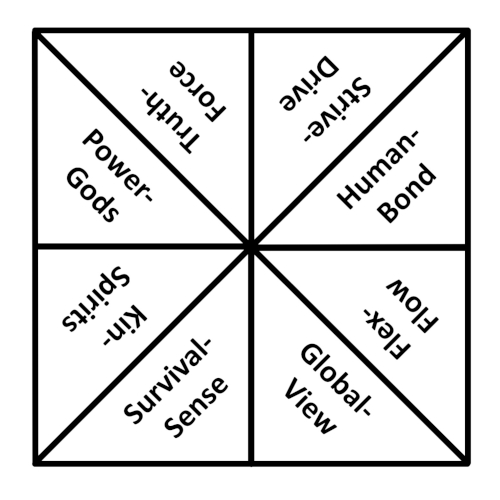
I previously mentioned two fourfolds which are perhaps better combined as an eightfold. These concepts or entities are from Carl Jung’s “Seven Sermons to the Dead”.
To the left are the “principal gods”, who are said to be in one-to-one correspondence with the “world’s measurements”. What then are these measurements? Are they the coordinates of relativistic Space-Time or something else?
The God-Sun: The beginning
Eros: Binding of two together, outspreading and brightening
The Tree of Life: Filling space with bodily forms
The Devil: The Void, opening all that is closed, dissolving all formed bodies, and destroyer of everything
And to the right we have:
The Pleroma: The spiritual universe as the abode of gods and of the totality of the divine powers and emanations.
The Creatura: The living world, subject to perceptual difference, distinction, and information
Abraxas: The supreme power of being transcending all divinities and demons and uniting all opposites into one
Philemon: Jung’s spiritual guide and the narrator, also said to be Simon Magus or Basilides
Erik Erikson developed an eight stage developmental model of the psyche for the full life of the human individual. Each stage has a key conflict (with both positive and negative sides), its resolution into a “virtue,” and the typical age range for that conflict.
Trust vs. Mistrust, “Hope”, Infancy (0-1 years)
Autonomy vs. Shame, “Will”, Early Childhood (1-3 years)
Initiative vs. Guilt, “Purpose”, Play Age (3-5 years)
Industry vs. Inferiority, “Competency” (or “Ability” or “Skill”), Schooling (5-12 years)
Ego identity vs. Role confusion, “Fidelity”, Adolescence (12-18 years)
Intimacy vs. Isolation, “Love”, Young Adult (18-40 years)
Generativity vs. Stagnation, “Care”, Adulthood (40-65 years)
Ego integrity vs. Despair, “Wisdom”, Old Age (65-? years)
I would think that these ages would depend significantly on cultural norms.
Timothy Leary’s dead… No, no-no, he’s outside, looking in…
— The Moody Blues
Timothy Leary came up with this scheme of eight circuits of consciousness and Robert Anton Wilson expanded and renamed most of them. It’s basically a “great-chain” of evolutionary brain circuitry, leading from lower to higher states of consciousness.
labeled my diagram with RAW’s names, but below I also list Leary’s names in parentheses.
After my last post about an ad-hoc eightfold metaphysics, I spent a few minutes trying to create an eightfold psychology. Feeling insufficient to the task, I quickly put this aside and instead wondered if there was any prior work for this, and lo and behold, I found a wealth of such things. Eight seems to be a popular number for the enumeration of the psyche and related subjects.
I’ve already mentioned Robert Plutchik’s Emotions and Mihaly Csikszentmihalyi’s Flow, which are both sort of psychological dissections. If you’re into Jung and related psychologies, Jungian analyst John Beebe developed his eight-function model of personality types that blends Jungian concepts together into an interesting system. The eight types are split into two sets of four: for every type in the first “positive” set (ego-syntonic) there is a corresponding type in a “shadow” set (ego-dystonic). Each set of four has a superior, an auxiliary, a tertiary, and an inferior function.
Hero/Heroine (superior function)
Father/Mother (auxiliary function) (or good parent)
Senex/Witch (shadow of auxiliary) (or critical parent)
Trickster (shadow of tertiary) (added deceiver for balance)
Demon/Daimon (shadow of inferior) (daemon?)
In my diagram, I’ve shown each function paired with its shadow function. And of course being Jungian, the terminology is full of gender distinctions, which could fairly easily be eliminated. There are also lots of arcane associations to MBTI and such, so this will take more than a quick look. Please just wait here, and I’ll be back with an update soon (or not)!
Speaking of flow, I see that the psychological concept of flow is based around a distinction of low-to-high challenge vs. low-to-high skill. When both challenge and skill are high, an efficient mental state can be engaged. From Wikipedia:
“In positive psychology, flow, also known colloquially as being in the zone, is the mental state of operation in which a person performing an activity is fully immersed in a feeling of energized focus, full involvement, and enjoyment in the process of the activity. In essence, flow is characterized by complete absorption in what one does, and a resulting loss in one’s sense of space and time.”
Why Evolution is True is a blog written by Jerry Coyne, centered on evolution and biology but also dealing with diverse topics like politics, culture, and cats.
 How does one circumscribe the totality of human experience, both for the individual as well as for culture? One of the oldest ways is the twelvefold division of the Houses of the Zodiac, which may have its origins in Babylon. Other similar systems were used in India, China, Europe, etc. In my diagram above I’m using Latin numerals along with the Latin names of the houses.




 Equivalent Exchange