Category Archives: Philosophy

Four Philosophies

sq_four_philosophies3

If one could divide all philosophies into four groups, what would those groups be? There doesn’t seem to be a strong consensus on how to do this although several have tried.

My first inclination is to start with the Archic Philosophers, discussed by Robert McKeon and his students Walter Watson and David Dilworth. These would be the Sophists, Plato, Democritus, and Aristotle. Philosophies aren’t usally divided in this way, but pros of doing this is that all four groups emerge from classical Greek thought. One of the main cons is that many would not agree that all philosophies are decendents of these four philosophers, or even combinations of aspects from each.

Another student of McKeon, Robert S. Brumbaugh, thought the process philosophies starting from those of Heraclitus and Anaxagoras (both pre-Socratic) and ranging through Whitehead should be represented instead of the Sophists. Otherwise he choose the same three as McKeon, giving Anaxagorean, Platonic, Democritean, and Aristotelian philosophies. By doing this he can form the double dual of Materialist-Formalist (direction) and Holoscopic-Meroscopic (method).

  • Anaxagoras: Materialist, Holoscopic
  • Platonic: Formalist, Holoscopic
  • Democritean: Materialist, Meroscopic
  • Aristotelian: Formalist, Meroscopic

Two works older than Brumbaugh’s that divide philosophy into the same four groups are those of Ralph Barton Perry and James Donald Butler. Their division is Naturalism, Idealism, Pragmatism, and Realism. I believe that the Realism in these books means Platonic Realism, instead of the more recent Scientific Realism thought of today. Of course Realism has many shadings as seen below.

It might be advantageous to consider Naturalism as a group instead of Realism, since the very concept of the real has so much disagreement. Naturalism does too, but not the extent that Realism does.

Several web sites divide four philosophies of eduction into Idealism, Realism, Pragmatism, and Existentialism. To me, Existentialism is similar to the Relativism of the Sophists. But what about Phenomenalism? Is that more like Relativism or Idealism?

There is also the monumental work “The Sociology of Philosophies” by Randall Collins but I haven’t examined it yet. I suspect they are not condensed or simplified into four groups.

So for now I’ve settled on Relativism, Idealism, Pragmatism, and Naturalism.

http://en.wikipedia.org/wiki/List_of_philosophies

http://en.wikipedia.org/wiki/Idealism
http://en.wikipedia.org/wiki/Relativism
http://en.wikipedia.org/wiki/Pragmatism
http://en.wikipedia.org/wiki/Philosophical_realism
http://en.wikipedia.org/wiki/Naturalism_%28philosophy%29
http://en.wikipedia.org/wiki/Aesthetic_Realism
http://en.wikipedia.org/wiki/Karen_Barad#Agential_Realism
http://en.wikipedia.org/wiki/Anti-realism
http://en.wikipedia.org/wiki/Critical_realism_%28philosophy_of_perception%29
http://en.wikipedia.org/wiki/Irrealism_%28philosophy%29
http://en.wikipedia.org/wiki/Moral_realism
http://en.wikipedia.org/wiki/Na%C3%AFve_realism
http://en.wikipedia.org/wiki/New_realism_%28philosophy%29
http://en.wikipedia.org/wiki/Platonic_realism
http://en.wikipedia.org/wiki/Surrealism
http://en.wikipedia.org/wiki/Actual_idealism
http://en.wikipedia.org/wiki/Absolute_idealism
http://en.wikipedia.org/wiki/German_idealism
http://en.wikipedia.org/wiki/Objective_idealism
http://en.wikipedia.org/wiki/Subjective_idealism
http://en.wikipedia.org/wiki/Transcendental_idealism
http://en.wikipedia.org/wiki/Metaphysical_naturalism
http://en.wikipedia.org/wiki/Spiritual_naturalism
http://en.wikipedia.org/wiki/Process_philosophy
http://en.wikipedia.org/wiki/Heraclitus
http://en.wikipedia.org/wiki/Anaxagoras
http://en.wikipedia.org/wiki/Pluralism_%28philosophy%29
http://edu402mariasblog.blogspot.com/2008/10/four-philosophies-of-education.html

Walter Watson / The Architectonics of Meaning: Foundations of the New Pluralism

David Dilworth / Philosophy in World Perspective: A Comparative Hermeneutic of the Major Theories

Robert S. Brumbaugh / Western Philosophic Systems and Their Cyclic Transformations

Ralph Barton Perry /Present Philosophical Tendencies: a critical survey of naturalism, idealism, pragmatism, and realism together with a synopsis of the philosophy of William James

James Donald Butler /Four Philosophies and Their Practice in Education and Religion

Randall Collins / The Sociology of Philosophies: a global theory of intellectual change

[*8.138, *8.151, *8.152]

<>


The Rational Structure of Inquiring Systems

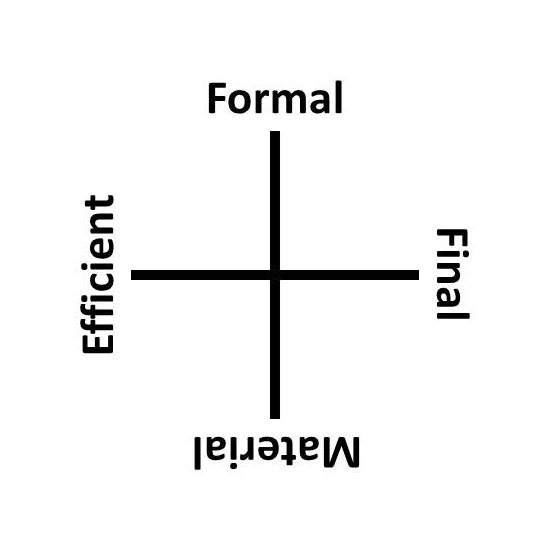
sq_engelhartWhat are the components of consciousness? In the dissertation of L. Kurt Engelhart we see a fourfold used to analyze the texts and bodies of work of both scientists and philosophers, a hermeneutical tool if you will. This tool is also styled by concepts of “systems theory”, and requires the exposition of the aspects of Content, Control, Process, and Purpose of the authors. These match closely the Four Causes of Aristotle, which are the causes of made things or the explanations of how and why they came about: material, efficient, formal, and final. In fact, this close association was one of the main reasons I dove into the world of fourfolds. Texts are made things, after all.sq_causes

Making is so fundamental to what we do, that humans have been called “Homo Faber”, man the maker. We make tools, stories, culture, and even our concept of self. What if I turned this tool onto my own work, the writings and images found here? Perhaps that will be the project of another analyst, if my efforts warrant. What if I applied this tool to Engelhart’s project? That would be interesting indeed.

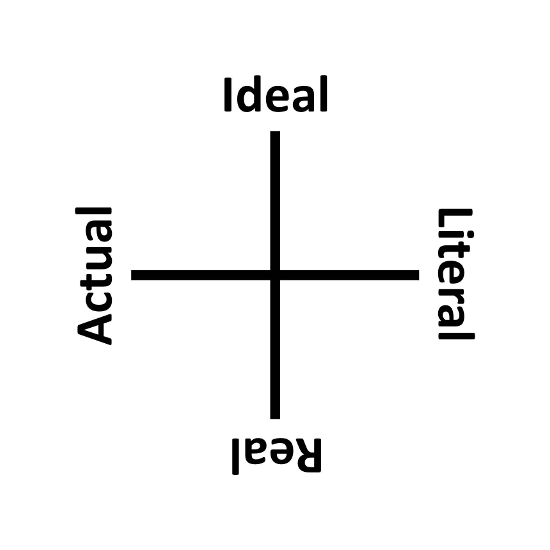
Another fourfold Engelhart presents is that of the domains of conscious experience, or the self itself as system. sq_four_alsThis fourfold consists of the Real, the Actual, the Ideal, and the Literal, but my version is in disagreement with Engelhart’s as to the classification of integrative and differentiative for the Ideal and the Literal. My assignments match the conjunctive and disjunctive properties of the operators of Linear Logic. Also left out is the Universal and how it supersedes the Actual as we make a complete turn. I like my version because it is similar to Richard McKeon’s Things, Thoughts, Words, and Actions. Also T. S. Eliot’s Falls the Shadow.

Of course this is just a brief gloss of the rich ideas presented in Engelhart’s work. Another of his key concepts is that of wholeness, which I have completely omitted. I hope to return and write a better review at a later time. I’m glad to see that Engelhart’s dissertation is now available as a Kindle book for the low, low price of $1. It is much easier to read in this format! From the Amazon Book Description:

This study describes, as a single systemic model of inquiry, the context common to conscious experience of the phenomenon of inquiry. Data are the published texts of selected contemporary writers relevant to the question. The problem is to define a common systemic structure of inquiry in a context of consciousness. Research verifies that a specific structure is common to these writers and that their respective views are converging on this same structure.

Identifying a common structure involves reducing the textual descriptions of the writers to their systemically relevant essentials. Defining the essential elements and describing a reduction method depends heavily on theory of metaphor and metaphorical evolution. A history of the metaphorical structure relevant to inquiry is described and this structure is used as a basis for finding structure in the selected texts. Texts researched include evolutionary biology, sociology, psychology (phenomenology), and philosophy. This work replicates that done by Talcott Parsons in experimentally describing a voluntaristic theory of action. A wholistic theory of inquiry is described using the same systemic scheme.

The metaphysical approaches to inquiry of realism and idealism have converged on a common theoretical structure for describing inquiry. Commonalities emphasize systemic structure comprising the elements of function: purpose, process, content, and control. It has been necessary to distinguish between affectual and instrumental purposes, and between organic and mechanical function. The ontological essentiality of the structure reveals a necessary logical relationship between function, systemicity, wholeness, and rationality in human understanding. Continuing research in philosophy is crucial to expanding our understanding of the ontological and epistemological structural essentials of consciousness.

Human inquiry during the last century has specialized in the material realm of realism, objective description, and mechanical explanation. A wholistic theory of inquiry does not discount the contributions of realism-based science or idealism-based philosophy, but expands the horizons of each to include the other. Where mathematics provides essential tools for mechanical explanation, organic explanation still lacks abstract structural tools for describing conscious organic, including human, behavior. The intent of a wholistic theory of inquiry is to provide conceptual tools that support disciplined inquiry into conscious behavior.

References and Links:

L. Kurt Engelhart / Wholeness and the Rational Structure of Inquiring Systems: A Dissertation

http://lkengelhartassoc.org/

http://en.wikipedia.org/wiki/Systems_theory

http://en.wikipedia.org/wiki/Homo_faber

http://en.wikipedia.org/wiki/Book_of_Nature

http://en.wikipedia.org/wiki/The_purpose_of_a_system_is_what_it_does

Notes:

I removed some text about the “Book of Nature”, because it needed more work. This mentioned the systems theory adage “the purpose of a system”, which can also tie into “meaning as use”. I also missed seeing an obvious thought that inquiry is making.

[*2.188, *3.104, *8.134]

<>


Kant’s Analytic-Synthetic Distinction

One of the oldest and most problematic philosophical questions is the comparison of the a prioria posteriori distinction with that of the analyticsynthetic distinction. Both are used in epistemology to divide knowledge, or true statements, between the innate and the learned, or the immediate and the earned, so they might even be considered the same. A priori and a posteriori statements are before “experience” and after it, respectively. Analytic statements are true only by their “meaning”, whereas synthetic statements are true only when facts about the world are combined consistently with that meaning.

It seems we have complicated the issue because now we must define and understand “experience” and “meaning”. However, these concepts are not independent because we must experience meaning, and meaning in turn conditions experience. In addition, even the a priori or the analytic are not innate or immediately obvious because deductions and the rules of logic require effort just like inductions do. Otherwise we would have Fitch’s Paradox: all truths are in fact known. What a muddle! So both experience and meaning are necessarily locked into a cooperative spiral dance to improve each other.

Even so, these two distinctions can be distinguished and combined into a fourfold.

The web site of Stephen R. Palmquist has a great wealth of material on fourfolds in relation to Kant’s as well as his own philosophy. From my own initial reading of his extensive material I have tried to choose a canonical Kantian fourfold which has the most relevance to my project.

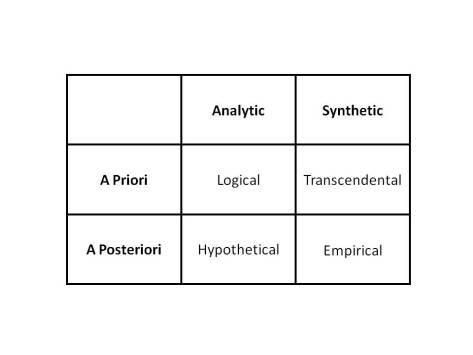
The fourfold shown to the right Dr. Palmquist calls Kant’s “reflective perspectives on experience”. Consisting of the logical, the empirical, the transcendental, and the hypothetical, these facets bear a close analogical likeness to many of the fourfolds presented here.

Logical: Analytic a priori
Transcendental: Synthetic a priori
Hypothetical: Analytic a posteriori
Empirical: Synthetic a posteriorikant_table

Dr. Palmquist also has many of his own books available on his web site for the interested reader. I will certainly be returning to his web site in the future for much enjoyable study.

Links:

http://en.wikipedia.org/wiki/Analytic-synthetic_distinction

http://en.wikipedia.org/wiki/A_priori_and_a_posteriori

http://plato.stanford.edu/entries/analytic-synthetic/

A Priori and A Posteriori

http://plato.stanford.edu/entries/fitch-paradox/

http://www.philosophypages.com/hy/5f.htm

http://www.hkbu.edu.hk/~ppp/

http://www.hkbu.edu.hk/~ppp/ksp2/KCR3.htm

[*8.126]

<>


Relative Time

sq_relative_time For what more terrifying revelation can there be than that it is the present moment? That we survive the shock at all is only possible because the past shelters us on one side and the future on another.

— From Orlando, by Virgina Woolf

As we can see on the previous four-folds of space and time, all have a degree of conditioning to the location and orientation of an observer. In other words, there are no absolute frameworks of space or time. That does not mean that they are not useful conventional and conceptual tools.

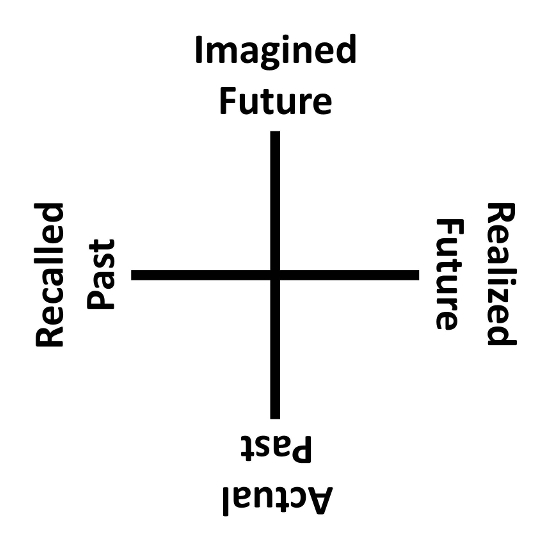
What would a four-fold of Relative Time be like? Because time seems to be linear instead of two dimensional, relative time would be very different than relative directions. What if we contrast our understanding of what happened in time with what actually occurred? What if we compare our thoughts of an imagined future with what becomes realized?

One could contrast an individual’s notions of past and future with a group or society’s notions of past and future. Or one could contrast an individual’s or society’s recalled past and imagined future with the actual past and the realized future. Some might argue that there is no actual past, but only the past we think or recall that it is. Similarly, those or others might argue that there is no realized future, because once the future becomes the present it has already slipped into the past that we can now only recall.

As the future becomes realized, the imagined future is discarded or blended into it to become our recalled past. As we understand more about the real past, our recalled past may be discarded or blended into it to become our new recalled past. Or one can refuse that knowledge and believe whatever suits them.

[*8.99, *9.60]

<>

Plato’s Chariot

sq_plato_chariotAt the risk of being labeled a neo-platonist, another triad of Plato’s that is often discussed is that of the Allegory of the Chariot. This analogy is supposed to bring insight into the workings of the human soul and consists of two horses, one good and one bad, and the charioteer whose duty is to control them.

You never hear about the chariot itself (but it is always pictured), but it is required to have a chariot, after all. The charioteer isn’t just standing on the backs of the horses, like Jean-Claude Van Damme doing his epic split, although that would be cool. (They do this at the circus, and I know I’ve seen it in old gladiator movies when the chariot loses a wheel and the charioteer has to cut away the chariot.)

Thus, unless you want to change the nature of the analogy, the chariot is required for everything to be connected together. This fourth material component completes the triad into a fourfold, and I place it at the lowest, fundamental position where I added The Real to The Beautiful, The True and The Good.

And of course everyone knows that Bad Horse is the Thoroughbred of Sin!

Further Reading:

http://en.wikipedia.org/wiki/Chariot_Allegory

https://drhorrible.fandom.com/wiki/Bad_Horse

[*8.86]

<>

Plato Redux

sq_plato_redux

What is, is The True
What is, is The Good
What is, is The Beautiful
What is, is The Real

— Anonymous

I recently finished reading Rebecca Goldstein’s Plato at the Googleplex: Why Philosophy Won’t Go Away. In it there was much talk of The Beautiful, The True and The Good.

Besides Plato’s Divided Line, which was mentioned in The Republic and consists of four parts, the threesome of The Beautiful, The True and The Good is mentioned in various dialogues.

Being the quadraphile I am, I thought adding The Real to the threesome makes the now foursome nicely balanced. Usually one hears of just the three, without the fourth, but why is that?

Some argue loud and long that The Real has no part in this threesome of Universals, that the three are sufficient among themselves. Others disagree. Which side would you say I’d be on?

Further Reading:

http://en.wikipedia.org/wiki/Transcendentals

http://en.wikipedia.org/wiki/Analogy_of_the_Divided_Line

Henry Rutgers Marshall / The True, The Good and the Beautiful (The Philosophical Review, Vol. 31, No. 5, Sep. 1922 pp. 449-470)

Michael Boylan / The Good, the True and the Beautiful

[*4.82, *8.72, *8.82]

<>


The Quadralectics of Marten Kuilman

sq_quadralectics Marten Kuilman has written extensively on four-folds and what he calls quadralectics, division-thinking, or four-fold thinking.

Publishing in the Netherlands, his books aren’t available on Amazon. Graciously, he has made several of his works available on the internet via his blogs Quadralectics and Quadriformisratio. Quadriformisratio presents Four – A Rediscovery of the ‘Tetragonus Mundus’, a treatise of four-folds through history, and Quadralectics is his two volume work on Quadralectic Architecture.

Not only does Kuilman expound at length on various four-folds throughout the ages and how they affected the intellectual and artistic developments of the time, his work unifies many of them into his four aspects of visibility: invisible invisibility, invisible visibility, visible visibility, and visible invisibility. Above, I’ve arranged these four aspects by my positions for the four elements. Unfortunately, they aren’t in the same sequence as Kuilman’s quadrants.

Because Kuilman emphasizes a recurring association of  his four-fold of visibility with communication, it is also reminiscent of Hjelmslev’s Net. Then, invisibility could be understood as content, and visibility as expression.

Interestingly, my four-fold of Bright-to-Dark (here or here) is most relatable to this four-fold of visibility, but in the reverse sense that the invisible invisibility is bright, and the visible visibility is dark. One could quickly reconcile this opposition by considering the empty circle as most invisible, and the full circle as most visible.

Another interesting result of Kuilman’s investigations is to derive his four-fold of Unity, Muun (Multi-unity), Part, and Whole, which I believe has important associations with my four-fold Structure-Function.

References:

Marten Kuilman / Four – A Rediscovery of the ‘Tetragonus Mundus’

Marten Kuilman / QUADRALECTIC ARCHITECTURE – A Panoramic Review

http://quadriformisratio.wordpress.com/

http://quadralectics.wordpress.com/

http://quadralectics.wordpress.com/7-the-quadralectic-theory/

[*8.48, *8.52, *8.53, *8.54, *8.55]

<>

Graham Harman’s Quadruple Object, V2

The world is made up of a basic set of polarities – four of them, it turns out. They cannot be derived from a single radical root, but neither do they exist as incorruptible elements untransmutable into one another in the manner of the Empedoclean air, earth, fire and water.

— From Prince of Networks by Graham Harman

sq_harman

Objects exist as autonous units, but they also exist in conjunction with their qualities, accidents, relations, and moments without being reducible to these. To show how these terms can convert into one another is the alchemical mission of the object-oriented thinker.

— From Prince of Networks by Graham Harman

sq_harman2

I have made an attempt at orienting Graham Harman’s fourfold of real object, sensual object, real qualities, and sensual qualities with respect to the other fourfolds presented here. The fourfold object emerges from Harman’s analysis of Heidegger’s das Geviert.

References:

Graham Harman / Guerrilla Metaphysics: phenomenology and the carpentry of things

Graham Harman / Prince of Networks: Bruno Latour and metaphysics

Graham Harman / The Quadruple Object

[*6.46, *6.48, *6.62, *7.40, *7.132, *7.133]

<>

Relations All the Way Down

There is nothing to be known about anything except an initially large, and forever expandable, web of relations to other things. Everything that can serve as a term of relation can be dissolved into another set of relations, and so on for ever. There are, so to speak, relations all the way down, all the way up, and all the way out in every direction: you never reach something which is not just one more nexus of relations.

— Richard Rorty from Philosophy and Social Hope

sq_ll2

The ancient Greek philosopher Empedocles somehow reasoned that the world was made entirely from four basic elements: fire, earth, water, and air. Science as we know it has disproved this from being the case, but this idea still has a rich symbolic meaning even today that informs our popular culture.

A recent philosophical stance called “ontic structural realism” argues that science suggests that only relations between things are of lasting importance, that is the structural relationships within and between things, not the things themselves that bracket the relations. What we call a quark for instance is just the relations it has with other quarks and the other entities that have relationships with quarks. Perhaps then the world consists of “relations all the way down”, instead of stopping at some point on the lowest level with the things that constitute the world.

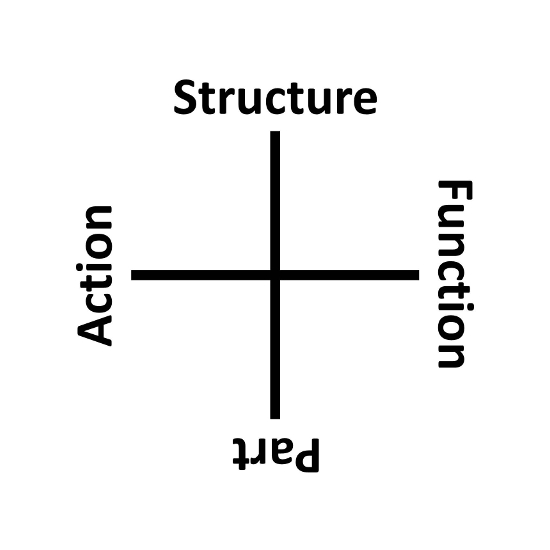
If this is so, what if the world was made completely from four basic relations, instead of four basic things? sq_structure_functionCould they be something like the four binary operators of linear logic? I have likened these four basic operators of Linear Logic to my fourfold Structure-Function, where in addition to Structures, we also have Functions, Actions, and Parts. But these three other relations are also structural, in that only the relation something has to another something makes it structural, functional, actional, or a part of a something.

Book Description for Every Thing Must Go:

Every Thing Must Go argues that the only kind of metaphysics that can contribute to objective knowledge is one based specifically on contemporary science as it really is, and not on philosophers’ a priori intuitions, common sense, or simplifications of science. In addition to showing how recent metaphysics has drifted away from connection with all other serious scholarly inquiry as a result of not heeding this restriction, they demonstrate how to build a metaphysics compatible with current fundamental physics (“ontic structural realism”), which, when combined with their metaphysics of the special sciences (“rainforest realism”), can be used to unify physics with the other sciences without reducing these sciences to physics itself. Taking science metaphysically seriously, Ladyman and Ross argue, means that metaphysicians must abandon the picture of the world as composed of self-subsistent individual objects, and the paradigm of causation as the collision of such objects. Every Thing Must Go also assesses the role of information theory and complex systems theory in attempts to explain the relationship between the special sciences and physics, treading a middle road between the grand synthesis of thermodynamics and information, and eliminativism about information. The consequences of the author’s metaphysical theory for central issues in the philosophy of science are explored, including the implications for the realism vs. empiricism debate, the role of causation in scientific explanations, the nature of causation and laws, the status of abstract and virtual objects, and the objective reality of natural kinds.

Stuff I need to read:

James Ladyman, Don Ross / Every Thing Must Go: Metaphysics Naturalized

http://plato.stanford.edu/entries/structural-realism/

Jason D. Taylor / Relations all the way down? Exploring the relata of Ontic Structural Realism

http://hdl.handle.net/10402/era.27885

Relations All the Way Down

https://ndpr.nd.edu/reviews/every-thing-must-go-metaphysics-naturalized/

<>


Knowledge and Its Limits

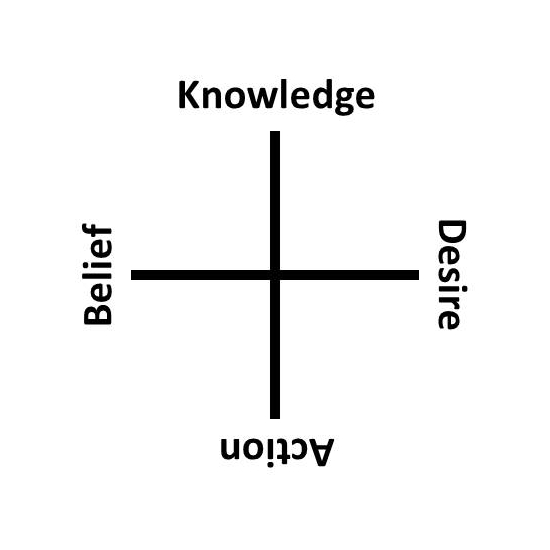
Knowledge and action are the central relations between mind and world. In action, world is adapted to mind. In knowledge, mind is adapted to world. When world is maladapted to mind, there is a residue of desire. When mind is maladapted to world, there is a residue of belief. Desire aspires to action; belief aspires to knowledge. The point of desire is action; the point of belief is knowledge.

— From Knowledge and Its Limits by Timothy Williamson

sq_knowledge_limits

Or with some substitutions:

Theory and practice are the central relations between the mental and the physical. In practice, the physical is shaped to the mental. In theory, the mental is shaped to the physical. When the physical is misshaped to the mental, there is a residue of intention. When the mental is misshaped to the physical, there is a residue of attention. Intention aspires to practice; attention aspires to theory. The point of intention is practice; the point of attention is theory.

sq_knowledge_limits2

Also, note the similarity to The Scientific Method.

Further Reading:

Timothy Williamson / Knowledge and Its Limits

[*6.24, *6.32, *8.22]

<>