Category Archives: Mathematics

Complex Numbers and Quaternions

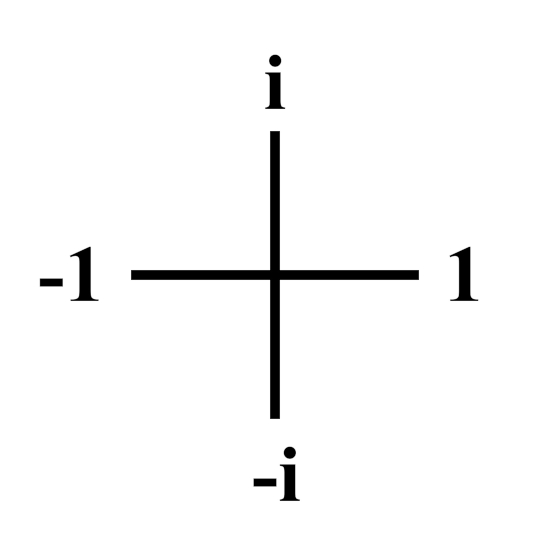
Two conceptualizations of four directions in mathematics are Complex numbers and Quaternions. For complex numbers, two of the directions are the opposite or negative of the other two. Complex numbers are like Cartesian coordinates in that they combine an (x,y) coordinate pair of real numbers into one complex number x + yi. Plus, complex numbers can by manipulated by extensions of arithmetic operations, like addition, subtraction, multiplication, and division.
Quaternions are an extension of the complex numbers where the directions are all different, and each direction is perpendicular to the other three. Like complex numbers are a notion of numbers that cover a plane, quaternions are a notion of number that fill four dimensional space. Thus they combine a 4-tuple (w,x,y,z) into one quaternion number w + xi + yj + zk. Like complex numbers, quaternions can be manipulated by further extensions of arithmetic operations.

http://en.wikipedia.org/wiki/Complex_number

http://en.wikipedia.org/wiki/Quaternion

[*7.189]

<>

The Stone Gamut

Our thesis is that the category Set is the ultimate abstraction of body, and that Set^op, equivalent to the category of complete atomic Boolean algebras (i.e. power sets), which we shall advocate thinking of as antisets, is dually the ultimate abstraction of mind.

— From Chu Spaces: automata with quantum aspects by Vaughan Pratt

Reflecting an era of reduced expectations for the superiority of humans, we have implemented causal interaction not with the pineal gland but with machinery freely available to all classical entities, whether newt, pet rock, electron, or theorem (but not quantum mechanical wavefunction, which is sibling to if not an actual instance of our machinery).

— From Rational Mechanics and Natural Mathematics by Vaughan Pratt

http://en.wikipedia.org/wiki/Boolean_algebra

http://en.wikipedia.org/wiki/Distributive_lattice

http://en.wikipedia.org/wiki/Vector_space

http://en.wikipedia.org/wiki/Partially_ordered_set

http://en.wikipedia.org/wiki/Set_%28mathematics%29

References:

Click to access ph94.pdf

Click to access ratmech.pdf

http://chu.stanford.edu/

http://en.wikipedia.org/wiki/Chu_space

Vaughan Pratt / The Stone Gamut: a coordinatization of mathematics

https://ieeexplore.ieee.org/document/523278

[*7.140]

<>

My Dear Aunt Sally

When I took first year algebra in school, I learned the rule “My Dear Aunt Sally” as a mnemonic for the order of applying binary operations in algebraic expressions. “My Dear” meant to perform multiplication and division first. “Aunt Sally” meant to perform addition and subtraction next and last. Most of us have learned some variation of this rule. I see that it has now been enlarged to “Please Excuse My Dear Aunt Sally” to include parentheses and exponentiation, and to perform these two first before the original and now last four.

Why remark about this simplistic and even obsolete rule? Note the similarity between this fourfold of binary arithmetic operators and the four binary linear logic operators. In each there are two operators for increasing: addition and multiplication in arithmetic, and the disjunctive operators plus and par in linear logic. In each there are two operators for decreasing: subtraction and division in arithmetic, versus the conjunctive operators with and tensor in linear logic. In each there are two rules for attraction and two rules for repulsion.

In addition, the double duality of the four arithmetic operators is revealed, as in arithmetic addition and subtraction are duals, and multiplication and division are duals. In linear logic, with and plus are duals, and tensor and par are duals. Can arithmetic be simulated by linear logic, or vice versa? Is linear logic equivalently exchangable with arithmetic? I don’t think so but perhaps some expert can tell us.

References:

http://en.wikipedia.org/wiki/Order_of_operations

[*7.94]

<>

Fourier Analysis

Here is another example of a fourfold, in the mathematics of Fourier Analysis. Here the four elements of our investigation resolve into Discrete Time, Continuous Time, the Fourier Series, and the Fourier Transform.

From the three dualities of Time – Frequency, Periodic – Aperiodic, and Discrete – Continuous, we obtain the four combinations Discrete Time/Periodic Frequency, Continuous Time/Aperiodic Frequency, the Fourier Series (Periodic Time/Discrete Frequency), and the Fourier Transform (Aperiodic Time/Continuous Frequency).

In the table below, T stands for Time and f for Frequency. The subscripts denote the attributes of each: D for Discrete, C for Continuous, P for Periodic, and A for Aperiodic. So T subscript C,  f subscript A means that when Time is Continuous, Frequency is Aperiodic, etc. Please see Steve Tjoa’s web site for the equations for the Fourier Series and the Fourier Transform in Continuous and Discrete Time.

References:

http://stevetjoa.com/633

http://en.wikipedia.org/wiki/Fourier_analysis

http://en.wikipedia.org/wiki/Fourier_series

http://en.wikipedia.org/wiki/Fourier_transform

[*7.74, *7.108]

<>

Noether’s Theorem

Nature is thrifty in all its actions.

    — Pierre Louis Maupertuis

From Wikipedia:

Noether’s (first) theorem states that any differentiable symmetry of the action of a physical system has a corresponding conservation law. The theorem was proved by German mathematician Emmy Noether in 1915 and published in 1918. The action of a physical system is the integral over time of a Lagrangian function (which may or may not be an integral over space of a Lagrangian density function), from which the system’s behavior can be determined by the principle of least action.

Noether’s theorem can be stated informally:

If a system has a continuous symmetry property, then there are corresponding quantities whose values are conserved in time.

Note:

Symmetries are transformations or exchanges in space or time that leave systems structurally or functionally equivalent to what they were before. The equivalence may or may not be an identity, but only the same in appearance or behavior.

Conservation laws are equivalences for quantitative properties of systems. A given property of matter or energy is quantitatively the same before and after, or continuously through space or time. The functional measure of this property remains constant.

So consider an analogy between Noether’s Theorem and the concept of Equivalent Exchange: for (symmetrical, differentiable) exchanges, there are properties that are equivalent (conserved)!

http://en.wikipedia.org/wiki/Noether’s_theorem

http://en.wikipedia.org/wiki/Action_%28physics%29

http://en.wikipedia.org/wiki/Lagrangian

http://en.wikipedia.org/wiki/Principle_of_least_action

http://math.ucr.edu/home/baez/noether.html

<>

Systems Dynamics

Another interesting fourfold that I discovered while reading mathematical physicist John C. Baez’s blogs Azimuth and This Week’s Finds in Mathematical Physics concerns the notions of system dynamics and bond graphs. These concepts generalize the fourfold of the basic electronic components into other types of physical systems, such as mechanics, hydraulics, and to some extent even thermodynamics and chemistry.

The types of systems that can be modeled by system dynamics are described by two variables that vary functionally over time and their corresponding integrals. These four functions can be thought of as flow and effort and their respective integrals displacement and momentum.

  Displace-
ment
Flow Momentum Effort
Mechanics of translation Position Velocity Momentum Force
Mechanics of rotation Angle Angular velocity Angular momentum Torque
Electronics Charge Current Flux Voltage
Hydraulics Volume Flow Pressure momentum Pressure
Thermo-dynamics Entropy Entropy flow Temperature momentum Temperature
Chemistry Moles Molar flow Chemical momentum Chemical potential


Further Reading:

http://johncarlosbaez.wordpress.com/2012/02/02/quantizing-electrical-circuits/

http://math.ucr.edu/home/baez/week288.html

http://math.ucr.edu/home/baez/week292.html

http://ncatlab.org/johnbaez/show/Diagrams

http://magisciences.tuxfamily.org/BondGraph/co/03%20Passive%20elements.html

Dean C. Karnopp, Donald L. Margolis, Ronald C. Rosenberg / System Dynamics: modeling and simulation of mechatronic systems

[*7.60, *7.61]

<>

Relational Models Theory

The Relational Models Theory (RMT) of Alan Fiske is a framework for social relations that details four major types of interpersonal interactions: Communal Sharing (CS), Authority Ranking (AR), Equality Matching (EM), and Market Pricing (MP). These four types can also be combined and nested to form more complex social relations. Thus they are presented to be the elementary building blocks out of which all social relations are made.

John Bolender expounds on Fiske’s theory, by arguing that the four relationships are each described by the inherent mathematical symmetry of the social relation, and that all four can be ordered: in one way by inclusion (in the sense of mathematical group theory) and the opposite way by symmetry breaking (usually considered in physics). The symmetries are viewed as transformations which when applied, like a reorganization of the relationship, do not alter the substance or content of the relationship. CS is more symmetric than AR, which in turn is more symmetric than EM, which lastly is more symmetric than MP. For inclusion, the symmetries of MP are included in the symmetries of EM, those of EM in AR, and AR in CS. For symmetry breaking, a symmetry of CS can be broken to form AR, which in turn has a symmetry that can be broken to form EM, and so on to MP. Thus CS > AR > EM > MP in terms of transformations that preserve symmetry.

As we move from CS to MP, we add increasing structure to a social relation, a greater number of constraints. Additionally, consider symmetry operations in general in the context of equivalent exchange: symmetry by definition is an exchange of participants in a relation, a permutation such that the relation itself is unchanged, that is, equivalent.

References:

Alan Page Fiske / Structures of social life: the four elementary forms of human relations

John Bolender / The Self-Organizing Social Mind

http://www.rmt.ucla.edu/

http://fuquaccl.wordpress.com/tag/relational-models-theory/

http://www.sscnet.ucla.edu/anthro/faculty/fiske/RM_PDFs/Fiske_Haslam_Four_Basic_Bonds_2005.pdf

http://www.sscnet.ucla.edu/anthro/faculty/fiske/relmodov.htm

http://ndpr.nd.edu/news/24644-the-self-organizing-social-mind/

http://www.iep.utm.edu/r-models/

Notes:

Some changes: replacing the diagram and removing reference to J.-Y. Girard’s infernos of semantics. Also the very important insight from IEP: “The symmetries of solid matter form a subset of the symmetries of liquid matter which form a subset of the symmetries of gaseous matter which form a subset of the symmetries of plasma.”

[*6.110]

<>

The 64 Hexagrams of the I Ching

Steven H. Cullinane has a great wealth of interesting material about square and cubic figures on various blogs and web sites. This figure was inspired by his arrangement of von Franz’s “box” style representation of the hexagrams. In the above figure, solid and open lines are shown as they are in the regular hexagrams. At the top is 01 The Creative, at the bottom is 02 The Receptive, at left is 64 Before Completion, and at right is 63 After Completion. It’s not quite symmetric, but I think it looks pleasing. The trigrams can be separated into two N and Z figures, but I’m still trying to find the best arrangement to display them.

Further Reading:

http://finitegeometry.org/sc/64/iching.html

http://m759.net/wordpress/

The Eight Trigrams of the Bagua

<>


The Four Conic Sections

To teach superstitions as truth is a most terrible thing.

– Hypatia of Alexandria

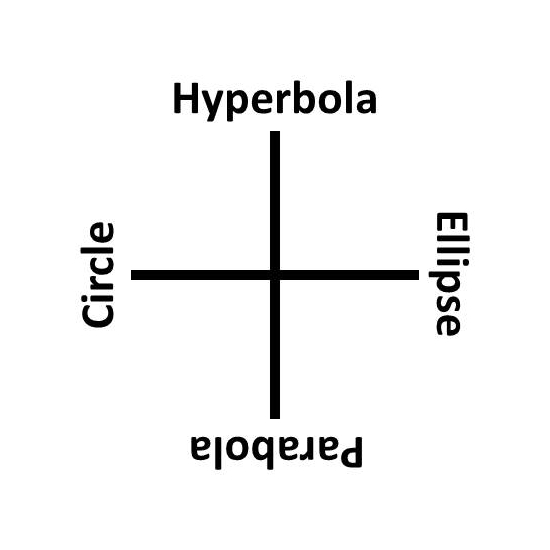
In mathematics, the four conic sections are the different shapes that can be formed by the intersection of a three dimensional right double cone and a plane: the circle, the ellipse, the parabola, and the hyperbola. The conics have been studied since the dawn of Greek mathematics. These shapes have interest as pure mathematical constructions, as well as many practical uses in applied mathematics.

Special points (focus or foci, plural) and lines (directrix or directrices, plural) can also be used to generate the conic sections in analytic geometry. A circle or parabola has one focus; the ellipse or hyperbola has two. The circle is a special case of the ellipse, one whose two foci coincide at a unique center, and in a different sense, the parabola can also be considered as a special case of the ellipse, having one of its foci at infinity. All circles can be transformed into each other by uniform scaling, a property shared by all parabolas. Thus the circle can be considered to be a singular shape, as well as the parabola. In contrast, ellipses and hyperbolas have a multitude of shapes and cannot be transformed into others of the same kind by uniform scaling. However, a nonuniform scaling or affine transformation can be used to achieve this goal. In even more abstract projective geometry, one could consider that all the conics are the same.

If the double cone is considered as the so-called light cone in Minkowski Space-time, many interesting concepts in special relativity can be considered. In this simplified model, space has two dimensions and time has one. The light cone divides all of space-time into four parts: the past, the present, the future, and the rest. The observer is located in time and space at the common apex of the two cones. Light travels on the surface of the cones, in straight lines towards and away from the observer. Anything traveling strictly within the space-time of a cone must necessarily be traveling slower than the speed of light. One cone can be thought of as the past: the interior of which contains all space-time that could have been observed by the observer, bounded by the circles of light traveling towards her. The second cone can be thought of as the future: the interior of which contains all space-time that could possibly be observed by the observer, bounded by the circles of other observers observing her light. Everything outside of the light cone cannot be observed or influenced by the observer at that instant, since light from it would have to travel faster than the speed of light in order to be seen or acted on by the observer.

Letting my analogical thinking run rampant, I can think of several associations with other fourfolds presented here. The circle is the shape of perfection, of identity and wholeness. It has one center or focus. In Minkowski Space-time, it is formed by the plane cutting the light cone at a constant time, so that all light arrives at the observer simultaneously from the past. Thus it is the shape of the knower or perspective. The parabola has the shape of gravity, the arc of an object thrown from and falling towards the earth. The shape reminds me of a reality that flies up from the opaque depths of the knowable only to fall away again. Numbers that are perfect squares may have started ancient mathematicians thinking about arithmetic. The ellipse has the shape of cosmology. Once astronomers could consider orbits of planets not to be circles or epicycles, only then science changed from idealism to empiricism. The hyperbola’s asymptotes form the crossed lines of my ever-present double duals, dividing yet unifying, as well as the profile of Minkowski Space-time. In fact, space and time occur over and over in many of the fourfolds I have considered.

Circles and ellipses could be considered the shapes of time, subjectivity, conjunction, and content: closed, finite, and bounded, yet cyclic. Parabolas and hyperbolas could be considered the shapes of space, objectivity, disjunction, and expression: open, infinite, and unbounded, acyclic.

In the recent movie Agora, the main character is Hypatia, the daughter of the last librarian of the great Library of Alexandria. A mathematician, astronomer, and philosopher, only fragments of Hypatia’s writings are available to us today. After the sack of the library, Hypatia is shown in her new study with a beautiful wooden model of the conics that she saved from destruction. For any that love wisdom over superstition, the movie is heartbreaking. As an echo to the loss of the contents of the library, it is offered (without any proof) that she considered the truth of the Heliocentric model of the solar system with the planets moving in elliptical orbits. Her senseless murder meant her insights were destroyed without legacy, falling away into the gravity of the dark unknown. Fortunately, even if she had, Copernicus and Kepler rediscovered these insights well over a thousand years later and brought them to light. The library’s loss will never be recovered.

References:

http://en.wikipedia.org/wiki/Conic_section

http://www.npr.org/blogs/13.7/2011/07/11/137743796/agora-most-intelligent-movie-on-science-and-religion-ever?ft=1&f=114424647

http://babelniche.wordpress.com/2010/09/28/more-on-agora-and-hypatia/

http://www.skepticforum.com/viewtopic.php?f=85&t=14979

[*6.170, *6.172]

<>

The Medieval Quadrivium

As Proclus wrote:  The Pythagoreans considered all mathematical science to be divided into four parts: one half they marked off as concerned with quantity, the other half with magnitude; and each of these they posited as twofold. A quantity can be considered in regard to its character by itself or in its relation to another quantity, magnitudes as either stationary or in motion. Arithmetic, then, studies quantities as such, music the relations between quantities, geometry magnitude at rest, spherics [astronomy] magnitude inherently moving.

Thus arithmetic is number in itself, music is number in time, geometry is number in space, and cosmology is number in space and time.

References:

http://en.wikipedia.org/wiki/Quadrivium

http://quadriformisratio.wordpress.com/2013/07/01/the-curriculum-in-ancient-times/

[*6.66, *7.40]

<>