Category Archives: Mathematics

Recipe for Mathematics

Guided only by their feelings for symmetry, simplicity, and generality, and an indefinable sense of the fitness of things, creative mathematicians now, as in the past, are inspired by the art of mathematics rather than by any prospect of ultimate usefullness.

— E. T. Bell

A smile fell on the grass.
Irretrievable!

And how will your night dances
Lose themselves. In mathematics?

— Sylvia Plath, from The Night Dances

Further Reading:

https://en.wikipedia.org/wiki/Eric_Temple_Bell

https://hellopoetry.com/poem/710/the-night-dances/

https://poetrywithmathematics.blogspot.com/

[*11.14]

<>


Degen’s Eight-square Identity

Here is another identity but this time corresponding to an eight-fold: the Eight-square identity of Ferdinand Degen found about 1818. You know the drill: it states that a product of two numbers that are each the sum of eight squares is itself the sum of eight squares!

(a12 + a22 + a32 + a42 + a52 + a62 + a72 + a82)(b12 + b22 + b32 + b42 + b52 + b62 + b72 + b82) =

…The sum of the expressions in the eight triangles written in the diagram above. (Please consult the Wikipedia entry below for the textual formulas, as it’s too hard to write in HTML.)

Note that the expressions above have an interesting symmetry, aside from the one on the upper left. Indeed, Euler’s Four-square Identity has a similar simpler symmetry. There is also a connection with Octonions if you are interested in digging for it. If you are anticipating that there is such a formula for sums of sixteen squares, there is, but not a bilinear one, and it is much more complicated!

Further Reading:

https://en.wikipedia.org/wiki/Degen%27s_eight-square_identity

https://en.wikipedia.org/wiki/Pfister%27s_sixteen-square_identity

[*11.64]

<>


Euler’s Four-square Identity

Here’s a nice little math identity that mathematician Leonard Euler wrote down in a letter dated 1748. It states that the product of two numbers that are sums of four squares is itself the sum of four squares.

(a12+a22+a32+a42)(b12+b22+b32+b42) =

(a1b1-a2b2-a3b3-a4b4)2 + (a1b2+a2b1+a3b4-a4b3)2 + (a1b3+a3b1+a4b2-a2b4)2 + (a1b4+a4b1+a2b3-a3b2)2

It can be proved with elementary algebra or even by quaternions!

Further Reading:

https://en.wikipedia.org/wiki/Euler%27s_four-square_identity

[*11.62]

<>

Four Forms Make a Universe, Part 2

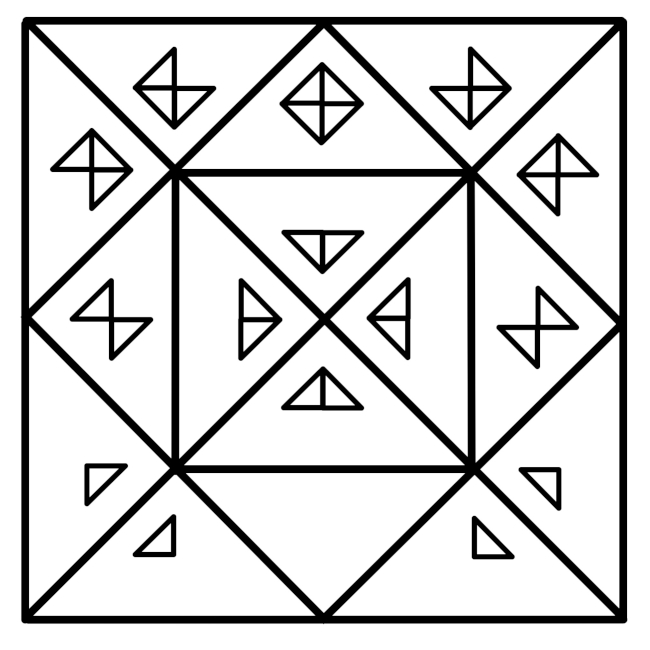
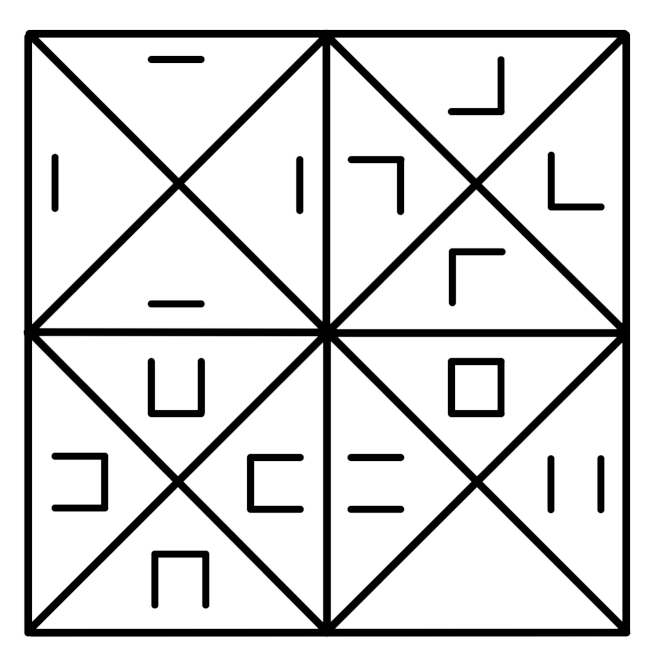
This is a continuation of my last entry. Above is a different representation of the LICO alphabet, with the letters turned 45 degrees counter-clockwise, and rearranged into a symmetric pattern. The letters seem to arise more naturally in this orientation, but then Schmeikal rotates them into his normal schema.

And to the right is a diagram of the logical expressions that correspond to the letters above.

After making these new diagrams, I became inspired and made a few other figures to share with you.

These two versions, with triangles instead of line segments, and also with borders between adjacent triangles removed:


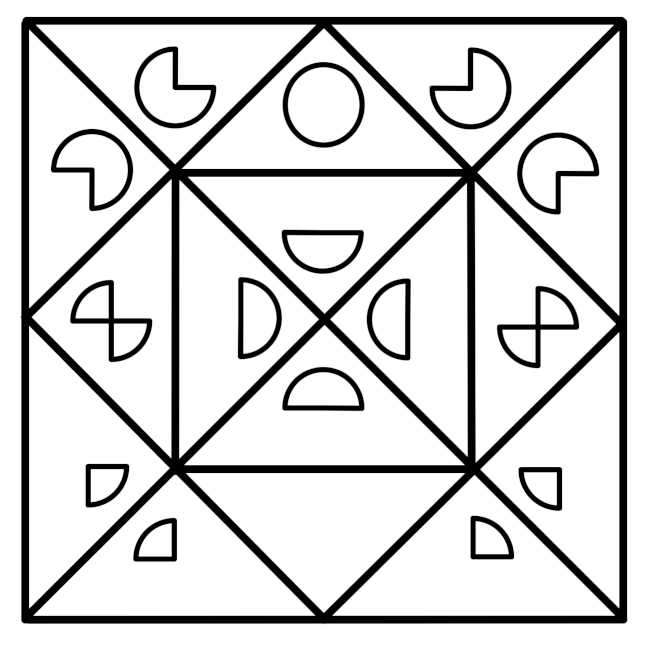
And these two versions, with quarter circles, and also with edges between adjacent quarter circles removed:


Further Reading:

Four Forms Make a Universe

[* 11.50, *11.58]

<>


Four Forms Make a Universe

How could I not love a paper with this title? I’ve struggled with it for a bit, and I’ve only managed a couple of diagrams relating the author’s LICO (Linear Iconic) alphabet made up of 16 letters. However, I see that there are a few other papers by Schmeikal available on ResearchGate that look easier to understand. But also however, the first one says to read the “Four Forms” paper first!

At any rate, I present a sixteen-fold of the LICO alphabet, and another of the binary Boolean operators that are in a one-to-one mapping with LICO. There is much to understand from these papers, including much syncretism between various mathematical sixteen-folds, so please forgive me if I don’t explain it all with immediate ease. However, I believe it is well worth the effort to understand.

(Please note that the characters of the LICO alphabet are oriented so that the bottoms of the letters are downward, but the Boolean operators are oriented so that the bottoms of the equations are towards the right angles of the triangles.)

The title comes from the result that four elements of LICO can reproduce the other twelve via linear combinations. These four forms are 1) Boolean True (A or ~A), 2) A, 3) B, and 4) A=B. These are within the interior right-hand triangles in the LICO diagram. Of course, it is well known from Computer Science that the NAND operator (~A or ~B) can also generate all other fifteen operators, but this is by multiple nested operations instead of simple Boolean arithmetic. There are several other “universal” binary gates that can do this as well.

Two other representations that have four elements that can generate the other twelve via linear combinations come from CL(3,1), the Minkowski algebra. These representations are called “Idempotents” and  “Colorspace vectors”. Because of this algebra’s association with space and time in relativity, Schmeikal claims that LICO has ramifications in many far-ranging conceptualizations.

Further Reading:

Bernd Schmeikal / Four Forms Make a Universe, in Advances in Applied Clifford Algebras (2015), Springer Basel (DOI 10.1007/s00006-015-0551-z)

https://link.springer.com/article/10.1007/s00006-015-0551-z

At http://www.researchgate.net:

Bernd Schmeikal / Free Linear Iconic Calculus – AlgLog Part 1: Adjunction, Disconfirmation and Multiplication Tables

Bernd Schmeikal / LICO a Reflexive Domain in Space-time (AlgLog Part 3)

https://en.wikipedia.org/wiki/Spacetime_algebra

https://www.allaboutcircuits.com/technical-articles/universal-logic-gates/

[*9.145, *11.50]

<>


Octonions

Octonions are the fourth, the last, and the greatest of the so-called normed division algebras based on the Real numbers. When I first learned about the Octonions way back when, I didn’t like them because they weren’t associative like the Quaternions, the Complex numbers, and the Reals. But now I’m fine with that, and they may be important for new theories of physics!

Octonions have the general form:

a0e0 + a1e1 + a2e2 + a3e3 + a4e4 + a5e5 + a6e6 + a7e7

Where the coefficients ai are Real and the bases ei have (something like) the following relations:

e0 = 1 (and -1 = e12 = e22 = …)

e1 = I = e2e3 = e7e6 = e4e5

e2 = J = e5e7 = e3e1 = e4e6

e3 = IJ = e1e2 = e6e5 = e4e7

e4 = K = e5e1 = e6e2 = e7e3

e5 = IK = e7e2 = e1e4 = e3e6

e6 = JK =e5e3 = e1e7 = e2e4

e7 = IJK = e6e1 = e3e4 = e2e5

In addition, if any of the products like e2e3 = e1 are reversed you get the negative, so e3e2 = -e1.

Non-associativity is demonstrated by going through the list of triples:

(e1e2)e3 = e32 = -1

e1(e2e3) = e12 = -1

(e1e2)e4 = e3e4 = e7

e1(e2e4) = e1e6 = -e7

(e1e2)e5 = e3e5 = -e6

e1(e2e5) = e1e7 = e6

so it is hit or miss I guess. Also note that e7 = (IJ)K = -I(JK). And for all (eiej)ek and ei(ejek), if they are not equal, is one equal to the negative of the other? And do I have to multiply them all out to find out?

Further Reading:

https://en.wikipedia.org/wiki/Octonion

http://math.ucr.edu/home/baez/octonions/

https://www.quantamagazine.org/the-octonion-math-that-could-underpin-physics-20180720/

http://mathworld.wolfram.com/Octonion.html

https://ncatlab.org/nlab/show/normed+division+algebra

[*11.33]

<>

Quaternions

The Quaternions are a number system that enlarges the Complex numbers, just as the Complex numbers enlarge the Real numbers. In fact, Quaternions can be thought as special pairs of Complex numbers, just as Complex numbers can be thought as special pairs of Real numbers.

Quaternions can be used for all sorts of wonderful things, such as rotations in 3D space, instead of using matrices. Above is a pitiful diagram (although better than my last one) of the Quaternion units 1, i, j, and k used in the typical representation a + b i + c j + d k. Please read about them in the links below and be amazed!

Further Reading:

https://en.wikipedia.org/wiki/Quaternion

https://en.wikipedia.org/wiki/Quaternions_and_spatial_rotation

http://mathworld.wolfram.com/Quaternion.html

http://www.euclideanspace.com/maths/algebra/realNormedAlgebra/quaternions/

https://www.quantamagazine.org/the-strange-numbers-that-birthed-modern-algebra-20180906/

[*10.160]

<>


The Free Energy Principle

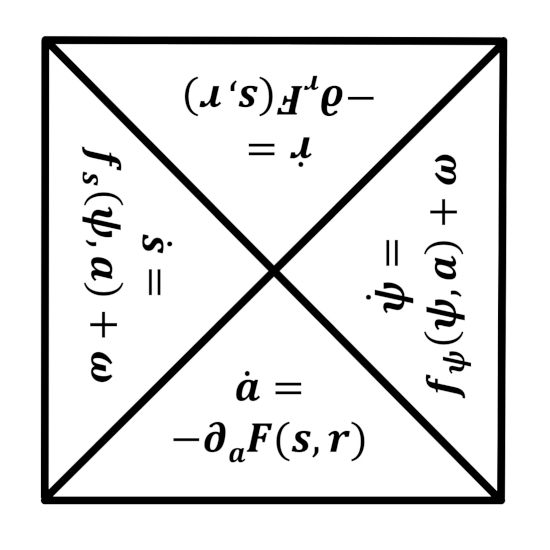
Below is a link to a fascinating article about Karl Friston, whose research on the “free energy principle” (also known as active inference) tries to explain how biological (or even artificial) systems maintain or even increase their organization. Without much explanation, here are some details. The model is a system with four main variables:

  • Sense (s)
  • Action (a)
  • Internal States (r or μ)
  • Hidden States (ψ)

Sense and action divide the internal states of the system from the hidden states external to it. This division is called a “Markov Blanket”. I’ve tried to show the equations between the variables correctly but I’m not too sure if I have them right. They seem to change from paper to paper. F is an expression of the free energy, but I’m not sure what f is at the moment, except for being some sort of “flow”.

Further Reading:

https://www.wired.com/story/karl-friston-free-energy-principle-artificial-intelligence/

https://en.wikipedia.org/wiki/Free_energy_principle

https://en.wikipedia.org/wiki/Markov_blanket

http://rsif.royalsocietypublishing.org/content/15/138/20170792

[*11.6]

<>


Viete’s Method of Constructing Pythagorean Triples

Number is the ruler of forms and ideas, and the cause of gods and daemons.

— Pythagoras, as attributed by Iamblichus

This diagram shows (but not to scale ;-)) a clever method of constructing two Pythagorean triples given any two other Pythagorean triples due to Francois Viete.

Given (a, b, c, d, e, f are integers):

a^2 + b^2 = c^2
d^2 + e^2 = f^2

two other triples are found by synaeresis:

A = ae + bd
B = be – ad

and diaeresis:

D = ae – bd
E = be + ad

(I guess a, b, d, and e can always be picked so that B > 0 and D > 0, that is, be > ad and ae > bd?)

so that:

A^2 + B^2 = (cf)^2
D^2 + E^2 = (cf)^2

Voila!

Further Reading:

https://en.wikipedia.org/wiki/Pythagorean_triple

Special thanks to Pat’s Blog for this little gem:

https://pballew.blogspot.com/2018/10/viete-on-pythagorean-triples.html

Additionally, these relationships are also used in Fermat’s Theorem on sums of 2 squares

https://en.wikipedia.org/wiki/Proofs_of_Fermat%27s_theorem_on_sums_of_two_squares

[*9.138, *10.186, *10.187]

<>

Science, Technology, Engineering, and Mathematics

STEM: Science, Technology, Engineering, and Mathematics. We often hear that these areas of education and expertise are critical for the development of our modern society. To attract students to these fields, banners and logos are full of bright colors and crisp graphics. In comparison, above is my rather dull diagram. Not very enticing, is it?

Some are now adding Arts to the four, giving STEAM. I think the Arts are important of course, but fives don’t go with my oeuvre.

In addition, I give you a diagram with Chinese substituted for English (科學 技術 工程 數學).

Further Reading:

https://en.wikipedia.org/wiki/Science,_technology,_engineering,_and_mathematics

https://www.google.com/search?tbm=isch&q=science+technology+engineering+mathematics

[*10.110]

<>