Category Archives: fourfolds

The Four Elements of Thinking

While searching for something else I chanced upon “The Four Elements of Thinking: Reasoning, Creativity, Synthesis, Evaluation” by Benjamin Cheung, Ph.D., published in 2019. Any book about the four classical elements being used as metaphors for other things is of personal interest, plus that the things being four aspects of thinking was immediately intriguing. Dr. Cheung divides thinking into the four aspects of the subtitle, plus he divides each aspect into four sub-aspects or skills as follows:

    • Reasoning (Earth Thinking)
      • Evidence
      • Inductive Reasoning
      • Deductive Reasoning
      • Abductive Reasoning
    • Creativity (Air Thinking)
      • Investigation
      • Incubation
      • Insight
      • Innovation
    • Synthesis (Water Thinking)
      • Linking
      • Perspective
      • Synthesis
      • Pivots
    • Evaluation (Fire Thinking)
      • Decisions
      • Judgments
      • Contingency Plans
      • Validation

Note his choice in assignment of the Classical Four Elements to each of these aspects of thinking. I would have assigned them differently: Reasoning to Fire, Creativity to Earth, Synthesis to Air, and Evaluation to Water. The price of the e-book is reasonable, so I may investigate the “thinking” behind his alignments by purchasing and reading further.

He also has an interesting book on collections of ideas which he arranges into a “periodic table,” which might be analogous to a more modern scientific elemental assignment. Additionally, he has had Kickstarters on playing or flash cards for both books, which is a notion somewhat dear to my heart (See A Game of Fourfolds).

I have mentioned thinking or thought often in this blog, and believe that poor thinking or irrational thinking is greatly to blame for many of our current ills. Blame can also be attributed to poor communication skills. The best thinking can be obscured by poor communication. What is the best theory of the linkage between thought and language?

Further Reading:

Benjamin Cheung, Ph. D. / The Four Elements of Thinking: Reasoning, Creativity, Synthesis, Evaluation

Link to Amazon

https://en.wikipedia.org/wiki/Language_and_thought

[*13.1]


Maxwell Relations

Maxwell Relations are commonly known as a set of four partial differential equations between four thermodynamic quantities or potentials: pressure (P), volume (V), temperature (T), and entropy (S). So for example the expression (∂T/∂V) |S  means the partial derivative of T with respect to V while keeping S constant.

    • (∂T/∂V) |S = -(∂P/∂S) |V
    • (∂P/∂T) |V = (∂S/∂V) |T
    • -(∂S/∂P) |T = (∂V/∂T) |P
    • (∂V/∂S) |P = (∂T/∂P) |S

In my diagram above, the expressions that are equal are on either side of the common leg of adjacent isosceles right triangles.

Further Reading:

https://en.wikipedia.org/wiki/Maxwell_relations

Maxwell’s Relations (Part 1)

Maxwell’s Relations (Part 2)

Maxwell’s Relations (Part 3)

https://en.wikipedia.org/wiki/Thermodynamic_potential

Thermodynamics and the Four Thermodynamic Potentials

[*12.194, *12.195]

<>

Linear Process Algebra

One of computer scientist and Professor Emeritus Vaughan Pratt’s most recent conference papers is on “linear process algebra,” which relates several of his previous interests on linear logic, Chu spaces, concurrent processes, events and states, etc.

The paper opens with a nice overview of computer science research primarily concerned with concurrent processes. Computation itself divides into the aspects of logical and algorithmic, formal methods into the logical and algebraic, concurrent computation into operational and denotational, and then the author gives a brief list of models of processes by a variety of mathematical structures until he comes to his theme of using Chu spaces.

As an example, he presents processes as Chu spaces over the set K, where K = { 0, T, 1, X}, with names and meanings :

  • 0: Ready
  • T: Transition
  • 1: Done
  • X: Cancelled

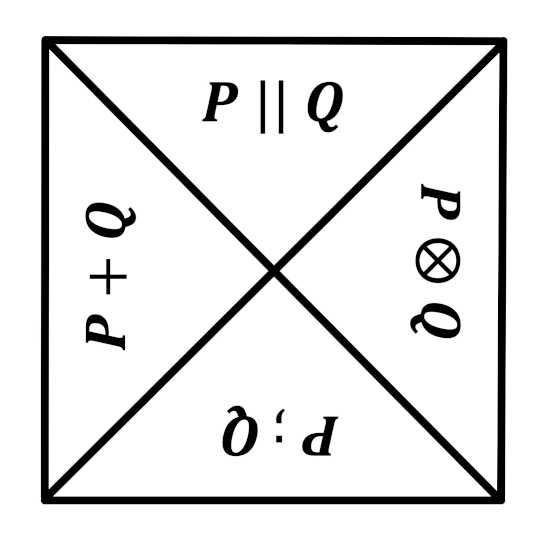
and then details four binary operations as working in Chu spaces over K:

  • P ; Q: Sequence
  • P + Q: Choice
  • P || Q: Concurrence
  • P ⊗ Q: Orthocurrence

Further Reading:

Vaughan Pratt / Linear Process Algebra

Click to access bhub.pdf

Click to access lpa.pdf

Click to access bud.pdf

https://www.researchgate.net/publication/2663060_Chu_Spaces_A_Model_Of_Concurrency

https://www.researchgate.net/publication/222310260_Types_as_Processes_via_Chu_spaces

https://en.wikipedia.org/wiki/Vaughan_Pratt

https://dblp.org/pid/p/VRPratt.html

[*12.122]

<>

Neon Genesis Evangelion Rebuilt, V2

The fourth movie was finally made and finally shown! Thank you Hideaki Anno, for finishing your rebuild, and Amazon Prime, for letting us easily see all four.

Full of battles between giant robots and kaiju called angels, full of teenage, human, and non-human emotional struggles, and full of signature Evangelion nonsense, about midway I was getting a bit unhappy with it. But as it coming to a close I thought that this was indeed a good ending.

So what does “Thrice Upon a Time” mean? That this is the third ending? First for the series, second for the movies after the series, and thirdly for the rebuilt movies? And what does the designation “3.0+1.0” mean? Three movies plus one more?

Further Reading:

https://www.cnet.com/news/anime-epic-evangelion-gets-a-worthy-conclusion-heres-the-ending-explained/

https://www.indiewire.com/2021/08/evangelion-thrice-upon-a-time-review-1234658228/

https://www.polygon.com/22627444/watch-evangelion-franchise-amazon-netflix

https://en.wikipedia.org/wiki/Evangelion:_3.0%2B1.0_Thrice_Upon_a_Time

Neon Genesis Evangelion Rebuilt

<>


On the Death of a Giant

Renowned physicist Steven Weinberg passed away recently. He was a giant in the world of physics and winner of the Nobel prize, advancing knowledge about the Standard Model and the unification of physical forces. He was also, famously, a materialist and atheist.

In his book “The Sophist”, Plato wrote (metaphorically?) about the battle of the gods and the giants. He related how the gods were friends of Platonic forms (perhaps being close to forms themselves) whereas the giants were materialists. Plato, being partial to forms, painted the giants as militant and unreasonable materialists, and the gods as a friendly and peaceful sort.

The Greek gods were friendly and peaceful? Perhaps the giants of the legend were the easy-going and reasonable sort, since the gods of the Greeks seemed the opposite. They say that history is rewritten by the victors.

Further Reading:

https://en.wikipedia.org/wiki/Steven_Weinberg

With Steven Weinberg’s death, physics loses a titan

https://www.scientificamerican.com/article/learning-to-live-in-steven-weinbergs-pointless-universe/

https://www.washingtonpost.com/local/obituaries/steven-weinberg-nobel-winning-physicist-who-united-principal-forces-of-nature-dies-at-88/2021/07/26/75d8d24a-ee31-11eb-bf80-e3877d9c5f06_story.html

A very nice article:

https://www.scottaaronson.com/blog/?p=5566

http://www.perseus.tufts.edu/hopper/text?doc=Perseus%3Atext%3A1999.01.0172%3Atext%3DSoph.%3Apage%3D246

<>

John Buridan’s Octagon of Opposition

Medieval logician John (or Jean) Buridan was a scholar of Aristotle, and wrote many works of commentary and elaboration on Aristotelian philosophy. Several items in logic and philosophy are tied to Buridan (such as Buridan’s Bridge and Buridan’s Ass) but he may now be more widely known for his Octagon which combines Aristotle’s Square of Opposition with a Square of Modality.

Below and to the right is a fourfold diagram of Aristotle’s Square of Opposition. The modern universal and existential (or particular) qualifiers are ∀ (meaning All) and ∃ (meaning Some), respectively. Also in these diagrams, ¬ means logical Not.

  • ∀ S are P
  • ∃ S are P
  • ∀ S are ¬ P
  • ∃ S are ¬ P

Next I show a fourfold of modal operators and their equivalents. The modern modal symbols are (meaning Necessarily) and or ◊ (meaning Possibly).

  • P ≡ ¬ ◊ ¬ P
  • ◊ P ≡ ¬ ¬ P
  • ¬ P ≡ ◊ ¬ P
  • ¬ ◊ P ≡ ¬ P


Further Reading:

https://en.wikipedia.org/wiki/Jean_Buridan

https://plato.stanford.edu/entries/buridan/

https://plato.stanford.edu/entries/medieval-syllogism/#JohnBuri

The Art of the Syllogism

Possibility and Necessity: An Introduction to Modality

https://en.wikipedia.org/wiki/Modal_logic

https://plato.stanford.edu/entries/logic-modal/

https://plato.stanford.edu/entries/modality-varieties/

https://lirias.kuleuven.be/retrieve/517366

Click to access Demey_DWMC2015_Buridan_Avicenna_slides.pdf

Click to access Buridan_Octagon.pdf

Click to access hughes-buridan.pdf

https://en.wikipedia.org/wiki/Buridan%27s_ass

https://en.wikipedia.org/wiki/Buridan%27s_bridge

https://en.wikipedia.org/wiki/Buridan_formula

[*12.144]

<>


What am I?

I am the Beginning of Everything,
I am the End of Time and Space,
I am the Beginning of Every End,
and the End of Every Place.

What am I? (Hint: the answer isn’t Four!)

Further Reading:

Other images of this riddle are here.

Such riddles remind me of the Song of Amergin.

https://en.wikipedia.org/wiki/Amergin_Gl%C3%BAingel

https://en.wikipedia.org/wiki/The_Dark_Is_Rising_Sequence

https://minbarigirl.livejournal.com/32873.html

[*12.146]

<>


The Square of Epictetus

Here is a nice two-by-two matrix by engineer David E. Goldberg derived from the stoic philosophy of Epictetus. For each and every concern, it’s the cross product of one’s Activity (control vs. no control) and State of Mind (concerned vs. not concerned). And so we have the four combinations:

  • Concerned with Control: Accomplishment
  • Unconcerned with Control: Forgone Opportunity
  • Concerned but No Control: Needless Worry
  • Unconcerned and No Control: Peace of Mind

Of course the key is to dwell within the positive Accomplishment and Peace of Mind regions, and not to inhabit the negative ones of Needless Worry and Forgone Opportunity.

Further Reading:

http://entrepreneurialengineer.blogspot.com/2006/11/square-of-epictetus.html

https://www.linkedin.com/pulse/20141007110433-722904-worry-less-accomplish-more/

More Accomplishment, Less Worry: Follow the Epictetus Square

https://plato.stanford.edu/entries/epictetus/

Epictetus

<>


The Four Worlds of the Kabbalah

The Kabbalah (correspondence) is a traditional and esoteric school of thought in Jewish mysticism. The ten Sephirot (emanations) of the Kabbalah in the Tree of Life diagram can be divided into Four Worlds as follows, and correspond with the Four Suits of the Tarot and the Four Elements:

  • Atziluth (אֲצִילוּת): World of Emanation (Wands, Fire, Spirit)
  • Beri’ah (בְּרִיאָה): World of Creation (Swords, Air, Intellect)
  • Yetzirah (יְצִירָה): World of Formation (Cups, Water, Emotion)
  • Asiyah (עֲשִׂיָה): World of Manifestion (Disks, Earth, Action)


Further Reading:

https://en.wikipedia.org/wiki/Four_Worlds

https://en.wikipedia.org/wiki/Kabbalah

https://en.wikipedia.org/wiki/Tree_of_life_(Kabbalah)

And:

The Four Worlds

Four Worlds Judaism

http://www.yashanet.com/studies/revstudy/rev6.htm

Alan Bain’s Thirty Two Paths of Wisdom

Also:

https://en.wikipedia.org/wiki/Promethea

<>

The Art of Memory

Memory is the treasury and guardian of all things.

— Cicero

Before the internet and before even writing, memory served as the treasury and the guardian of the past, as the imagination served as the vanguard and the promise of the future. Today, our memory is weakened by the onslaught of the new and the now, leaving us open to attack from forgetfulness and apathy. Well-documented techniques of the past exercised our “artificial” memory, over and above that of our “natural” memory. One such method was the use of a “memory palace,” a spatial geography or edifice that enabled a visualization and recall of structural sequence, ornamented by real or imaginary decoration to link things or words into this order.

The art listed four main constituents: the rules for the places (or loci), the rules for the images, and (rules for) the memories of the things or the words to be remembered. As the art originated in antiquity, the records of its use and evolution come to us only in written or printed form. Perhaps this is like trying to reconstruct a living, breathing life-form from the bits and pieces of its fossilized body. And so, perhaps this arcane art was nothing like what we imagine it is today, but something else, rich and strange, that enabled techniques and skills beyond mere recall.

  • Rules for Places
  • Rules for Images
  • Memory for Things
  • Memory for Words

And so as Plato recounts Socrates’ dialog with Phaedrus, wherein Thamus says to Thoth, inventor of the written word:

This discovery of yours will create forgetfulness in the learners’ souls, because they will not use their memories; they will trust to the external written characters and not remember of themselves. The specific which you have discovered is an aid not to memory, but to reminiscence, and you give your disciples not truth, but only the semblance of truth; they will be hearers of many things and will have learned nothing; they will appear to be omniscient and will generally know nothing; they will be tiresome company, having the show of wisdom without the reality.

Further Reading:

https://en.wikipedia.org/wiki/Art_of_memory

https://en.wikipedia.org/wiki/The_Art_of_Memory

https://artofmemory.com/wiki/Main_Page

Frances Yates / The Art of Memory

https://plato.stanford.edu/archives/spr2018/entries/mental-imagery/

Daniel J. Boorstin / The Lost Arts of Memory
The Wilson Quarterly, Vol. 8, No. 2 (Spring, 1984), pp. 104-113
https://www.jstor.org/stable/40256753

https://en.wikipedia.org/wiki/Giordano_Bruno

event-state2

<>